Calculating Loom Reed Space for Plain Weaves
Loom reed space equals finished width divided by finishing shrinkage factor, multiplied by weft crimp expansion, plus selvedge allowances.

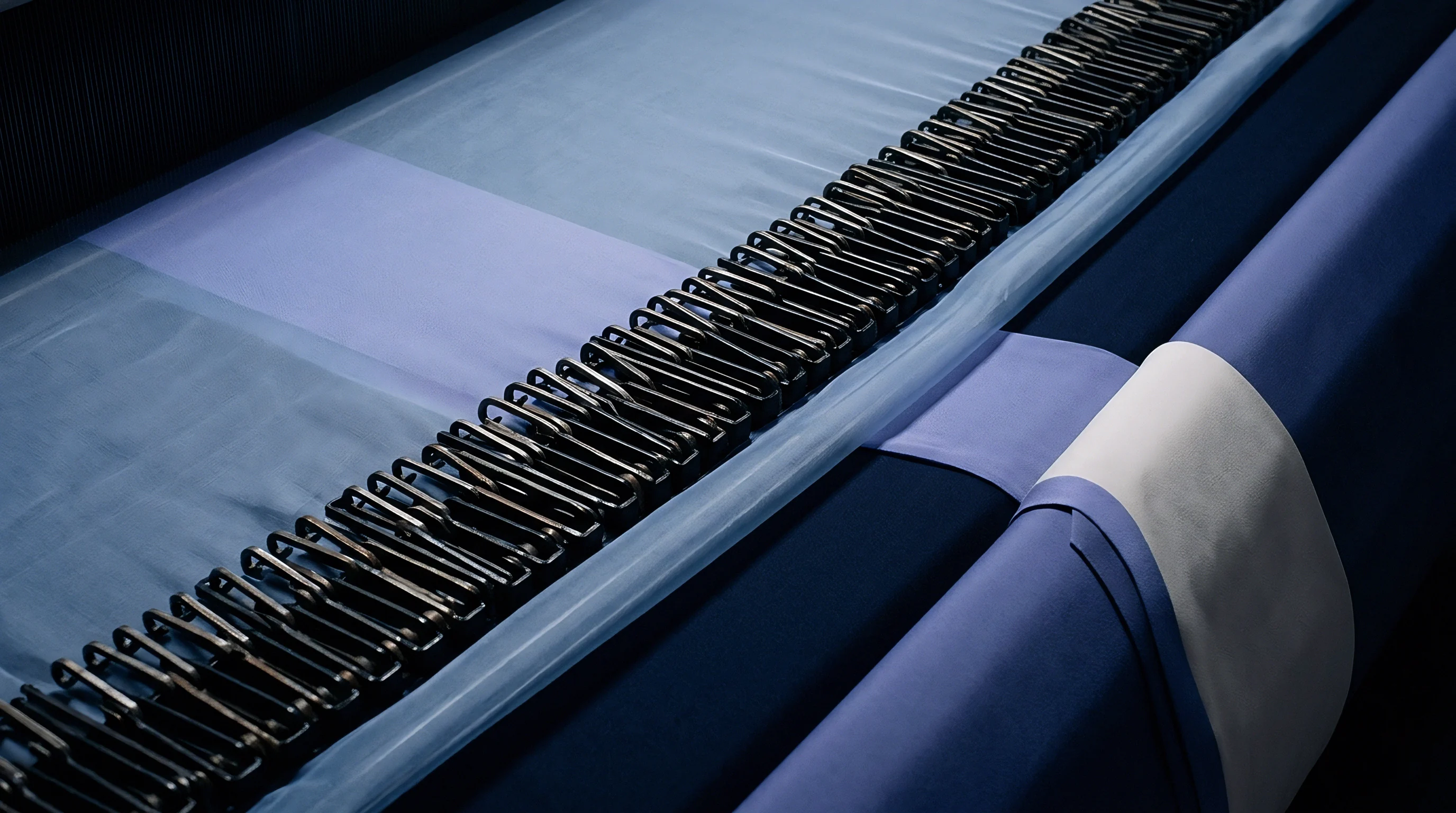
Contraction
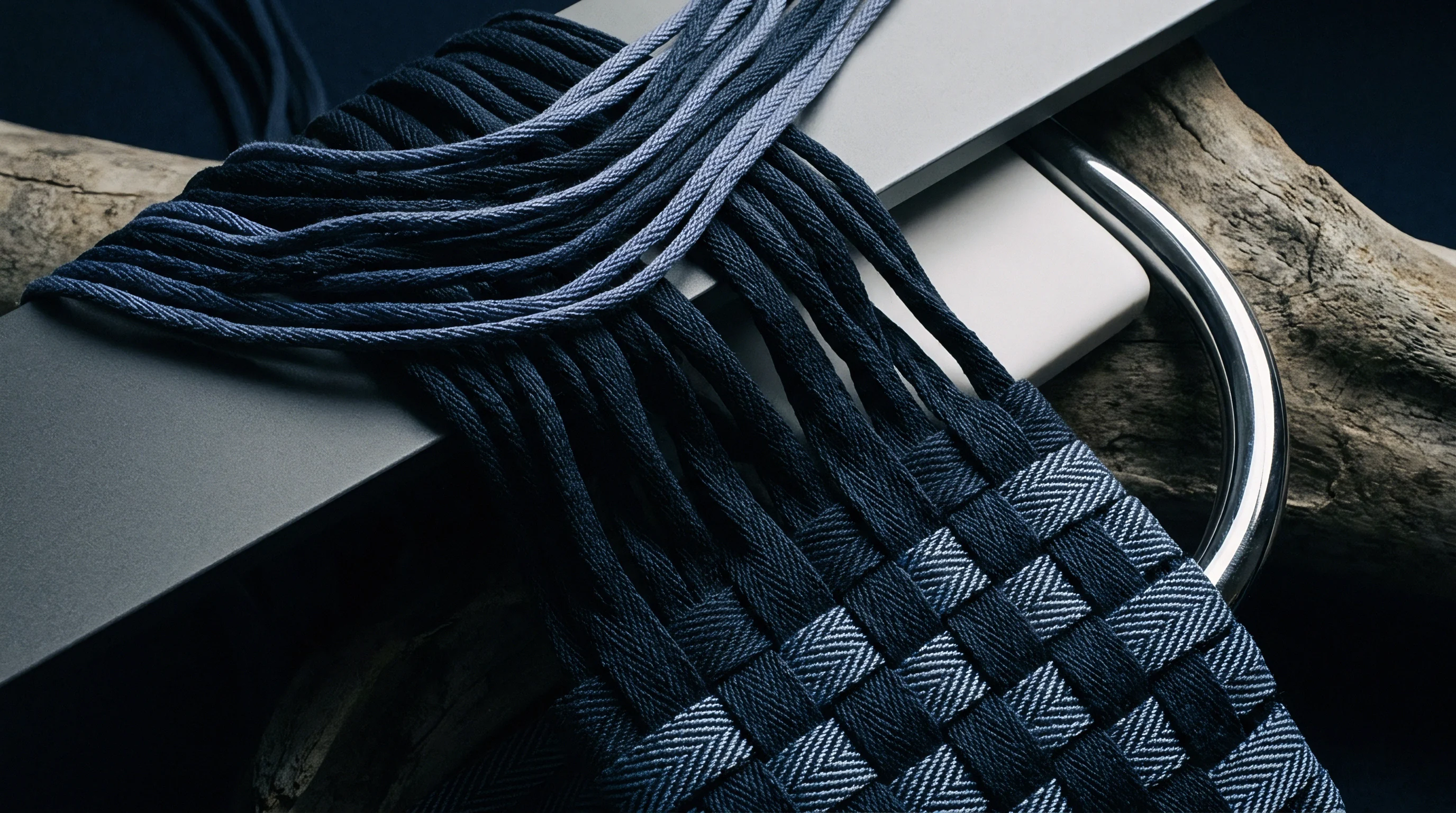
Greige Take up Mechanics in 1×1 Interlacing
In a 1×1 weave structure, every warp end alternates over and under every weft pick, producing the maximum intersection frequency possible in woven cloth. Each crossing forces yarn out of a straight line into structural curvature, or crimp. As beat-up drives a pick into the fell, weft bends around the taut warp ends while warp bends around the weft.
Consequently, the width covered by a pick in the finished fabric is shorter than the raw yarn length fed from the nozzle or shuttle, making crimp measurement essential to loom setup.
How much a yarn bends depends on relative yarn diameters, twist factors, and beam tension. High warp tension flattens the warp path so that weft absorbs nearly all the crimp. Lower tension allows crimp to divide more evenly.
In balanced plain fabrics where warp and weft counts match, weft crimp usually sits between 6 percent and 12 percent. High-density poplins with fine warps and heavy wefts alter this balance sharply: if weft yarns are much thicker than warp ends, weft crimp can drop below 4 percent as warp crimp exceeds 15 percent.
A balanced cotton plain weave under moderate loom tension exhibits an average weft crimp percentage equal to eighty percent of its warp crimp percentage.

Distinguishing Yarn Crimp from Fabric Width Reduction
Thread curvature and overall width contraction are frequently confused. Curvature, measured per ISO 7211-3, compares the straightened length of an extracted yarn to its span inside the woven fabric. Width contraction measures the total reed space against the relaxed grey width after loom unloading.
Because tension holds fabric wide during weaving, releasing it at the front rest onto the take-up roll prompts immediate elastic recovery.
This instant elastic recovery shrinks cloth width by 1.5 to 3.0 percent regardless of weave geometry, combining with geometric crimp to determine off-loom grey width. If setup calculations fail to separate elastic recovery from crimp, greige rolls come off narrow. Engineers must build a specific relaxation allowance into initial setup formulas; ignoring it forces the dyehouse to over-stretch cloth on the stenter, weakening selvedges and driving up laundering shrinkage in finished garments.
Under Pierce’s classic weave model, high cover factors lead to thread jamming, where adjacent yarns touch and resist lateral movement. Once jamming occurs at beat-up, inserted weft cannot bend further without distorting the warp. Pushing pick density past this threshold raises loom motor load, accelerates reed wire wear, and widens cloth width variation across a run.
Crimp is not uniform across the cloth width because edge threads face different lateral restraint than center threads. Center picks encounter balanced friction, while edge picks pull inward against selvedge leno or tucking units. Spiked temple rings hold the fabric edges out near the fell to match reed width.
If temple rings wear or misalign, edge draw-in develops, creating uneven pick density and snapping warp ends along the outer five centimeters.
Spinning systems directly affect crimp behavior. Ring-spun cotton offers high cohesion and uniform diameter, producing consistent crimp ratios. Open-end rotor yarns carry surface wrapper fibers and greater bulk, increasing inter-yarn friction at beat-up; this extra resistance requires a slightly wider reed space setting to hit target grey width.
Vortex and air-jet yarns have smoother profiles that alter compaction, yielding lower crimp numbers at identical thread counts.
Higher yarn twist accelerates off-loom width loss. Crepe and hard-twist voiles store torsional energy that causes structural snarling the moment tension drops, pulling the fabric inward as it exits the pin roller. Weaving these constructions requires wider reed space and modified temple controls to control width loss before scouring and heat setting.
Loom speed also alters crimp. Air-jet looms operating above 800 picks per minute subject weft to sharp acceleration spikes, temporarily stretching the yarn before beat-up. As this dynamic strain recovers inside the fell, it pulls selvedges inward more aggressively than rapier or projectile machines, requiring setup adjustments tailored to the insertion mechanism.
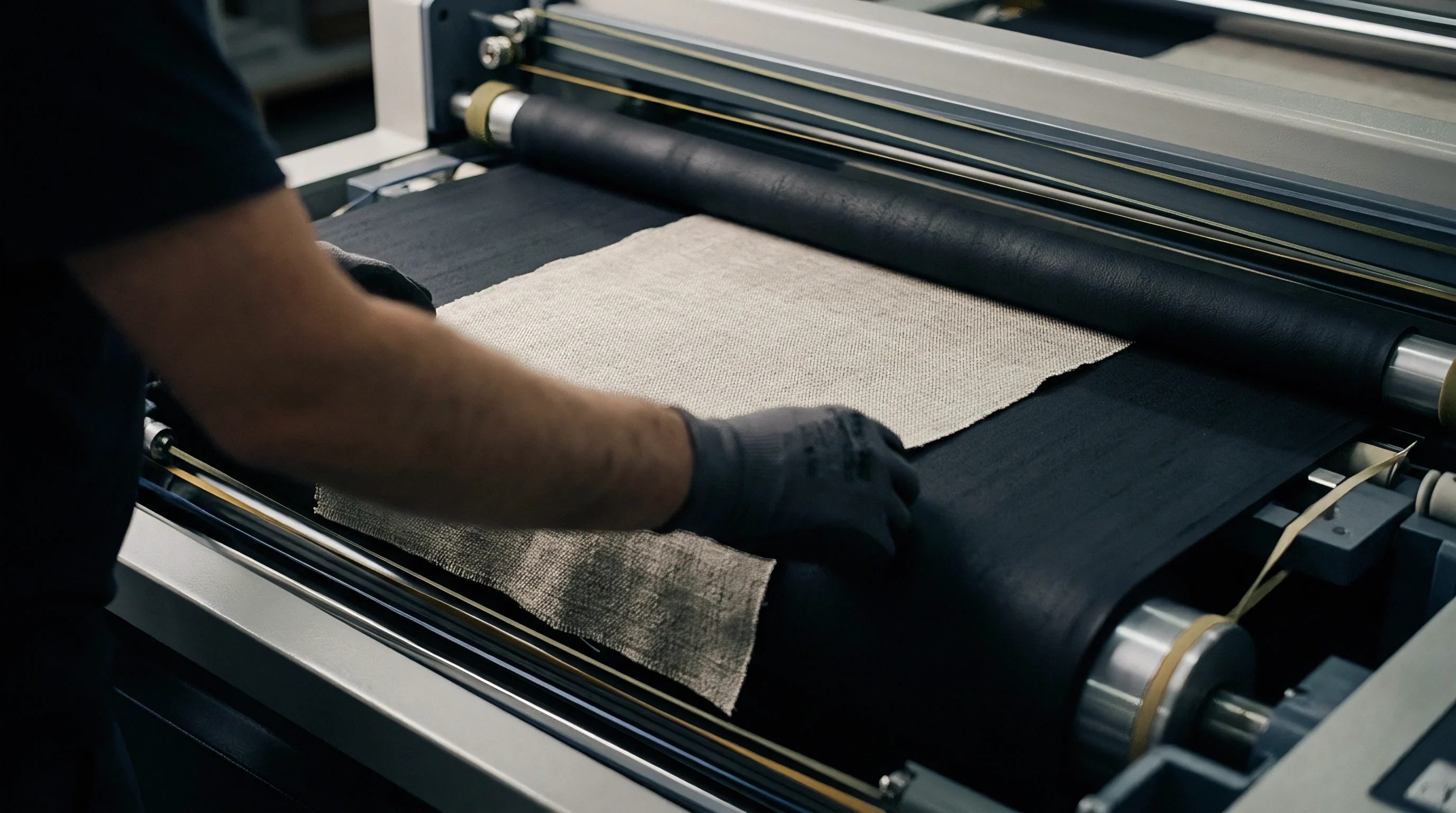

Dent
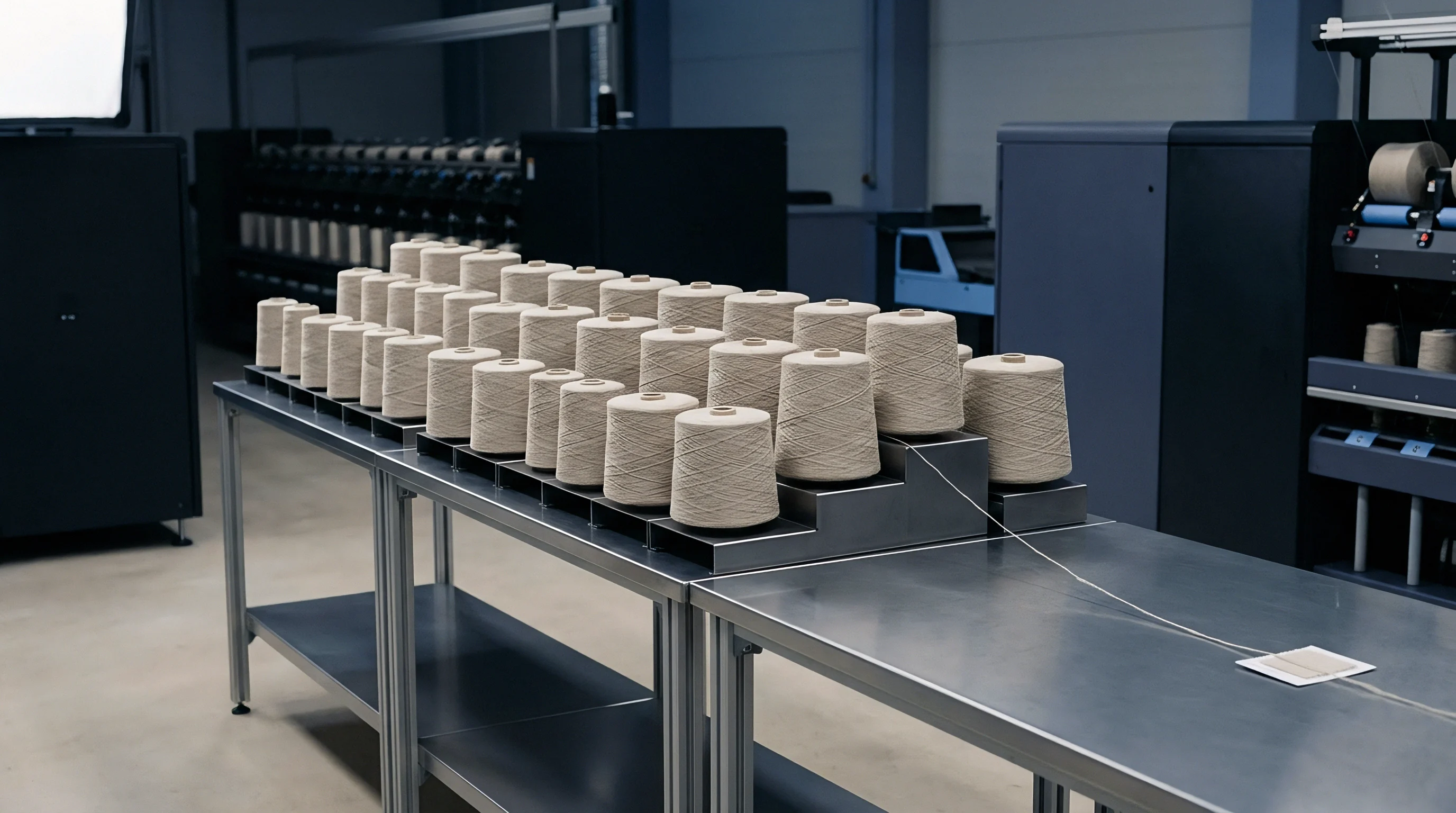
Denting Calculations and Reed Count Selection
Reed wire arrangement fixes warp end spacing and dictates total warp sheet width. Reeds are specified by dents per unit length ~ typically dents per inch or per two centimeters. Passing too few ends per dent leaves visible vertical gaps (reed marks) in the finished fabric.
Overcrowding dents creates friction during shedding, causing fuzzing, warp breaks, and patchy cover.
Standard plain weaves run 2 ends per dent for balanced distribution. Coarse, heavy weaves may drop to 1 end per dent to minimize wire friction, while lightweight poplins and high-density shirtings use 3 or 4 ends per dent to pack in ends without needing overly delicate reed wires. Total dents occupied equals total warp ends divided by ends per dent.
| Ends Per Dent | Recommended Sett Range (ends/cm) | Reed Wire Abrasion Risk | Reed Mark Visibility | Ideal Fabric Weight Range |
|---|---|---|---|---|
| 1 End | 10 to 18 | Negligible | Zero | 250 to 450 gsm |
| 2 Ends | 18 to 36 | Low | Minimal | 100 to 250 gsm |
| 3 Ends | 32 to 50 | Moderate | Moderate if untruncated | 60 to 140 gsm |
| 4 Ends | 45 to 70 | High | High on light shades | 40 to 90 gsm |
Translating target grey warp density back to reed dimensions requires accounting for off-loom contraction. A fabric requiring 30 warp ends per centimeter in the grey state does not take a 30-dent-per-centimeter reed; because the sheet contracts laterally upon leaving the reed, grey end density is always higher than in-reed density. In-reed end density is grey density multiplied by the contraction factor.
Standard reed selection involves picking the closest commercially available reed number and adjusting total occupied dents.
Calculation mistakes quickly translate into production costs. If an exact reed count is unavailable, mills sometimes substitute an adjacent size. Using a 10 percent coarser reed forces technicians either to crowd more ends into fewer dents or to expand reed width, altering fabric mass per unit area and breaching target specifications.
Checking reed counts directly on the loom frame before running production prevents these shifts.
Standard purchasing contracts reject fabric lots where grey width deviates by more than one point five percent from the approved construction sheet.

Selvedge Density Adjustments
Selvedges need higher thread density to endure temple ring teeth, rapier pull, and tenter clips during wet processing. Plain weaves usually run double ends, catch cords, or basket structures over a 6 to 12 millimeter strip along each edge. Warp density in this zone is typically 1.5 to 2.0 times higher than in the main body, demanding dedicated denting patterns at both reed edges.
These selvedge ends occupy extra dents beyond the active body width. For example, 40 selvedge ends at 4 ends per dent use 10 dents per side, adding 20 dents overall. Omitting selvedge dents from total reed space math narrows the active body, as edge threads consume width intended for the main weave.
- Denting mismatch creates longitudinal streaks running parallel to the selvedge due to unequal warp end distribution across adjacent dent wires.
- High wire friction causes filamentation and fuzzing on synthetic warp yarns when ends per dent exceed wire clearance limits.
- Temple ring damage punctures outer fabric edges when excessive weft contraction pulls the selvedge off the temple pin alignment line.
- Uneven beat-up band forms across the fell line when reed count selection forces extreme differences in warp denting density between body and selvedge.
Reeds wear unevenly in service. High-density cotton warps grind grooves into wires near the fell position, stripping sizing material into powder along the race board. Accumulated lint then snags adjacent warp ends, causing floats and loom stops.
Periodic ultrasonic cleaning and polishing protect wire spacing across the reed width.
Air-jet reeds contain a profiled tunnel milled into the front wire face to channel the air blast. Effective reed space must align with nozzle positions and reed profile geometry; installing incorrect depths or profiles destabilizes insertion, leading to trailing pick folds and short arrivals at the far selvedge. Swapping rapier reeds onto air-jet looms disrupts this airflow physics.
Narrow off-loom cloth is often attributed to unexpected warping tension variations, though the underlying cause is frequently poor calculation practices or uncalibrated temple settings on the weaving floor.


Allowance

Which Variables Change Reed Width under High Tension?
Shed geometry, backrest height, and drop wire elevation all affect warp sheet width under dynamic tension. Raising the backrest roll above the drop wires creates asymmetrical tension between top and bottom sheds. Tighter bottom-shed tension packs weft picks more firmly, raising lateral compaction and drawing selvedges inward.
Moving the backrest also shifts the fell line relative to the temple rings and reed sweep.
Sizing formulations directly influence structural take-up. Formulations heavy in polyvinyl alcohol (PVA) or modified starches stiffen warp yarns, limiting their ability to bend around the weft at beat-up. Stiff warp ends force the softer weft to absorb most of the crimp, boosting weft contraction.
Once desizing relaxes the warp during wet processing, this balance shifts again. Keeping sizing recipes constant across production runs is essential for width consistency.
Stop motion settings also influence edge contraction. Prolonged loom stops under high tension allow synthetic yarns to undergo stress relaxation while bound in the shed. When the loom restarts, initial picks weave into relaxed warp sections, causing localized width variations.
Optimized restart sequences prevent this wide-to-narrow banding along the roll.
Wet Processing Width Reduction Profile
Greige fabric undergoes substantial dimensional changes in the dyehouse. Scouring strips away size, oils, and waxes, letting cotton fibers swell laterally. This increased yarn diameter promotes thread jamming and shrinks the sheet in both directions.
While mercerization under tension rounds out cotton fibers and partially restores width, subsequent washing brings further relaxation.
| Fiber Composition | Yarn Type | Greige to Finished Width Shrinkage Range (%) | Finishing Line Stenter Overfeed Adjustment (%) |
|---|---|---|---|
| 100% Combed Cotton | Ring Spun (Ne 40/1) | 5.0 to 8.0 | +2.0 to +4.0 |
| 100% Carded Cotton | Open-End (Ne 20/1) | 6.5 to 10.0 | +3.0 to +5.0 |
| 65/35 Poly-Cotton | Ring Spun (Ne 30/1) | 3.5 to 5.5 | +1.0 to +2.5 |
| 100% Viscose Rayon | Vortex (Ne 30/1) | 8.0 to 12.5 | +4.0 to +7.0 |
| 98% Cotton / 2% Elastane | Core Spun (Ne 30/1) | 14.0 to 22.0 | +8.0 to +15.0 |
Dyeing equipment places continuous tension along the fabric length. Pad-steam and jig lines pull the sheet longitudinally, causing width necking governed by Poisson’s ratio for textiles. Continuous finishing lines use stenter frames with pin or clip chains to counteract necking, holding selvedges at target width while hot air dries or sets the fabric.
Heat-setting synthetic fibers like polyester or polyamide locks yarn geometry at elevated temperatures. Setting polyester between 180 and 200 degrees Celsius causes thermal shrinkage that must be included in setup calculations. If greige fabric is woven too narrow, stenter stretching risks torn selvedges or high residual thermal shrinkage during garment pressing.
Resin finishes fix fabric dimensions permanently. Applying cross-linking resins like dimethyloldihydroxyethyleneurea (DMDHEU) to cellulosic fibers restricts post-wash fiber swelling. While resin treatment lowers wet processing shrinkage, tension during curing sets final width permanently; over-stretching on the stenter during resin application generates artificial width that collapses in home laundering.
Sanforizing and mechanical compacting drive rubber belts against wet fabric to restore thread equilibrium. Compactors compress fabric lengthwise to ensure low laundering shrinkage, but this length reduction slightly increases width and mass per square meter. Finishing plans must track each machine pass from greige to final packing.
Under ISO 5077 dimensional stability testing, fabric samples washed three times at 60 degrees Celsius must remain within agreed tolerances. Standard commercial contracts limit finished shrinkage to 2.0 percent for woven synthetics and 3.0 percent for woven cotton plain goods. Meeting these limits requires aligning initial loom reed space with downstream finishing setups.
Finished width specifications typically permit zero to plus two centimeters relative to purchase order contract width, strictly barring negative tolerance.

Derivation

Stepwise Mathematical Formula for Plain Weave Reed Space
Calculating reed space requires a mathematical sequence built back from target usable finished width. This derivation ties finishing shrinkage, elastic relaxation, weft crimp, and selvedge allowances into one sequence; evaluating parameters separately introduces rounding errors that throw off production.
Let Wf represent required finished width between selvedges in centimeters, and Sw represent total widthwise wet processing shrinkage as a decimal ratio. Required off-loom grey width Wg is derived directly:
Wg = fracWf1 – Sw
Off-loom grey width Wg does not equal warp width in the reed because crimp and elastic draw-in contract the sheet laterally upon unloading. With Cw representing weft crimp percentage per ISO 7211-3 as a decimal ratio relative to grey width, baseline active body reed space RSb is calculated as:
RSb = Wg × (1 + Cw)
Alternatively, if weft contraction Kw is expressed directly as a percentage reduction from reed space to grey width, the formula becomes:
RSb = fracWg1 – Kw
Establishing total physical reed space RSt requires adding total selvedge width Ws to active body space. Selvedge width depends on total selvedge ends Ns and selvedge denting density Ds (dents per centimeter):
Ws = fracNsEnds Per Dents × Ds
Combining primary parameters yields the total loom reed space formula:
RSt = left( fracWf(1 – Sw) × (1 + Cw) right) + (2 × Ws)
- Determine finished fabric width requirement (Wf) and select total selvedge width allowance (Ws).
- Measure or reference total wet processing finishing shrinkage ratio (Sw) for the specific fiber class and mill finishing route.
- Compute target off-loom grey width (Wg) using the shrinkage correction formula.
- Input laboratory testing weft crimp factor (Cw) based on yarn count, twist, and targeted thread density.
- Calculate active body reed space (RSb) by multiplying off-loom grey width by the crimp expansion factor.
- Add left and right selvedge denting allowances (2 × Ws) to establish total physical reed space (RSt).
- Divide total physical reed space by the chosen reed count (dents per centimeter) to determine the exact total number of reed dents occupied on the loom beam.

Sensitivity Analysis across Yarn Counts and Sett
Consider a commercial 100 percent cotton poplin specified at 150 centimeters finished width (Wf). Lab trials set wet finishing shrinkage (Sw) at 0.06 (6 percent) and weft crimp (Cw) at 0.08 (8 percent). Selvedges require 40 ends per side reeded at 4 ends per dent in a 20 dent per centimeter reed, using 0.5 centimeters per side (Ws = 0.5 cm).
Step one yields off-loom grey width: Wg = 150 / (1 – 0.06) = 159.57 centimeters. Step two gives active body reed space: RSb = 159.57 × (1 + 0.08) = 172.34 centimeters. Step three adds selvedges: RSt = 172.34 + 1.0 = 173.34 centimeters.
Total required reed space on the loom is 173.34 centimeters.
Small input variations create substantial shifts in required reed space. If scouring routines push finishing shrinkage from 6 to 9 percent, off-loom grey width increases to 164.84 centimeters and total reed space reaches 179.03 centimeters. Running this construction on the original 173.34-centimeter setup yields finished fabric at only 145 centimeters wide, making the entire lot non-compliant for standard 150-centimeter marker layplans.
Inaccurate reed space calculations carry commercial consequences, including batch rejections, price discounts, and panel yield loss during cutting.

Discrepancy

Tension off Balance and Reed Wear Penalties
Uneven warp tension across the beam creates irregular lateral contraction. Warps unwinding from unevenly wound beams carry higher tension on one side than the other; tight sections restrict weft crimp while slack sections increase it. This imbalance bows or skews picks across the fabric, producing wavy selvedges and width variations along the roll.
Reed wear alters local dent spacing over extended runs as wires pit, bend, or shift. Outward-leaning wires widen dent spacing to create light streaks in dyed fabric, while inward-leaning wires crowd warp ends, causing abrasion and end breaks. Visual reed checks with optical gauges should accompany routine width measurements.
Variable yarn twist alters width consistency across orders. Ring-spun yarn with a high twist multiplier exerts torque that pulls weft tighter in the shed ~ raising twist multiplier from 3.8 to 4.3 increases weft crimp by over 1.5 percentage points. Delivering yarn with variable twist factors causes grey widths to drift even under fixed loom setups.
| Discrepancy Mode | Root Technical Cause | Physical Goods Result | Direct Commercial Penalty |
|---|---|---|---|
| Narrow Grey Width | Underestimated finishing shrinkage allowance | Finished fabric narrow by 3 to 5 cm | 5 to 12 percent invoice claim or complete roll rejection |
| Excess Grey Width | Overestimated weft crimp percentage | High greige weight; finished fabric wide | Excess yarn consumption cost; converter absorbs loss |
| Reed Marking | Incorrect ends per dent selection | Vertical streaking along warp plane | Grade B downgrading with 20 percent price deduction |
| Selvedge Tearing | Insufficient selvedge denting allowance | Tenter clip punctures; edge fraying | 100 percent replacement of damaged selvedge yardage |
Forcing narrow fabric to target width on a stenter distorts thread geometry. Over-stretching plain weave under heat increases skew and bow beyond ASTM D3882 limits. Once cut into panels and sewn, internal stresses relax during laundering: leg seams twist, pocket flaps buckle, and finished garments lose shape.

Commercial Yield Limits on Finished Fabric Width
Fabric purchasing centers on usable cuttable width ~ the span inside stenter clip pinholes. If cloth measures 152 centimeters total but loses 2 centimeters per side to edge damage, usable width drops to 148 centimeters. A marker requiring 150 centimeters cannot use that roll.
Reed space math must leave enough margin to deliver cuttable width after trimming pinhole damage.
Yield calculations determine converter profitability. Accurate reed space math meets target width and weight per unit area together. Over-designing reed space wastes yarn weight across thousands of meters, while under-designing risks narrow goods rejected at full contract price.
- Verify greige metrics by sampling raw cloth off the loom frame and measuring physical width, ends per centimeter, picks per centimeter, and mass per unit area.
- Audit finishing routes to confirm whether wet processing houses use tensionless relaxation drying or continuous tensioned stenter drying.
- Check crimp values on extracted yarns from lab trial swatches before finalizing bulk beam warping counts and reed wire purchases.
- Confirm cuttable width by subtracting pinhole distances and selvedge margins from total finished fabric width measurements.
Inspection checks must account for ambient humidity. Cotton plain weaves absorb atmospheric moisture, swelling in fiber diameter and contracting slightly in length and width. Per ISO 139, measurements in unconditioned space often diverge from standard testing conditions (20 degrees Celsius and 65 percent relative humidity), so width disputes require testing in conditioned environments.
How do digital loom monitoring systems handle real-time reed space adjustments during high-speed insertion?