Compensating Finishing Contraction in Reed Denting for Cotton Fabrics
Calculate greige reed space by dividing target finished cuttable width by one minus total finishing contraction to guarantee post-processing fabric density and width.

Pitch
Reed selection sets the physical boundary for all subsequent wet finishing, ultimately fixing the width and yarn density of the finished cotton goods. Because greige cloth comes off the loom under warp tension, the ends sit wider than in the finished target. The reed must therefore accommodate both initial on-loom relaxation and the lateral shrinkage that occurs during scouring, bleaching, mercerization, dyeing, and sanforizing.
Sizing a reed without factoring in this contraction leaves finished fabric narrow or overly dense in the warp, which leads to rejections at the cutting table.
Denting governs how warp ends pass through the reed blade’s slits. Combining the reed pitch ~ measured in dents per inch or per two centimeters ~ with the ends-per-dent pattern establishes the greige warp sett across the reed space. If the reed is too narrow, the dyehouse has to pull the fabric out on the stenter to hit finished width.
That outward pull distorts the weave, increases residual relaxation shrinkage, and cuts into tear strength under ISO 13937.
Reed Denting Configurations and Draw-In Schemes
Denting ratios balance yarn spacing against mechanical friction in the shed. Jamming too many ends into one dent creates yarn-on-yarn abrasion, fuzz, and warp breaks on air-jets; spreading them across too many dents drives up reed wire weight and tooling expense. Common denting schemes across staple cotton weaves include:
- Single Denting Scheme draws one end per dent, used mainly for coarse yarns above 50 tex where shedding clearance is tight.
- Double Denting Layout runs two ends per dent, the standard setup for plain-weave cotton poplins from 100 to 180 grams per square metre.
- Triple Denting Pattern places three ends in a dent to reach warp counts up to 140 ends per inch for dense, down-proof combed cottons.
- Split Denting System alternates two and three ends in adjacent dents, fitting fractional counts without creating reed lines on the face.
Selvedge denting must be calculated independently from the body. Edge yarns bear the brunt of cross-machine tension throughout finishing and anchor the cloth to stenter pins. Packing the outer 12 to 24 dents with 25 to 50 percent more ends forms a firm selvedge rib that resists curling and tearing under tension during pad-batch runs.
Off-loom grey cloth width must exceed target finished cuttable width by eight to fourteen percent to account for cumulative processing take-up.
Blade thickness controls available air space within the dent. In fine reeds, heavy stainless wires reduce open area below 50 percent, pinching yarn as the shed opens. Moving to thinner wire profiles lifts the open area toward 65 percent, allowing slubs or two-ply 80/2 combed yarns to pass cleanly without sacrificing spacing across the loom.


Shrinkage
Raw cotton carries torsional and longitudinal stress locked into the cellulose microfibrils during spinning. When the cloth enters hot scouring and bleaching baths, water penetrates the amorphous regions of the fiber, breaking secondary hydrogen bonds and letting the polymer chains relax. The yarns swell in cross-section and shorten, raising crimp in both directions across the weave.
Caustic mercerization intensifies this contraction by converting Cellulose I into Cellulose II. Bathing greige or scoured fabric in 28 to 30 degrees Baumé caustic soda swells the fibers, uncoiling their natural twist until the flat ribbons round into cylinders. Left unrestrained, weft dimensions can shrink over twelve percent, which is why mercerizer stenters use heavy chain clips and high warp tension to hold the cloth out to width.

Finishing Wet Processing Contraction Drivers
Contraction accumulates with each wet processing stage. Tracking the shrinkage introduced at each step gives the baseline compensation factor needed when calculating reed width.
- Aqueous Scouring Relaxation dissolves natural waxes and relieves spinning stresses, pulling the width in three to five percent on initial wet-out.
- Caustic Mercerization Swelling reorganizes cell walls in alkali, yielding five to ten percent lateral contraction if run unclipped.
- Continuous Jet Dyeing works the fabric under liquor turbulence and length tension, producing up to seven percent warp shrinkage while narrowing the filling.
- Sanforizing Compressive Shrinkage compacts the moistened goods mechanically with a rubber belt, taking out three to eight percent of warp length to satisfy ISO 5077 stability standards.
Crimp interchange drives most of this dimensional shift. On the loom, warp ends remain taut and relatively straight, forcing the filling picks to do most of the bending. In wet processing, the warp yarns swell and relax, taking on a steeper crimp angle and drawing the weft picks closer together.
This interchange reduces total surface area and drives the finished areal weight well above greige loom-state values.
ISO 5077 testing specifies dimensional change measurement after domestic washing and drying cycles to confirm fabric stability prior to bulk cutting.
Overlooking the crimp capacity of a given yarn count leads to an unrecoverable width deficit. If a mill tries to pull a narrow fabric back out on the stenter, the cloth stays unstable and snaps back to its relaxed crimp balance on the first home wash, leading directly to cut-and-sew sizing defects.


Arithmetic
Reed design works backward from finished specifications to greige loom settings. Starting with finished cuttable width, ends per inch, and finished weight per ISO 3801, anticipated warp and weft contraction rates determine total reed space, overall warp ends, reed count, and ends per dent.
Derivation of Reed Space and Reed Count
Total reed space is the working width across the reed through which body and selvedge ends are drawn. The formula is:
Reed Space (inches) = Finished Width (inches) / (1 - Weft Shrinkage Factor)
Here the shrinkage factor represents cumulative wet contraction plus weft crimp take-up expressed as a decimal. For a 58-inch finished width with an anticipated 10 percent filling contraction, required reed space is 58 divided by 0.90, or 64.44 inches. Multiplying finished width by finished ends per inch yields total body ends, which are then corrected for selvedges and crimp.
Reed count equals total warp ends divided by the product of reed space and ends per dent.
Comparative Reed Calculation Matrix for Cotton Constructions
The matrix below outlines greige reed sizing for three 100% cotton constructions undergoing continuous scouring, mercerizing, reactive dyeing, and compressive shrinking.
| Fabric Type | Finished Width (in) | Finished Sett (EPI x PPI) | Total Weft Contraction (%) | Greige Reed Space (in) | Target Reed Count (Dents/in) | Ends Per Dent |
|---|---|---|---|---|---|---|
| 20s Cotton Poplin | 58.0 | 100 x 56 | 9.5% | 64.1 | 40 | 2 |
| 40s Combed Twill | 58.0 | 130 x 70 | 11.0% | 65.2 | 40 | 3 |
| 60s 2-Ply Satin | 56.0 | 165 x 90 | 12.5% | 64.0 | 50 | 3 |
For the 40s Combed Twill, multiplying 58 inches finished width by 130 finished ends per inch gives 7,540 body ends. Adding 120 selvedge ends brings the total to 7,660 warp ends. Across a 65.2-inch reed space, that leaves 117.48 ends per inch in the reed.
At three ends per dent, the theoretical reed count is 117.48 divided by 3, or 39.16 dents per inch. In practice, the mill mounts a standard 40-dent reed and pulls the working reed width in to 63.83 inches to balance the harness draft.
A calculated reed count of 39.16 dents per inch requires rounding to a standard 40-dent reed, adjusting total reed space to 63.83 inches.
Yarn count variations across spinning lots alter this calculated contraction percentage, requiring dynamic correction during bulk weaving.

Stenter
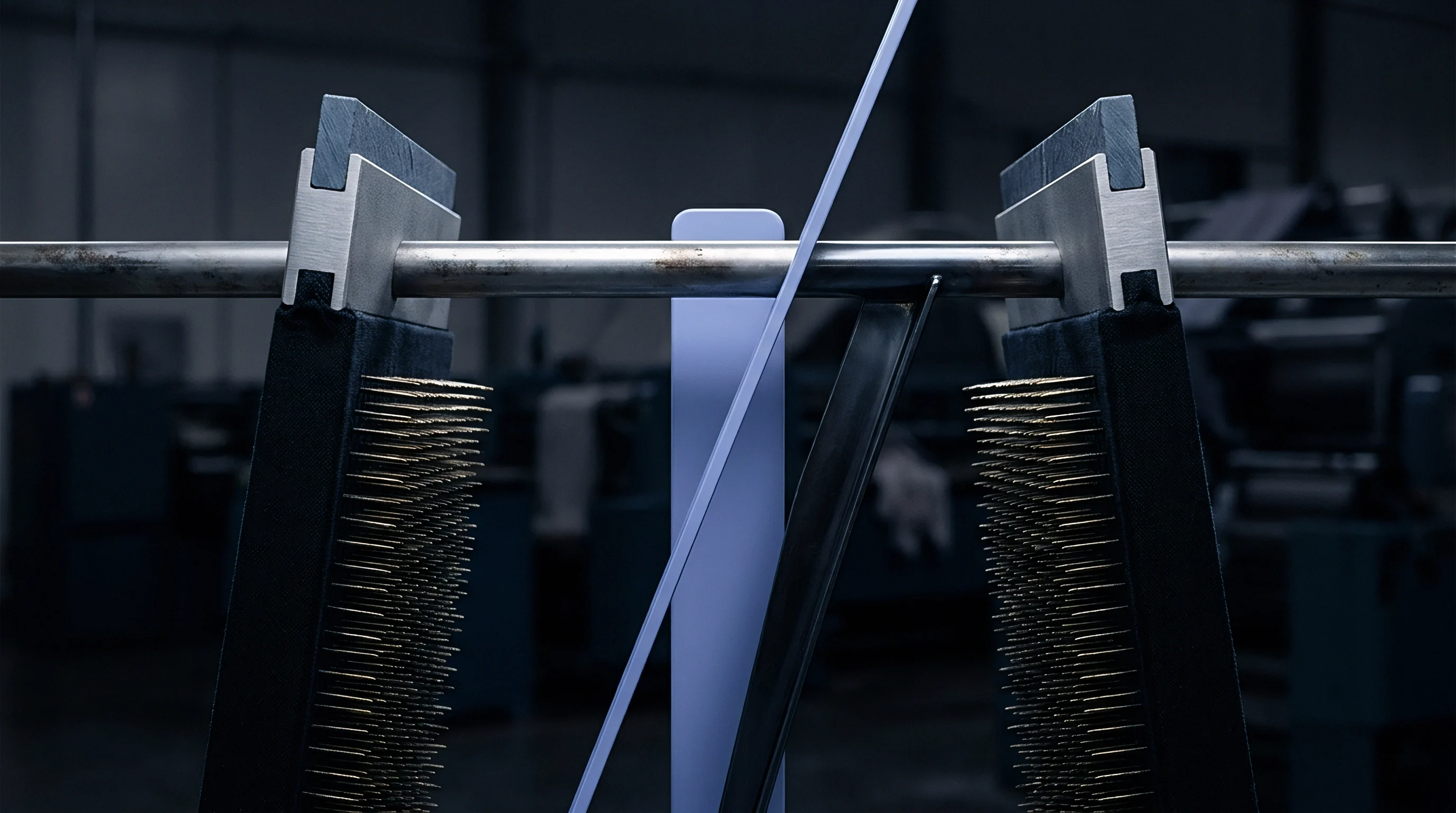
Stenter frames set the final width and dry the cloth after wet processing. In the entry field, overfeed rollers feed the selvedges onto mechanical pins or clips. Setting a positive differential between entry rollers and chain speed controls fabric overfeed; an overfeed of positive eight percent feeds enough length into the drying house to let warp crimp re-form, holding residual warp shrinkage under two percent.
Clip chains grip fabric edges without puncturing, providing the holding force needed for heavy canvas and duck under high tension. Pin chains pierce the selvedges with fine angled pins, giving better control over warp overfeed when drying lighter poplins and voiles. If the chain rails are set wider than the natural width established by the reed calculation, crosswise tension rises sharply, causing bow and skew across the piece.

Standard Stenter Protocol for Stabilizing Fabric Width and Crimp
- Feed wet scoured or dyed fabric through the center-line guider to keep the selvedges aligned with the pin plates.
- Run edge uncurlers and steam boxes to relax the selvedges immediately before pinning.
- Set overfeed between positive four and positive ten percent according to pre-calculated warp crimp targets.
- Set rail divergence with a narrower entry width, gradual expansion through drying zones 1 and 2, and parallel chains through curing zones 3 and 4.
- Maintain chamber temperatures between 110 and 140 degrees Celsius to clear moisture without scorching or yellowing the cotton.
- Run fabric over cooling drums at the delivery end to freeze dimensions before batching.
Forcing width on the stenter introduces latent mechanical strain. When pulled beyond its engineered contraction limit, weft picks are drawn artificially flat. During ISO 6330 laundering, that stored stress releases at once: the fabric pulls in sharply across its width and grows in length.
Post-dyeing stenter stretching cannot compensate for inadequate greige reed space without compromising wash stability.
Stretching fabric on the stenter to scrape past minimum cuttable width ruins seam strength, skews twill angles, and frequently pushes diagonal distortion past the 2.5 percent limit set by garment makers.


Variance
Weaving sheds and finishing plants work to different practical tolerances. Shifts in raw cotton micronaire, yarn twist multiplier, warp beam tension, and chain wear on the stenter all compound across production, moving finished width and sett away from nominal targets. Managing this variance means tracking weaving data and finishing runs side by side against recognized test methods.
Warp yarn count variation directly changes crimp uptake. If warp runs two percent heavier than spec, the bulkier yarn crowds the dent, increases shed friction, and crimps more aggressively. That extra crimp pulls the weft in past the calculation, leaving the cloth narrow unless the finishing range makes dynamic width corrections.
Where Do Reed Selection Errors Distort Finished Fabrics?
Reed errors produce unmistakable physical defects in finished cloth. Catching these flaws during fabric inspection keeps defective yardage off garment sewing lines.
| Quality Parameter | Standard Reference | Acceptable Tolerance | Defect Cause from Reed Miscalculation |
|---|---|---|---|
| Finished Width | ISO 3932 / BS EN 1773 | -0.5 in / +1.0 in | Reed selected too narrow forces under-width cloth or stenter over-stretching. |
| Thread Count (EPI/PPI) | ISO 10499 / EN 1049 | +/- 3.0% of spec | Incorrect ends per dent alters finished warp density per unit width. |
| Dimensional Change | ISO 5077 / ISO 6330 | Max 3.0% warp / weft | Excessive stenter stretching to compensate for reed error causes high residual shrinkage. |
| Bow and Skewness | ISO 3759 / ASTM D3882 | Max 2.0% of width | Uneven reed denting or improper stenter rail expansion skews weft alignment. |
Under ASTM D5430 four-point inspection, reed marks stand out as warpwise light and dark streaks running parallel to the selvedge. Bent wires, uneven denting, or worn blades alter yarn spacing enough to catch the eye. If these streaks persist past penalty thresholds over ten consecutive meters, the roll drops to second quality.
Bulk purchasing contracts require finished cuttable width to be measured between pin-hole lines under ISO 3932, ignoring unusable selvedge waste.
Strict incoming inspection assigns financial responsibility to the weaving mill whenever improper reed choice leaves yardage below contractual width limits.


Sourcing
Procurement contracts for custom cotton wovens must divide dimensional risk cleanly between buyer, weaver, and finishing converter. Buyers often order greige cloth on nominal off-loom width alone without detailing reed denting parameters, which lets the weaving mill optimize loom efficiency at the expense of finishing allowance. Once that cloth hits the dyehouse, the converter is saddled with a width shortfall that cannot be pulled out without destabilizing the goods.
Building a custom reed adds two to three weeks to loom setup whenever non-standard wire counts or pitches are specified. Buyers need to confirm whether a mill has suitable reeds in stock before finalizing construction. Forcing an on-hand 30-dent reed to weave a fabric designed for a 40-dent reed requires crowding ends into dents, upsetting weave uniformity and telegraphing distinct reed marks into the dyed fabric.
Contractual Greige Provisions for Route Verification
- Mandatory Reed Construction Sheet requires the mill to state reed count, ends per dent, total reed space, and drawing-in draft before mounting the warp.
- Finished Cuttable Width Guarantee fixes minimum usable width between stenter pin marks, keeping liability for narrow goods on the primary weaving vendor.
- Pre-Production Wet Processing Trial Clause requires a 50-meter sample roll to run through the complete finishing line to confirm shrinkage rates before releasing bulk weaving.
- Dimensional Change Cap Assurance caps residual shrinkage at three percent under ISO 5077 across three commercial wash cycles.
Minimum order quantities depend directly on reed changeover costs and warp lengths. Tying into an air-jet loom for a run under 3,000 meters spikes meter rates through downtime, warp tying, and sleying labor. When volume is small, converters often weave double-width master rolls and split them after dyeing, though edge contraction differs between the outer selvedges and the cut center.
Contracts written on finished linear meter cost have to account for both warp take-up and filling contraction. Securing 10,000 finished meters from a construction with ten percent warp shrinkage requires 11,111 meters of greige cloth. Overlooking this conversion math erodes operating margins the moment finishing invoices reflect the greige-to-finished loss.
Tying reed denting parameters directly to contract terms keeps bulk cotton shipments on width, on density, and inside cost projections.