Correlating Surface Temperature Evolution with Polyelectrolyte Crosslinking Depths in Heavy Weight Cotton Fabrics
Thermal surface pyrometry overestimates core resin polymerization in heavy cotton canvas during drying without dual-stage Z-axis dwell management.

Heat
Thermal radiometers mounted over stenter entries register immediate surface heating when heavy cotton fabrics pass into infrared curing zones. In heavy duck canvas weighing between 380 gsm and 480 gsm, the physical bulk of the yarn bundle creates an immediate thermal barrier. Surface pyrometry reads radiant emission from the outer fiber layer, where temperatures rise within seconds to 160 degrees Celsius.
Internal fiber core temperatures lag behind surface readings due to moisture enthalpy and low transverse thermal conductivity of cellulosic fibers. Wet processing lines running polycarboxylic acid crosslinkers like 1,2,3,4-butanetetracarboxylic acid (BTCA) or citric acid alongside sodium hypophosphite catalysts rely on precise thermal thresholds to initiate esterification.
Radiometric Signatures
Non-contact infrared pyrometry records three distinct thermal regimes during the continuous drying and curing of thick woven cotton. Phase one exhibits rapid heating to the wet-bulb temperature, hovering between 60 degrees Celsius and 72 degrees Celsius depending on air velocity and exhaust humidity. Core moisture buffers heat.
Phase two maintains this thermal plateau as long as free capillary water migrates from the interior to the face of the fabric. Phase three marks the departure from wet-bulb equilibrium, where surface temperatures ascend sharply toward the ambient zone temperature of 170 degrees Celsius to 185 degrees Celsius.
Coarse yarn bundles retain internal moisture long after surface radiometers register full thermal cure temperature.
Discrepancies between surface pyrometer outputs and internal core temperatures broaden as fabric mass per unit area increases. On a 410 gsm 3/1 heavy twill, surface radiometers record target cure temperature 45 seconds before the fabric core reaches the 150 degrees Celsius threshold necessary to trigger effective polyelectrolyte ester crosslinking.
| Fabric Weight (gsm) | Weave Structure | Surface Ramp Time to 160°C (s) | Core Lag Duration at Wet Bulb (s) | Esterification Depth Index (%) |
|---|---|---|---|---|
| 340 | Plain Canvas | 18 | 22 | 88 |
| 410 | 3/1 Twill | 24 | 38 | 64 |
| 480 | Duck Canvas | 31 | 52 | 41 |
Evaporative Lag
Water retention inside heavy cotton yarn bundles dictates the duration of the thermal plateau. During pad-dry-cure processing, wet pickup ranges from 65 percent to 85 percent by weight on heavy goods. Evaporative cooling holds the inner substrate at low temperatures while outer surfaces dry completely.
Outer fibers crosslink early. Premium finishes demand uniform ester bond formation across the entire Z-axis of the fabric, but asymmetric drying forces chemical solutes to migrate along thermal and moisture gradients.
Finishing chemical vendors frequently claim that elevated surface pyrometry guarantees uniform resin reaction throughout heavy fabrics.
Kinetics
Chemical migration within heavy cotton weaves depends on mass transfer phenomena operating prior to water evaporation. Applied polyelectrolytes, including polyacrylic acid (PAA), chitosan derivatives, and maleic acid copolymers, exist as hydrated ions in aqueous bath formulations. When wet fabric enters the drying stenter, water moves rapidly toward the outer faces exposed to hot air jets or radiant infrared heating.
This convective flow carries dissolved polyelectrolytes, crosslinkers, and catalysts outward, depleting resin concentration in the core and concentrating active chemistry at the surface faces.

Capillary Transport
Liquid phase distribution of polycarboxylic acids follows capillary transport channels established by interstitial spaces between cotton fibers. Coarse yarns with low twist multipliers create large capillary radii, promoting rapid mass flux toward high-evaporation zones. Microscopic capillary voids inside the cotton fibers themselves retain water, retarding chemical mobility.
Migration alters resin density.
Stenter line speeds directly dictate the balance between drying rates and chemical diffusion. Rapid initial heating accelerates water evaporation at the surface, creating sharp concentration gradients that drive solute accumulation on top and bottom weave crests.
A high drying rate at 120 degrees Celsius drives up to 70 percent of applied polyelectrolyte resin into the outer 15 percent of fabric thickness.
Crosslinking Thermodynamics
Polycondensation reactions between carboxylic acid groups and cellulosic hydroxyls accelerate only after free water evaporates. The catalyst sodium hypophosphite lowers the activation energy of anhydride intermediate formation, allowing esterification to proceed at 165 degrees Celsius. If internal core temperatures remain at the evaporative wet-bulb plateau while the outer skin reaches 175 degrees Celsius, crosslinking takes place exclusively in the outer fiber shell.
Uneven crosslink density degrades physical integrity. High crosslinking in outer fibers restricts micro-yield mechanism under tension, concentrating mechanical loads on fewer un-crosslinked core fibers during bending and tearing forces.
- Surface Ring Curing concentrates ester bonds within the outer 50 micrometers of yarn, reducing surface abrasion resistance under ISO 12947-2 testing.
- Core Depletion Strain leaves internal yarn cores un-crosslinked, resulting in low wrinkle recovery angles despite high nominal chemical add-on percentages.
- Catalyst Precipitation occurs when local water evaporation outpaces salt solubility, creating inactive crystalline clusters that lower durable press ratings.
- Asymmetric Stiffness arises when air velocity differences between top and bottom stenter nozzles drive polyelectrolytes preferentially toward one face.
High initial drying rates push liquid chemical solutes outward while moderate thermal ramping keeps active polyelectrolytes distributed across the fabric core.


Depth
Sectioning a 400 gsm canvas reveals spatial variations in polyelectrolyte network formation across the vertical axis. Attenuated Total Reflectance Fourier Transform Infrared (ATR-FTIR) spectroscopy combined with diamond crystal step-scan depth profiling allows micro-scale mapping of ester carbonyl peak absorbance at 1720 cm⁻¹ against cellulosic C-O absorbance at 1030 cm⁻¹. High absorbance ratios indicate dense ester crosslinking, whereas low ratios highlight un-esterified cellulosic regions.
Infrared Micro-Spectroscopy
Step-scan optical depth profiling measures infrared absorption at discrete distances from the fabric surface. By microtoming 10-micrometer cross-sectional slices from frozen heavy cotton specimens, analytical spectro-radiometry plots crosslink density curves from face to core. In heavy canvas fabrics cured with rapid infrared surface heating, the ratio of 1720 cm⁻¹ to 1030 cm⁻¹ peaks scales up to 0.45 at the surface, but plunges to 0.08 at the core center.
Core temperature remains depressed.
Absorbance peak ratios at 1720 cm⁻¹ drop by over 80 percent from fabric face to fabric center under un-optimized drying profiles.
| Thickness Zone (z/d) | Ester Peak Ratio (1720/1030 cm⁻¹) | Polyelectrolyte Density (wt%) | Local Cellulosic Crosslink Spacing (nm) |
|---|---|---|---|
| 0.0 (Face) | 0.48 | 6.2 | 4.2 |
| 0.2 (Sub-surface) | 0.31 | 4.1 | 6.8 |
| 0.5 (Core) | 0.09 | 1.2 | 22.5 |
| 0.8 (Sub-surface) | 0.28 | 3.8 | 7.1 |
| 1.0 (Back) | 0.45 | 5.9 | 4.5 |
Can Surface Radiometry Predict Core Polymerization in Canvas?
Pyrometer readings capture radiative emission solely from top fiber layers. Radiometers miss thermal lag inside heavy yarn cores, offering false confirmation of cure kinetics. Infrared surface sensors report target cure temperatures of 170 degrees Celsius within 20 seconds, while internal moisture keeps core temperatures at 70 degrees Celsius.
Relying exclusively on surface temperature data leads to premature line speed increases, causing insufficient core polymer network consolidation.
Whether real-time surface thermal imaging can differentiate between superficial shell formation and true core polymer network consolidation without destructive sectioning remains open to industrial field verification.


Tradeoff
Esterification of cellobiose hydroxyl groups stiffens the molecular skeleton of cotton fibers, altering overall fabric hand and mechanical strength. Crosslinking limits inter-chain slippage under load, increasing wrinkle recovery angles while sacrificing tensile and tear strength. In heavy fabrics intended for workwear, military gear, or industrial bags, maintaining high tear strength under ISO 13937-2 takes precedence over crease recovery.
Concentrating crosslinks in a rigid outer shell creates stress concentrations during flexural fatigue.
Tensile Degradation
Acid-catalyzed hydrolysis of glycosidic bonds reduces the degree of polymerization in cotton cellulose during thermal curing. High curing temperatures above 175 degrees Celsius accelerate chain scission alongside esterification. When polyelectrolytes concentrate on fabric faces, outer fibers undergo severe embrittlement.
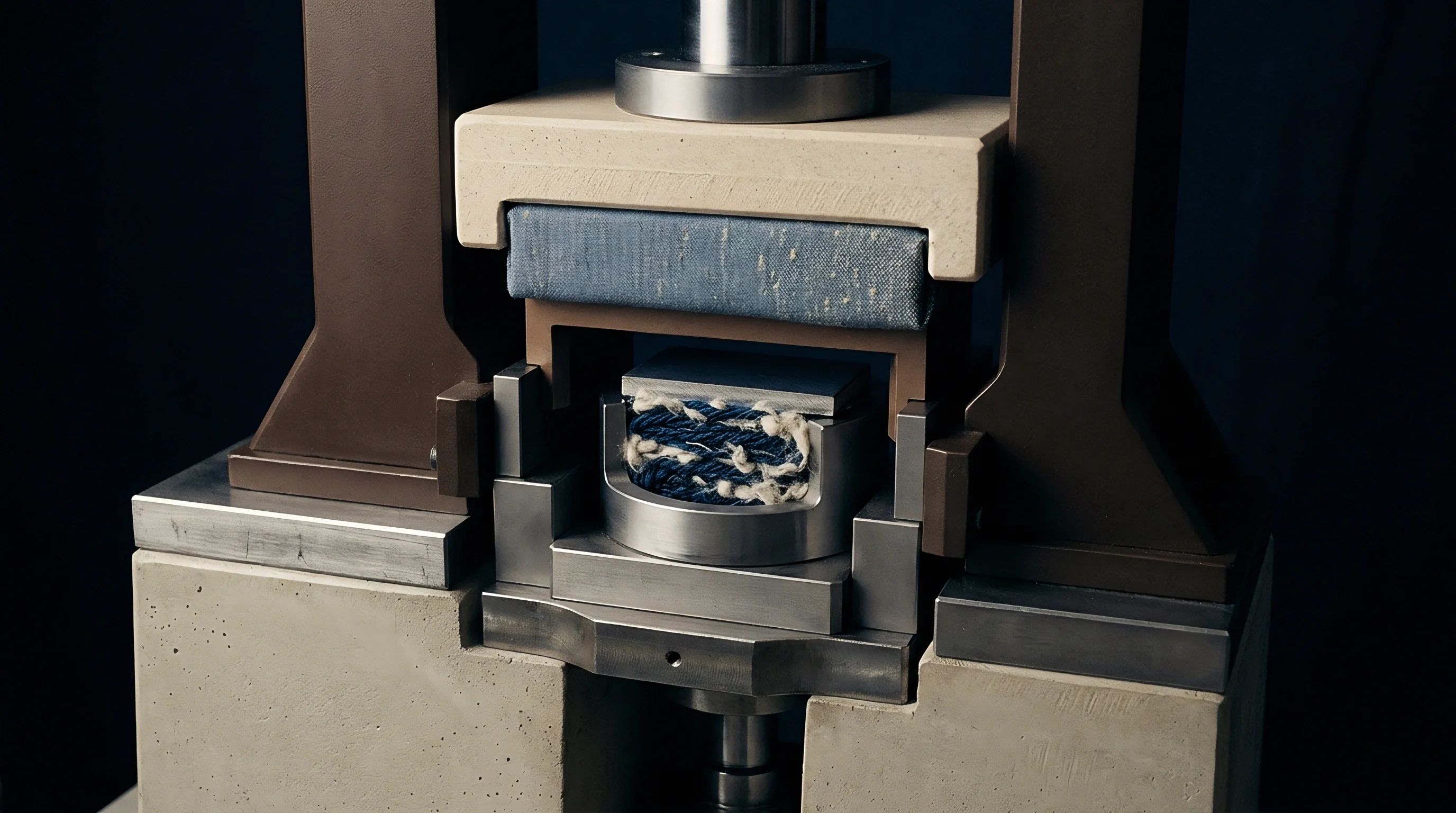
Under tensile loads measured via ISO 13934-1 strip trials, outer fibers rupture prematurely, transferring the load to the un-crosslinked core fibers which then fail sequentially.
Tear values plummet. Uniform crosslinking across the full vertical depth maintains collective fiber load sharing, preserving up to 25 percent more tear resistance compared to surface-segregated curing patterns at equivalent overall resin add-on.
Abrasion Resistance
Surface-concentrated polyelectrolytes form brittle outer shells vulnerable to frictional wear. Martindale abrasion trials under ISO 12947-2 demonstrate that fabrics with high surface ester ratios exhibit rapid surface fuzzing and premature end-point breakdown. Brittle surface fibers fracture under low-cycle frictional stress.
Cellulosic chains stiffen. Distributing crosslinking depth evenly lowers peak surface brittleness while retaining overall wrinkle recovery performance.
- Audit Wet Pickup Uniformity by measuring pad roll nip pressure profiles across the full bowl length to prevent edge-to-center moisture gradients.
- Implement Dual-Stage Drying using low-temperature air drying at 100 degrees Celsius to remove 80 percent of moisture before initiating thermal curing.
- Verify Core Curing Depth using cross-sectional ATR-FTIR mapping to confirm a core-to-surface ester absorbance ratio of at least 0.40.
- Balance Catalyst Ratios to avoid excess acid hydrolysis of cellulose during extended thermal dwell times required for heavy canvas core heating.
Imbalanced crosslinking depths generate localized brittle skins that fail Martindale abrasion testing prematurely, forcing full lot rejections and scrap remelting or disposal costs on the converter.

Dossier
Commercial mill specifications for durable press finishes on heavy cotton goods specify acceptable operating windows for stenter lines. To establish qualification dossiers for functional textile sourcing, converters validate thermal profiles, chemical add-on rates, and performance balances. Standard operating parameters require matching line speeds directly to fabric mass per unit area and weave density to ensure uniform Z-axis reaction kinetics.
Finishing Line Adjustments
Stenter velocity dictates the thermal dwell time across heating zones. Dwell times shrink. Finishing heavy fabrics demands multi-zone stenter setups where drying occurs in initial zones at moderate temperatures while curing is restricted to final zones operating at higher temperatures.
Air velocity differential controls prevent asymmetric chemical migration between fabric face and back.
- Calibrate pad mangle nip pressure to achieve 70 percent wet pickup on conditioned greige goods.
- Set stenter zones one and two to 105 degrees Celsius with 40 percent exhaust fan speeds to minimize convective chemical migration.
- Ramp stenter zones three and four to 140 degrees Celsius to clear remaining interstitial yarn moisture.
- Dwell in stenter zones five and six at 170 degrees Celsius for 45 seconds to drive full Z-axis esterification.
- Pass finished cloth immediately through a cooling can array to drop fabric core temperatures below 50 degrees Celsius.
Quality Qualification Clauses
Purchase orders specify laboratory test thresholds that must be met by finished production runs before lot release. Specifications detail minimum tensile strength retention, tear resistance, wrinkle recovery angles, and crosslink uniformity indices verified through spectrographic analysis.
Standard purchase agreements incorporating ISO 2313 and ISO 13934-1 dual-compliance clauses restrict final invoice payment until cross-sectional FTIR absorbance ratios confirm uniform resin distribution within the specified core boundaries.