Predicting Finished Fabric Sett and Weight from Loom State Greige Parameters
Predict finished woven sett and weight by adjusting loom greige parameters for yarn crimp interchange, wet processing mass loss, and stenter overfeed.

Geometry
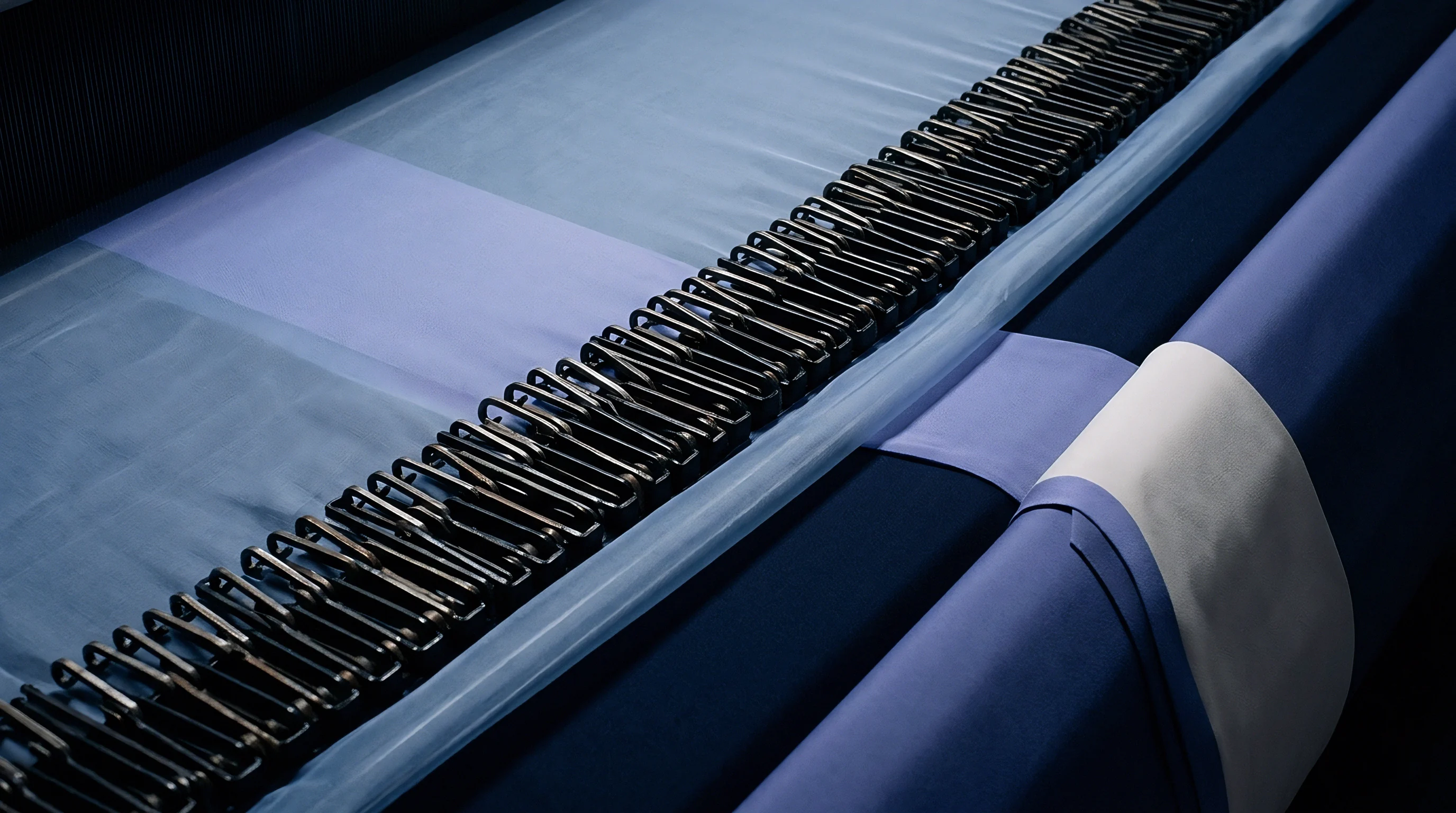
Spatial relationships in a woven fabric govern how thread spacing and linear mass determine finished cloth properties. As raw yarn enters the loom, warp tension constrains thread placement. Machine settings fix the initial warp ends and weft picks per unit length, while the loom reed width sets the lateral distribution of warp threads across the machine bed.
Weft insertion rates determine pick density along the length of the web. Finding expected finished values requires separating these greige parameters from on-loom tension deformation.
Greige Structural Parameters and Loom Configuration
Greige yarn parameters measured in the loom shed differ from settled, relaxed values. Warp ends per centimetre on the loom depend on reed number, denting plan, and total warp count, while lateral web contraction during weaving makes the actual reed width wider than the nominal greige width. Take-up roller speed relative to main shaft rotation sets on-loom pick density.
High warp tension flattens undulations and reduces apparent yarn diameter, producing temporary physical dimensions that shift immediately upon doffing.
Yarn linear density expresses thread thickness in Tex or English Cotton Count (Ne). Greige pick density measures twenty ends. Converting Ne to Tex establishes a metric mass basis where Tex equals 590.5 divided by Ne. Total yarn mass per unit length of cloth depends directly on these linear density values combined with spatial thread counts.
Because shed opening alters warp undulation, evaluating layout without accounting for tension deformation skews post-loom density predictions.
Cover Factor Relationships across Weave Constructions
Yarn packing density sets the upper limit for how many threads fit into a single layer. Derived from Peirce classical geometry, theoretical fractional cover factor expresses the ratio of yarn diameter to thread spacing. Warp cover factor equals warp ends per centimetre multiplied by the square root of warp Tex divided by ten.
Weft cover factor similarly depends on picks per centimetre and weft Tex. Total cloth cover factor combines warp and weft cover factors minus their product divided by twenty-eight.
| Weave Structure | Yarn Count (Tex) | Reed Width (cm) | Loom Ends/cm | Loom Picks/cm | Greige Cover Factor |
|---|---|---|---|---|---|
| 1/1 Plain Weave | 30 Tex Warp / 30 Tex Weft | 170.0 | 24.0 | 20.0 | 18.4 |
| 2/1 Warp Twill | 25 Tex Warp / 30 Tex Weft | 168.0 | 32.0 | 24.0 | 20.1 |
| 4/1 Satin | 20 Tex Warp / 20 Tex Weft | 165.0 | 40.0 | 28.0 | 21.8 |
Weave design dictates how closely threads pack under beat-up pressure. Plain weaves produce frequent interlacings, forcing high yarn curvature that caps maximum thread density per centimetre. Twill and satin structures accommodate higher thread counts because longer yarn floats let threads nest closer together.
When warp packing tightens, weft threads bend into deeper undulations, shifting the main axis of dimensional relaxation from length to width during wet processing.


Crimp
Yarn undulations in the warp and weft form the structural link between raw loom state dimensions and final relaxed measurements. Yarn crimp measures the additional length of thread required to traverse over and under perpendicular threads. Expressed as a percentage, crimp is the difference between uncurled yarn length and woven cloth length, divided by woven length.
Take-up percentage, by contrast, divides that length difference by the uncurled yarn length. Distinguishing between crimp and take-up prevents systematic errors in yarn consumption calculations.

Off Loom Tension Release Mechanics
Cutting the woven web from the take-up roll prompts immediate elastic recovery, with off-loom tension relaxing within twenty hours. Heavy longitudinal tension during weaving stretches warp threads, keeping warp crimp artificially low while forcing weft threads into pronounced undulations. Upon doffing, warp ends contract lengthwise, transferring part of the weft crimp into warp crimp.
This crimp interchange increases both warp end density and pick density per unit area prior to any aqueous treatment.
Reaching full physical equilibrium requires up to forty-eight hours of storage under standard atmospheric conditions of twenty degrees Celsius and sixty-five percent relative humidity. Measuring thread density immediately behind the reed yields inflated widths and underestimates unit mass; evaluating greige specifications prior to complete crimp equilibrium distorts downstream wet processing targets.
Higher weaving tension locks temporary elastic extension into warp ends, which disappears completely during the first aqueous boil-off.
Standard Methods for Thread Length Measurement
Straightening a yarn without stretching its individual fibres reveals its original uncurled dimension. Standardized testing under ISO 7211-3 specifies mounting extracted yarn ends in a crimp tester under a fixed initial tension, calculated from yarn linear density ~ typically 0.5 centinewtons per Tex for spun yarns. Accurate crimp determination requires averaging at least ten warp and ten weft specimens taken across the full width of the greige roll.
- Warp Tension Elevation lowers off-loom warp crimp while increasing greige linear density variance across the reed width.
- Shed Opening Depth alters the bending radius of warp ends, causing asymmetric crimp distribution between face and back threads.
- Beat-up Force Spike forces picks past the physical yarn spacing threshold, inducing mechanical yarn flattening that alters post-wash density calculations.
Yarn count shifts during wet processing. Unexpectedly high finished pick density is often attributed to unaccounted yarn lot variation when excessive warp beam tension was the actual driver of longitudinal fabric shrinkage.


Contraction
Dimensional changes during wet processing alter both end counts and pick counts per unit measure. Greige goods contain chemical sizes, spin finishes, natural waxes, and oils that contribute non-structural mass. Scouring and desizing strip these additives, causing raw mass loss while releasing mechanical stress locked into yarn structures during spinning and weaving.
Swelling agents alter yarn diameter, driving structural contraction across both longitudinal and transverse axes.

Wet Processing Mass Alteration and Add On
Desizing operations strip starch and synthetic binders from raw warp ends, while cotton wax removal reduces overall weight. Scouring cotton greige goods eliminates four to eight percent of raw material weight by extracting non-cellulosic impurities. Synthetic fibres experience lower mass loss, typically one to three percent, attributable to spin finish removal.
Caustic mercerization at twenty-eight degrees Baume increases finished warp density by nine percent while reducing total width from one hundred sixty centimetres down to one hundred forty-six centimetres.
Chemical processing also introduces mass back into the substrate through dyeing and functional finishing. Continuous dyeing adds colorant mass ranging from 0.5 to 3.0 percent depending on shade depth, while chemical finishes add two percent mass. Durable press resins, fluorocarbon water repellents, and flame retardants add one to four percent dry solids mass onto the relaxed web.
Net wet processing mass change represents the sum of raw fibre loss and dry finish add-on.
- Sample three full-width swatches across the head end of the greige roll immediately after twenty-four hour relaxation.
- Measure dry sample mass on an analytical balance after conditioning at twenty degrees Celsius and sixty-five percent relative humidity per ISO 139.
- Desize and scour the swatches in a laboratory bath using non-ionic surfactant and sodium hydroxide at boiling point for sixty minutes.
- Dry swatches flat without tension and re-weigh to establish raw fibre mass loss percentage.
- Apply anticipated stenter overfeed ratio to calculated crimp values to predict final pick density per centimetre.

Stenter Overfeed Controls for Density Adjustment
Chain width adjustments on the drying frame establish the final lateral spacing of warp threads, while stenter overfeed controls final pick density. Feeding cloth onto the stenter pin chain faster than the chain speed introduces two to ten percent mechanical overfeed. This longitudinal contraction allows warp yarns to re-crimp fully, elevating finished picks per centimetre while stabilizing the material against future laundry shrinkage.
| Processing Stage | Width Change (%) | Length Change (%) | Mass Loss/Gain (%) | Cumulative Sett Impact |
|---|---|---|---|---|
| Off-Loom Relaxation | -2.5 | -1.5 | 0.0 | Warp and Weft Densification |
| Desizing & Scouring | -3.0 | -4.0 | -6.5 | Picks/cm Increases Rapidly |
| Caustic Mercerization | -8.0 | +1.5 | -1.0 | Warp Ends/cm Increases Peak |
| Stenter Finishing | +2.0 | -5.0 | +2.5 | Final Density Locked by Pins |
Width contraction increases finished warp density. Skimming over desizing mass loss when calculating finished weight produces undersized bulk shipments that trigger automatic lot rejections and costly buyer chargebacks.

Arithmetic
Predicting final physical properties demands a unified mass balance model combining geometrical thread counts with processing loss factors. Mathematical forecasting connects initial loom settings directly to finished ends per centimetre, picks per centimetre, and mass per unit area, eliminating reliance on informal trial swatches during production planning.

Predictive Equations for Finished Thread Density
Linear contraction ratios directly govern the shift from greige picks to finished pick counts. Let N_w_greige represent greige warp ends per centimetre and N_p_greige represent greige weft picks per centimetre. Let S_w denote total width contraction percentage from greige to finished state, and S_l denote total length shrinkage percentage.
Finished warp end density N_w_fin follows the equation:
N_w_fin = N_w_greige (100 / (100 – S_w))
Finished weft pick density N_p_fin follows the parallel relationship:
N_p_fin = N_p_greige (100 / (100 – S_l))
Calculating these values establishes the spatial grid of the finished web before entering chemical processing ranges.

Mass Balance Formulations for Finished Weight
Combining yarn linear density, thread counts, and chemical processing factors yields total mass per unit area. Baseline greige weight W_greige in grams per square metre combines warp and weft mass contributions based on crimp percentages c_w_g and c_p_g:
W_greige = (N_w_greige 100 Tex_w / (100 – c_w_g)) + (N_p_greige 100 Tex_p / (100 – c_p_g))
Finished weight W_fin in grams per square metre incorporates wet processing mass loss percentage L_loss, chemical add-on percentage A_chem, and dimensional contraction factors:
W_fin = W_greige (1 – (L_loss / 100)) (1 + (A_chem / 100)) (100 / (100 – S_w)) (100 / (100 – S_l))
This formulation captures the dual influence of mass removal and spatial compaction.
Under ISO 3801 testing rules, a three percent deviation between calculated and delivered mass per unit area permits buyer price renegotiation or full batch rejection.
Worked Bulk Calculation Walkthrough
A production batch of one thousand metres provides the baseline parameters for this predictive verification. Assume a 100% cotton plain weave woven on an air-jet loom under the following greige specifications:
- Greige Reed Width measures 170.0 cm with a nominal target finished width of 150.0 cm, establishing a width contraction S_w of 11.76 percent.
- Loom Warp Sett specifies 24.0 ends/cm (240 ends per 10 cm), creating 4,080 total warp ends across the reed width.
- Loom Weft Sett specifies 20.0 picks/cm set by the machine take-up gear.
- Yarn Linear Density utilizes 30.0 Tex spun cotton for both warp and weft yarns.
- Greige Yarn Crimp measures 7.50 percent warp crimp and 6.00 percent weft crimp after twenty-four hour relaxation.
- Wet Processing Losses total 5.50 percent mass removal during scouring, while chemical finish add-on contributes 2.00 percent dry solids mass.
- Stenter Overfeed Setting imposes a 6.00 percent longitudinal length shrinkage S_l during final heat setting.
Step one computes finished warp ends per centimetre:
N_w_fin = 24.0 (100 / (100 – 11.76)) = 27.20 ends/cm
Step two computes finished weft picks per centimetre:
N_p_fin = 20.0 (100 / (100 – 6.00)) = 21.28 picks/cm
Step three calculates relaxed greige mass per square metre:
Warp Greige Mass = 24.0 100 30.0 / (100 – 7.50) = 77.84 g/m²
Weft Greige Mass = 20.0 100 30.0 / (100 – 6.00) = 63.83 g/m²
W_greige = 77.84 + 63.83 = 141.67 g/m²
Step four calculates finished mass per square metre:
Net Mass Factor = (1 – 0.055) (1 + 0.020) = 0.9639
Area Contraction Factor = (100 / (100 – 11.76)) (100 / (100 – 6.00)) = 1.1332 1.0638 = 1.2055
W_fin = 141.67 0.9639 1.2055 = 164.60 g/m²
| Stenter Overfeed (%) | Scour Loss (%) | Finished Ends/cm | Finished Picks/cm | Finished GSM (g/m²) | Target Variance (%) |
|---|---|---|---|---|---|
| 4.0 | 4.5 | 27.20 | 20.83 | 162.8 | -1.09 |
| 6.0 | 5.5 | 27.20 | 21.28 | 164.6 | 0.00 |
| 8.0 | 6.5 | 27.20 | 21.74 | 166.4 | +1.09 |
| Base calculation assumes fixed warp end count of 4,080 ends and constant finished width of 150.0 cm. | |||||
Adjusting stenter overfeed settings provides fine control over finished weight without changing loom setup parameters. Modifying overfeed by two percent alters finished pick density by approximately 0.45 picks per centimetre, shifting finished unit mass by 1.8 grams per square metre.

Tolerance
Acceptable variance boundaries define whether a delivered commercial lot complies with technical purchasing agreements. Standard manufacturing tolerances accommodate natural variations in yarn count, loom speed, and wet processing temperatures. Establishing precise verification procedures protects sourcing practices from accepting substandard yardage that fails physical performance requirements.

International Test Methods and Inspection Standards
Standardized testing procedures establish uniform conditions for evaluating thread counts and unit weight. ISO 3801 defines methods for determining mass per unit length and mass per unit area, specifying specimen conditioning under a controlled atmosphere prior to precision cutting and weighing. Testing compliance requires taking circular cutter samples of 100 square centimetres across multiple points along the roll length, excluding selvage zones within five centimetres of the edge.
Yarn count variations exceeding two percent across different spinning lots directly distort final pick count predictions despite uniform loom settings.
Thread density verification follows ISO 7211-2 standards using direct counting, glass counting glasses, or automated optical traversing counters. For dense constructions exceeding fifty threads per centimetre, counting must cover a minimum distance of five centimetres to minimize fractional endpoint errors. Nominal commercial agreements accept a plus or minus three percent tolerance band on total finished weight and a plus or minus two percent tolerance on finished thread counts.

Commercial Specification Clauses and Contract Limits
Technical procurement dossiers contain target values alongside explicit variance thresholds to prevent delivery disputes. Converter contracts should link greige parameter verification directly to finished goods approvals. Specifying loom reed width, greige thread counts, and expected yarn take-up rates inside supply agreements prevents mills from substituting lighter yarn counts and over-compacting cloth to reach nominal finished weight targets.
Inserting ISO 3801 Option 5 test conditions into the master purchasing contract places the burden of proof for mass discrepancies squarely on the converting mill.