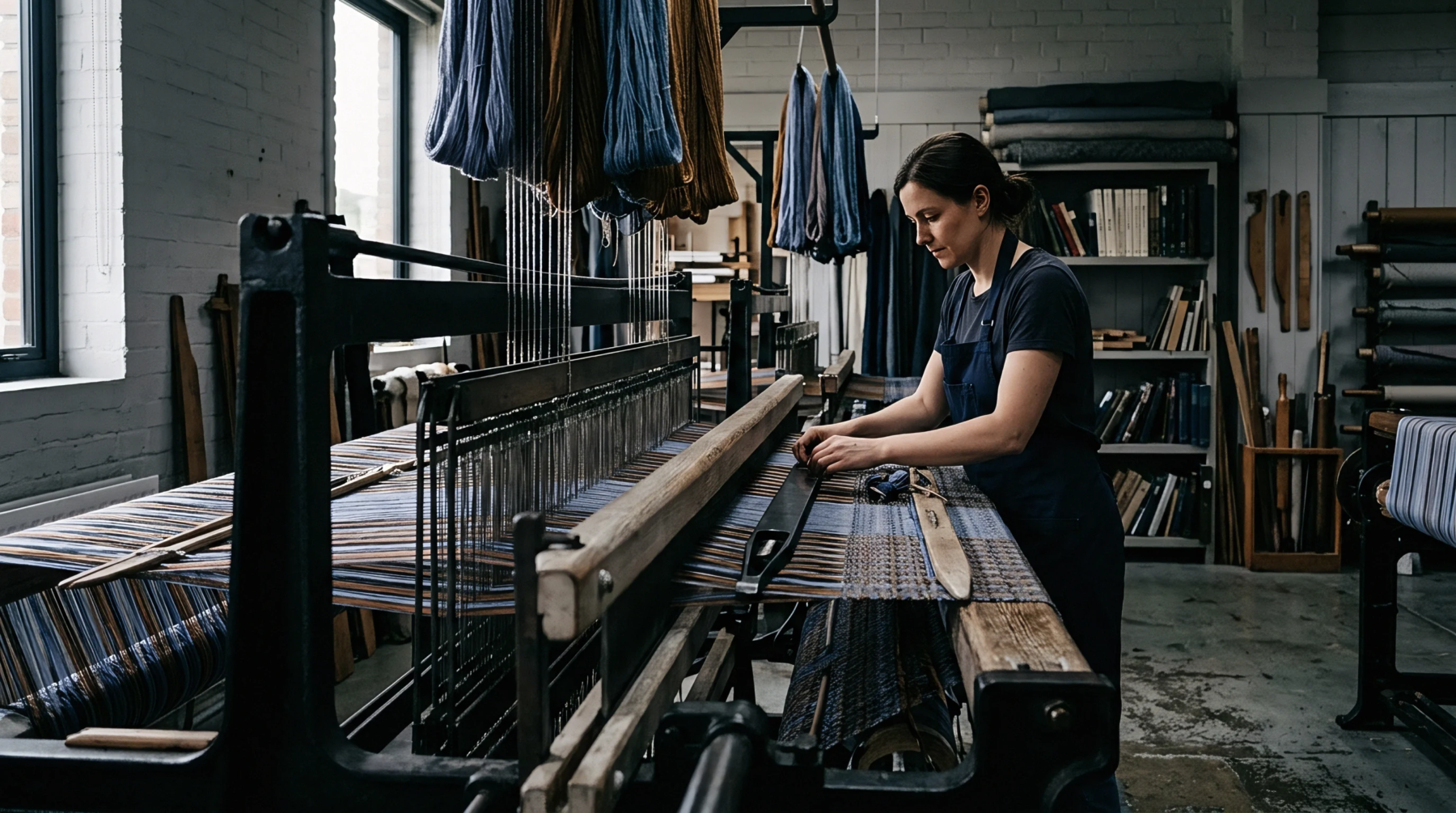
Unfinished Compactness
Mass per unit area and thread count of fabric immediately following removal from the loom or knitting frame characterize loom-state compactness. Raw fabric before washing, scouring, bleaching or dyeing displays greige density governed entirely by machine gauge, yarn linear density and take-up settings. This base property incorporates spinning sizes, oils and natural waxes that will wash out during subsequent finishing stages.
Accurate baseline tracking allows plants to predict dimensional shrinkage and final finished areal weight. Fabrics produced below planned raw density will finish underweight, fail opacity checks or suffer excessive width loss during stentering.
Measurement Protocol
Cut circular specimens taken from off-loom rolls are weighed on precision analytical balances under standard conditioning temperatures. Technicians combine gram-per-square-meter values with physical counts of ends and picks, or wales and courses, to document greige density completely. Processing oils and sizing agents can constitute up to ten percent of unfinished mass in raw cotton or sized synthetics.
Testing teams must account for these processing aids when forecasting dry, clean yield. Unstable environmental humidity in the production shed causes rapid shifts in raw yarn moisture content and unconditioned fabric mass.
Production Adjustment
Let-off tension, warp speed and fabric take-down roller gearings control this mechanical state directly at the machine head. When greige density drifts from set points, loom operators adjust sand roller gearing, electronic cloth take-up rates or yarn delivery feeds. Over-tightening warp tension increases stretch on the machine, yielding a deceptive raw density that contracts violently once rolled and relaxed.
Balanced tension settings ensure that raw rolls remain uniform from start to finish. In warp knitting, monitoring run-in values per rack prevents unwanted density swings across consecutive shifts.
Process Prediction
Downstream wet finishing recipes depend on predictable raw fabric mass to control chemical concentration and bath exhaustion rates. Variations in greige density disrupt dyestuff absorption, leading to batch-to-batch color variations and uneven heat setting in stenter ovens. Finishing mills run routine intake checks to verify raw roll weights against master technical sheets before wet processing begins.
Discrepancies at the raw inspection table prompt immediate machine recalibration at the weaving or knitting plant. Off-loom density tracking controls finished yield long before goods reach final packaging.