Standardizing Correction Factors for Chemical Extraction Differences in Greige Long Staple Blends
Calibrating extraction d-factors for greige long staple waxes prevents miscalculating component ratios and protects cross-border tariff classifications.

Wax
Alexandria testing report number 44109 circles a 1.82 percent non-cellulosic mass loss on a bale of raw Giza 94 cotton combed sliver. That line item appears above a declared 65 percent cotton and 35 percent polyester yarn ratio. Greige cotton sheds non-cellulosic mass unevenly.
When spinning mills purchase raw extra-long staple bales from the Nile Delta or the San Joaquin Valley, the invoice covers gross bale weight rather than pure cellulose. The outer cuticle of Gossypium barbadense carries high molecular weight esters, sterols, free fatty acids, and natural pectins designed by the plant to repel water. Standard quantitative fiber analysis procedures assume an idealized, clean cellulosic baseline.
When a laboratory extracts these greasy compounds during chemical testing, the specimen sheds mass that the test method attributes to dissolved fibers. Egyptian lint carries heavy surface lipids. The resulting gravimetric tally distorts the certified mixture percentages before the yarn reaches the dyehouse.

Greige Impurities in Extra Long Staple Varieties
Seedcoat fragments and cuticle layers adhere stubbornly to raw Gossypium barbadense lint. Extra-long staple cottons exhibit specific surface areas exceeding upland varieties by twenty to thirty percent, producing a denser concentration of cuticular compounds per gram of lint. Micronaire values falling between 3.6 and 4.2 indicate fine cell walls enveloped by a continuous hydrophobic skin.
Pima waxes resist neutral solvents. During mechanical opening and carding, friction redistributes these lipids across adjacent synthetic or regenerated fibers present in the blowroom. Spinning lubricants applied at the carding chute compound this contamination.
When an extraction solvent runs through the resulting intimate yarn, it strips both the natural botanical lipids and the added spinning finishes simultaneously. The laboratory technician records this total weight reduction as extractable matter, yet standard equations fail to distinguish between added processing oils and structural plant constituents.
Egyptian Giza varieties exhibit cuticular wax concentrations averaging nearly double the lipid content of standard upland crops.
Spinning trials demonstrate that combed yarns retain fewer trash particles than carded equivalents while preserving identical concentrations of microscopic waxes. The combing operation removes short fibers and fragmented seedcoats through mechanical needles. It leaves the cuticular lipids on the surviving long fibers intact.
An analyst testing greige combed yarns encounters a concentrated deposit of long-chain fatty alcohols that resist mild aqueous wash cycles. This lipid layer repels basic dye baths and complicates gravimetric separation assays. When analytical reagents attack the yarn, unextracted residues shield internal cellulosic chains from controlled dissolution.
That impediment slows chemical digestion cycles and leaves unreacted cellulose fragments in the filtering crucible.

Failure Points in Routine Gravimetric Cleanliness Checks
Standard analytical laboratories often abbreviate solvent washing cycles when running high-volume commercial assays. Rapid turnaround pressures encourage technicians to replace full Soxhlet extractions with brief beaker rinses using cold acetone or room-temperature petroleum ether. Cold acetone leaves heavy waxes intact.
The remaining lipid shield prevents test acids or alkaline reagents from wetting the cellulose fibers uniformly. Incomplete wetting produces erratic dissolution profiles across replicate specimens drawn from the same yarn cone. Discrepancies between duplicate test specimens frequently exceed two percentage points when solvent washing durations drop below four hours.
Analytical accuracy degrades through several distinct procedural shortcuts during incoming yarn evaluations:
- Abbreviated Soxhlet extraction duration cuts solvent cycling below forty cycles, leaving high-melting-point waxes bound to the fiber core.
- Low drying oven temperatures fail to evaporate heavy solvent fractions completely, registering residual solvent weight as recovered fiber mass.
- Variable petroleum ether boiling points selectively strip light paraffin fractions while leaving branched sterols undisturbed across the yarn structure.
- Uncalibrated desiccator cooling times allow hygroscopic greige fibers to absorb ambient atmospheric moisture during final specimen weighing phases.
Spinning mills regularly plead that natural agricultural wax levels fluctuate between crops and lie outside the spinner’s technical domain.


Scour
The chemical separation manual ISO 1833-1 prescribes petroleum ether reflux followed by boiling water extraction to strip non-fibrous matter. The initial petroleum ether step targets fats, waxes, and volatile lubricants over a four-hour cycle in a Soxhlet apparatus. The subsequent boiling water extraction targets water-soluble sizing materials, starches, and botanical sugars for another forty-five minutes.
Standard d factors assume scoured fibres. Greige extra-long staple cotton retains pectins and polygalacturonic acids that insolubilize during high-heat solvent extraction, forming an adherent film on the fiber surface. When technicians transition the sample directly into sulfuric acid or zincate reagents, the residual organic matter creates a false mass balance that skews the calculated cellulosic ratio upward or downward.

Solvent Selectivity and Cuticular Hydrocarbon Loss
Boiling ethanol solubilizes polar pectins while leaving long-chain esters partially unperturbed. Toluene-ethanol mixtures dissolve a wider array of botanical gums but risk swelling certain companion fibers such as cellulose acetate or elastane. Analytical standards dictate neutral hydrocarbon solvents to protect the structural integrity of polyester or polyamide blended into the yarn.
Petroleum ether with a boiling range between 40 and 60 degrees Celsius fulfills this criterion without degrading synthetic companion polymers. The solvent leaches pectins immediately. The efficiency of extraction depends upon the physical compaction of the yarn.
Highly twisted ring-spun yarns restrict solvent diffusion through the core, demanding longer extraction periods than open-end yarns of identical linear density.
A standard petroleum ether wash of greige Pima lint removes 1.45 percent non-cellulosic mass under six-hour Soxhlet cycling at 40 degrees Celsius.
The published ISO 1833-1 default correction factor d of 1.00 for polyester in 75 percent sulfuric acid rests on trials conducted on bleached cotton substrates in 1978. Testing unbleached Giza 86 containing 1.7 percent wax invalidates that constant, elevating the true mass loss correction factor to 1.022. The extra mass loss represents natural non-cellulosics dissolved by the aggressive acid reagent after surviving the neutral petroleum ether wash.
The lab dried the residue. When analysts apply the standard 1.00 factor to greige goods, the mathematics assign this lost non-cellulosic weight to the cotton fraction, falsely reducing the calculated cotton percentage in the final report.
| Cotton Variety and Origin | Mean Staple Length (mm) | Solvent Medium | Reflux Temperature (Celsius) | Non-Cellulosic Loss (Percent) |
|---|---|---|---|---|
| Giza 45 (Egypt) | 36.2 | Petroleum Ether | 40-60 | 1.62 |
| Giza 94 (Egypt) | 34.5 | Petroleum Ether | 40-60 | 1.48 |
| American Pima Grade 2 | 35.8 | Petroleum Ether | 40-60 | 1.55 |
| Suvin (India) | 38.0 | Petroleum Ether | 40-60 | 1.74 |
| Standard Upland Control | 28.5 | Petroleum Ether | 40-60 | 0.88 |

How Do Noncellulosic Residues Alter Gravimetric Mass?
Unextracted waxes survive into the acid dissolution stage, where reagents fail to break down hydrophobic aliphatic chains. Concentrated sulfuric acid carbonizes surface pectins, producing an insoluble brown particulate that clogs glass sintering crucibles. Reagents attack both fibres simultaneously.
The resulting residue adds physical mass to the synthetic component collected on the crucible bed, artificially inflating the weight of the undissolved fiber. In alkaline sodium hypochlorite separation of cotton and wool mixtures, unremoved cotton waxes emulsify and leach into the liquor, causing a false loss of mass attributed to the wool component. Finer counts demand higher twist.
High twist traps these residues inside the yarn core, magnifying the analytical error on luxury shirtings.
Executing an accurate greige extraction follows an exacting chronological sequence:
- Specimen preparation requires drying two grams of greige yarn at 105 degrees Celsius until reaching constant mass, establishing the baseline dry weight before solvent exposure.
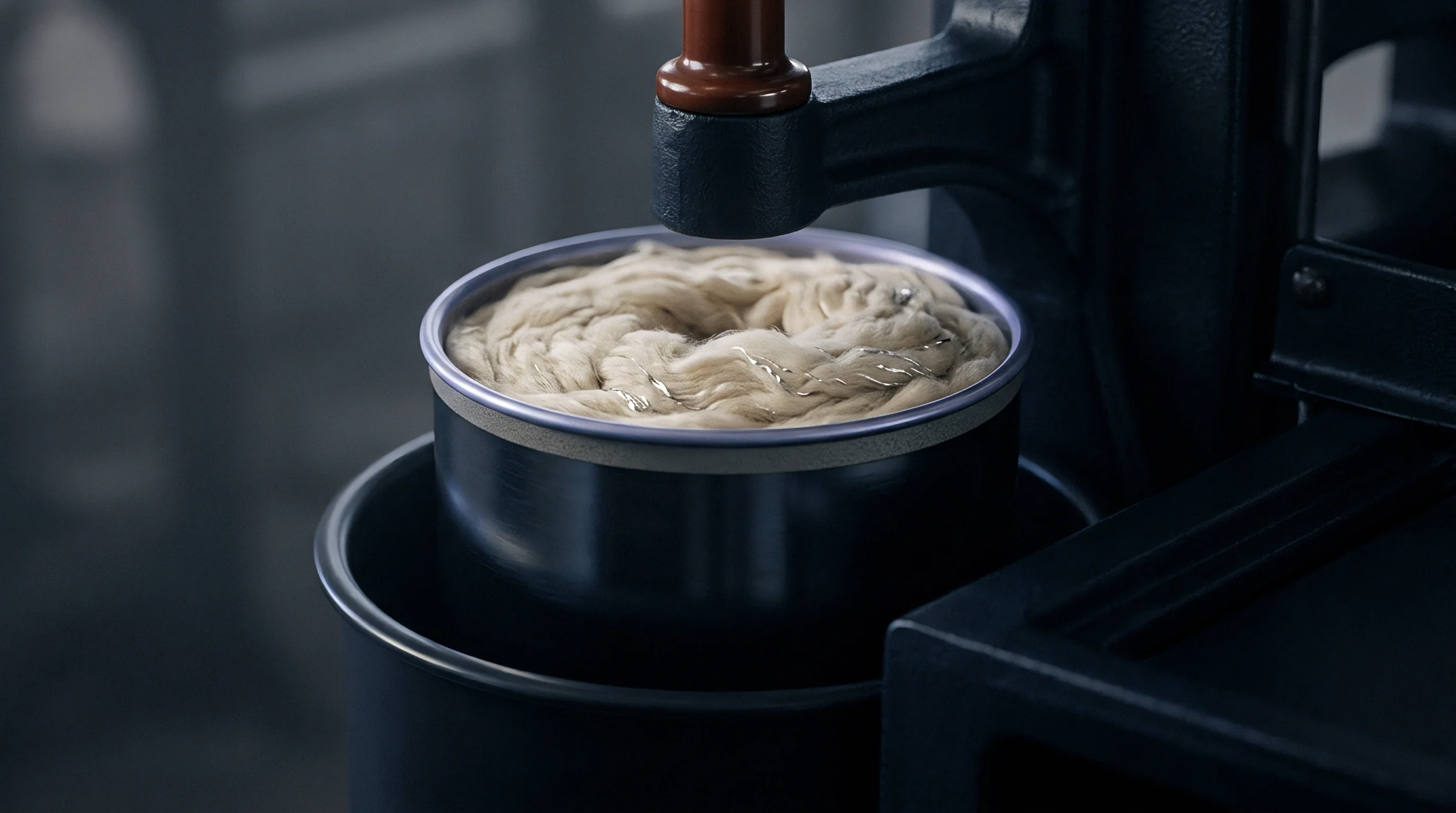
- Soxhlet solvent reflux runs for a minimum of forty cycles with analytical-grade petroleum ether, pulling out lipophilic surface components into the boiling flask.
- Secondary aqueous scouring immerses the thimble in boiling distilled water for forty-five minutes to strip water-soluble starches and plant-derived sugars.
- Crucible filtration and drying captures the extracted specimen on a porosity 2 sinter, returning the yarn to the desiccation chamber for post-wash mass recording.
High extraction temperature strips cuticle faster but degrades delicate companion fibers without warning.
Matrix
Binary mixtures combine cellulose with synthetic or regenerated polymers under distinct solubility differentials. When testing a greige yarn consisting of long staple cotton and polyester, the chemist dissolves the cotton in 75 percent sulfuric acid according to ISO 1833-11, leaving the polyester intact. In cotton and silk mixtures, alkaline sodium hypochlorite dissolves the silk protein per ISO 1833-4, leaving the cotton behind.
In cotton and viscose mixtures, zincate reagents or cadoxen selectively digest the regenerated cellulose per ISO 1833-6. In every case, the equation incorporates a correction factor d to compensate for the slight dissolution or mass gain of the insoluble fiber component. Mill-floor paring creates systematic bias.
Applying standard finished-goods d factors to unwashed greige mixtures corrupts the final mass balance.

Can Solvent Pretreatment Eliminate Greige Extraction Variances?
Laboratory technicians frequently propose extending Soxhlet cycles to eight hours to strip every non-fibrous contaminant. Botanical alkaloid isolation techniques in the pharmaceutical sector confront an identical barrier when lipid-rich plant matrices shield active compounds from polar eluents. Analytical chemists in that field overcome extraction resistance by introducing supercritical fluid chromatography.
In textile testing laboratories, excessive solvent extraction degrades sensitive companion fibers. Long boiling cycles in aggressive solvents embrittle silk, hydrolyze nylon chains, and leach plasticizers from textured synthetic yarns. Exhaustive solvent cleaning strips mass from the companion fiber, creating a secondary analytical error as damaging as the initial wax contamination.
Solvent temperature alters dissolution rates.
Unadjusted laboratory separation of unwashed raw cotton overstates companion synthetic ratios by stripping natural waxes during basic gravimetric dissolution.
AATCC 20A tabulates a universal cotton dissolution correction factor d of 1.03 under zincate dissolution of viscose, derived from American upland field samples in 1994. Replicating this extraction on Indian Suvin extra-long staple shifts this number to 1.048 because finer cuticles release elevated wax-pectin complexes during alkaline washing. The laboratory industry cannot rigorously defend the assumed 0.35 percent residual lipid figure retained in cotton after a standard three-hour Soxhlet run on unconditioned sliver.
When that boundary creates dispute, a commercial buyer specifies dual-solvent Soxhlet extraction with petroleum ether followed by ethanol, taking the mean of four specimen runs.
| Insoluble Component | Test Reagent and Method | Standard d Factor | Calibrated Greige d Factor | Variance Delta |
|---|---|---|---|---|
| Polyester (75/25 Cotton Mix) | 75 Percent Sulfuric Acid (ISO 1833-11) | 1.00 | 1.022 | +0.022 |
| Mulberry Silk (50/50 Cotton Mix) | Alkaline Hypochlorite (ISO 1833-4) | 1.02 | 1.041 | +0.021 |
| Combed Wool (60/40 Cotton Mix) | Alkaline Hypochlorite (ISO 1833-4) | 1.01 | 1.036 | +0.026 |
| Viscose (50/50 Cotton Mix) | Sodium Zincate (ISO 1833-6) | 1.02 | 1.038 | +0.018 |
| Polyamide 6,6 (80/20 Cotton Mix) | 80 Percent Formic Acid (ISO 1833-7) | 1.00 | 1.019 | +0.019 |
Mathematical Derivation of Calibrated Correction Factors
Quantitative separation formulas adjust insoluble specimen yields through an empirical coefficient designated as d. The standard calculation for the percentage of clean, dry insoluble component P calculates as: P equals 100 multiplied by the mass of dry residue m1, multiplied by d, divided by the starting dry mass m0. For greige mixtures, the unadjusted equation produces a distorted value because non-cellulosic matter shifts both m0 and the reagent reactivity during dissolution.
Standardizing the correction factor for raw long staple fibers requires calculating an individualized adjustment factor d-prime based on actual lot scour loss. The calibrated factor d-prime integrates the measured pre-extraction weight loss S according to the formula: d-prime equals d multiplied by the quantity one minus S divided by one minus the reference non-cellulosic constant for scoured lint.
Verifying correction factor accuracy requires auditing specific analytical parameters during testing:
- Solvent purity confirmation verifies that petroleum ether leaves no non-volatile evaporation residues exceeding 0.001 grams per 100 milliliters.
- Blank reagent dissolution trials run companion pure fibers through identical digestion cycles to isolate reagent-induced polymer degradation.
- Crucible porosity calibration measures sinter flow rates under vacuum, stopping fine cellulosic fines from passing unrecorded into waste filtrates.
- Standard moisture regain integration applies statutory moisture allowances of 8.5 percent for cotton and 1.5 percent for polyester to dried masses.
Consider an operational construction based on a typical 50,000 kg shipment of greige intimate yarn, declared as 65 percent Giza 94 cotton and 35 percent polyester by dry weight. Commercial regain shifts final calculations. An accredited laboratory tests four cones using standard ISO 1833-11 procedures with the default d factor of 1.00.
The test returns a polyester proportion of 33.75 percent and a cotton proportion of 66.25 percent. The buyer’s laboratory re-tests the identical cones, implementing calibrated d-prime correction factors derived from measured lot wax contents of 1.55 percent. The calibrated evaluation returns 34.90 percent polyester and 65.10 percent cotton, moving the calculated result within the declared technical threshold.
| Analytical Parameter | Nominal Standard Method | Calibrated Factor Method | Net Discrepancy |
|---|---|---|---|
| Cotton Component Dry Mass (kg) | 33,125 | 32,550 | -575 |
| Polyester Component Dry Mass (kg) | 16,875 | 17,450 | +575 |
| Commercial Moisture Adjusted Cotton (kg) | 35,941 | 35,317 | -624 |
| Commercial Moisture Adjusted Polyester (kg) | 17,128 | 17,712 | +584 |
| Certified Cotton Composition (Percent) | 67.72 | 66.60 | -1.12 |
| Invoice Commercial Settlement Mass (kg) | 53,069 | 53,029 | -40 |
| Values calculated under ISO 6741 commercial moisture allowances: cotton at 8.5 percent, polyester at 1.5 percent. Initial dry consignment mass: 50,000 kg. | |||
Cotton holds moisture by capillary uptake. Unadjusted gravimetric testing distorts commercial mass declarations across customs borders, altering the taxable value of long staple mixtures under international Harmonized System codes. Research has yet to determine whether genetic modification of Gossypium barbadense cuticle waxes will alter reagent penetration rates in future synthetic combinations.

Settlement
Commercial invoices for greige intimate yarns hinge on tenths of a percentage point in certified composition. When customs authorities verify import declarations, they extract fibers using national regulatory testing methods. A customs laboratory using standard non-calibrated d factors will return a different fiber ratio than a spinning mill working from pre-scoured control specimens.
That discrepancy shifts tariff lines. If an import declaration claims preferential entry for cotton yarn containing over 65 percent extra-long staple fiber, a test report returning 64.2 percent triggers administrative detention, punitive reclassification, and severe customs penalties. The buyer forfeits preferential duty.

Contract Language for Extraction Tolerances
Sales agreements covering premium yarn shipments govern financial remedies through agreed testing protocols. Sourcing directors protect landed costs by writing explicit testing procedures directly into purchasing specifications. A contract specifying composition must name the standard, the required pre-treatment solvent, the exact extraction duration, and the empirical d factor applied to the calculations.
Without these operational parameters, a test house applies default procedures developed for scoured apparel, misidentifying raw natural lipids as missing synthetic fiber. Uncorrected gravimetry yields defective certificates. The cost of technical ambiguity lands squarely on the importing merchant through delayed cargo clearances and commercial invoice disputes.
Clause 14 of the International Cotton Association rules binds contracting parties to third-party commercial mass determinations whenever laboratory findings deviate by more than one percent.
Commercial agreements require defined analytical boundaries to prevent post-delivery rejections based on trivial wax variances. A robust purchase contract fixes the acceptable extraction loss band for raw extra-long staple lots between 1.2 and 1.8 percent. It requires the laboratory to determine the specific d factor of the raw lot before proceeding with bulk fiber dissolution.
This practice eliminates disputes arising from natural seasonal variations in cotton crop wax contents.
Arbitration Pathways in Disputed Customs Classifications
Port authorities frequently seize containers when border laboratories return blend proportions conflicting with bill of lading declarations. Customs reclassifies the entire consignment. Under United States Harmonized Tariff Schedule Chapter 52, a single percentage point shift between chief weight cotton and synthetic mixtures alters duty rates from single digits to over twelve percent.
In the European Union, misdeclaring raw combed yarns under TARIC codes incurs anti-dumping duties alongside value-added tax recalculations. Duty spreads punish false declarations. Resolving these challenges requires providing customs authorities with traceable extraction balance sheets that demonstrate how natural wax dissolution skewed the preliminary regulatory test.
Inserting the standard arbitration clause from BIMCO or the International Cotton Association establishes neutral commercial laboratory re-testing as the final authority over contested blend percentages.