Quantifying Carding Waste Composition Drift in Cotton Synthetic Blends
Carding waste selectively extracts short cotton over synthetic staple, shifting sliver ratios by up to 2 percent synthetic enrichment unless compensated in laydown.

Grate
Mechanical carding redistributes short and long staple elements across discrete waste fractions, systematically altering the proportion of natural to synthetic components in delivered sliver relative to the initial laydown. When carding short-staple cotton blended with synthetic fibres such as polyethylene terephthalate, viscose, or recycled polyester, the carding machine operates as a selective mass separator. The primary carding zone ~ bounded by the licker-in roll, main cylinder, revolving flats, and under-card suction grids ~ subjects incoming tufts to mechanical forces that act unequally upon fibres based on length distribution, surface friction, flexural rigidity, and linear density.
Cotton fibres present a non-uniform staple length profile, typically spanning from under 5 millimetres up to 32 millimetres in medium-staple upland varieties, alongside natural convolutions, wax coatings, and variable micronaire values. Synthetic staple fibres are cut to precise uniform lengths, commonly 38 millimetres or 44 millimetres, with consistent dtex ratings and engineered surface finishes. This physical disparity governs how each fibre type responds to centrifugal forces, aerodynamic currents, and card wire pinning forces within the machine.

Mechanical Fractionation Mechanics at the Licker-in
The licker-in region is the first major point of differential waste extraction. As feed rollers push the opened blend web over the feed plate toward the rapidly rotating licker-in cylinder, saw-tooth wire clothing combs through the fibre mass. Heavy particles, seed coat fragments, un-opened fibre clusters, and loose short fibres escape through the openings between grid bars under centrifugal action and localized airflow patterns.
Because natural cotton contains short fibre fractions below 12.7 millimetres that lack structural cohesion within incoming tufts, these short fragments break free readily during high-speed combing. Synthetic staple fibres, possessing higher individual tenacity, uniform length, and continuous mechanical crimp, resist early liberation from the tuft core. Waste collected beneath the licker-in roll routinely exhibits a cotton concentration substantially higher than the nominal blend ratio of the incoming stock.
Air currents beneath the main card cylinder further amplify this separation. The boundary layer generated by the high surface speed of the cylinder pushes low-mass, short-staple fragments through under-card screens into the central waste suction system. Low-density cotton dust and degraded short fibres enter this air stream at rates four to six times higher than synthetic staple fibres.
The synthetic component, benefiting from inter-fibre friction and mechanical entrapment within the cylinder wire, remains predominantly anchored on the main carding surface.
Waste collected from the licker-in droppings of a 60/40 cotton polyester blend feed regularly tests at 84 percent cotton by dry mass under standard laboratory conditions.
Revolving Flat Strip Composition Mechanics
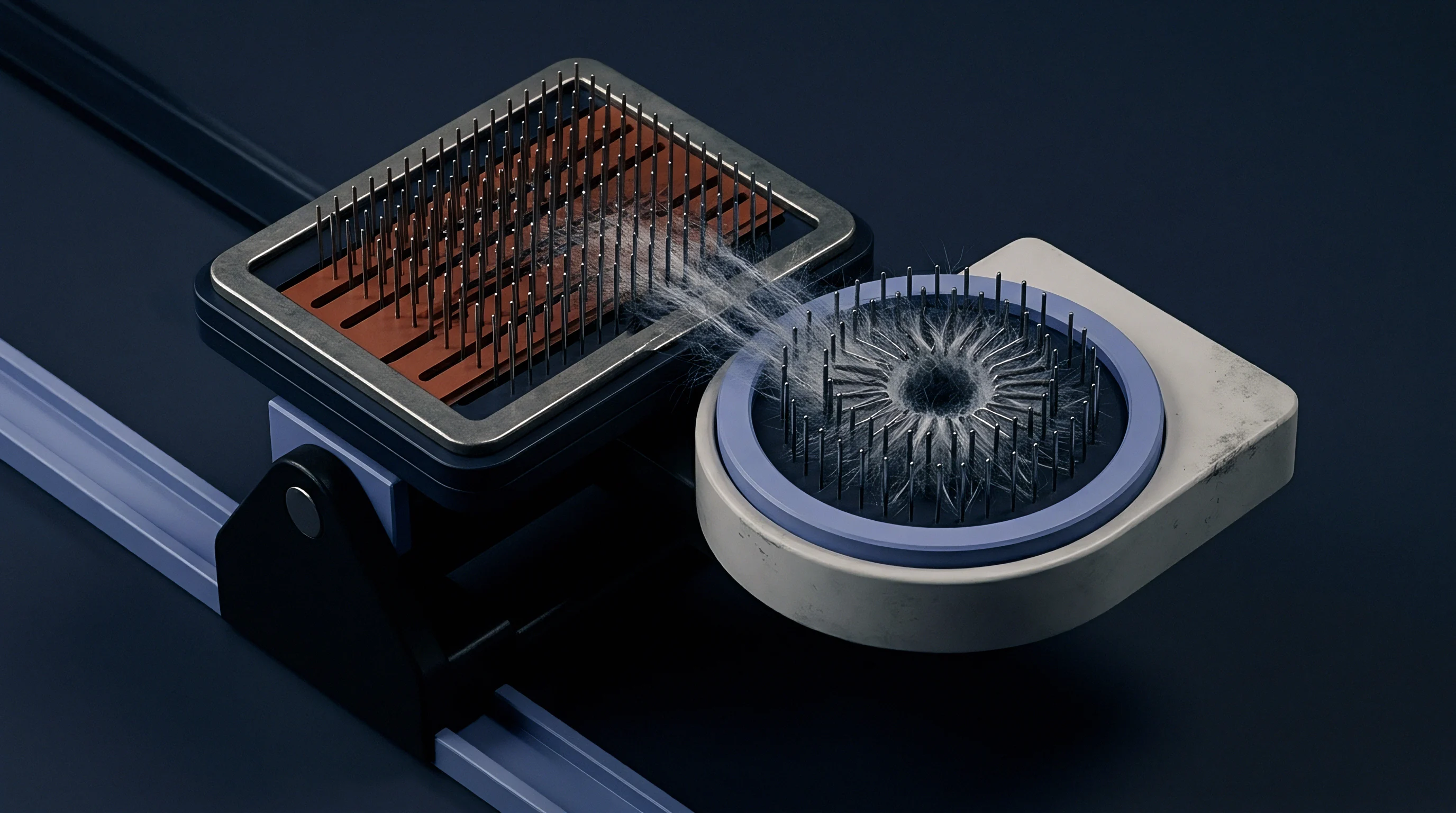
Carding action between main cylinder clothing and revolving flat strips yields the second major waste stream. The operational clearance between cylinder wire and flat wire, often set between 0.15 millimetres and 0.25 millimetres, subjects the fibre mass to intense combing and parallelization. Neps, fine trash, and fibres whose ends project outward from the main wire clothing are caught by the slow-moving flats and carried away as flat strips.
Differential extraction at the flats depends heavily on fibre stiffness and surface friction coefficients. Cotton fibres possess a higher bending modulus and natural twist, causing short or damaged cotton elements to rise to the tips of the cylinder wire where flat strips remove them. Synthetic fibres, manufactured with smooth surface profiles and specific spin finishes, tend to embed deeper into the main cylinder clothing pins.
When flat strip speed increases, the total mass of flat waste rises, but the relative proportion of extracted cotton expands faster than that of synthetic staple.
Significant shifts in flat strip fractions occur when processing blends containing recycled polyester. Recycled synthetic staples frequently exhibit uneven crimp frequency and variable surface coating distribution compared to virgin synthetic fibres. These irregularities cause recycled synthetic fibres to interact unpredictably with revolving flat wire, occasionally elevating synthetic extraction rates in flat strips.
In standard virgin synthetic and cotton blends, however, flat strips remain overwhelmingly biased toward cotton extraction.
Differential Extraction Pathways across Carding Waste Streams
Quantifying total carding waste composition drift requires auditing every discrete discharge port on the carding machine. Total mass lost during carding typically ranges between 3.5 percent and 6.0 percent of total throughput, depending on raw material cleanliness, machine settings, and target sliver quality. Because each waste port extracts fibres through distinct physical mechanisms, each port exhibits a distinct composition ratio.
- Licker-in droppings capture dense non-lint content and short cotton fragments released during initial tuft opening, exhibiting high cotton depletion rates relative to feed.
- Revolving flat strips extract surface neps, micro-dust, and intermediate short fibres caught by top wire pins, operating as the largest volume waste fraction.
- Under-card screen waste collects light airborne lint and short fly driven through grid perforations by high-velocity cylinder boundary layer air currents.
- Filter box suction fly gathers pneumatic waste drawn from continuous card cleaning points, representing ultra-short fibre fragments and free surface dust.
The cumulative effect of these extraction pathways is a systematic depletion of cotton from the fibre mass passing through the carding machine. As cotton leaves the system at higher percentages across licker-in, flat strip, and filter streams, the remaining fibre web delivered to the doffer cylinder becomes enriched in synthetic content. The carded sliver exiting the draw-box consequently delivers a blend ratio that has drifted away from the initial laydown target.
A spinning mill supplying raw blend ratios directly to processing equipment without accounting for this extraction skew discovers that carded sliver yields higher synthetic percentages than raw material invoices state. Machine operators attempting to explain this shift often attribute the drift to opening room blending errors rather than mechanical carding dynamics. Raw bale laydown ratios do not guarantee that delivery specs match targets, as physical extraction skew occurs inside the carding zone.

Chemistry
Accurate measurement of composition drift between raw laydown feed and carded waste streams depends on quantitative chemical separation methods. Visual microscopy and physical sorting fail to isolate short fibre fragments, degraded lint, and lint-dust mixtures present in carding droppings. Quantitative chemical dissolution isolates specific polymer fractions by selectively dissolving one component while preserving the secondary fibre mass for gravimetric measurement.
Standard testing methods, primarily ISO 1833 and AATCC Method 20A, establish strict operational parameters for dissolving blended textiles and waste samples. Applying these standards to carding waste introduces analytical challenges absent in yarn or fabric testing. Carding waste contains elevated non-lint content, seed coat fragments, spin finishes, and high surface area micro-dust that skew direct dry mass readings if untreated.

Chemical Dissolution Regimes for Binary Blends
Isolating polyethylene terephthalate from cotton requires high-purity sulfuric acid reagents prepared to specific concentration thresholds. ISO 1833-11 specifies using 75 percent mass fraction sulfuric acid to dissolve cotton, flax, or viscose elements while leaving polyester intact. The test specimen must be dried, weighed, treated in the acid solution at specified temperatures, filtered, washed, dried again, and reweighed to determine the insoluble polyester residue mass.
For blends combining cotton with cellulosics like viscose or modal, alternative solvent systems are required. ISO 1833-3 uses zinc chloride and formic acid reagents to dissolve manufactured cellulosic fibres without attacking native cotton cellulose. Acrylic and cotton blends require dimethylformamide or sodium thiocyanate systems under ISO 1833-12.
Each reagent system carries specific correction factors (d-factors) to account for slight mass losses of the insoluble component during chemical immersion.
| Blend Type | Target Dissolved Fibre | Reagent System | Temperature and Time | Standard Correction Factor (d) |
|---|---|---|---|---|
| Cotton / Polyester | Cotton | 75% Sulfuric Acid (H2SO4) | 50°C for 75 minutes | 1.01 for virgin polyester |
| Cotton / Viscose | Viscose | Formic Acid / Zinc Chloride | 40°C for 15 minutes | 1.02 for upland cotton |
| Cotton / Polyamide | Polyamide (Nylon 6/66) | 80% Formic Acid (HCOOH) | 20°C for 15 minutes | 1.00 for cleaned cotton |
| Cotton / Acrylic | Acrylic | 100% Dimethylformamide | 90°C for 60 minutes | 1.01 for raw cotton |
Standard Operational Sequence for Waste Extraction Testing
Measuring card waste composition requires complete removal of lubricants, spin finishes, and non-fibrous impurities prior to chemical immersion. The following procedural sequence details the quantitative laboratory protocol required to analyze carding waste samples accurately.
- Sample collection requires drawing at least 50 grams of waste material from across the full width of the carding waste port to eliminate localized channel bias.
- The collected specimen undergoes mechanical pre-cleaning using a laboratory lint analyzer to separate heavy trash, motes, and sand from fibrous elements.
- The fibrous fraction is placed in a Soxhlet extraction apparatus and washed with petroleum ether for 1 hour to remove added spin finishes and processing oils.
- The solvent-washed specimen is dried in a ventilated oven at 105°C plus or minus 3°C until constant mass is reached, establishing initial oven-dry mass (m0).
- The specimen is immersed in the designated chemical reagent inside a temperature-controlled water bath under continuous mechanical agitation.
- The mixture is filtered through a pre-weighed sintered glass filter crucible using vacuum suction to capture the insoluble fibre fraction.
- The residual mass on the filter is washed thoroughly with neutralising solutions, rinsed with distilled water, and dried at 105°C to constant mass (m1).
- The dry mass of the insoluble component is adjusted by the standard correction factor (d) to calculate true dry fibre mass percentage.
Because precise temperature control is required during separation, if acid concentrations or immersion temperatures drift outside standard specifications during the dissolution of cotton from polyester, partial hydrolysis of the polyester polymer chains occurs. This over-dissolution inflates the measured cotton percentage. Conversely, insufficient reaction time leaves undissolved cotton fragments trapped in the filter matrix, falsely inflating the measured synthetic fraction.

Commercial Regain Adjustments and Gravimetric Mathematics
Calculating commercial composition percentages from raw oven-dry laboratory figures requires applying official moisture regain rates. Synthetic fibres and natural fibres absorb atmospheric moisture at fundamentally different rates under standard laboratory testing conditions of 20°C and 65 percent relative humidity.
According to ISO 6741 standards, the commercial moisture regain allowance for cotton is fixed at 8.50 percent, while standard polyester carries an official regain allowance of only 0.40 percent. Viscose carries a commercial regain allowance of 13.00 percent, and acrylic carries 1.50 percent. Calculating landed invoice mass or trade blend ratios without adjusting dry laboratory mass for commercial regain produces commercial errors that misrepresent landed value.
Standard ISO 6741-1 mandate requires converting oven-dry mass determinations to commercial mass using official regain allowances before declaring blend composition on trade documents.
Consider a carding flat strip sample yielding an oven-dry mass of 10.00 grams, containing 8.00 grams of cotton dry mass (mcdry) and 2.00 grams of polyester dry mass (mpdry). On an oven-dry basis, the material contains 80.00 percent cotton and 20.00 percent polyester. Applying official commercial regain percentages alters the effective commercial mass calculations significantly:
Commercial mass of cotton (mccomm) equals 8.00 multiplied by (1 + 0.085), which equals 8.68 grams. Commercial mass of polyester (mpcomm) equals 2.00 multiplied by (1 + 0.004), which equals 2.008 grams. Total commercial mass of the specimen equals 10.688 grams.
Divided across total commercial mass, the commercial composition of the waste stream equals 81.21 percent cotton and 18.79 percent polyester.
Spinning mills account for commercial moisture regain allowances in valuation. Failure to perform moisture regain corrections skews the quantitative mass balance across the spinning mill, creating discrepancies between raw material intake accounting and yarn delivery declarations. Standard purchase contracts explicitly state that composition declarations shall be based on commercial mass including official regain allowances rather than raw oven-dry laboratory weight.


Wire
Card clothing specifications and mechanical card settings govern the magnitude of composition drift occurring between raw feed and carded sliver. Carding equipment manufacturers optimize wire geometry, pin density, and component clearances to maximize trash removal and web clarity. However, tuning these parameters to clean low-grade cotton aggressively often accelerates the preferential removal of natural fibres, inflating synthetic drift in the processed web.
Card clothing consists of specialized metallic wire wrapped around the licker-in cylinder, main cylinder, doffer, and individual revolving flat bars. The geometry of this wire ~ including tooth height, front angle, tooth pitch, and points per square inch ~ determines the mechanical grip exerted on passing fibres. Varying wire parameters changes the mechanical separation force applied to different fibre types within a blended lot.

How Does Clothing Density Alter Selective Fibre Extraction?
Point density, expressed in points per square inch (ppsi), dictates how effectively the carding surface grips short versus long fibres. Processing pure cotton typically requires high wire point densities, ranging from 860 to 960 ppsi on the main cylinder, to process short, fine natural fibres effectively. Processing pure synthetic staple requires open wire point densities, typically 720 to 820 ppsi, to prevent fibre loading, friction damage, and excessive nep generation in smooth synthetic filaments.
When carding a cotton and synthetic blend, selecting an intermediate point density of 840 ppsi creates a structural bias. The dense wire points hold shorter cotton fibres firmly against the cylinder surface, exposing their tips to the revolving flat clothing. Concurrently, longer synthetic fibres span across multiple wire points, remaining protected within the upper zone of the wire teeth.
Dense main cylinder wire elevates flat strip extraction of short cotton, accelerating polyester enrichment in the carded sliver.
Licker-in wire specifications exert an equally pronounced effect on waste drift. A sharp licker-in front angle combined with coarse tooth pitch aggressively combs dense tufts. When raw cotton contains high trash content, mills frequently install aggressive licker-in wire with a 10-degree positive rake angle.
This aggressive wire geometry strips short cotton fibres alongside motes, driving licker-in waste volume up and skewing the sliver ratio toward the synthetic component.
Machine Settings Governing Waste Composition Shift
Beyond wire selection, daily operational settings adjusted by mill technicians directly alter waste stream composition. Adjusting clearance between the main cylinder and revolving flats alters the mechanical intensity of the carding zone. Narrowing cylinder-to-flat clearance from 0.20 millimetres to 0.12 millimetres increases carding intensity, breaking weak cotton fibres and increasing flat strip mass.
- Flat bar surface speed directly controls the volume of flat strip waste; higher speeds remove more flat strips per minute, accelerating total cotton extraction from the blend.
- Licker-in rotation speed alters centrifugal extraction force beneath the taker-in cylinder; higher revolutions per minute expel greater proportions of heavy short cotton.
- Mote knife settings regulate under-card air venting; tightening mote knife clearances increases heavy lint drop in licker-in droppings.
- Front upper stationary flat clearance determines web transfer efficiency to the doffer; wide settings increase fly generation and top waste volume.
Increasing revolving flat speed from 150 millimetres per minute to 300 millimetres per minute doubles the mass of flat strips generated per hour. Because flat strips are predominantly composed of extracted short cotton, doubling flat speed increases total cotton loss without proportionally increasing synthetic fibre loss.
Increasing flat speed from 180 to 280 millimetres per minute elevates total waste extraction by 1.2 percent while shifting sliver synthetic ratio upward by 0.7 percentage points.
The operational tension between cleaning efficiency and composition control presents a continuous compromise for mill managers. Optimizing card settings to remove trash completely from dirty raw cotton automatically drives higher cotton waste loss, shifting delivered sliver blend ratios away from target specifications.
Can a carding machine be tuned to eliminate differential fibre extraction across waste streams entirely? Operational trials demonstrate that matching extraction rates perfectly across different fibre types remains mechanically unachievable due to fundamental physical disparities in staple length and surface friction.


Yield
Tracking composition drift requires rigorous mass balance accounting across every processing stage from blowroom opening to carded sliver delivery. A spinning mill feeding a nominal 60.0 percent cotton and 40.0 percent polyester blend into the opening line does not deliver a 60.0/40.0 sliver to the drawframe. Mechanical waste extraction continuously strips mass from the system, altering the internal blend ratio at each point of discharge.
Evaluating this composition shift requires establishing clear baseline assumptions regarding raw material parameters, waste extraction rates, and individual waste stream composition profiles. Mathematical modeling translates discrete waste port measurements into an accurate prediction of final carded sliver blend composition.
Mathematical Framework for Carding Mass Balance Analysis
The total mass balance of a carding machine operating over a defined time interval is expressed by the equation governing mass conservation. Total mass of raw blended feed (Mfeed) equals the mass of delivered carded sliver (Msliver) plus the sum of all extracted waste stream masses (Mwaste).
Mfeed = Msliver + Mlicker + Mflats + Mfilter
Let Cfeed represent the fractional cotton content of the incoming raw feed laydown, and Sfeed represent the fractional synthetic content, such that Cfeed + Sfeed = 1.0. Similarly, let Csliver and Ssliver represent the fractional composition of the delivered carded sliver. Individual waste streams carry specific fractional cotton contents denoted by Clicker, Cflats, and Cfilter.
The individual mass balance for the cotton component within the carding system is governed by the following quantitative equation:
Mfeed · Cfeed = (Msliver · Csliver) + (Mlicker · Clicker) + (Mflats · Cflats) + (Mfilter · Cfilter)
Rearranging this relationship yields the exact formula to calculate the actual cotton composition of the delivered carded sliver (Csliver):
Csliver = frac(Mfeed · Cfeed) – left Msliver

Worked Sensitivity Analysis: 60/40 Cotton Polyester Blend Lot
To demonstrate the operational application of this mass balance framework, consider a production lot of 10,000 kilograms of raw blended laydown. The raw material target composition is specified at exactly 60.00 percent cotton and 40.00 percent polyester on a dry mass basis. The lot passes through a modern high-production opening and carding line operating under standard commercial parameters.
Pre-carding opening and cleaning waste (blowroom waste) extracts 1.50 percent of total throughput mass, consisting of 90.00 percent cotton trash and short fibre and 10.00 percent synthetic fly. The remaining 9,850 kilograms of cleaned tufts feed directly into the carding machines. Carding waste extraction rates and measured chemical compositions across individual ports are documented in the mass balance table below.
| Processing Stream | Total Mass Yield (kg) | Percentage of Input Mass (%) | Dry Cotton Content (%) | Dry Polyester Content (%) | Absolute Cotton Mass (kg) | Absolute Polyester Mass (kg) |
|---|---|---|---|---|---|---|
| Raw Blend Feed Laydown | 10,000.00 | 100.00% | 60.00% | 40.00% | 6,000.00 | 4,000.00 |
| Blowroom Droppings | 150.00 | 1.50% | 90.00% | 10.00% | 135.00 | 15.00 |
| Licker-in Waste | 200.00 | 2.00% | 82.00% | 18.00% | 164.00 | 36.00 |
| Revolving Flat Strips | 250.00 | 2.50% | 78.00% | 22.00% | 195.00 | 55.00 |
| Under-Card / Filter Fly | 100.00 | 1.00% | 70.00% | 30.00% | 70.00 | 30.00 |
| Delivered Carded Sliver | 9,300.00 | 93.00% | 58.45% | 41.55% | 5,436.00 | 3,864.00 |
Analyzing the resulting mass balance figures reveals the operational magnitude of carding waste composition drift. Total mass lost across blowroom and carding processing equals 700.00 kilograms, representing a total waste extraction rate of 7.00 percent. Cumulative cotton mass extracted across all waste streams equals 564.00 kilograms, while total synthetic mass extracted equals 136.00 kilograms.
Cumulative waste composition measures 80.57 percent cotton and 19.43 percent synthetic.
Subtracting extracted component masses from initial laydown figures leaves 5,436.00 kilograms of cotton mass and 3,864.00 kilograms of polyester mass in the delivered carded sliver. Dividing individual component masses by the total sliver yield of 9,300.00 kilograms yields a final dry sliver composition of 58.45 percent cotton and 41.55 percent polyester.
The carding process induces a net composition drift of minus 1.55 percentage points in cotton content and plus 1.55 percentage points in polyester content relative to the initial laydown ratio. Synthetic content expands relative to cotton yield. If the mill attempts to spin a 60.00 percent cotton yarn without correcting raw laydown composition, the delivered yarn will fail contract specification boundaries requiring a minimum 60.00 percent cotton content.

Audit Protocol for Mill Blend Verification
Preventing composition non-conformance requires commercial spinning mills to establish systematic verification protocols at incoming bale receiving, drawframe sliver stages, and final packaging. The following specification parameters must be integrated into standard purchasing agreements to control waste drift risk.
- Laydown compensation ratio defines the required initial cotton over-blend percentage added to raw laydown to compensate for predicted carding waste drift.
- Discrete waste stream testing frequency establishes mandatory chemical dissolution testing of flat strips and licker-in waste every 5,000 kilograms of production.
- Commercial regain correction clause mandates that all laboratory sliver and waste test reports adjust dry mass values using official ISO 6741 allowances.
- Drawframe sliver tolerance band establishes an acceptable composition variation window of plus or minus 0.8 percentage points from target blend ratios.
To deliver a finished yarn containing exactly 60.00 percent cotton and 40.00 percent polyester under the carding extraction parameters calculated above, the raw laydown must be deliberately over-blended with cotton. Calculating the dry mass ratio required in the initial laydown uses the known component extraction factors. Raw laydown must be set to 61.48 percent cotton and 38.52 percent polyester to deliver a precise 60.00/40.00 ratio in carded sliver.
Because cotton often trades at a premium over synthetic staple, over-blending cotton into raw laydown increases initial raw material costs per kilo of mix, making it necessary to price fibre waste into yarn cost sheets to maintain operating margins.

Duty
Uncontrolled composition drift during carding poses severe commercial financial risks extending far beyond yarn physical performance. Customs authorities worldwide enforce tariff classifications based on strict composition thresholds governed by the Harmonized Commodity Description and Coding System (HS Code). When carding waste drift pushes a yarn or fabric across an HS chapter boundary, tariff duty rates can double or triple upon import.
Under World Customs Organization rules, textile products containing mixed fibres are classified under specific chapters according to the fibre component that predominates by weight. In binary cotton and polyester blends, a yarn containing 50.1 percent cotton by weight falls under HS Chapter 52 (Cotton), whereas a yarn containing 50.1 percent polyester by weight falls under HS Chapter 55 (Man-made Staple Fibres), as customs laboratories perform classifications strictly on dry weight.
Customs Classification Thresholds and Tariff Spreads
Importing goods classified under Chapter 52 versus Chapter 55 triggers distinct tariff schedules across major global trading regions. Preferential trade agreements, anti-dumping duties, and baseline standard tariffs frequently penalize synthetic yarns while granting preferential entry to cotton-dominant textiles. A shift of just 0.5 percentage points in yarn composition caused by uncompensated carding drift can reclassify an entire shipment.
| Target Destination | Cotton-Dominant HS Code (>50% Cotton) | Synthetic-Dominant HS Code (>50% PET) | Cotton Import Duty Rate (%) | Synthetic Import Duty Rate (%) | Duty Spread per $100k Shipment |
|---|---|---|---|---|---|
| European Union | 5205.12.00 (Single Cotton Yarn) | 5509.53.00 (Polyester Blend Yarn) | 4.00% | 8.00% | $4,000.00 |
| United States | 5205.23.00 (Combed Cotton Yarn) | 5509.53.00 (Polyester Staple Yarn) | 5.00% | 12.00% | $7,000.00 |
| Japan | 5205.12.10 (Unbleached Cotton) | 5509.53.10 (Mixed Polyester) | 3.20% | 6.60% | $3,400.00 |
| United Kingdom | 5205.12.00 (Standard Cotton) | 5509.53.00 (Synthetic Blend) | 4.00% | 8.00% | $4,000.00 |
Consider an enterprise exporting 100,000 kilograms of yarn invoiced at $4.50 per kilogram to the United States. The commercial order specifies a 50.5 percent cotton and 49.5 percent polyester blend, designed to enter under US Harmonized Tariff Schedule heading 5205 at a 5.00 percent import duty rate. Total anticipated import duty equals $22,500.00.
During manufacturing, carding waste extraction removes 2.0 percentage points of cotton without compensation in the laydown room. The delivered yarn composition arrives at 48.5 percent cotton and 51.5 percent polyester. Upon arrival at the destination port, customs authorities draw representative samples and perform chemical dissolution testing under ISO 1833 guidelines.
The laboratory test report certifies that polyester predominates by weight. Customs officials reclassify the shipment under HTS heading 5509, subjecting the shipment to a 12.00 percent import duty rate. Import duty increases to $54,000.00, generating an unbudgeted tax liability of $31,500.00, while customs authorities may also issue misdeclaration fines ranging from 20 percent to 100 percent of shipment value.
Audit Trail Documentation for Regulatory Compliance
Defending blend declarations during customs audits requires maintaining an unbroken chain of testing documentation from raw bale laydown to finished cloth. Sourcing practices must require spinning mills to produce comprehensive qualification dossiers containing dry mass laboratory receipts, commercial regain calculations, and waste extraction logs for every production lot.
Contracts that fail to specify binding chemical testing protocols and waste compensation factors leave buyers exposed to total financial liability for customs misdeclaration penalties. Sourcing agreements must explicitly mandate that blend declarations reflect post-carding commercial mass testing performed according to ISO 1833 protocols. Incorporating strict waste drift verification standards into raw yarn procurement contracts protects landed margins against extraction-driven composition failure.
Failure to audit carding waste composition drift exposes sourcing agencies to catastrophic duty reclassifications, customs impoundment, and severe commercial contract penalties when delivered textiles cross international boundaries.