Structural Mass Variations and Fabric Weight Tolerances across High Speed Weaving
High-speed weaving weight variations require crimp-adjusted let-off control and calibrated stenter overfeed to lock finished GSM within a three percent margin.


Shed
High-speed looms running above eight hundred picks per minute subject warp yarns to dynamic mechanical stresses that alter cross-sectional diameter and pick spacing while the fabric forms. The physical geometry of the harness frame opening changes yarn tension millions of times per shift. When warp tension spikes during harness inversion, the yarn elongates temporarily.
This structural stretch lowers effective linear density right at pick insertion, causing localized micro-variations in fabric mass along the roll.

How Does Loom Velocity Impact Greige Weight Uniformity?
Modern air-jet and rapier looms insert picks in milliseconds. At speeds above two thousand meters per minute, the propulsion medium exerts uneven drag on the weft yarn. Air-jet relay nozzles fire in micro-timed sequences across the reed width.
If air pressure drops by even zero point two bar between the drive side and the outer selvedge, the weft yarn decelerates unevenly. That pressure drop allows the weft to relax inconsistently before the reed packs the pick into the fell of the cloth.
Warp beam eccentricity introduces another cyclic variable to mass distribution. As the let-off system rotates, slight out-of-round defects in the beam barrel shift warp sheet tension with every turn. Electronic let-off motors adjust based on load cell feedback, but mechanical latency in heavy backrest rollers still creates periodic weight waves in the fabric.
These variations show up as repeating bands of higher or lower GSM across a thousand-meter roll.
- Warp Tension Spikes create temporary drops in linear density during peak harness lifts, lowering mass per unit area in tight weaves.
- Propulsion Pressure Loss along the relay nozzle line buckles weft yarns near the non-drive selvedge, building up local fabric weight.
- Beam Barrel Eccentricity causes long-period sinusoidal weight variations that track the circumference of the weaver beam.
- Temples Hold Width against variable lateral contraction forces, creating density gradients between the body of the fabric and its edges.
The mechanical restraint from temple cylinders keeps gray cloth from pulling in too far under weft crimp tension. Even so, temple pin engagement leaves a high-density zone three to five centimeters inside the selvedge. Pick density in this border runs two to four percent higher than in the main body, skewing full-width mass measurements taken during incoming inspections.
Weavers often blame roll-to-roll mass drift on natural lot variations in single-origin cotton rather than uneven calibration of the electronic let-off motors.


Sett
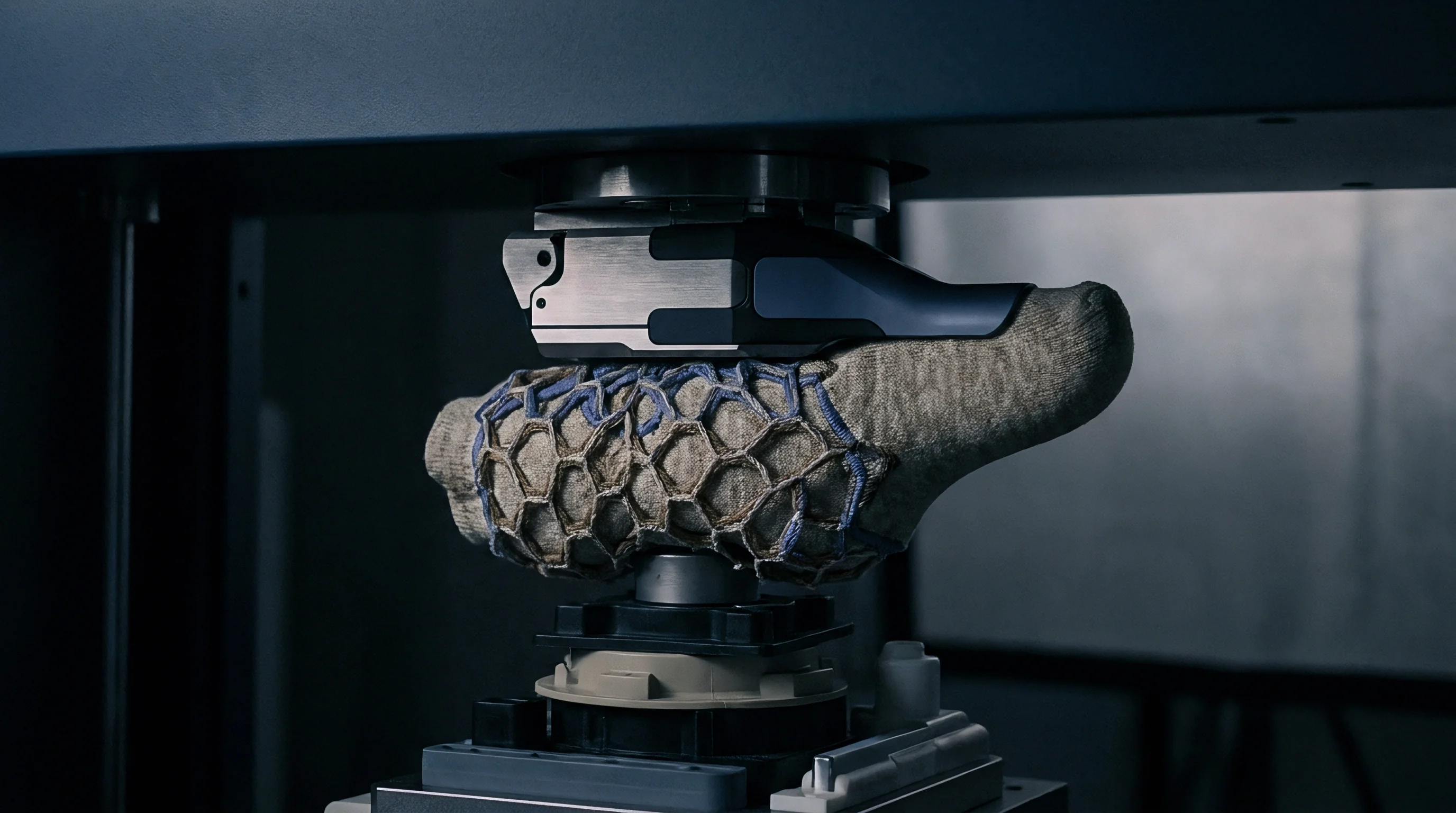
Pick counts per centimeter fluctuate when electronic take-up motion is uneven, directly altering the structural density of unwashed greige fabric. Warp and weft yarns interlock in repeating geometries dictated by the weave pattern. As yarn crimp interchanges during beat-up, thread placement sets the final mass per unit area.
Higher pick counts raise the weft weight ratio, whereas lower pick counts let warp threads straighten, changing overall fabric thickness and aerial weight.
Crimp Interchange Dynamics and Linear Mass Conversion
Calculating expected fabric weight off the loom requires factoring yarn crimp percentages along with nominal yarn counts. Crimp is the percentage by which yarn length exceeds the finished fabric length it occupies. When warp crimp rises, the weft yarn flattens out, lowering weft crimp.
This shift transfers yarn mass from one axis to the other without changing the total mass fed to the loom. Calculating structural mass depends on explicit yarn linear density in tex or Ne, paired with end and pick counts measured under standard tension.
Consider a combed cotton twill running on a high-speed air-jet loom with thirty Ne (nineteen point six eight tex) warp yarn at forty-three ends per centimeter and fifteen Ne (thirty-nine point three seven tex) carded weft yarn at twenty-four picks per centimeter. Off-the-loom warp crimp measures eight point five percent, while weft crimp sits at four point two percent. The basic unwashed mass formula evaluates dry yarn weight per square meter:
Warp Mass = (Ends per cm 100 Tex_warp) / (1000 (1 – Crimp_warp))
Weft Mass = (Picks per cm 100 Tex_weft) / (1000 (1 – Crimp_weft))
Applying these baseline values yields ninety-two point four grams per square meter in the warp and ninety-eight point six grams per square meter in the weft, giving an unwashed greige total of one hundred ninety-one point zero GSM. If electronic take-up hunting drops pick density from twenty-four to twenty-three picks per centimeter over a fifty-meter section, weft mass falls to ninety-four point five GSM, reducing overall fabric weight to one hundred eighty-six point nine GSM.
- Count ends and picks per centimeter with an illuminated counting glass across five distinct zones of the usable cloth width.
- Extract warp and weft yarns from a conditioned ten-by-ten centimeter sample to measure relaxed thread lengths for crimp determination.
- Determine yarn linear density on an analytical balance following ISO 2060 testing protocols.
- Calculate raw yarn mass contributions using crimp-adjusted linear density equations.
- Compare calculated structural mass against physical cut-swatch weight to determine sizing agent load percentages.
Sizing applied during warp preparation adds substantial temporary mass to greige cloth, with pick-up ratios ranging from six percent to fourteen percent of total warp weight based on fiber blend and loom speed. Fluctuations in size box temperature, refractometer solids readings, and squeeze roll pressure produce noticeable weight variations between size sets from the same warping run.
| Weave Pattern | Nominal Greige GSM | Desize Mass Loss (%) | Finishing Overfeed (%) | Target Finished GSM |
|---|---|---|---|---|
| Plain Weave (1/1) | 145.0 | 8.5 | +4.0 | 138.5 |
| Twill (2/1) | 210.0 | 7.2 | +6.5 | 208.0 |
| Satin (4/1) | 285.0 | 6.0 | +8.0 | 291.0 |
| Ripstop (Grid 5mm) | 175.0 | 9.0 | +3.5 | 165.5 |
Whether online ultrasonic thickness sensors can replace physical cut-swatch weighing for real-time pick-density feedback on air-jet looms remains an open question in high-volume production.

Tolerance
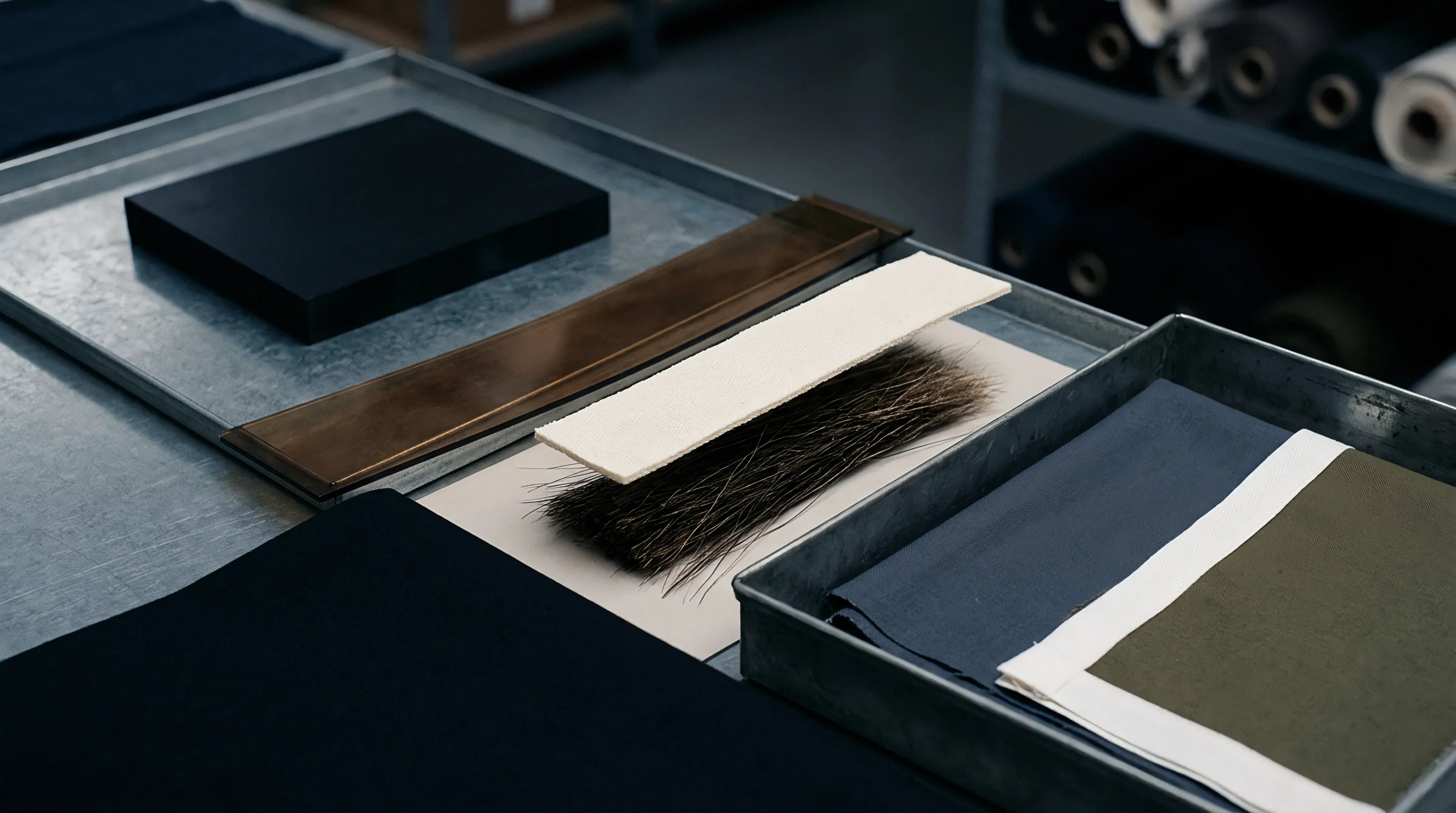
Commercial purchasing contracts quote fabric weight in grams per square meter based on fully conditioned swatches tested in controlled environments. Fluctuating room humidity alters weight readings rapidly. Cotton fibers carry an equilibrium moisture regain of eight point five percent under standard conditions of twenty-one degrees Celsius and sixty-five percent relative humidity, whereas synthetic fibers like polyester hold just zero point four percent.
When inspecting mixed-fiber lots, weighing raw swatches on the mill floor produces misleading results whenever ambient humidity strays from laboratory standards.
Atmospheric Moisture Regain and Dry Weight Determination
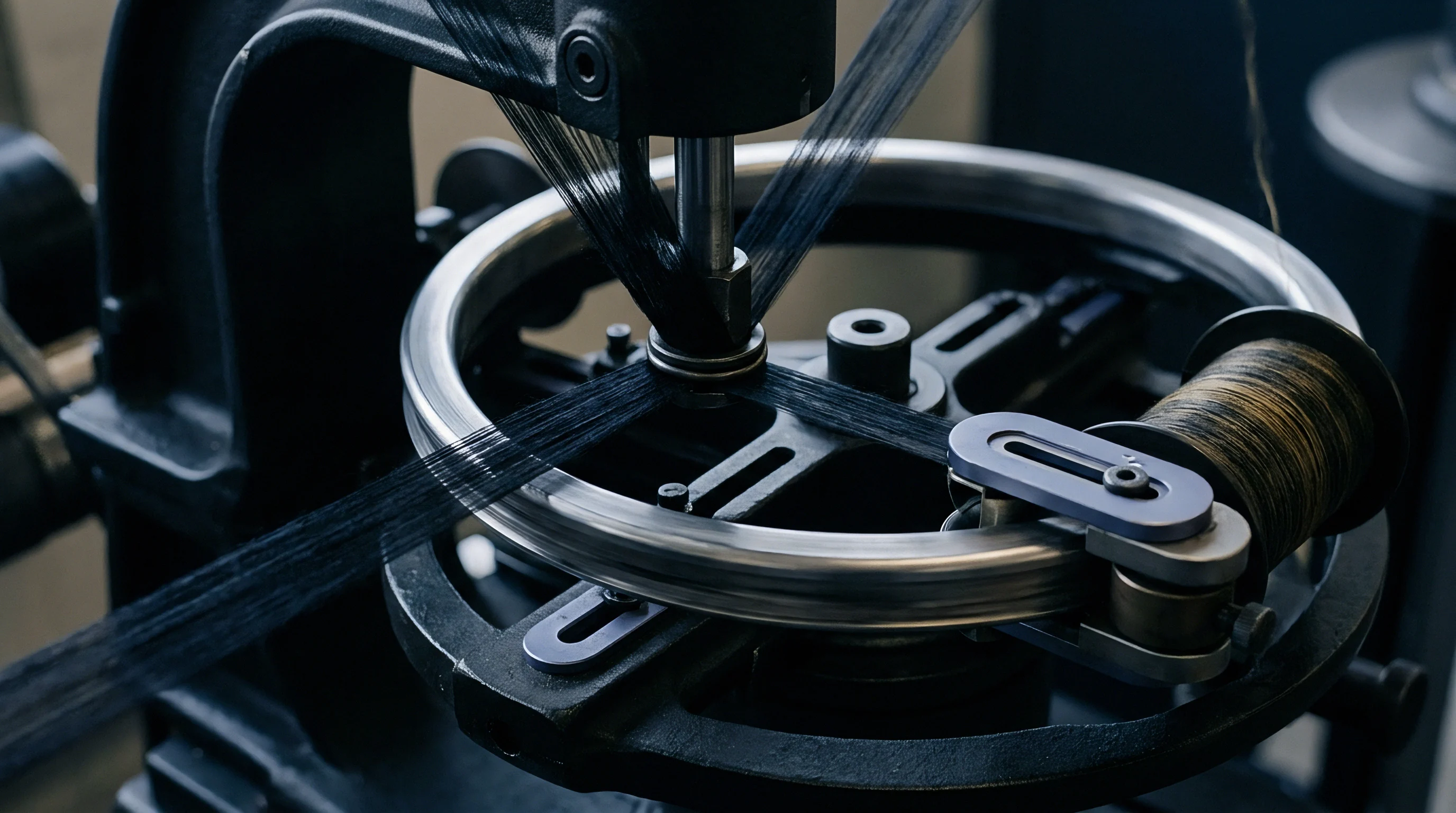
Dry weight testing removes moisture variables by drying samples to constant mass in an oven at one hundred five degrees Celsius. Commercial agreements then calculate conditioned weight by adding standard moisture regain percentages back to the oven-dry weight. ISO 3801 Method 5 outlines the procedure for measuring mass per unit area on small specimens, while ASTM D3776 serves as the main standard across Americas sourcing networks.
Sourcing contracts typically allow mass acceptance bands of plus or minus five percent against nominal target weight. High-speed air-jet weaving aimed at tight tolerances must operate within a narrower three percent margin off the loom to absorb downstream wet-processing variations.
| Standard Designation | Sample Type | Minimum Area Required | Conditioning Time |
|---|---|---|---|
| ISO 3801 Method 5 | Circular Cut Swatch | 100 cm² (11.28 cm diameter) | 4 Hours at 65% RH / 21°C |
| ASTM D3776 Option C | Full Width Roll Strip | Full Width x 1 Meter Length | 24 Hours at 65% RH / 21°C |
| BS EN 12127 | Square Cut Die | 100 cm² (10 x 10 cm) | 16 Hours at 65% RH / 20°C |
| GB/T 4669 | Rectangular Section | 500 cm² | 4 Hours at 65% RH / 20°C |
Testing fabric mass without conditioning for four hours at twenty-one degrees Celsius and sixty-five percent relative humidity invalidates commercial weight claims.
Where specimens are cut from a fabric roll directly affects weight verification. Samples taken within ten centimeters of the selvedge give artificially high GSM values because of edge compaction and heavier selvedge yarns. Technicians cut five circular specimens along a diagonal line across the usable width to determine a reliable average weight.
Accepting bulk shipments without verifying moisture-adjusted dry weight leads to downstream shade variation during continuous dyeing, as denser roll zones absorb less dye liquor per meter.
Stenter
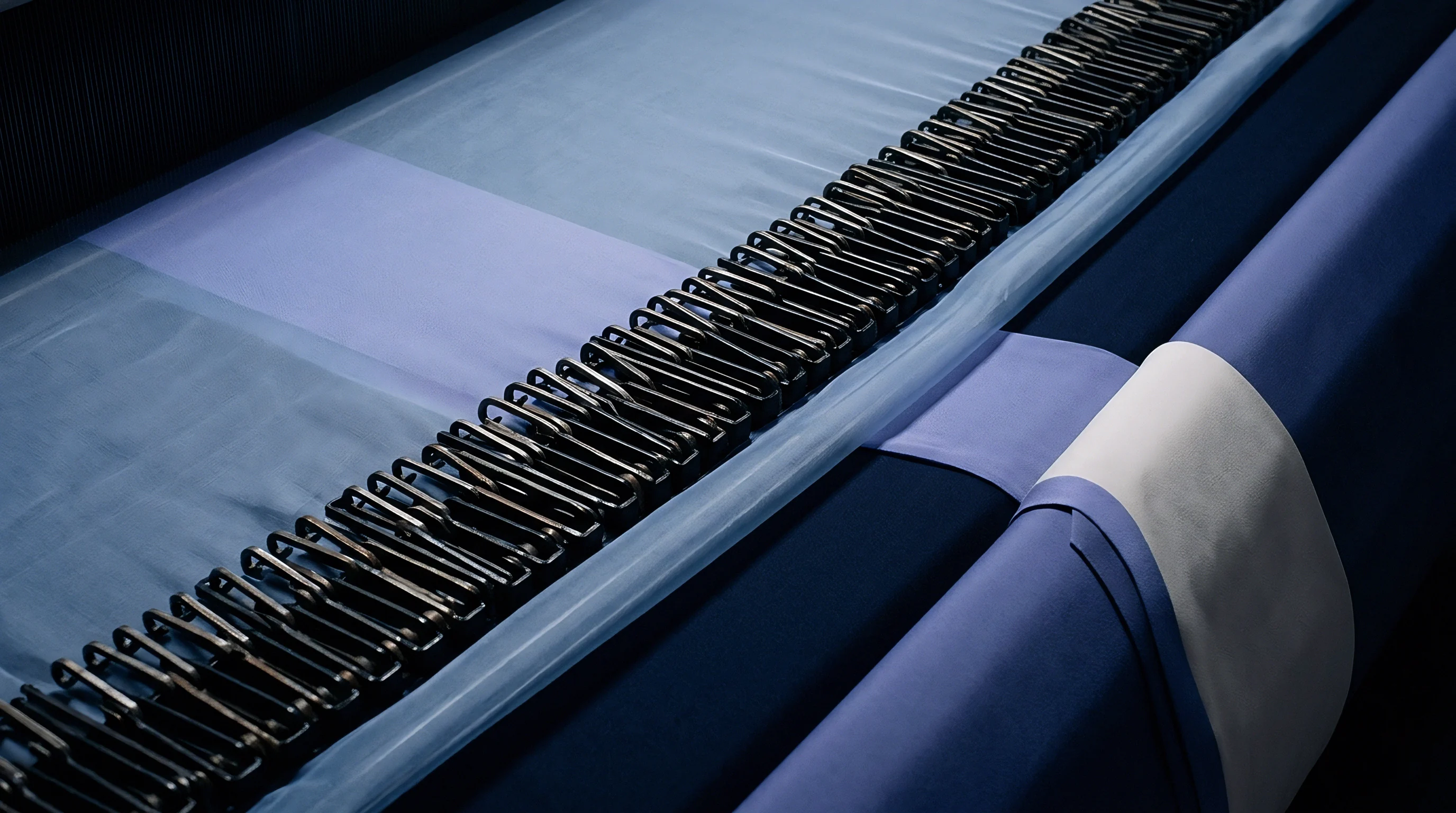
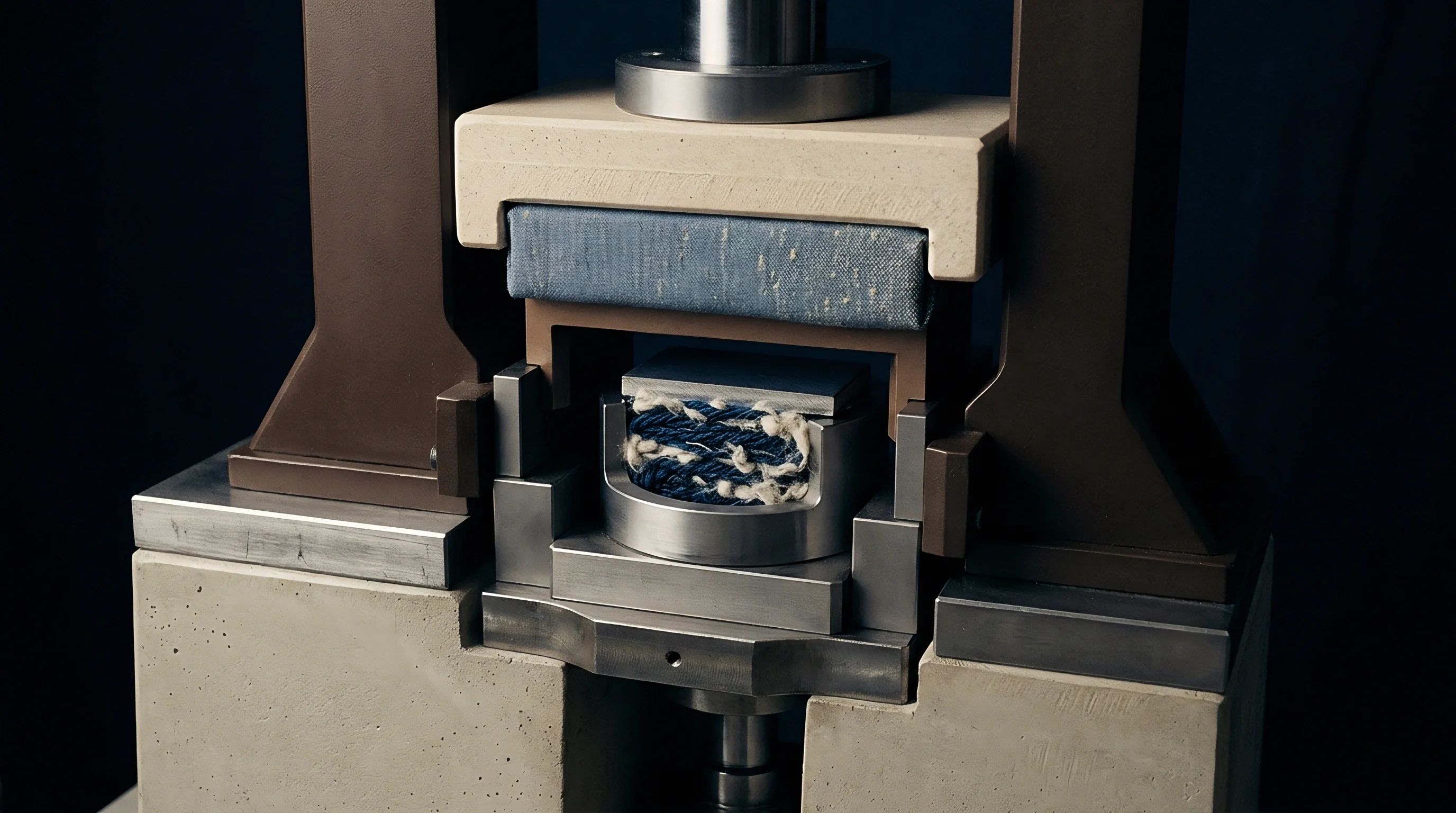
Thermal fixation frames pull off-spec greige material into target dimensions by adjusting overfeed ratios and pin-chain widths during heat setting. Wet-processing plants rely on stenters as the final mechanical control for fabric weight. If loom-state cloth comes out of the weave shed three percent below target GSM, the operator increases overfeed at the entry, pushing extra length into the drying chamber to pack picks together and raise finished weight per square meter.

Overfeed Mechanics and Width Correction
Stenter overfeed mechanisms drive entry pin chains faster than the main chain inside the heating zones, with settings ranging from negative five percent to positive thirty-five percent. Applying ten percent overfeed forces the fabric to contract along the warp axis, increasing pick count per centimeter and boosting unit weight. High gas-fired energy costs across European finishing plants often push operators to run lines faster than ideal dwell times, linking macro energy market swings to incomplete yarn relaxation.
Chemical finishes applied during padding add non-fibrous mass to the cloth. Fluorocarbon water repellents, cross-linking resin softeners, and flame retardants raise fabric weight by two to eight percent depending on dry pick-up. A finished target of two hundred GSM may require a greige weight of only one hundred eighty-eight GSM if substantial resin solids stay in the fiber matrix after curing.
| Greige GSM | Stenter Entry Width | Applied Overfeed (%) | Finished Width | Finished GSM |
|---|---|---|---|---|
| 180.0 | 172 cm | +2.0 | 160 cm | 184.5 |
| 180.0 | 172 cm | +8.0 | 160 cm | 192.0 |
| 180.0 | 172 cm | +14.0 | 160 cm | 199.5 |
| 180.0 | 172 cm | +20.0 | 155 cm | 212.0 |
Stretching woven goods beyond loom reed width to meet nominal fabric weight destabilizes dimensional recovery in subsequent laundering.
Desizing, scouring, and bleaching strip away natural impurities, waxes, and synthetic sizing, reducing raw yarn mass before dyeing. Cotton fabrics lose between six and eleven percent of their greige weight during full preparation. Finishing plants have to account for these losses in initial reed setups; otherwise, stenter operators must over-shrink the fabric lengthwise to hit contract weight, sacrificing garment cutting yield.
Finishing plants that rely purely on heavy mechanical tension to hit target weight inevitably produce goods that shrink excessively when laundered.

Contract
Commercial purchase orders for woven textiles require clear rules for mass variation liability across the supply chain. Fabric weight determines marker yield in apparel production, controlling how many garment panels fit on a lay. If a vertical mill delivers fabric four percent below target GSM, cut components lack expected body and drape.
Conversely, fabric arriving five percent overweight reduces linear yield per roll, adding freight costs and altering thermal performance in technical outerwear.

Roll Mass Distribution and Cutting Room Yields
Weight variations between rolls in the same dye lot disrupt automated spreading and cutting. High-speed spreading tables experience tension spikes when handling dense, overweight rolls compared to lighter rolls from the same production run. Sportswear specifications mandate tight cut-piece weight tolerances to prevent performance variations between garment sizes.
A four percent drop in finished fabric weight reduces garment yield by three hundred cut pieces per ten thousand meters of marker length.
Brands structure quality agreements around statistical sampling using standard four-point inspection frameworks. Weight verification is a required step during roll audits, and individual rolls outside agreed tolerances face rejection or price adjustments.
- Unwashed Mass Verification requires testing swatches directly from loom beams before sending greige fabric to commission dyehouses.
- Conditioned Weight Acceptance caps lot-average GSM variations at plus or minus two point five percent of target order weights.
- Moisture Allowance Fixation mandates oven-dry weight testing for high-regain cellulosic blends to avoid paying for water weight.
- Width-Weight Decoupling prevents converters from heat-stretching fabric to reach width targets at the expense of minimum unit weight.
Including a moisture-regain correction clause in mill purchase terms puts financial responsibility for inflated weight back on the finishing plant.