Heterobifunctional Reactive Dye Fixation Control across Continuous Pad Ranges
Heterobifunctional reactive dye control demands dual-stage pH management, tight nip pickup tolerances, and rapid saturated steaming to maximize fixation yield.

Kinetics
Dual-Group Chemical Reactivity Mechanisms
Dual-functional reactive molecules integrate a monochlorotriazine ring and an aliphatic beta-sulfatoethylsulfone group onto a single chromophore backbone, with each site reacting via a distinct pathway in alkaline media. At elevated temperatures, the monochlorotriazine ring undergoes nucleophilic substitution, displacing its chlorine atom with a cellulosate anion from the cotton fiber. Under alkaline conditions, the beta-sulfatoethylsulfone precursor undergoes elimination to generate an active vinyl sulfone group, which then binds to cellulosic hydroxyl groups through nucleophilic addition across the double bond.
Fixation kinetics differ markedly between the two functional groups across the thermal and pH profiles of a continuous pad line. Vinyl sulfone groups form covalent bonds with cellulose between 60°C and 70°C at pH 10.5 to 11.2. Monochlorotriazine groups are less reactive, requiring 80°C to 85°C and a higher pH window of 11.5 to 12.0 to achieve peak fixation.
Equilibrium fixation yields on continuous pad lines reflect the competing rates of covalent dye-fiber bonding and pad liquor hydrolysis. Hydrolysis inactivates the dye by converting chlorotriazines to hydroxy-triazines and vinyl sulfones to 2-hydroxyethylsulfones; once hydrolyzed, the dye loses fiber affinity and remains in the liquid film as unfixed residue that requires thorough wash-off. Heterobifunctional dyes balance these competing kinetics, raising overall fixation yield to 85 percent compared with the 60 to 70 percent typical of single-anchor monofunctional structures.
ISO 105-C06 test standards reject bulk lots when unreacted dye residues stain adjacent multi-fiber swatches past grade 4.
Competitive Hydrolysis and Fixation Kinetics
Fixation yield in continuous padding depends directly on dye bath stability. As soon as alkali enters the liquor, trough hydrolysis begins, accelerating exponentially with higher temperature and pH. Continuous pad-dry-steam or pad-thermofix lines running heterobifunctional dyes therefore keep pad trough liquor below 25°C to suppress premature hydrolysis before wet pick-up.
| Reactive Group Structure | Fixation Mechanism | Optimum Fixation Temp (°C) | Optimum pH Window | Fixation Yield Range (%) |
|---|---|---|---|---|
| Monochlorotriazine (MCT) | Nucleophilic Substitution | 80 – 85 | 11.5 – 12.0 | 62 – 70 |
| Vinyl Sulfone (VS) | Nucleophilic Addition | 60 – 65 | 10.5 – 11.0 | 68 – 75 |
| Heterobifunctional (MCT/VS) | Substitution + Addition | 70 – 80 | 10.8 – 11.2 | 82 – 90 |
Activating both reactive centers simultaneously makes shade depth far less sensitive to thermal fluctuations in the continuous steamer. Should steam temperatures dip slightly below target, the vinyl sulfone group maintains overall fixation; if residence time extends, the monochlorotriazine group finishes bonding. Balancing the two reaction pathways ensures consistent shade yield across long runs.
How fluctuating ambient humidity inside high-speed pad enclosures affects initial hydrolysis rates prior to the infrared pre-dryer remains an open operational question.
Pad
Liquor Application and Wet Pick-Up Dynamics
Nip pressure uniformity across the horizontal roll face governs how much liquor remains within the advancing yarn structure. Continuous pad ranges apply heterobifunctional dyes using resilient rubber bowls designed to maintain consistent loading across the full web width. Target wet pick-up for 100 percent combed cotton wovens spans 55 percent to 65 percent of dry fabric weight: tight or heavy constructions require higher nip pressures to force dye into high-twist yarn cores, while open weaves need lighter squeezing to prevent edge buildup and expression marks.
Pneumatic loading causes rubber bowls to deflect across their crown, concentrating pressure at the selvedges and lightening it through the middle. Variable-frequency deflection control systems adjust internal hydraulic pressure to equalize squeeze force across the entire roll face, preventing the center-to-selvedge shade variations (listing) that occur when uneven wet pick-up alters local dye mass per unit area.
Continuous padders rely on low-volume troughs holding 10 to 15 liters ~ often fitted with internal displacement blocks ~ to accelerate bath renewal. Running at speeds between 40 and 60 meters per minute replaces the total liquor volume every 2 to 4 minutes. This rapid turnover prevents chemical depletion and suppresses tailing, where high dye substantivity otherwise causes progressive shade drift from the head to the tail of a production lot.
Nip Non-Uniformity and Tailing Failure Modes
Improper pad configuration or poor mechanical maintenance creates physical defects that compromise shade levelness before thermal drying takes place.
- Bowl Surface Abrasion circumferential grooves on squeeze rolls produce continuous longitudinal streaks along the running fabric web.
- Differential Substantivity high affinity causes selective tailing when the lead fabric absorbs dye faster than incoming feed liquor replenishes the trough.
- Pneumatic Asymmetry unbalanced load cylinders between the drive and operator sides create broad side-to-side shade gradients across the web width.
- Temperature Spikes uncooled pad troughs allow bath temperatures to climb, triggering premature vinyl sulfone hydrolysis and shade loss on extended runs.
Adjusting nip squeeze settings maintains consistent liquor application as line speeds change.
Maintaining pad trough volume below three minutes of fabric consumption preserves uniform shade across forty thousand meters of continuous production.

Steam
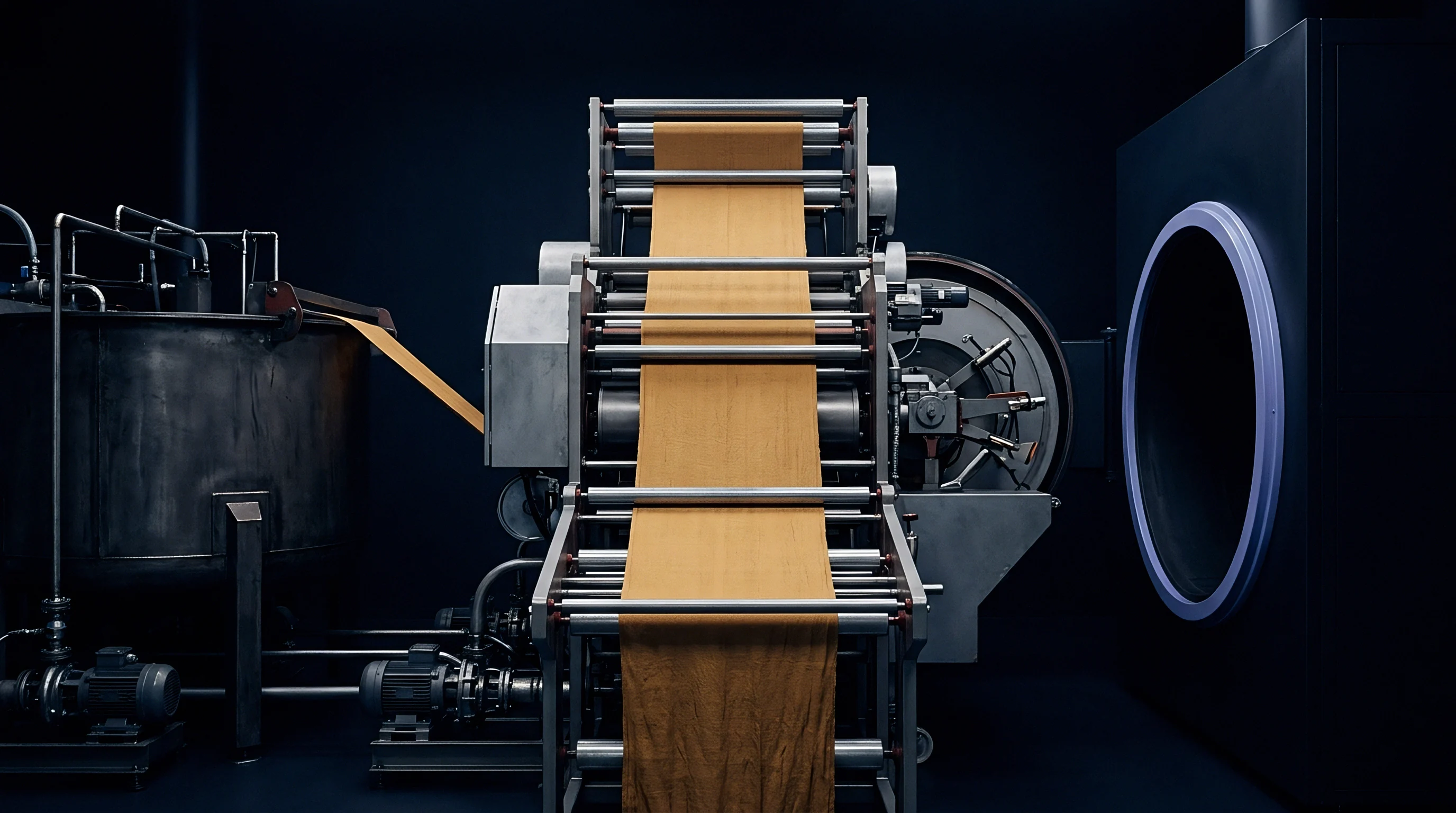
Intermediate Drying and Thermal Fixation Energy
Heat transfer during intermediate drying determines whether unfixed dye remains distributed in the fiber core or migrates toward the surface. Upon exiting the nip, the wet web passes through a non-contact infrared pre-dryer to lower moisture content from 60 percent to between 25 and 30 percent. Equal evaporation from both fabric faces is essential; uneven heating pulls dissolved dye toward the hotter side, creating front-to-back shade two-sidedness.
Adding polyacrylate or sodium alginate anti-migration agents to the pad liquor at 10 g/L to 20 g/L raises liquid viscosity as water evaporates, locking dye particles within capillary inter-yarn spaces before the web enters the hot-flue air dryer. The fabric leaves the hot flue at a uniform residual moisture level of 2 to 4 percent before entering the steamer or thermofixing chamber.
Continuous range operation dictates that moisture migration pre-dryer controls must hold web evaporation balance within two percent side-to-side variance.
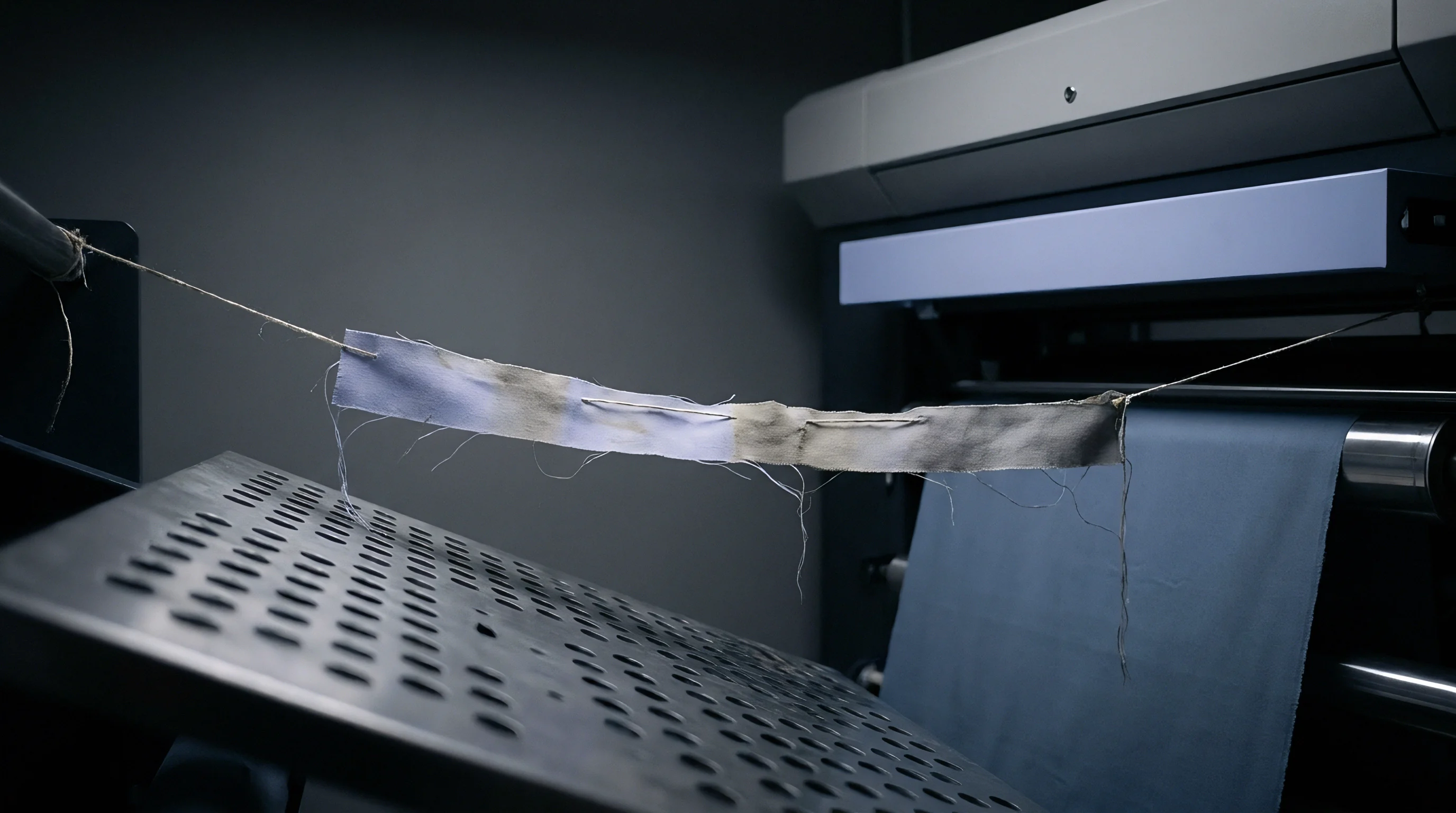
Thermofixation Parameters and Mass Energy Balance
Continuous steamers supply saturated steam at 100°C to 102°C to swell the cellulose matrix and speed dye diffusion. As saturated steam condenses onto the dry fabric, it releases latent heat that brings the web temperature to 100°C in seconds. Moisture absorption expands the fiber pore structure, allowing activated monochlorotriazine and vinyl sulfone molecules to migrate into the amorphous regions of the cotton.
Air leaks into the steamer chest dilute steam purity, cutting heat transfer rates and causing shade variation. Maintaining positive steam pressure excludes oxygen, preventing thermal reduction of the dye chromophores at elevated processing temperatures.
On a continuous pad-dry-steam line processing 220 g/m² cotton twill at 50 meters per minute across a 1.6-meter width, dry fabric throughput equals 17.6 kilograms per minute. Applying alkali-dye liquor at 60 percent wet pick-up introduces 10.56 kilograms of water per minute into the drying zone.
The infrared pre-dryer evaporates 55 percent of this water load, removing 5.81 kilograms of moisture per minute via electrical emitters. At a latent heat of vaporization of 2,260 kilojoules per kilogram, effective power delivery to the web in the IR zone reaches 218.8 kilowatts, excluding exhaust losses. The remaining 4.75 kilograms of water per minute flows into the hot-flue section, exiting at a target moisture content of 3 percent before entering the 102°C steam chamber for a 75-second dwell.
If steam temperature drops below 100°C or dwell time falls below 60 seconds, unreacted monochlorotriazine groups fail to complete covalent bonding, dropping fastness performance by over 1.5 gray scale grades and causing lot rejection.
Dosage
Continuous Dosing Unit Architecture
Dosing alkali separately from the color bath prevents premature hydrolysis before the fabric enters the nip. Continuous range dosing systems use dual-circuit metering pumps to feed concentrated alkali and dye solutions from separate stock tanks into a low-volume static mixer just ahead of the pad trough inlet. Proportional dosing controls maintain a fixed volumetric ratio ~ typically 4 parts dye solution to 1 part alkali ~ across varying line speeds.
Silicate-free alkali formulations combine sodium carbonate (soda ash) and liquid sodium hydroxide (caustic soda) to reach the target pH without leaving insoluble scale on pad rolls or steamer rollers. While liquid sodium silicate provides strong buffering at pH 12.0, incomplete wash-off leaves scale deposit issues, equipment cleanout difficulties, and a harsh fabric hand.
| Alkali System Type | Chemical Composition & Ratio | Target Bath pH | Substantivity Effect | Fixation Efficiency (%) |
|---|---|---|---|---|
| Mixed Alkali (Sodium Hydroxide / Carbonate) | NaOH 38°Bé (3-5 g/L) + Na2CO3 (20 g/L) | 10.8 – 11.2 | Moderate | 84 – 88 |
| Sodium Carbonate Only | Na2CO3 (20-30 g/L) | 10.5 – 10.8 | Low | 78 – 82 |
| Sodium Silicate Modified | Na2SiO3 38°Bé (50 mL/L) + NaOH (5 g/L) | 11.8 – 12.2 | High | 86 – 90 |
Using demineralized water prevents calcium and magnesium precipitation, which would otherwise consume active carbonate ions and shift the pad bath pH outside the fixation window.
Pad bath pH measurements taken at twenty-minute intervals across a continuous run must fall within a tolerance band of plus or minus 0.15 pH units.
Sequential Calibration Protocol for Continuous Dosing Systems
Maintaining stable chemical delivery across long production runs demands strict adherence to sequential setup procedures.
- Calibrate volumetric stroke rates on dye and alkali metering pumps using calibrated sight glasses under simulated backpressure.
- Verify stock liquor concentrations by refractive index or density measurement prior to releasing chemical batches to the supply tanks.
- Monitor internal differential pressure across the static mixer to identify partial blockages or crystallization before shade variation develops.
- Measure the pH and temperature of mixed liquor at the pad trough feed manifold every thirty minutes during production.
- Check wet pick-up across the left, center, and right sections of the web immediately following line speed adjustments.
Shade tailing over 20,000 meters can originate from variation in gray cloth absorbency rather than volumetric metering pump drift inside the dosing unit.
Ledger
Wash-Off Efficiency and Fastness Metrics
Commercial acceptance of continuous dyeing depends on fastness verification and wash-off efficiency. Unfixed heterobifunctional dye remaining in the swollen cellulose matrix after steaming must be fully extracted to meet fastness requirements. Continuous wash-off ranges use 8 to 10 counter-current wash boxes with cascading temperature profiles, beginning with cold rinses to clear residual alkali, moving to 95°C hot washes with chelating agents to extract hydrolyzed dye, and ending with neutral cold rinses.
Incomplete removal of hydrolyzed vinyl sulfone dye results in poor wet fastness, particularly under ISO 105-C06 C2S laundering and ISO 105-E04 perspiration tests. Adding chelating agents prevents divalent metal ions from complexing with hydrolyzed dye, keeping dissolved chromophores suspended in the wash liquor so they flush to the effluent discharge.
| Wash-Off Stage Profile | Water Temp (°C) | Chemical Auxiliaries Added | Residual Dye on Web (%) | ISO 105-C06 Staining Rating |
|---|---|---|---|---|
| Box 1-2: Cold Rinse | 30 – 40 | Overflow Water Only | 12.0 – 15.0 | Grade 2-3 |
| Box 3-4: Neutralization | 50 – 60 | Acetic Acid (1-2 g/L) | 6.0 – 8.0 | Grade 3 |
| Box 5-7: Hot Extraction | 95 – 98 | Polymeric Washing Agent (1 g/L) | 0.5 – 1.2 | Grade 4-5 |
| Box 8: Final Rinse | 40 – 50 | Softener / Core Neutralizer | < 0.2 | Grade 5 |
Washing efficiency directly dictates total landed cost per finished meter through its control of water, steam, and auxiliary chemical consumption across the wash range.

Buyer Qualification Checklist for Dyeing Specifications
Verification protocols built into master purchase contracts establish clear acceptance thresholds before bulk goods leave the finishing mill floor.
- Fastness Testing Compliance ISO 105-C06 C2S washing fastness and ISO 105-X12 dry/wet rubbing fastness results must accompany each shade lot dossier.
- Center-to-Selvedge Spectrophotometry DEcmc color difference between left, center, and right swatches cannot exceed 0.6 units under D65 and TL84 illuminants.
- Fixation Yield Verification total unfixed dye extracted from bulk production swatches must measure below 0.3 percent of total dry fiber mass.
- Effluent COD Limits chemical oxygen demand in wash-off effluent must pass local environmental discharge standards without secondary penalty surcharges.
Tightening environmental regulations on wastewater discharge force dyehouses to optimize wash ranges for maximum dye recovery.
Standard purchase specifications dictate that shade variations exceeding DEcmc 0.8 against the approved buyer master sample grant the buyer full right to reject the shipment or apply a 15 percent invoice debit.