Mechanical Volumetric Dosing Calibration for Continuous Pad-Dyeing Lines
Mechanical volumetric dosing calibration requires gravimetric mass verification within 1.5 percent pump stroke tolerance to prevent shade tailing in pad dyeing.

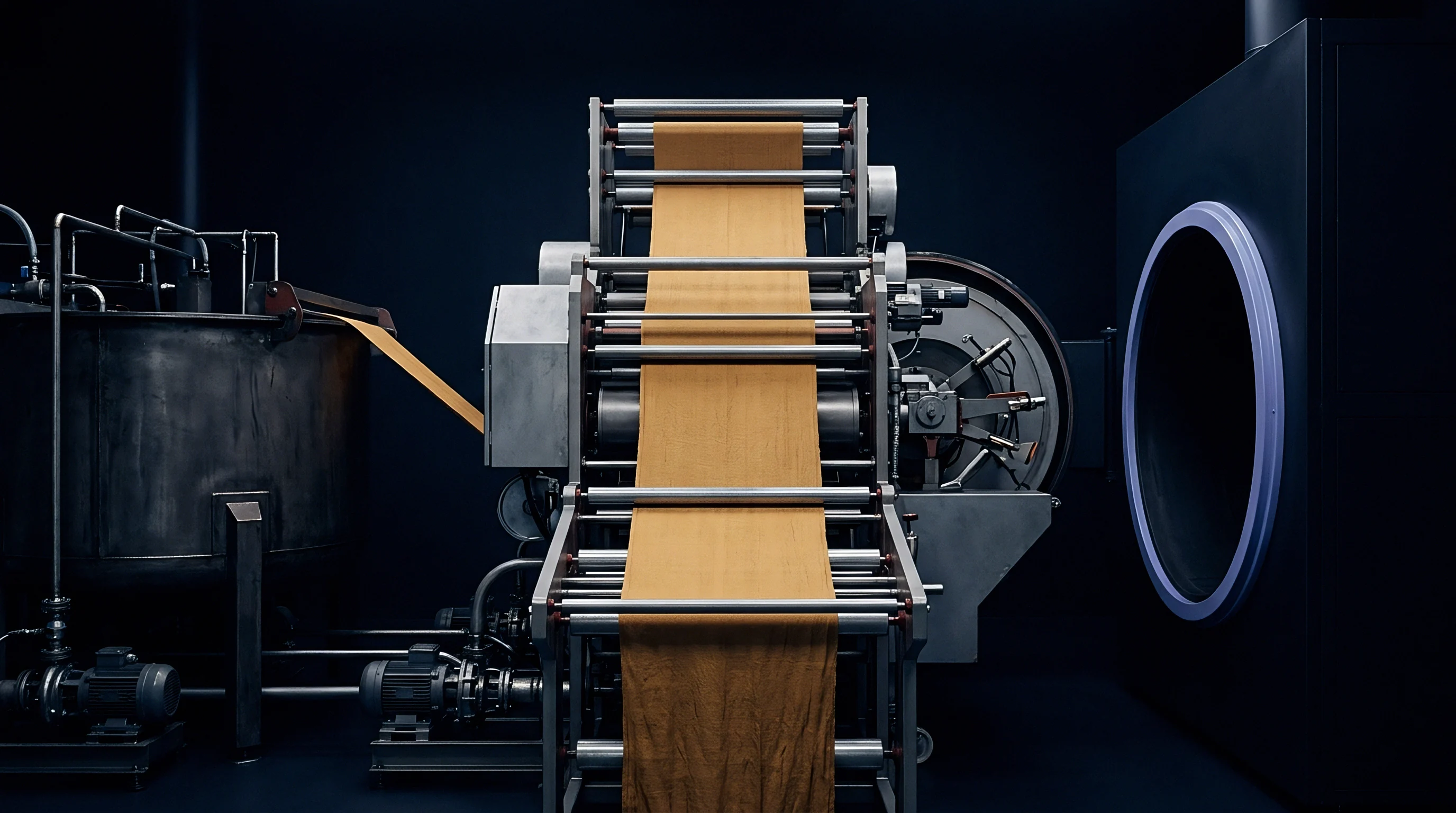
Trough
Continuous pad-dyeing depends on keeping liquor volume and chemical concentration stable inside the pad trough. Minute volumetric shifts in dye concentrate or alkali feed will drift shade fastness across thousands of metres. Fabric passing through the padder continuously absorbs and displaces liquid, driven by line speed, substrate construction, and targeted wet pick-up percentages.
If dosing pumps fall out of sync with fabric extraction, the fluid level inside the trough moves, altering dwell time and triggering reactive dye hydrolysis.
Mechanical volumetric dosing units prevent this drift by metering concentrate and auxiliary chemicals into a low-volume mixing head right before the trough. Most continuous troughs hold between 5 and 15 litres to keep dwell times brief. That tight window prevents dye molecules and alkali solutions from reacting before the nip squeeze locks liquid into the yarn.
Running a 200 grams per square metre fabric at 40 metres per minute with a target wet pick-up of 70 percent pulls 5.6 litres of liquor out of the trough every minute. At that rate, a dosing drop of just 0.2 litres per minute shifts trough fluid volume by more than 30 percent across a ten-minute production window.
| Fabric Weight (g/m²) | Line Speed (m/min) | Target Wet Pick-Up (%) | Liquor Consumption (L/min) | Trough Volume (L) | Liquor Replacement Time (s) |
|---|---|---|---|---|---|
| 120 | 60 | 60 | 4.32 | 8.0 | 111 |
| 200 | 45 | 65 | 5.85 | 8.0 | 82 |
| 280 | 35 | 70 | 6.86 | 6.5 | 57 |
| 350 | 25 | 75 | 6.56 | 6.5 | 59 |
Maintaining fluid dynamic balance requires tight mechanical calibration. Dosing units have to match consumption cleanly, without creating turbulence, foam, or localized concentration gradients inside the box. Stroke length adjusters and variable-speed drives set displacement per cycle.
Higher line speeds leave less margin for error, as fast consumption demands immediate pump response so the pad nip never runs dry.
Liquor depletion in the pad trough alters immersion length and pneumatic squeeze pressure transmission, distorting shade depth across long production runs.
Uncalibrated pumps create systematic shade banding down the fabric roll. If alkali feed drops relative to dye concentrate, fixation falls off and leaves light tailing end-to-end. Too much alkali accelerates hydrolysis in the bath, producing unreactive hydrolysed dye that washes out during rinsing and wastes raw material.
The financial loss mounts unnoticed across multi-thousand-metre production lots until laboratory spectrophotometers check the finished rolls.
Piston
Positive displacement piston pumps form the core of continuous dosing installations. Each stroke draws a set volume of fluid through an inlet check valve into the chamber, then pushes it through a discharge valve into the manifold. Turning the micrometer stroke adjustment alters the travel distance of the piston inside the cylinder, setting volumetric output per cycle.
Delivery accuracy depends entirely on seal integrity, fluid viscosity, and stable backpressure.
Worn internal seals allow micro-leakage back into the pump housing, pulling actual displacement below theoretical stroke volume. High-viscosity dye solutions and thickened pad-batch formulas add resistance across check valves, introducing seating lags that drop volumetric efficiency below 95 percent. Mechanical backpressure valves on discharge lines hold a steady counter-pressure ~ typically between 0.5 and 1.5 bar ~ to stop fluid from siphoning when supply tanks sit above the pad trough inlet.
- System Flushing Run demineralized water through the cylinder, suction lines, and delivery manifold to clear air bubbles, debris, and residual chemical deposits from check valve seats.
- Backpressure Verification Set the downstream pressure relief valve to the line sheet operating pressure using an inline gauge right after the pump outlet.
- Stroke Calibration Setup Turn the mechanical stroke control knob to 100 percent capacity while the pump is off, then secure the locking collar to stop vibration drift.
- Volumetric Catch Sampling Divert the discharge line into a calibrated Class A glass volumetric cylinder, start the pump, and catch output for exactly 60 seconds measured with a digital stopwatch.
- Linearity Multi-Point Check Repeat the catch procedure at 75 percent, 50 percent, and 25 percent stroke settings, recording displaced volumes to check linearity across the full operating range.
- Micrometer Collar Locking Lock the mechanical adjustment at the calculated target stroke setting and fit tamper-evident seals to block unauthorized adjustment during production runs.
Fluctuating pressure deforms flexible piston seals, compressing them under load and reducing effective stroke displacement. Combining hard ceramic pistons with chemical-resistant polytetrafluoroethylene seals maintains dimensional stability against manifold pressure spikes, preserving tight tolerances during continuous operation.
Check valves introduce another common failure mode. Dye solids crusting on ball valve seats stop the valve from closing completely during compression. Fluid leaks back into the suction line, cutting delivered volume while the mechanical stroke counter still logs full displacement.
Operators frequently blame shade lightness on weak dye batches when poor valve seating is actually starving the trough.

Proportion
Continuous reactive dyeing relies on exact proportional mixing between dye liquor and alkali chemistry. Standard recipes use a 4:1 volumetric ratio ~ four parts concentrated dye solution to one part liquid alkali containing sodium hydroxide and sodium carbonate. Mechanical dosing feeds these two streams through an inline static mixer placed centimeters from the trough inlet.
Off-ratio proportioning disrupts the chemical balance required to form covalent bonds between dye molecules and cellulose fibers.

How Does Backpressure Shift Metering Accuracy during Long Runs?
Pressure shifts across delivery piping alter relative flow rates between dosing heads linked to a shared drive shaft. If the dye liquor is thicker than the alkali solution, the more viscous stream encounters greater resistance in the pipe. That pump head suffers more internal fluid slip, while the thinner alkali stream maintains high volumetric efficiency.
This differential slip pulls the active ratio from 4:1 down to 3.7:1, raising alkali concentration in the feed and accelerating bath hydrolysis.
Automated loops use integrated flow meters to monitor real-time discharge. Magnetic inductive units track volumetric flow without internal restrictions or moving parts that might clog on dye solids. When a meter detects a gap between target displacement and measured delivery, the control loop adjusts variable-speed pump drives to maintain ratio.
Systems without electronic feedback depend entirely on static volumetric calibrations completed before line startup.
- Viscosity Differential Slip Higher internal bypass inside dye pump heads handling viscous formulas shifts the target 4:1 dye-to-alkali ratio off spec.
- Check Valve Sedimentation Particulate buildup on valve seats allows backflow, cutting dye delivery relative to a steady alkali flow.
- Supply Line Air Entrainment Micro-bubbles pulled through loose suction fittings compress during the stroke, starving liquid volume without tripping motor alarms.
- Pneumatic Manifold Fluctuation Pressure drops across pneumatic diaphragm units cause irregular pulsing, creating localized concentration spikes inside the mixing head.
Side-to-center shade variation across the web often stems from incomplete inline mixing. When a static mixer fails to generate sufficient turbulence, unmixed streaks of dye concentrate and alkali enter opposite sides of the trough. The edge getting excess alkali fixes dye too fast, creating a dark selvage, while the under-dosed side stays light.
Thorough mechanical dispersion in the mixing manifold eliminates these concentration gradients before liquid touches the trough roll.
Standard fastness evaluations under ISO 105-C06 reveal color transfer failure when deficient alkali dosing leaves unattached reactive dye inside the fiber core.
Incorrect alkali proportions leave unfixed dye deep in the fiber matrix. Cloth may hit target shade depth straight out of the dryer, only to fail wash-fastness testing later. The expense of re-handling off-shade goods quickly outstrips the cost of installing dual-head mechanical dosing pumps.

Gravimetry
Relying solely on glass flasks for volumetric calibration invites temperature and meniscus reading errors. Liquid density shifts with ambient dyehouse temperature, altering the true mass delivered per unit volume. Gravimetric calibration replaces visual estimates with mass readings taken on analytical balances, accounting for density shifts to establish exact mass flow rates over time.
Running a gravimetric calibration protocol starts with finding the density of every liquid in the formulation. Sample mass is measured in a calibrated 100-millilitre pycnometer at ambient dyehouse temperature. Dividing that mass by volume gives exact fluid density in grams per cubic centimetre.
During the run, the pump discharges into a tare container on a balance sensitive to 0.01 grams. Dividing total mass by fluid density yields true volumetric displacement for that stroke count.
| Target Flow Rate (L/min) | Calibration Duration (s) | Minimum Target Mass (g) | Balance Resolution (g) | Max Allowable Mass Error (%) | Max Permissible Volumetric Drift (mL) |
|---|---|---|---|---|---|
| 0.50 | 60 | 500.0 | 0.01 | ± 0.5 | ± 2.50 |
| 1.50 | 60 | 1500.0 | 0.05 | ± 0.5 | ± 7.50 |
| 3.00 | 60 | 3000.0 | 0.10 | ± 0.3 | ± 9.00 |
| 6.00 | 30 | 3000.0 | 0.10 | ± 0.3 | ± 9.00 |
Air drafts, floor vibration, and balance drift can throw off gravimetric testing on active finishing lines. Calibration setups need isolated anti-vibration bases, placed away from stenter exhaust fans and pneumatic drives. Collection vessels require narrow necks or oil seals to stop evaporation during timed tests.
Losing just a few grams to evaporation produces a false low reading, leading operators to over-adjust stroke controls.
Density calculations missing ambient fluid temperature corrections miscalculate actual volumetric pump output by several millilitres per minute.
Gravimetric verification provides the baseline for mass balance across continuous lines. A pump setting that looks accurate in a glass cylinder frequently misses mass tolerances under dynamic line testing. Setting strict mass acceptance windows protects production from subtle shade drift.
Mechanical calibration logs should record density, room temperature, collected mass, elapsed time, and stroke settings. Connecting digital balances to logging software eliminates manual entry errors and builds a reliable displacement curve for each pump head across its full operating range.
Tolerance
Linking volumetric dosing errors to shade variation requires color difference modeling. Spectrophotometers quantify color shifts as Delta E values under CIELAB standards. On woven cotton, dye yield scales linearly with concentration until the fiber reaches saturation.
Error propagation models show how minor stroke variations translate directly into unacceptable shade off-cuts.
Take a continuous run on 200 g/m² woven cotton at 40 metres per minute. With wet pick-up set at 65 percent, total liquor application reaches 5.20 litres per minute. The recipe specifies 30.0 grams per litre of Reactive Blue 19 and 10.0 grams per litre of liquid alkali, fed through a 4:1 dosing pump layout.
That puts target dye delivery at 156.0 grams of concentrate per minute. If piston wear creates a negative 3.5 percent volumetric error on the dye head, actual dye feed drops to 150.54 grams per minute.
That drops trough concentration from 30.0 grams per litre to 28.95 grams per litre. Assuming a linear yield where a 1.0 percent drop in bath concentration shifts CIELAB Delta E by 0.25 units, this 3.5 percent volumetric deficit generates a Delta E of 0.88. Commercial fabric contracts typically cap shade deviation at Delta E 0.50 against the primary lab dip under illuminant D65.
| Dosing Error (%) | Actual Dye Conc. (g/L) | Fabric Pick-Up (%) | Dyestuff on Fabric (g/m²) | Calculated Delta E (CIELAB) | Pass/Fail Status (Tolerance 0.50) |
|---|---|---|---|---|---|
| 0.00 | 30.00 | 65.0 | 3.900 | 0.00 | Pass |
| – 1.00 | 29.70 | 65.0 | 3.861 | 0.25 | Pass |
| – 2.00 | 29.40 | 65.0 | 3.822 | 0.50 | Pass Boundary |
| – 3.00 | 29.10 | 65.0 | 3.783 | 0.75 | Fail |
| – 5.00 | 28.50 | 65.0 | 3.705 | 1.25 | Fail |
The matrix shows that pump delivery errors cannot exceed 2.0 percent without breaching commercial shade limits. When combined with normal variations in fabric absorbency or nip bowl pneumatic pressure, the allowable margin for pump error shrinks below 1.0 percent displacement deviation. Uncalibrated commercial dosing pumps typically drift between 3.0 and 5.0 percent over three months of operation.
Specifying ISO 105-J03 color difference evaluation in supply contracts holds mills to tight maintenance schedules. If an audit shows a mill cannot produce calibration logs proving dosing accuracy within a 1.5 percent tolerance window, the buyer has grounds to reject the production lot before garment cutting.

Discharge
Auditing a continuous pad line requires checking delivery hardware from supply tanks to the discharge manifold. Technical auditors inspect pump mounting rigidity, pipe dampening clamps, valve seat wear, and flow meter integration. Loose suction lines draw micro-air bubbles that reduce stroke volume without leaking liquid, while worn spring check valves permit cross-contamination between dye and alkali circuits during line stops.
A rigorous audit enforces compliance through documented verification. Technical dossiers need dated calibration curves for every dosing head on continuous lines, backed by raw gravimetric test sheets. Operating without fixed calibration schedules leaves mills exposed to severe rejections when bulk lots fail shade uniformity or fastness tests at destination ports.
- Pump Calibration Dossier Master maintenance records detailing stroke linearity, volumetric discharge rates, density correction factors, and seal replacement history for each dosing head.
- Inline Flow Meter Certificates Factory test data verifying electromagnetic flow meter accuracy within ± 0.2 percent of full scale across operating ranges.
- Standard Operating Procedures Written protocols covering pre-run flushing, backpressure valve settings, and gravimetric check intervals.
- Log of Mechanical Deviations Incident logs covering seal failures, valve clogging, emergency line stops, and resulting shade corrections made during production.
Verification has to extend to the chemical supply interface. Bulk storage tanks need to maintain constant head pressure using overflow loops or regulated nitrogen blankets. Fluctuating supply head alters suction pressure at the pump inlet, disrupting valve dynamics and throwing off calibrated displacement.
Consistent shade match across multi-thousand-metre orders requires connecting mechanical maintenance directly to dyehouse process control. Specifying explicit volumetric calibration protocols in manufacturing contracts removes the primary cause of shade variation before production ever starts.