Aerodynamic Boundary Layer Stabilization in Gravity Sorters
Laminar deck boundary stabilization stops eddy entrapment, cutting fibre loss below two percent while purging dense shives from classified spinning stock.

Deck
Oscillating inclined screens separate mechanically gathered staple from heavy botanical trash through pneumatic fluidization. The sorting surface operates on a continuous slope between two and eight degrees from horizontal, driven by an eccentric cam rotating between 350 and 650 cycles per minute. Uncleaned raw cotton, post-consumer textile shred, or scoured wool clips enter at the upper rear quadrant.
The combination of multi-axis mechanical vibration and pressurized upward air flow establishes a differential mobility field across the screen surface.
Density differences govern the heavy split. Heavy impurities slide along the wire. Heavier contaminants, including whole cottonseeds, seed coat fragments, gravel, and uncarded synthetic nibs, settle directly against the woven wire mesh.
Frictional grip between these dense elements and the wire screen drives them uphill toward the high reject bank. Lighter, spinnable fibres catch the ascending air stream, lifting off the deck surface into an aerated suspension layer.
Mechanical Motion and Surface Friction
A counterbalanced eccentric drive imparts directional acceleration to incoming seed stock. The stroke length ranges from 6 to 14 millimetres, angled diagonally upward at twenty to forty-five degrees relative to the deck plane. This mechanical throw propels contacting material forward and upward during the forward stroke.
The backward stroke drops away from the material bed, leaving high-density particles advanced along the deck incline.
Screen surface roughness controls the friction coefficient between botanical trash and the wire. Stainless steel square weave cloth with 30 to 50 percent open area provides positive engagement with seed hulls while preventing long staple fibres from snagging. Perforated screens induce viscous drag.
If the deck surface friction coefficient drops below 0.35, seed coat fragments slip backward down the incline, re-entering the clean fibre stream.
Heavy particles hug the oscillating mesh while light fibres ride the calm air crest.

Airflow Penetration across Woven Wire
Pressurized gas streams enter through sub-millimetre openings to suspend lighter tufts. The superficial air velocity through the mesh varies from 0.8 to 2.4 metres per second, matching the terminal velocity of open lint tufts. Airspeed drops rapidly above the wire.
If the air velocity exceeds the terminal velocity of the dense contaminants, whole seeds become airborne, destroying the separation cut.
- Fluidization initiation occurs at the rear feed plate where pressurized air lifts low-density tufts above the vibrating wire mesh.
- Stratification progress develops across the central deck zone as gravitational settling forces heavy botanical trash into the screen boundary.
- Longitudinal conveyance drives the settled seed coats toward the upper reject discharge through eccentric deck throws.
- Fibre skim collection directs the aerated clean lint down the inclined slope into the main delivery hopper.
Stable fluidization demands a uniform aerodynamic boundary layer directly above the screen mesh. Micro-scale turbulence at the wire interface creates localized recirculating eddies. These eddies trap clean staple fibres, pulling them downward into the friction bed where they travel into the reject waste stream.
Smooth upward air volume keeps heavy shives against the screen while allowing spinnable tufts to skim the crest.

Stratification
Density sorting relies on the balance between aerodynamic lift and gravitational settling. Inside the fluid bed, every incoming particle experiences two primary vectors: the upward aerodynamic drag force generated by plenum air velocity, and the downward gravitational force dictated by particle mass. Fine, spinnable lint tufts present an extremely high surface-area-to-mass ratio, generating high drag at low superficial airspeeds.
Dense seed particles and shives present a low surface-area-to-mass ratio, settling rapidly through the upward gas flow.
Terminal velocity dictates separation cut points. Clean tufts float toward discharge chutes. When raw cotton enters the sorting zone, the vertical separation distance between clean lint and dense trash develops within the first 300 millimetres of deck travel.
Mote extraction depends on boundary stabilization. The thickness of this stratified bed typically ranges from 15 to 45 millimetres, depending on feed mass flow rates and deck oscillation frequency.

Aerodynamic Drag and Particle Geometry
Terminal settling velocity governs the vertical displacement rate of each particulate class. Botanical trash particles display diverse geometric shapes, ranging from spherical whole seeds to flat seed coat fragments and elongated stick shives. Aerodynamic drag coefficients vary from 0.44 for round seeds up to 1.20 for jagged bark flakes.
High drag coefficients permit light trash particles to mimic the aerodynamic behavior of dense fibre bundles.
| Material Fraction | Mean Diameter (mm) | Effective Density (g/cm³) | Drag Coefficient (Cd) | Terminal Velocity (m/s) |
|---|---|---|---|---|
| Singulated Cotton Staple | 0.018 | 1.52 | 1.15 | 0.15 to 0.35 |
| Open Lint Tuft (5 mg) | 8.50 | 0.04 | 0.92 | 0.75 to 1.20 |
| Pin Trash / Leaf Flakes | 1.20 | 0.65 | 1.05 | 1.80 to 2.40 |
| Seed Coat Fragment with Fibre | 3.10 | 0.88 | 0.82 | 2.80 to 3.60 |
| Whole Cottonseed | 8.20 | 1.02 | 0.48 | 5.40 to 6.80 |
| Sand and Mineral Grit | 0.80 | 2.45 | 0.44 | 6.20 to 8.10 |
Fibre density determines buoyant suspension. Botanical contaminants possess material densities exceeding 0.60 grams per cubic centimetre. Open lint tufts incorporate substantial trapped air, yielding an apparent bulk density below 0.05 grams per cubic centimetre.
This immense density differential enables rapid mechanical sorting, provided upward airflow remains laminar across the wire mesh.
Testing under ASTM D2812 penalizes lots with invisible waste content through mandatory invoice deductions.

Velocity Profiles in the Laminar Boundary
Fluid shear adjacent to the oscillating wire mesh dictates whether fine staple remains suspended. The boundary layer directly above the screen measures between 1.5 and 4.0 millimetres in thickness. Within this zone, the horizontal air velocity matches the screen oscillation velocity, creating an alternating shear gradient.
When the boundary layer detaches, chaotic flow vortices form behind the wire knuckles.
Boundary layer eddies destroy classification precision. Turbulent bursts remix stratified clean lint. These micro-vortices draw light fibres into direct contact with the wire cloth, where the mechanical eccentric stroke traps them under advancing seed coat fragments.
Preventing boundary detachment demands precise control over screen wire diameter, mesh aperture geometry, and local pressure drop.
- Vortex shedding behind thick woven screen wires induces localized pressure drops that pull spinnable staple out of the floating suspension layer.
- Channeling flow through thin spots in the material bed produces high-velocity air geysers that throw dense seed hulls into the clean lint discharge zone.
- Dead zone stalling occurs when air supply drops below fluidization velocity, causing the entire fibre bed to collapse onto the screen surface.
- Transverse wave resonance across the flexible deck frame disrupts uniform boundary thickness, generating diagonal bands of uncleaned raw stock.
Unchecked boundary detachment dumps spinnable staple into waste chutes and leaves abrasive shives in the final sliver, accelerating ring spinning traveler wear and multiplying downstream yarn breakages.

Plenum
Pressurized chambers beneath the screen surface govern airflow distribution across the separation table. The air supply system uses multi-stage centrifugal fans feeding an expansion plenum designed to convert dynamic velocity pressure into uniform static pressure. Static pressure drops across the bed.
Operating pressures inside the chamber range from 180 to 350 Pascals, overcoming the combined flow resistance of the deck wire, perforated backing plates, and the dynamic fibre bed.
Draft variations destabilize the fluid bed. Centrifugal blowers deliver air into the plenum through divergent transition ducts. Without internal flow conditioning, jetting currents strike the underside of the sorting deck directly opposite the fan outlets.
These localized velocity peaks disrupt bed stratification, blowing holes through the fibre blanket and creating turbulent recirculating cells above the working zone.
Perforated deck inserts generate local pressure resistance to suppress turbulent jetting across uneven seed beds.

Which Porosity Gradients Arrest Boundary Separation?
Tailored opening ratios along the incline match the changing mass loading of the material stream. Material density drops as the feed moves from the feed hopper toward the clean fibre discharge. The heavy feed zone carries the entire unseparated burden, demanding high air volumes and elevated static pressure to initiate bed aeration.
The discharge zone carries only a thin veil of clean lint tufts, requiring lower air velocity to prevent blow-off.
Graduated deck plates use laser-perforated sheet metal featuring variable hole spacing. The rear feed section utilizes a 42 percent open area pattern with 2.0-millimetre hole diameters, producing sufficient upward momentum to fluidize dense seed masses. The forward discharge section transitions to an 18 percent open area pattern with 0.8-millimetre micro-perforations.
This progressive restriction prevents air from short-circuiting through the light delivery end.
Internal Vanes and Pressure Drop Balancing
Adjustable guide louvers distribute blower discharge evenly across individual deck compartments. Airfoil-shaped turning vanes split the incoming air stream into five independent pressurized zones beneath the vibrating frame. Damper plates control local mass flow.
Each zone features a dedicated manual balancing damper, permitting the technician to tailor the static pressure profile to specific raw material moisture levels and trash burdens.
- Static pressure equalization across all sub-deck zones eliminates transverse velocity discrepancies exceeding five percent of target flow.
- Divergent vane alignment directs high-volume air streams toward the heavy rear feed quadrant without generating internal chamber recirculation loops.
- Perforated baffle placement directly upstream of the deck wire diffuses jet turbulence, establishing laminar approach vectors beneath the mesh.
- Differential manometer monitoring verifies that the pressure drop across the bare deck exceeds fifty Pascals before introducing raw textile material.
Screen fouling generates sudden pressure spikes. Seed coat fragments resist pneumatic lift. Fine dust, plant wax, and broken fibre fibrils accumulate along the underside of the wire mesh during continuous commercial operation.
This particulate loading reduces effective deck porosity, skewing the calibrated boundary layer velocity profile. Equipment distributors frequently argue that localized turbulent eruptions simply reflect natural bale density fluctuations rather than flawed plenum internal geometry.

Yield
Mill profitability balances trash extraction against the loss of spinnable raw material. Operating an aerodynamic gravity separator involves an economic trade-off between clean sliver purity and good fibre rejection. High deck airspeeds remove extensive botanical trash, sand, and immature seed hulls.
These elevated velocities simultaneously pull open, high-grade staple into the reject stream, lowering total usable turnout.
Deck tilt sets particle residence time. Unstable vortices swallow spinnable staple. When boundary layers detach, turbulence remixes separated fractions at the transition boundary between clean lint and mid-fraction mote collections.
The resulting entrainment drags spinnable staple into the ginning waste bin. This waste fraction sells at a discount of sixty to eighty percent relative to virgin base-grade lint.
Worked Mass Balance on Cotton Trash Extraction
Take a 40-tonne lot of machine-stripped upland lint entering an eccentric air classifier at 1,400 kilograms per hour. The incoming raw stock carries an initial foreign matter content of 4.80 percent by mass, verified through standard Shirley analyser testing. Target cleaning efficiency demands the reduction of foreign matter down to 1.20 percent by mass to qualify for premium ring-spinning yarn grades without incurring leaf grade price penalties.
Assume baseline boundary layer instability causes a 2.60 percent loss of spinnable fibre into the reject stream alongside the extracted trash. Under stabilized boundary layer conditions achieved through zoned micro-perforated plenum plates, good fibre loss drops to 0.75 percent while maintaining identical trash extraction efficiency.
| Deck Frequency (CPM) | Clean Lint Output (kg/h) | Extracted Trash (kg/h) | Spinnable Fibre Lost (kg/h) | Cleaning Efficiency (%) | Total Usable Yield (%) |
|---|---|---|---|---|---|
| 420 | 1,310.4 | 42.0 | 47.6 | 62.5 | 93.6 |
| 480 | 1,324.4 | 50.4 | 25.2 | 75.0 | 94.6 |
| 540 (Stabilized) | 1,336.3 | 53.2 | 10.5 | 79.2 | 95.4 |
| 600 | 1,320.2 | 54.6 | 25.2 | 81.3 | 94.3 |
| 660 | 1,304.8 | 56.0 | 39.2 | 83.3 | 93.2 |
Trash ejectors dump seed coat fragments. The mass balance demonstrates that increasing eccentric oscillation beyond 540 cycles per minute induces mechanical bed bounce. This vertical throw detaches the aerodynamic boundary layer, throwing clean fibre back into the high-velocity discard zone.
Operating deck static pressure at 240 Pascals limits good fibre loss to 1.8 percent at standard commercial moisture regain.
Economic Losses from Entrainment Eddies
Uncontrolled boundary vortices carry high-grade fibres directly into rejection bins. At a baseline throughput of 1,400 kilograms per hour, reducing spinnable staple rejection from 2.60 percent to 0.75 percent recovers 25.9 kilograms of virgin spinning lint per hour of operation. Over a 40-tonne processing run, this recovery equals 740 kilograms of usable spinning staple.
Valuing base upland cotton at 1.95 US dollars per kilogram and gin motes at 0.45 US dollars per kilogram, recovered fibre generates a net revenue gain of 1.50 US dollars per kilogram. The recovered stock across the 40-tonne lot yields 1,110 US dollars in direct material margin recovery. Processing twenty thousand tonnes annually across a commercial ginning facility scales this boundary stabilization margin to 555,000 US dollars.
Moisture regain alters aerodynamic buoyancy. Sieve cloth friction changes with ambient temperature. Whether dynamic acoustic damping can suppress boundary turbulence across high-speed vibrating sorters without altering factory floor sound levels remains unsettled among mechanical designers.

Tariff
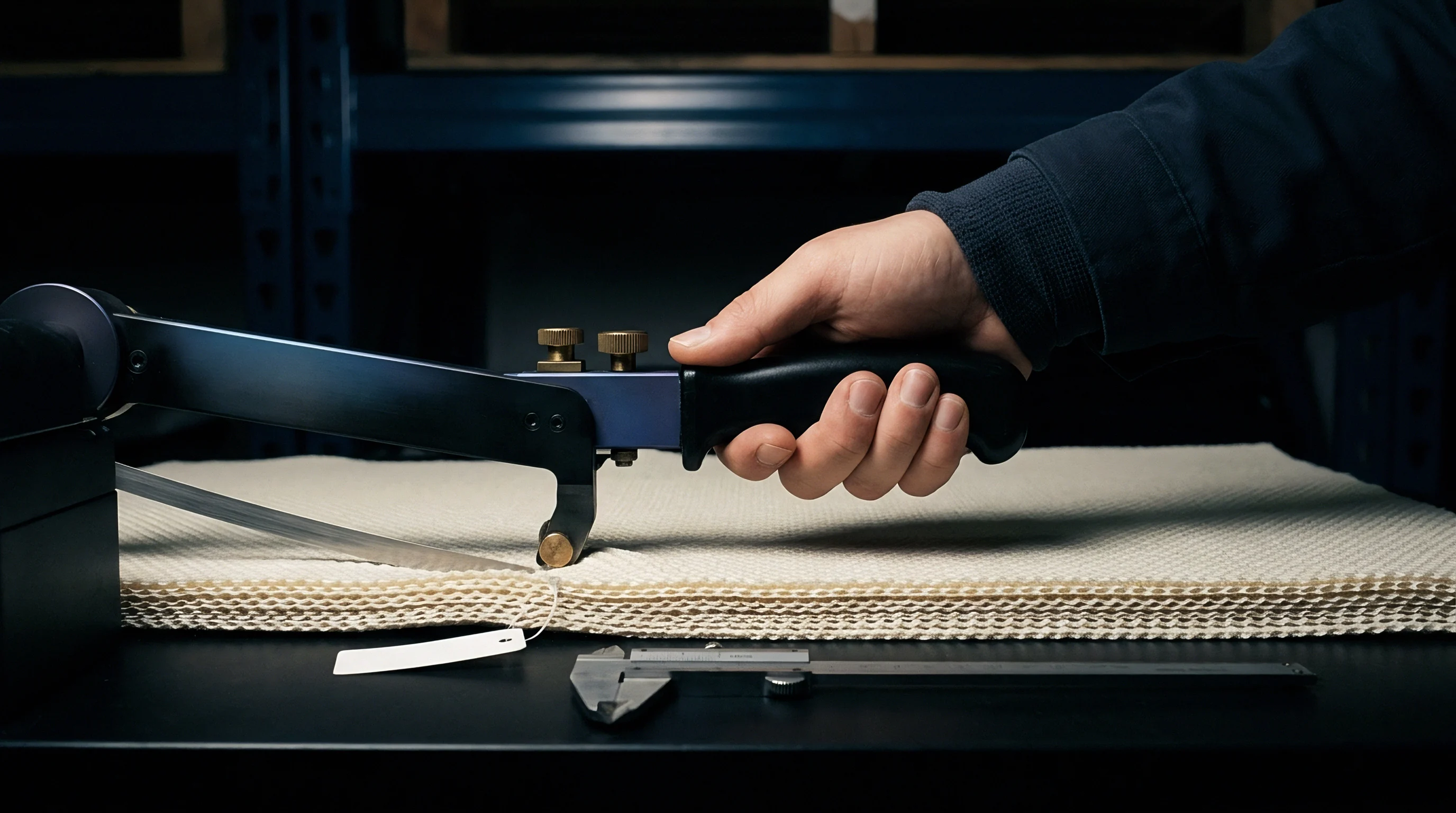
Customs authorities classify cross-border shipments of cleaned staple by weight of foreign contaminants. Border clearance offices assess import duty rates based on quantitative physical condition, processing stage, and residual trash thresholds. Fibre lots crossing international borders carry specific Harmonized System tariff declarations reflecting mechanical cleaning degree.
Misdeclarations arising from erratic gravity separation trigger administrative customs seizures and retroactive duty assessments.
Customs officers inspect foreign particulate levels. When aerodynamic sorting fails to purge dense shives and crushed seed fragments, the material fails the technical purity definition of fully cleaned spinning staple. Consignments declared under processed raw cotton headings face rejection if random laboratory gravimetric assays detect non-lint mass exceeding allowable customs tolerances.
Classification Thresholds under Chapter Fifty-Two
Heading 5201 admits uncombed raw cotton subject to specific cleanliness limits verified by Shirley analyser. Subheading 5201.00 covers cotton, not carded or combed, distinguishing between standard commercial grades and low-grade trash stock. Foreign matter content dictates customs valuation benchmarks.
Shipments containing excessive whole seeds or plant shives face reclassification under industrial waste headings, collapsing the declared commercial transaction value.
Textile mills importing raw fibre lots under tariff heading 5203 for carded or combed stock must demonstrate thorough mechanical trash extraction prior to shipment. An aerodynamic sorter operating with stable boundary conditions purges seed coat fragments below 0.50 percent by mass. This degree of purity prevents cross-border classification disputes regarding whether a lot represents spinnable primary staple or low-value carding waste under heading 5202.

Commercial Settlement and Retest Rules
Sale contracts define clear price discounts whenever delivered clean yield falls short of incoming specifications. International cotton merchant contracts incorporate commercial dispute clauses tied directly to gravimetric non-lint content. When destination port testing reveals residual seed hull levels exceeding contract limits, buyers execute financial adjustments against the commercial invoice.
Testing under ISO 1833 chemical separation and ASTM D2812 non-lint analysis governs official quality arbitration. If boundary layer instability during sorting leaves uneven trash distributions across an ocean container shipment, individual drawn bale samples fail acceptance criteria. The buyer issues a commercial rejection, halting balance payments and demanding independent testing at an accredited neutral laboratory.
Standard trading rule seventy-eight of the International Cotton Association establishes an automatic three percent invoice deduction when verified non-lint content exceeds agreed contract tolerances, shifting financial loss directly to the ginning mill.