Measuring Cyclic Oligomer Content in Synthetic Filament Extracted Yarns
Solvent extraction coupled with liquid chromatography isolates synthetic yarn cyclic oligomers to set strict delivery specs and stop knitting deposit failures.

Melt
Thermodynamic Formation of Ring Structures
Extruding synthetic filaments forces linear polymer chains through capillary dies under heavy heat and shear, where high barrel temperatures break ester and amide bonds along the main polymer backbone. Reversible transesterification in polyethylene terephthalate and ring-chain equilibrium in polyamide 6 continually generate low-molecular-weight species alongside the main polymer fraction. Lacking terminal carboxyl, hydroxyl, or amine groups, these cyclic monomers, dimers, trimers, and higher oligomers cannot participate in normal chain extension during synthesis.
Thermodynamic equilibrium during polyester condensation locks total oligomer content between 1.2 percent and 1.8 percent by weight of the virgin polymer matrix. In polyethylene terephthalate, cyclic tris(ethylene terephthalate) dominates at 60 to 80 percent of the total oligomer mass, while cyclic tetramers, pentamers, hexamers, and higher homologues up to nonamers account for the rest.
Ring closure accelerates at elevated temperatures, with polyamide 6 displaying a distinct ring distribution governed by caprolactam thermal equilibrium. Unwashed polycaproamide melt streams hold residual cyclic monomer, dimer, and trimer fractions totalling 2.5 to 3.5 percent by weight. Water extraction columns pull the cyclic monomer level down to 0.2 to 0.5 percent on industrial chips, but remelting during filament extrusion regenerates caprolactam monomer and cyclic dimer back to 0.8 to 1.2 percent by mass.
Linear chains and cyclic species remain in dynamic equilibrium at melt temperatures between 270 degrees Celsius and 300 degrees Celsius, and quenching the extrudate traps these oligomers inside the filament’s solid amorphous regions.
Migration Mechanics to Filament Surfaces
Lacking reactive chain ends and possessing lower molecular mass than the surrounding matrix, cyclic oligomers move easily through the amorphous regions of drawn filaments. Draw-texturing and heat-setting reintroduce thermal energy above the glass transition point, driving polyester cyclic trimers and polyamide cyclic dimers from the inner core toward the outer surface.
Drawing aligns linear chains into crystalline domains, squeezing non-crystallizable cyclic oligomers out of the ordered lattice and into amorphous channels. Heat then drives these small molecules along those channels toward the filament boundary. How quickly they accumulate on the surface depends on linear density, draw ratio, texturing temperature, and heater dwell time.
Because microfibers with linear densities below 1.0 dtex present much shorter diffusion paths, microdenier yarns yield a higher surface concentration of cyclic trimers per unit mass than 5.0 dtex industrial filaments under the same thermal conditions.
Heating causes PET filaments to recrystallize. As oligomers accumulate on the yarn sheath, cyclic tris(ethylene terephthalate) ~ which melts at 318 degrees Celsius, well above the 255 degree Celsius melting point of bulk polyester ~ precipitates into hard, insoluble white crystals. These micro-crystals adhere weakly to the fiber surface and readily rub off under mechanical friction during winding, warping, and knitting.
PET filament yarns extruded at 285 degrees Celsius maintain a cyclic trimer concentration between 1.15% and 1.45% by weight after solvent extraction.
Diffusional Kinetics and Temperature Dependencies
Movement of cyclic species through synthetic filaments follows Fickian diffusion during dry heat processing, but shifts to non-Fickian, relaxation-controlled transport if carrier solvents or high-pressure steam enter the fiber. Below the glass transition temperature, cyclic trimers stay trapped in the glassy matrix. Once heating exceeds this transition point, segmental chain mobility unlocks, and the diffusion coefficient of cyclic tris(ethylene terephthalate) surges by three orders of magnitude between 80 degrees Celsius and 180 degrees Celsius.
Spinning speed changes where these molecules end up. High-speed spinning above 4000 meters per minute creates high orientation in as-spun yarn, constricting amorphous pathways and slowing post-extrusion migration during storage. Conversely, fully drawn yarns undergoing tensionless thermal relaxation shed surface oligomers rapidly.
Tensile stress applied during heat-setting narrows these amorphous channels, cutting the void volume available for oligomer transport. Balancing process tension against thermal exposure ultimately dictates whether cyclic trimers stay locked inside the fiber or migrate to the surface.
White powder build-up on downstream machinery can stem from spin-finish breakdown rather than intrinsic polymer cyclics, provided a properly formulated finish keeps low-molecular-weight fractions permanently bound within the core.


Soxhlet

Solvent Selection and Dissolution Parameters
Isolating cyclic oligomers from synthetic filament yarns depends on selective solvent extraction. The solvent must dissolve low-molecular-weight linear and cyclic fractions without dissolving or degrading the primary high-molecular-weight matrix. Chlorinated hydrocarbons ~ mainly dichloromethane and chloroform ~ are standard extraction media for polyethylene terephthalate.
With a boiling point of 39.6 degrees Celsius, dichloromethane permits rapid Soxhlet siphon cycles while swelling the polyester matrix enough to extract internal cyclic trimers without causing chain scopolysis.
Strong inter-chain hydrogen bonding in polyamide filaments calls for different solvent pairings. Methanol extracts caprolactam monomer and low cyclic oligomers from polyamide 6 at 64.7 degrees Celsius, whereas full extraction of higher cyclic oligomers from polyamide 66 requires prolonged reflux in ethanol or boiling water. Tetrahydrofuran extracts cyclic oligomers from polybutylene terephthalate while keeping matrix dissolution within acceptable gravimetric limits.
Standardizing this extraction phase requires tight control of solvent purity, reflux rate, specimen weight, and siphon frequency.

Pre-Stripping Spin-Finish Interference
Synthetic filament yarns carry surface spin finishes applied during extrusion and texturing that contain emulsifiers, lubricants, antistatic agents, and fatty acid esters. Extracting these finish components alongside polymer oligomers corrupts both gravimetric and chromatographic analyses, creating overlapping peaks in liquid chromatography and inflating total extractable mass calculations.
Preventing spin-finish interference requires pre-stripping with non-swelling aliphatic hydrocarbons. Petroleum ether or n-hexane strips hydrophobic finish lubricants without penetrating the amorphous core of polyester or polyamide yarns. Washing the sample in boiling petroleum ether for 30 to 45 minutes, discarding the finish-laden liquor, and drying the substrate to constant mass under vacuum ensures clean baseline conditions before Soxhlet extraction.
DIN 54279 specifies dichloromethane Soxhlet extraction for oligomer quantification, making compliance non-negotiable for automotive seating fabric procurement.
Reflux Regimes and Extraction Kinetics
Soxhlet extraction efficiency hinges on siphon frequency and contact time, with standard protocols calling for 4 to 6 siphon cycles per hour. Fine filaments extract noticeably faster: a 50-dtex yarn with 72 filaments reaches equilibrium much sooner than a 300-dtex monofilament because of its larger surface-to-volume ratio. For polyester yarns, dichloromethane extraction requires 6 to 12 hours of continuous reflux to collect total extractable cyclic oligomers.
Abbreviated extraction runs capture surface-bound trimers but leave internal cyclics trapped in amorphous domains. Supercritical fluid extraction using carbon dioxide modified with 5 to 10 percent methanol provides an alternative to liquid Soxhlet methods. Operating at 40 degrees Celsius and 30 MPa, supercritical carbon dioxide penetrates polyester filaments rapidly, cutting extraction time to 40 minutes while matching the yield of a 12-hour dichloromethane Soxhlet run.
Accurate quantification of yarn extractables requires separating surface-adsorbed additives from polymer-derived cyclics through precise solvent choices.
- Spin Finish Esters migrate into petroleum ether washes during surface clearing, leaving internal cyclic trimers locked inside amorphous domains.
- Caprolactam Monomers dissolve completely in room-temperature methanol, separating from higher cyclic amide oligomers.
- Cyclic Polyester Trimers dissolve in refluxing dichloromethane, requiring precise temperature control to prevent ester linkage hydrolysis.
- Linear Low Polymers co-extract into boiling chloroform when extraction extends past sixteen hours, skewing oligomer mass balances.
- Antistatic Additives wash out in polar alcohol flushes, requiring isolation before chromatographic quantification of cyclic fractions.
| Polymer Type | Extraction Solvent | Boiling Temp (°C) | Reflux Duration (h) | Target Oligomer | Recovery Yield (%) |
|---|---|---|---|---|---|
| PET Filament | Dichloromethane | 39.6 | 8.0 | Cyclic Trimer (C15H18O6) | 98.4 |
| PET Filament | Chloroform | 61.2 | 6.0 | Cyclic Trimer / Tetramer | 99.1 |
| PA6 Filament | Methanol | 64.7 | 12.0 | Caprolactam / Cyclic Dimer | 97.8 |
| PA66 Filament | Absolute Ethanol | 78.4 | 16.0 | Cyclic Hexamethylenediamine | 95.2 |
| PBT Filament | Tetrahydrofuran | 66.0 | 10.0 | Cyclic Butylene Terephthalate | 96.7 |
Extraction parameters must align with fiber linear density to achieve quantitative yield without degrading the underlying polymer matrix.

Chromatography
High-Performance Separation of Oligomeric Homologues
Liquid chromatography separates extractable cyclic oligomers into individual homologous species based on molecular size and polarity. Reverse-phase HPLC using octadecylsilane C18 stationary phases clearly resolves cyclic polyester oligomers from trimer up to nonamer. Modern UHPLC systems operating above 800 bar cut analysis times from 45 minutes down to 8 minutes while sharpening peak shapes for trace cyclic species.
Separating cyclic trimers from linear oligomers requires precise mobile-phase gradients, usually running acetonitrile against high-purity water. Starting at 40 percent acetonitrile and 60 percent water, the gradient shifts smoothly to 100 percent acetonitrile over 15 minutes. Adding 0.1 percent trifluoroacetic acid by volume suppresses ionization of trace carboxyl end groups on linear oligomers, shifting their retention times away from non-polar cyclics.
Linear oligomers elute earlier than cyclic counterparts of equal molecular weight because their terminal functional groups interact more strongly with polar mobile phase components.
UV-Vis and Mass Spectrometric Detection
Detecting polyester cyclic oligomers relies on UV absorption spectroscopy focused on the terephthaloyl chromophore, with maximum absorption for cyclic tris(ethylene terephthalate) at 240 nanometers. Photodiode array detectors monitor absorption from 200 to 400 nanometers simultaneously, verifying peak purity against reference standards. Polyamide oligomers lack strong UV chromophores, so detection shifts to lower wavelengths between 205 and 210 nanometers where peptide carbonyl groups absorb.
Accurate quantification requires calibrating detector response against isolated pure oligomer standards. Cyclic trimer purified via preparative liquid chromatography establishes the response factors used for integration. When coupled to LC, single-quadrupole or time-of-flight mass spectrometry provides definitive mass identification; positive electrospray ionization produces ammonium adduct ions that confirm molecular weights of 576.5 m/z for cyclic trimer, 768.7 m/z for tetramer, and 960.8 m/z for pentamer.

Gel Permeation and Molecular Weight Profiling
Gel permeation chromatography (GPC), or size-exclusion chromatography, measures the complete molecular weight distribution of extracted yarn fractions. Columns packed with porous styrene-divinylbenzene gels separate molecules strictly by hydrodynamic volume: high-molecular-weight linear chains elute first, followed by smaller linear species, and finally small cyclic oligomers. This resolves the low-molecular-weight fraction below 1000 g/mol from bulk polymer, establishing the ratio of linear oligomers to cyclic structures.
Hexafluoroisopropanol serves as the eluent for room-temperature GPC analysis of nylon and polyester yarns, dissolving both the polymer matrix and oligomer residues. Calibration with narrow-distribution polystyrene standards converts elution volume into molecular mass distribution. This analysis confirms whether yarn washing steps selectively strip surface cyclics or pull out internal low-polymer fractions as well.
Higher texturing temperatures accelerate oligomer migration toward the filament perimeter where friction degrades yarn package unwinding.
When Does Oligomer Migration Surpass Finish Retention Bounds?
Thermal texturing forces cyclic trimers to the fiber surface faster than finish lubricants can emulsify them. Once local surface oligomer concentrations exceed 0.15 percent by weight, finishes can no longer suspend the crystalline particles. The oligomers nucleate into micro-crystals on the fiber skin, causing sharp spikes in yarn-to-metal friction during high-speed unwinding.
Tracking this transition requires isolating surface extractables from total matrix oligomers. A quick 30-second wash in cold dichloromethane strips surface-bound trimers alone. Comparing this figure against total Soxhlet extractables yields the migration ratio; a surface-to-total ratio above 0.10 indicates that internal oligomers have saturated the fiber skin, signaling imminent deposition issues during warping or knitting.
- Dissolve 10.0 milligrams of purified cyclic trimer reference standard in 10.0 milliliters of HPLC-grade hexafluoroisopropanol in a volumetric flask.
- Pipette 1.0 milliliter of stock solution into a 90.0 milliliter volumetric flask and dilute to volume with LC-grade acetonitrile to prepare working standard A.
- Perform serial dilutions from working standard A using a 50:50 v/v acetonitrile and water mixture to yield standard concentrations of 1.0, 5.0, 10.0, 25.0, and 50.0 micrograms per milliliter.
- Filter each standard solution through a 0.22-micrometer polytetrafluoroethylene syringe filter directly into brown glass chromatography vials.
- Inject 10.0 microliters of each standard level into the HPLC-UV system at 240 nanometers to build a five-point linear calibration curve with an R-squared value above 0.9990.
| Oligomer Structure | Chemical Formula | Molecular Mass (g/mol) | C18 Retention (min) | UV Maxima (nm) | Mass-to-Charge Ratio (m/z) |
|---|---|---|---|---|---|
| Cyclic Dimer | C10H12O4 | 384.38 | 3.42 | 240 | 401.4 + |
| Cyclic Trimer | C15H18O6 | 576.55 | 6.18 | 240 | 594.6 + |
| Cyclic Tetramer | C20H24O8 | 768.73 | 9.85 | 240 | 786.8 + |
| Cyclic Pentamer | C25H30O10 | 960.91 | 13.12 | 240 | 978.9 + |
| Cyclic Hexamer | C30H36O12 | 1153.09 | 15.90 | 240 | 1171.1 + |
Failing to verify chromatographic calibration against pure cyclic trimer standards can miscalculate total oligomer weight by up to 25 percent, leading to false lot acceptances that disrupt high-speed knitting lines.

Precipitation

Differential Solvent Fractionation
Differential solvent precipitation provides a gravimetric route to measure total cyclic oligomers without liquid chromatography equipment. The synthetic yarn sample is dissolved completely in a strong primary solvent, after which a selective non-solvent ~ such as cold methanol ~ is added to precipitate high-molecular-weight polymer chains while leaving low-molecular-weight cyclic oligomers in solution.
Polyester yarn analysis uses phenol and 1,1,2,2-tetrachloroethane (1:1 by weight) or trifluoroacetic acid as primary solvents. Dissolving 2.0 grams of yarn in trifluoroacetic acid at room temperature takes about 2 hours. Slowly adding cold methanol under high-shear stirring precipitates linear PET chains as a fine, fibrous mass due to their reduced solubility in the methanol-rich mixture, while cyclic oligomers remain dissolved in the supernatant.
Gravimetric Residue Determination
Isolating the oligomer fraction involves filtering the suspension through hardened, ashless glass-fiber paper rated for 0.7-micrometer retention. Washing the filter cake twice with fresh methanol frees any cyclic trimers trapped inside the precipitated polymer matrix, leaving a combined filtrate of solvent, non-solvent, and dissolved oligomers.
Rotary evaporation under reduced pressure at 45 degrees Celsius strips off the volatile solvent mixture, leaving cyclic oligomers and trace linear low polymers. Washing this residue with warm water removes polar contaminants, and drying the extract under vacuum at 105 degrees Celsius for 4 hours removes bound solvent to yield the dry oligomer mass. Comparing this residue mass to the initial dry yarn weight gives the percentage of total extractable oligomers.
Supercritical carbon dioxide extraction leaves organic solvent residues behind while isolating cyclic oligomers from polyamides.

Analytical Variance and Method Reconciliation
Gravimetric precipitation routinely yields higher oligomer percentages than reverse-phase liquid chromatography because gravimetric residues include trace linear oligomers, degraded spin-finish fragments, and thermal oxidation products that pass through the filter. HPLC methods, by contrast, measure specific cyclic peaks to isolate cyclic tris(ethylene terephthalate) precisely. In qualification trials, LC separation measured a baseline cyclic trimer fraction of 1.28 percent by weight for bright polyester filament, whereas gravimetric precipitation on the same yarn batch returned 1.54 percent total extractables.
Reconciling these test methods requires applying correction factors based on polymer type and solvent purity. When evaluating bulk shipments, applying a gravimetric-to-chromatographic conversion factor of 0.83 adjusts PET drawn yarn values. If gravimetric residue exceeds 1.50 percent, HPLC verification confirms whether excess mass stems from cyclic trimers or finish contamination.
Standardizing sample moisture before testing is critical; conditioning samples at 20 degrees Celsius and 65 percent relative humidity per ISO 6741 prevents moisture fluctuations from distorting dry mass calculations.
Selecting analytical workflows for cyclic oligomer evaluation requires matching solvent capabilities against polymer matrix stability.
- Dissolution Solvent Selection dictates whether linear polymer chains unpack completely without causing thermal or chemical chain scopolysis.
- Precipitant Addition Rate determines whether cyclic oligomers get mechanically trapped in the precipitating high-molecular-mass matrix.
- Filtration Pore Rating governs the retention of fine polymer micro-particles that would distort gravimetric residue balances.
- Vacuum Desiccation Parameters control the removal of trace solvent complexes without sublimating low-molecular-weight cyclic species.
Documenting batch compliance demands maintaining a complete dossier of analytical parameters to back up landed commercial declarations.
- Raw Material Identification Dossier containing polymer synthesis conditions, intrinsic viscosity values, and historical cyclic trimer baseline data.
- Sampling Traceability Log detailing specimen location within yarn packages, conditioning history under ISO 6741, and dry baseline masses.
- Extraction Protocol Certificate recording solvent purity grades, Soxhlet siphon cycle counts, reflux temperatures, and total exposure times.
- Chromatographic Calibration Record documenting reference standard purity, UV detector response factors, retention time stability, and peak integration limits.
- Method Cross-Reconciliation Summary showing the calculated ratio between gravimetric precipitation yields and reverse-phase liquid chromatography values.
| Yarn Substrate | Processing State | Gravimetric Yield (%) | HPLC Trimer Yield (%) | Method Delta (%) | Dominant Variance Factor |
|---|---|---|---|---|---|
| 150d/48f PET | Raw Undyed POY | 1.42 | 1.18 | +0.24 | Spin Finish Co-Extracts |
| 150d/48f PET | High-Temp Package Dyed | 0.68 | 0.58 | +0.10 | Dye Bath Oligomer Stripping |
| 78d/68f PA6 | Raw Textured | 2.85 | 2.10 | +0.75 | Caprolactam Monomer Residuals |
| 78d/68f PA6 | Scoured and Heat-Set | 1.12 | 0.95 | +0.17 | Aqueous Scour Extraction |
| 300d/96f PBT | Raw Undyed | 1.65 | 1.38 | +0.27 | Linear Low Polymer Fraction |
Whether supercritical fluid extraction can completely supplant chlorinated Soxhlet solvents across commercial arbitration laboratories remains a topic of active industry study.

Knitting
Mechanical Impact of Surface Accumulation
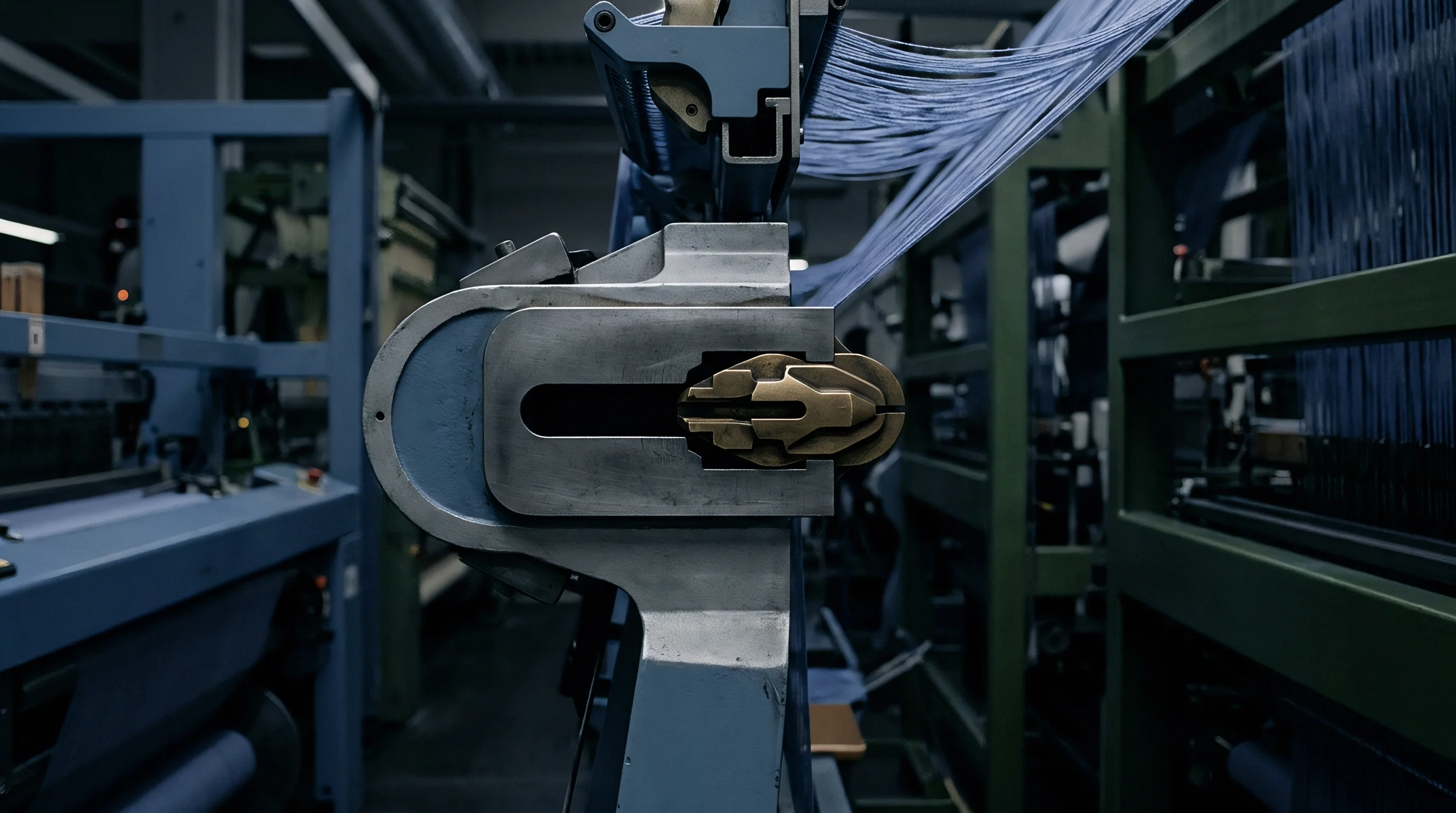
Excessive surface oligomer content damages downstream machinery during high-speed yarn processing. As cyclic trimers migrate to the perimeter of polyester filaments, friction strips them off in ceramic guides, tension disks, and knitting needles. The shed oligomer accumulates as a fine white powder inside needle latches, sinker tracks, and yarn feeds on circular knitting machines, clogging capillaries and causing yarn breakage.
Accumulated oligomer dust absorbs ambient needle oil to form an abrasive paste. This paste raises friction along the yarn path, creating tension fluctuations that cause horizontal streaking, uneven loops, and dropped stitches in knit fabrics. During jet dyeing, cyclic trimers migrate out of polyester filaments into 130 degrees Celsius dye liquor; as the bath cools to 80 degrees Celsius, they precipitate onto fabric surfaces as un-dyeable white specks or crystallize inside yarn packages, forming flow channels that cause patchy shading.
Commercial Tolerances and Purchase Specifications
Yarn buyers prevent operational disruptions by writing strict cyclic oligomer limits into raw material supply contracts. Quality specifications differentiate total internal oligomers from surface-accessible oligomers: total oligomer content for standard texturized polyester yarn must stay below 1.30 percent by weight, while surface oligomers measured by a rapid 30-second cold dichloromethane rinse cannot exceed 0.05 percent by weight.
Yarn lots exceeding these limits require specialized scouring before conversion. Applying anti-oligomer auxiliaries during package dyeing converts surface trimers into dispersible complexes, preventing them from recrystallizing onto the fiber skin. Adding an anti-oligomer scour step increases dye-house processing costs by 0.18 USD per kilogram of yarn.
Setting clear raw yarn oligomer limits at procurement shifts quality control responsibility back to the extruder, protecting mills from unexpected downtime and accelerated needle wear.
A standard procurement contract clause reads: Total extractable cyclic oligomer content shall not exceed 1.20 percent by dry weight when tested according to DIN 54279 dichloromethane Soxhlet extraction, and surface-bound oligomers shall not exceed 0.05 percent by weight following a 30-second cold solvent rinse, with non-compliant consignments subject to full batch rejection or supplier-funded scouring remediation.