Unresolved Inter Laboratory Gravimetric Variance in Recycled Filament Polyester Cotton Component Declarations
Eliminate border gravimetric variance by specifying ISO 1833-11 dissolution and contractually binding buyers and mills to ASTM D1909 commercial regains.


Drift
Accredited testing houses regularly issue conflicting mass percentages on identical cuts of recycled polyethylene terephthalate filament co-spun with combed cotton. A consignment certified at fifty-two percent natural fibre by an origin facility routinely returns forty-eight percent at destination customs clearance. Laboratory reports diverge on identical rolls.
This five-point gravimetric spread originates in analytical execution rather than raw batch inconsistency. Third-party testing houses employ divergent standard methods to separate synthetic filament from cellulosic staples, alternating between seventy-five percent sulfuric acid dissolution, zinc chloride digestion, and basic physical separation. Each route introduces systematic errors into the final gravimetric calculation.
Analytical chemists face unique chemical challenges when isolating mechanically or chemically recycled filament yarns from raw cotton matrices. Recycled polyester contains shorter polymer chains, broader polydispersity indices, and higher concentrations of cyclic oligomers than virgin synthetic polymers. Repetitive thermal processing cycles degrade the average molecular mass of post-consumer polyethylene terephthalate.
When exposed to concentrated acid extraction baths, low molecular mass polyester oligomers dissolve alongside the hydrolyzed cellulose instead of remaining on the filter disc. The laboratory records this dissolved synthetic mass as cotton, skewing the declared ratio toward natural fibre predominance.
A two percent shift in dry gravimetric yield flips customs classification between tariff headings when synthetic filament constitutes forty-nine point five percent of total unconditioned mass.
Variations across physical processing stages compound these chemical discrepancies. Spinning operations combine high-tenacity recycled synthetic continuous filament with carded or combed natural staples through core-spun, siro-spun, or alternate ring-twisting processes. Incomplete fibre de-twisting during laboratory specimen preparation prevents digestion reagents from penetrating dense yarn cores uniformly.
Undissolved cellulosic fragments remain trapped within synthetic filament agglomerations inside the filtration crucible. The resulting gravimetric tally understates the true vegetable constituent while overstating synthetic filament mass.

Quantitative Discrepancies across Commercial Testing Houses
Commercial testing laboratories process high volumes of textile imports under rapid turnaround constraints. Technicians frequently abbreviate solvent pre-treatment washes designed to strip yarn spin finishes, waxes, and sizing chemistry. Residual surface sizing agents resist aqueous rinses, contributing uncorrected mass to the final dry residue.
Solvent temperature alters mass loss. Immersion timing deviations of three minutes in ambient acid baths produce significant shifts in residual dry weight. A five-minute excess immersion in sulfuric acid at twenty-five degrees Celsius hydrolyzes exterior chains of crystalline synthetic polymers, stripping weight from the retained filament.
Inter-laboratory trials demonstrate consistent variance across common standardized testing systems. When multiple facilities evaluate identical production cuts from a single lot of fifty-fifty intimate composite yarn, results scatter across a four-point percentage range. The standard deviation widens further when laboratories switch between International Organization for Standardization protocols and American Society for Testing and Materials procedures.
| Standard Designation | Selective Reagent Chemistry | Solvent Temperature | Digestion Duration | Cellulose Dissolution Factor | Reported Synthetic Mean |
|---|---|---|---|---|---|
| ISO 1833-11 | 75% Aqueous H2SO4 | 20 °C | 60 min | 1.02 | 51.3% |
| ASTM D629 Section 10 | 70% Aqueous H2SO4 | 38 °C | 15 min | 1.04 | 49.4% |
| AATCC 20A Method 6 | 75% Aqueous H2SO4 | 20 °C | 60 min | 1.02 | 50.8% |
| GB/T 2910.11 | 75% Aqueous H2SO4 | 20 °C | 60 min | 1.02 | 51.6% |

Failure Modes in Gravimetric Separation
Systematic measurement discrepancies stem from four physical and chemical failure modes encountered during quantitative analysis:
- Partial cellulose carbonization occurs during forced-draft oven desiccation when drying temperatures exceed one hundred and five degrees Celsius.
- Selective oligomer dissolution extracts short-chain polyethylene terephthalate fragments into concentrated sulfuric acid baths alongside cotton cellulose.
- Mechanical filament fragmentation strips micro-denier synthetic debris through sintered glass crucibles during vacuum filtration rinses.
- Differential finish extraction removes non-polymeric processing oils unevenly across competing pre-treatment solvent cycles.
Misaligned gravimetric percentages incur sudden penalty assessments, immediate impoundment of cargo at entry points, and retroactive tariff collections spanning past imports.


Flask
Chemical digestion in quantitative textile analysis isolates organic polymers through selective solubility. The testing apparatus isolates synthetic filament by digesting cellulosic matter inside a reaction container under precise thermal agitation. Technicians measure dry specimens before chemical exposure, introduce specific solvent reagents, agitated the contents mechanically, and collect the insoluble fraction on sintered borosilicate discs.
Cellulose dissolves completely in seventy-five percent acid. The accuracy of the calculated constituent ratio rests on the premise that the reagent dissolves one polymer completely while leaving the co-mingled polymer unattacked.

Does Selective Solvation Dissolve Recycled Filament Oligomers?
Post-consumer polyethylene terephthalate contains broken molecular fragments and cyclic trimers generated through repetitive thermal re-extrusion cycles. Virgin polyester filament maintains a high degree of polymerization, typically displaying intrinsic viscosities above zero point six five decilitres per gram. Recycled filament extracted from mechanical bottle flake collections frequently drops below zero point six zero decilitres per gram.
Industrial recycling streams draw feedstocks from mixed consumer packaging, where municipal sorting systems separate polyolefins from polyesters using high-speed optical sorters and flotation tanks. That raw flake supply carries variable thermal histories into mechanical yarn drawing units. Short polymer chains exhibit increased sensitivity to concentrated acid solutions.
During the sixty-minute digestion period dictated by ISO 1833-11, seventy-five percent sulfuric acid attacks amorphous regions of low-viscosity recycled polyester filaments. The reagent dissolves short-chain cyclic oligomers, carrying them through the crucible into the liquid waste container. The dry residual weight of the filament decreases by zero point eight to one point five percent relative to initial synthetic mass.
When calculations fail to compensate for this dissolved synthetic fraction, the reported cotton percentage increases artificially.

Mechanical Attrition during Sintered Crucible Filtration
Vacuum filtration pulls dissolved cellulose solutions through porous borosilicate glass barriers of defined porosity. Standard testing procedures mandate Porosity 2 or Porosity 3 filter crucibles, featuring pore diameters between twenty and one hundred micrometres. When processing fine-denier continuous filament yarns, high-shear mechanical shaking inside the digestion vessel breaks down weakened filament fibrils into microscopic fragments.
Synthetic fibres resist cold acid attack. Mechanical washing tears weakened polymer tails. These fragments pass directly through Porosity 2 filters under vacuum pressure.
The cotton dissolution correction factor d sits at one point zero two in ISO 1833-11, established through trials on scoured virgin upland cotton; incomplete pre-treatment scour or heavy sizing deposits raise that empirical baseline toward one point zero five, corrupting calculated synthetic mass. Sintered crucibles also accumulate microscopic cellulose residues within their internal glass matrices during successive tests. If cleaning cycles with concentrated nitric acid are skipped, crucible tare weights drift, introducing systematic upward errors in synthetic weight recordings.
Acid strength directly dictates the boundary between complete cellulose hydrolysis and unwanted synthetic polymer degradation.

Critical Digestion Execution Controls
Achieving reproducible gravimetric yields requires strict adherence to bench parameters across four distinct analytical phases:
- Acid concentration control maintains aqueous sulfuric acid between seventy-three and seventy-five percent by mass to prevent polyester surface hydrolysis.
- Bath temperature stabilization limits digestion heat to twenty degrees Celsius during continuous mechanical shaking.
- Crucible porosity calibration isolates Porosity 2 sintered discs to retain short-staple filament fragments without retarding wash rates.
- Pre-wash solvent selection uses analytical-grade petroleum ether before aqueous extraction to remove silicone lubricants without stripping polymer additives.
| Nominal Bath Temperature | Actual Bath Temperature | Cellulose Dissolution Rate | rPET Filament Mass Loss | Reported Natural Component |
|---|---|---|---|---|
| 20 °C | 19.5 °C | 99.7% | 0.2% | 49.9% |
| 20 °C | 22.5 °C | 100.0% | 0.8% | 50.6% |
| 20 °C | 26.0 °C | 100.0% | 1.9% | 51.8% |
| 20 °C | 30.0 °C | 100.0% | 3.4% | 53.2% |
Analytical laboratories still debate whether any gravimetric technique can differentiate between mechanical filament erosion and chemical chain cleavage inside the digestion container without relying on chromatographic residue analysis.

Regain
Textile moisture content shifts the apparent weight of natural and synthetic polymers according to ambient atmospheric humidity. Combed cotton fibres absorb moisture readily, incorporating water molecules directly into amorphous cellulose hydroxyl groups. Filament polyethylene terephthalate contains a tightly packed crystalline molecular structure that repels water vapour, absorbing minimal atmospheric moisture under identical ambient environments.
Oven drying removes all volatile moisture. Standard testing methods strip environmental water by drying specimen swatches inside ventilated ovens at one hundred and five degrees Celsius until reaching mass equilibrium. The dry mass represents the baseline for gravimetric calculations.
Commercial transactions and customs declarations prohibit invoicing on dry mass alone. Commercial standards demand converting dry masses into conditioned commercial masses through mathematically applied moisture regain constants. These statutory regain values approximate the moisture a bone-dry fibre reabsorbs when exposed to standard atmospheric conditions of twenty degrees Celsius and sixty-five percent relative humidity.
Because cotton absorbs water at six times the rate of synthetic filament, the choice of commercial regain tables alters final component calculations.

Do Divergent Commercial Regains Invert Nominal Declarations?
Standardization bodies specify arbitrary moisture allowance percentages to reconcile raw desiccated mass with commercial invoice weights. ISO 1833-1 assigns combed cotton a commercial allowance of eight point five percent and filament polyester one point five percent, figures agreed in mid-century standardization conferences; raising cotton moisture to eight point seven percent in humid transit recalculates a fifty-fifty composite into a cotton-dominant material on paper. ASTM D1909 establishes eight point zero percent for combed cotton and two point one percent for continuous filament polyester.
United States Customs and Border Protection operates under statutory schedules mandating specific regain corrections for tariff classification that diverge from testing laboratory defaults.
The exact loss of hygroscopic surface area in chemically regenerated cotton remains unquantified across diverse commercial spinning lots, leaving analysts to apply standard virgin constants under acknowledged procedural compromise. Cotton absorbs eight point five percent. Pure petroleum ether extracts spin finishes.
When a testing technician takes oven-dry masses from a seventy-five percent sulfuric acid dissolution test and converts them into commercial percentages, applying ISO coefficients yields an entirely different constituent balance than applying ASTM coefficients. A lot containing equal bone-dry weights of synthetic and natural polymers yields fifty-one point seven percent cotton under ISO tables, whereas ASTM tables compute fifty-one point four percent cotton.
ISO 1833 Section 11 adjusts dry residual synthetic mass using an empirical correction factor that lowers the reported natural component by two full percentage points.

Commercial Regain Mathematics across Primary Jurisdictions
The mathematical impact of regional moisture regain factors surfaces when evaluating identical bone-dry analytical residues. Consider a test specimen yielding exactly 50.00 grams of oven-dry recycled polyester filament residue and 50.00 grams of dissolved cotton cellulose.
| Regulatory Jurisdiction | Standard Citation | Cotton Commercial Regain | Polyester Commercial Regain | Calculated Cotton Proportion | Calculated Polyester Proportion |
|---|---|---|---|---|---|
| European Union | EU Regulation 1007/2011 | 8.50% | 1.50% | 51.72% | 48.28% |
| United States | ASTM D1909 / ASTM D629 | 8.00% | 2.10% | 51.40% | 48.60% |
| China Customs | GB/T 9994 | 8.50% | 2.00% | 51.55% | 48.45% |
| Zero Regain Dry Mass | Bone Dry Desiccation | 0.00% | 0.00% | 50.00% | 50.00% |
Tariff schedules classify materials based on the predominant component by weight. When processing garments or co-spun yarns close to the fifty percent boundary, shifting from European Union regulatory regain standards to dry mass calculations completely changes which polymer constitutes the chief weight. Importers failing to specify calculation methods in supplier purchase agreements invite arbitrary border reclassifications.
Relying on dry mass calculations without harmonizing commercial moisture coefficients guarantees irreconcilable disputes between exporting mills and destination testing houses.

Ledger
Customs authorities classify imported yarns and yardage according to the constituent fibre carrying chief weight. Under Harmonized System General Rules of Interpretation, a textile assembly composed of multiple materials falls under the heading governing the component that predominates by total weight. Tariff lines pivot on chief weight.
A balanced fifty-fifty mixture that tests at fifty point one percent cotton enters Chapter 52 as a cotton-predominant yarn. If an importing customs laboratory returns fifty point one percent synthetic content, the material reclassifies into Chapter 54 as man-made filament, or Chapter 55 as man-made staple. Five percent variance triggers heavy duties.
Harmonized System Classification Shifts at Chief Weight Thresholds
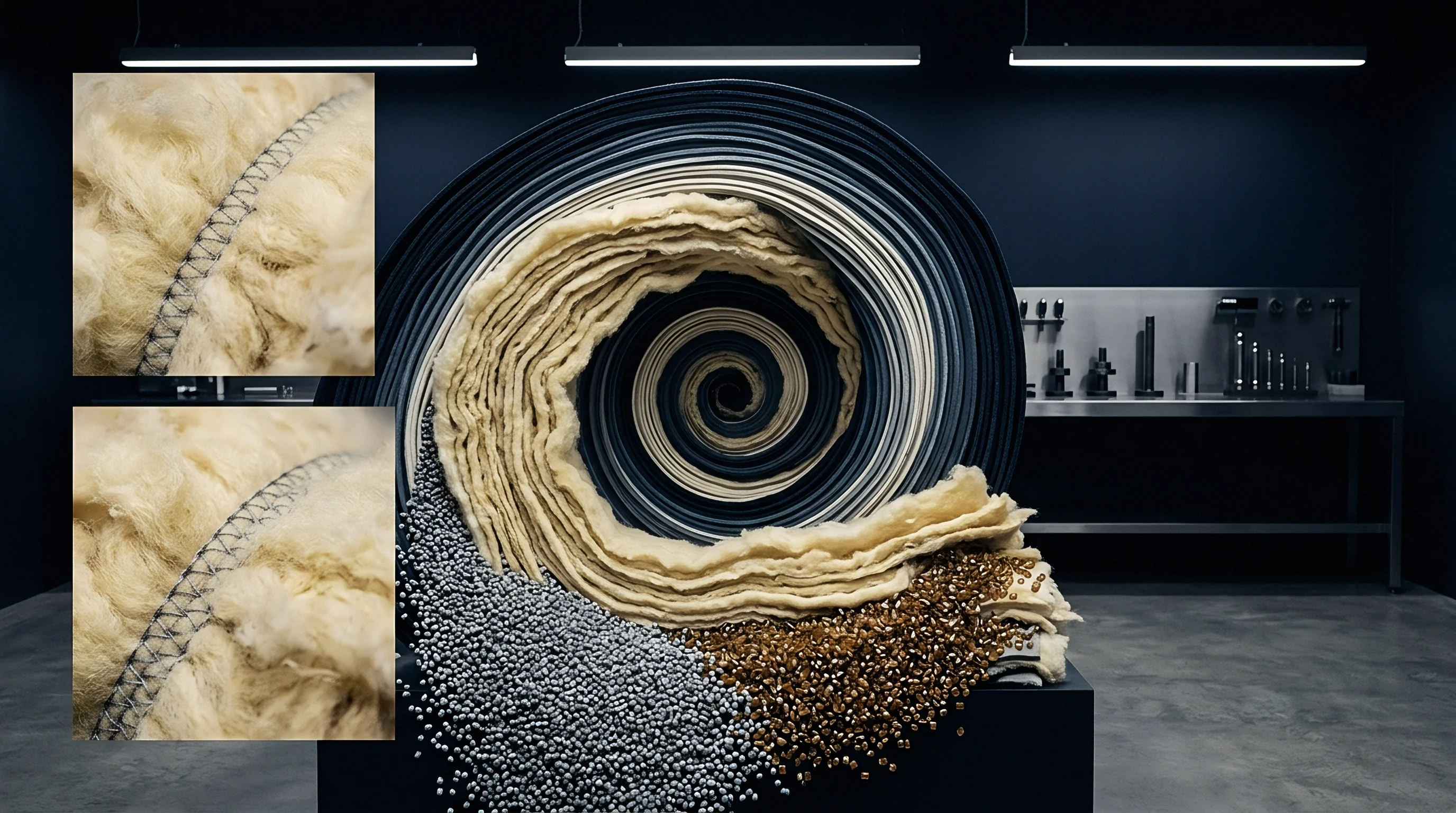
Binary compositions hovering near equal proportions face violent tariff changes across customs schedules. United States, European Union, and East Asian tariff books assess divergent customs duties depending on whether a yarn or substrate sits on the natural or synthetic side of the fifty percent dividing line. Recycled filament polyester products frequently attract punitive trade defense measures, including anti-dumping duties and countervailing duties designed to protect domestic chemical recyclers.
Take a forty-tonne consignment of nominal 50/50 combed cotton and recycled filament polyester co-spun yarn, valued at four dollars and eighty cents per kilogram CIF. If origin testing certifies 50.8 percent cotton content based on dry mass extraction, the cargo clears under Harmonized System code 5205.12 as single combed cotton yarn, carrying an ad valorem general tariff of five point zero percent. The total duty liability equals nine thousand six hundred dollars.
Destination customs authorities conduct random border screening, testing five cones from the container. The government laboratory employs ASTM D629, skipping petroleum ether pre-extraction and utilizing commercial regains that yield 49.3 percent cotton and 50.7 percent recycled polyester filament. Chief weight shifts to man-made filament under code 5402.33.
The general tariff rate increases to eight point eight percent. Border customs officers halt clearance. The synthetic filament also falls within an active anti-dumping decree against specific Asian origin points, assessing an additional fourteen point two percent duty.
The revised customs duty rate reaches twenty-three point zero percent, generating forty-four thousand one hundred and sixty dollars in direct duty charges.
| Analytical Classification | Harmonized System Heading | Declared Duty Rate | Anti-Dumping Assessment | Total Assessed Duty | Commercial Surcharge |
|---|---|---|---|---|---|
| Origin Lab (50.8% Cotton) | 5205.12 (Cotton Yarn) | 5.0% | 0.0% | $9,600 | Baseline |
| Customs Lab (50.7% rPET) | 5402.33 (Polyester Filament) | 8.8% | 14.2% | $44,160 | +$34,560 |
| Re-test Rejection Appeal | Administrative Review Hold | Disputed | Held in Escrow | $44,160 | +$12,800 Demurrage |
Retesting doubles direct laboratory expenditures. Importers pay the difference immediately. The net variance of thirty-four thousand five hundred and sixty dollars lands entirely on the buyer balance sheet.
Storage fees, bonded warehouse charges, container demurrage, and legal representation add twelve thousand eight hundred dollars in indirect costs while the formal protest moves through customs arbitration.
Escalation Procedures for Border Contestation
Importers facing hostile border laboratory reclassifications mitigate financial damage by executing structured administrative responses:
- Composite pre-shipment sampling draws specimen cones from twenty randomized cartons across the production run to establish baseline mass variance before container loading.
- Dual-method testing validation submits split swatches to both sulfuric acid dissolution and alkaline boiling tests to verify agreement within zero point five percent.
- Pre-clearance documentation filing deposits certified oven-dry mass values alongside commercial regain calculations with the customs entry summary to preclude default reclassification.
- Escrow deposit allocation protects importer cash flow against immediate liquidation penalties while administrative appeal panels review divergent border laboratory reports.
Spinning mill representatives invariably maintain that raw bale blending scales operated within mechanical tolerance and that border laboratory chemists burned off pure synthetic polymer in overheated acid.


Accord
Commercial purchasing agreements eliminate analytical ambiguity through contractually defined testing stipulations. Sourcing managers cannot control which testing protocols destination border authorities choose during random inspections. Buyers retain complete control over the technical rules governing commercial settlement between their business and the manufacturing mill.
When purchase contracts fail to designate a single authoritative analytical method, suppliers rely on the standard that maximizes reported cotton content while destination buyers test against strict regional customs guidelines.

Contractual Tolerance Bands and Reference Laboratories
Procurement documents specify acceptable gravimetric variance limits between commercial testing facilities. Standard trade regulations permit a three percent commercial tolerance on declared fibre percentages to accommodate unavoidable spinning variation. This statutory three percent tolerance does not protect an importer against a chief-weight tariff flip.
A composite declaring fifty-one percent cotton and forty-nine percent recycled polyester filament sits within normal commercial tolerance if a customs lab finds forty-eight point five percent cotton, yet that material still reclassifies under man-made filament tariff lines.
Precise supply contracts address this vulnerability by inserting binary threshold buffers. For any co-spun material intended to clear under cotton tariff headings, the contractual specification demands a minimum fifty-three percent natural fibre content at laboratory testing, establishing a three percent buffer against analytical error. The specification designates a single accredited international testing facility to serve as binding referee.
If mill testing and importer qualification reports disagree, the designated reference laboratory tests retained production cuts. The referee laboratory testing methods, chemical solvent strengths, filtration porosities, and moisture regain constants are hard-coded into the master purchase contract.

Harmonized Preparation Protocols and Binding Arbitration
Specifying the precise testing method within purchase contracts removes discretionary technical choices from third-party testing facilities. Procurement agreements must dictate whether calculations incorporate commercial moisture regains or rest solely on bone-dry masses. The contract line defines whether non-fibrous residues undergo petroleum ether extraction before acid immersion.
Specifying complete solvent pre-treatment removes the influence of proprietary spinning oils and size recipes, aligning independent testing laboratories onto an identical baseline.
Standard purchase contract clause sixteen binds buyer and seller to settle border discrepancies through a designated reference laboratory using seventy-five percent sulfuric acid dissolution, removing customs speculation and fixing the landed invoice valuation.