Predictive Thermodynamic Modeling of Non-Equilibrium Polymer Cavitation under Variable Decompression Velocities
Dynamic polymer cavitation kinetics dictate synthetic filament density and tenacity drops under high spinneret decompression speeds.


Void
Thermodynamic Phase Transitions in Decompressing Melt Streams
Dissolved gases inside molten synthetic polymers alter phase behavior during high-pressure extrusion. Supercritical carbon dioxide or nitrogen in polyethylene terephthalate or polyamide melt streams forms a single-phase homogeneous polymer-gas solution under core operating pressures above 20 MPa. As the polymer melt exits the spinneret orifice into atmospheric pressure, rapid depressurization forces the thermodynamic state into a highly supersaturated region.
The rate of pressure reduction governs whether gas molecules remain dissolved, coalesce into micro-bubbles, or form unstable foam architectures that destroy filament integrity.
Non-equilibrium cavitation occurs when decompression velocity outpaces the structural relaxation frequency of the polymer chains. At low depressurization speeds, polymer molecules reorient to accommodate gas concentration gradients, allowing controlled bubble nucleation and growth driven by standard classical diffusion kinetics. High decompression rates create extreme thermodynamic instability: local pressure drops below the binodal boundary faster than gas molecules can diffuse into growing nuclei, triggering spontaneous homogeneous phase separation that generates rapid micro-voids throughout the core of the extruding filament.
Excessive decompression rates degrade mechanical filament integrity before yarn packages reach the winder.
Micro-void creation alters the physical geometry of synthetic filaments before crystallization fixes the final yarn structure. Internal void fraction increases drive down filament density. When cavitation velocity crosses critical limits for a given melt viscosity and temperature profile, structural defects emerge that disrupt downstream processing.
- Filament fibrillation happens when adjacent internal micro-cavities coalesce under high shear rates, tearing the surrounding longitudinal polymer matrix and causing surface flaking during drawing operations.
- Diameter eccentricity occurs through uneven cross-sectional gas expansion when depressurization profiles fluctuate across individual spinneret capillaries within a single spinpack.
- Linear density drift develops as variable void volume fractions alter the mass-to-length ratio along continuous filament runs, causing dtex values to drift beyond standard commercial tolerances.
- Tensile tenacity collapse results from stress concentration points forming at the sharp internal perimeters of non-spherical cavitated cells under axial drawing tension.
Uncorrected rapid depressurization triggers micro-void coalescence, leading to unrecoverable yarn filament snapping across subsequent drawing stages.


Kinetics

Equation of State Modeling for Depressurization Fields
Predicting phase boundary movement in decompressing polymer melts requires thermodynamic models calibrated for transient state changes. The Sanchez-Lacombe Equation of State and the Perturbed-Chain Statistical Associating Fluid Theory EOS provide the mathematical foundation for calculating solubility limits, fractional free volume, and swell ratios under equilibrium conditions. Dynamic spinpack environments demand non-equilibrium corrections because pressure drop rates in commercial spinneret channels frequently exceed 15 MPa per millisecond.
Mathematical representations of non-equilibrium cavitation incorporate a dynamic pressure term into the Gibbs free energy of nucleation calculation. Free energy barriers for cavity formation drop sharply as the decompression rate escalates. Lower free energy thresholds increase nucleation rates exponentially, shifting the primary mechanism from heterogeneous nucleation at impurity sites to widespread homogeneous nucleation within the polymer matrix.
Dynamic interfacial tension between the polymer phase and the nucleating gas phase decreases as supersaturation levels climb under rapid decompression regimes.
| Polymer Matrix | Dissolved Gas Agent | Melt Temp (°C) | Decompression Velocity (MPa/s) | Nucleation Pressure Threshold (MPa) | Equilibrium Void Fraction (%) |
|---|---|---|---|---|---|
| Polyethylene Terephthalate | Supercritical CO2 (3.5 wt%) | 285 | 0.5 | 14.2 | 4.1 |
| Polyethylene Terephthalate | Supercritical CO2 (3.5 wt%) | 285 | 12.0 | 18.6 | 14.8 |
| Polyethylene Terephthalate | Supercritical CO2 (3.5 wt%) | 285 | 45.0 | 22.1 | 28.3 |
| Polyamide 6,6 | Dissolved N2 (1.8 wt%) | 275 | 1.0 | 11.8 | 2.8 |
| Polyamide 6,6 | Dissolved N2 (1.8 wt%) | 275 | 15.0 | 16.4 | 11.5 |
| Polyamide 6,6 | Dissolved N2 (1.8 wt%) | 275 | 50.0 | 20.8 | 22.9 |

Classical Nucleation Rate Corrections under High Velocity Drop
Classical Nucleation Theory assumes thermal equilibrium at the boundary of a critical nucleus. In rapid polymer decompression, the time required to establish a steady-state distribution of nucleus sizes exceeds the total duration of the pressure drop event. A transient time lag coefficient must modify the steady-state nucleation rate equation.
This time lag depends directly on the self-diffusion coefficient of the gas within the viscoelastic polymer matrix and the local relaxation time of the polymer chain segments.
At a decompression rate of 45 MPa per second, polyethylene terephthalate melts exhibit a void volume fraction of 28.3 percent under standard 285 degrees Celsius test conditions.
High polymer viscosity acts as a mechanical restraint against bubble growth. Viscoelastic stress fields around expanding micro-voids generate opposing normal stresses that slow growth kinetics compared to pure liquid systems. Rayleigh-Plesset equation modifications for non-Newtonian fluids incorporate upper-convected Maxwell or Phan-Thien-Tanner constitutive models to capture this resistance.
The balance between thermodynamic driving pressure pushing expansion and viscoelastic resistance suppressing growth determines the final cell density and matrix wall thickness between adjacent voids.
The extent to which structural relaxation times in ultra-high molecular weight polymer fractions alter early-stage void stabilization under extreme decompression velocities remains an unresolved question in dynamic polymer physics.

Gauge

Laboratory Measurement of Microcellular Void Geometry
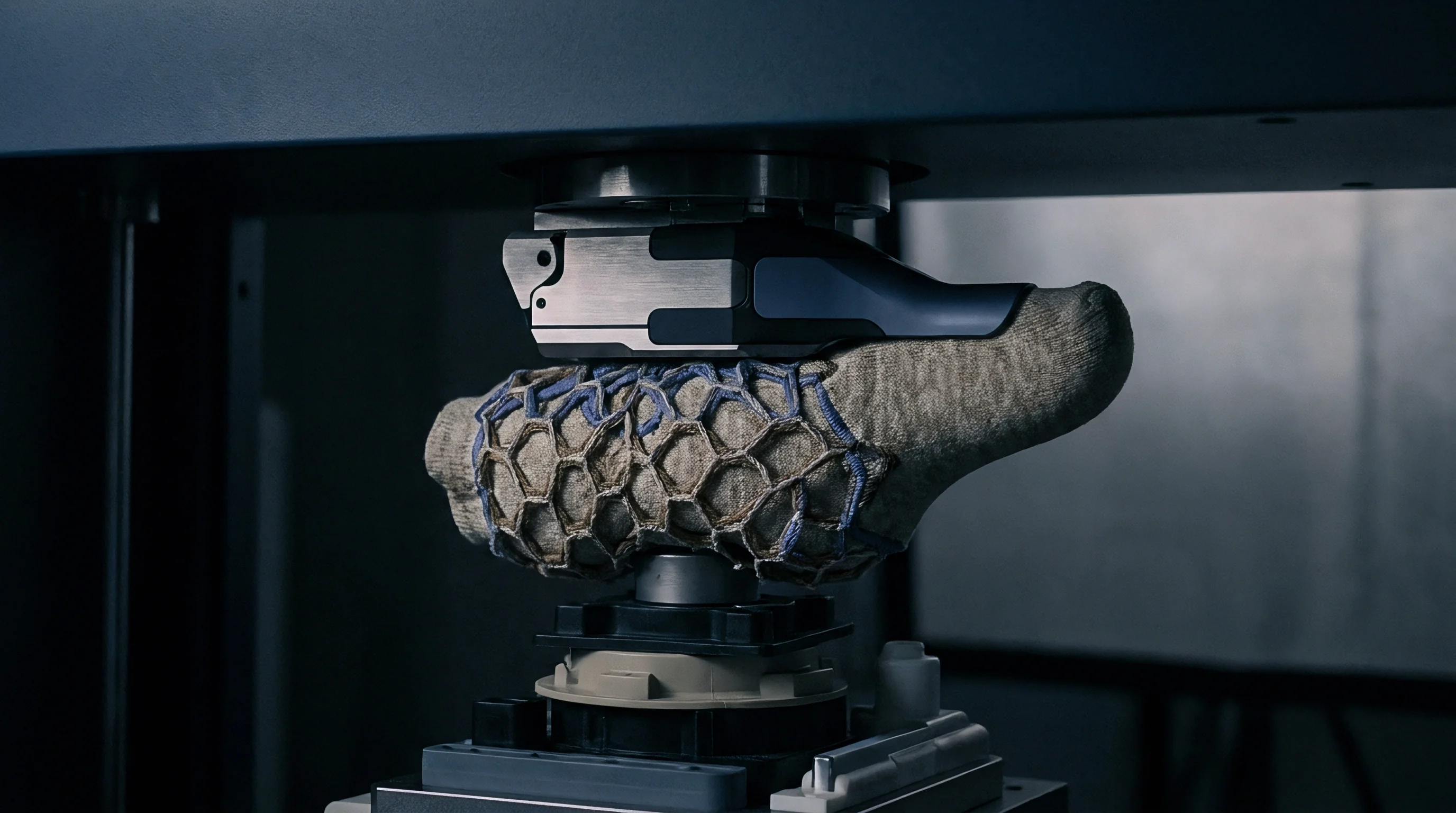
Direct verification of internal cavitation metrics demands precise analytical methodology applied to raw yarn samples before thermal setting or texturing occurs. Scanning electron microscopy performed on liquid nitrogen cryo-fractured cross-sections provides direct measurement of cell density, mean void diameter, and cell wall thickness. Cross-referencing micrographic data with gravimetric density determinations measured via helium pycnometry according to ISO 1183 standards ensures microscopic field observations reflect bulk yarn density shifts.
Testing linear density strictly under ISO 2060 prevents false weight claims when micro-cavitation alters core filament volume.
Single-filament mechanical testing reveals the structural penalty associated with non-equilibrium void generation. Standard tensile testing executed under ISO 2062 evaluates breaking force and elongation at break. Linear density variations caused by internal voiding shift the calculated tenacity values measured in centinewtons per tex.
A filament containing micro-voids presents a lower effective cross-sectional area of solid polymer than an uncavitated filament of identical outer diameter. Tensile strength calculations must account for true polymer cross-sectional area rather than nominal yarn diameter to isolate material degradation from geometric hollow volume effects.

Decompression Velocity and Filament Tenacity
Decompression rates directly alter the balance between void count and void diameter. Moderate decompression speeds yield fewer, larger voids that act as major structural flaws, causing early tensile failure under low elongation strains. Extremely high decompression speeds produce dense populations of sub-micron voids.
Small void size distributes mechanical stress more uniformly across the polymer cross-section, preserving a higher percentage of original filament tenacity despite identical total density reductions.
- Lot sampling selects ten bobbin packages randomly across the spinning creel, cutting away the outer 500 meters of yarn to eliminate surface transport damage.
- Conditioning balance stabilizes samples at 20 degrees Celsius and 65 percent relative humidity for 24 hours pursuant to ISO 139 standard atmosphere guidelines.
- Pycnometric density calculation determines true volumetric mass using helium gas displacement across five consecutive test runs per lot sample.
- Microstructural cross-sectioning prepares liquid-nitrogen fractured specimens for high-vacuum electron microscopy imaging across ten distinct field quadrants per filament.
- Tensile strength determination records breaking load and tenacity on twenty single-filament specimens per package using a constant rate of extension machine set to 250 millimeters per minute gauge length.
Yarn tenacity drops below 35 cN/tex often stem from spinneret decompression velocity profile shifts rather than raw polymer intrinsic viscosity variations.


Tariff

Customs Classification Shifts from Density Alteration
Micro-void creation through non-equilibrium cavitation changes the physical parameters used by customs authorities to establish yarn tariff classifications. Under Chapter 54 of the Harmonized Tariff Schedule, synthetic single yarns receive classification based on linear density, twist parameters, and structural morphology. When cavitated extrusions reduce yarn linear density below specific decitex thresholds while maintaining visual outer diameter, the declared tariff line can shift between subheadings.
Importers declaring solid filaments under HS 5402.47 risk reclassification into textured or hollow filament categories under HS 5402.33 if laboratory testing identifies internal void structures or modified cross-sectional profiles.
Duty rate differentials between standard synthetic filaments and modified hollow or micro-voided yarns create financial risk during cross-border shipping transactions. Harmonized System classification notes mandate that yarn weight declarations reflect dry polymer mass corrected for moisture regain and spin finish content per ISO 6741 procedures. Non-equilibrium voiding increases accessible surface area inside individual filaments, altering spin-finish absorption rates and moisture retention capacities.
Inaccurate accounting for added chemical finishes or retained moisture distorts verified dry yarn weight, triggering custom audit inquiries and duty reassessments.
| Yarn Sample Type | Nominal dtex | Bulk Density (g/cm³) | Tenacity (cN/tex) | Disperse Dye Take-up (%) | HS Code Classification |
|---|---|---|---|---|---|
| Solid Fully Drawn PET | 167 | 1.38 | 48.2 | 3.2 | 5402.47.00 |
| Low Cavitation Micro-Voided PET | 152 | 1.24 | 41.5 | 4.8 | 5402.33.90 |
| High Cavitation Micro-Voided PET | 135 | 1.08 | 33.1 | 6.7 | 5402.33.90 |
| Solid Drawn PA66 Filament | 110 | 1.14 | 52.0 | 4.1 | 5402.45.00 |
| Cavitated Microcellular PA66 Filament | 92 | 0.95 | 36.8 | 7.9 | 5402.31.00 |

Dye Regain and Shrinkage Behavior
Internal cavitation changes the dyeing kinetics of synthetic yarns during commercial batch processing. Sub-micron voids act as micro-channels that increase the diffusion rate of disperse dyes into polyester matrices or acid dyes into polyamide matrices. Dye bath exhaust rates accelerate when void volume fractions exceed 15 percent, allowing deep color shades to achieve fixation at lower bath temperatures.
Uncontrolled micro-cavitation yields variation in internal dye site accessibility, leading to streakiness or shade depth variation down the length of fabric rolls.
Thermal shrinkage rates also diverge in cavitated filaments. During heat setting or hot-water washing, thin polymer walls separating micro-cells undergo localized stress relaxation at temperatures below the glass transition point of solid polymer matrices. Higher void ratios correlate directly with elevated boiling water shrinkage measured under ISO 2060 guidelines.
Garment manufacturing specs must incorporate higher allowance margins for panel shrinkage when cutting fabrics woven from high-cavitation yarn lots.
Every commercial delivery contract must explicitly specify linear density tolerance bands locked to ISO 2060 dry mass determination to prevent tariff misdeclaration claims resulting from unannounced extrusion density modifications.


Cost

Financial Modeling of Extrusion Velocity Profiles
Optimizing decompression velocity involves balancing raw material yield gains against line productivity and yarn reject costs. High decompression rates reduce the mass of polymer required to produce a specific yarn diameter, increasing yarn meterage per ton of raw resin. Generating a 20 percent void volume fraction allows a mill to yield 1,250 meters of 135-dtex yarn from the same polymer mass that previously produced 1,000 meters of standard 167-dtex solid yarn.
The financial advantage vanishes quickly if rapid decompression causes filament breakage during high-speed texturing or weaving.
The total cost equation includes resin consumption, melt pump energy inputs, gas injection equipment maintenance, draw-frame efficiency losses, and quality reject rates. Pushing spinneret pressure drops beyond dynamic cavitation stability limits increases draw-line filament breaks. Line stoppages lower overall equipment effectiveness and generate high volumes of low-value scrap yarn.
Scrap yarn generated at the extrusion stage loses 85 percent of its original resin value when resold to mechanical recyclers.
| Operational Metric | Standard Solid Extrusion (Baseline) | Controlled Decompression (2 MPa/s) | Rapid Decompression (15 MPa/s) | Uncontrolled Decompression (45 MPa/s) |
|---|---|---|---|---|
| Raw PET Resin Cost ($/kg) | 1.25 | 1.25 | 1.25 | 1.25 |
| Finished Yarn Yield (meters/kg) | 5,988 | 6,600 | 7,407 | 8,403 |
| Extrusion Waste Rate (%) | 1.5 | 2.2 | 4.8 | 14.5 |
| Draw-line Break Rate (per ton) | 0.2 | 0.5 | 1.8 | 8.4 |
| Import Tariff Duty Rate (%) | 8.0 | 8.0 | 8.0 | 8.0 |
| Testing and Re-certification ($) | 450 | 1,200 | 1,200 | 3,500 |
| Landed Cost per 10,000m ($) | 2.16 | 2.01 | 1.87 | 2.28 |

Sensitivity Band for Reject Rates across Yield Targets
Operating financial models reveal a non-linear relationship between extrusion decompression velocity and landed yarn costs. Moderate decompression velocities around 15 MPa per second deliver optimal economic performance for micro-voided yarns. Yield gains offset moderate increases in testing costs and waste generation, reducing final landed cost per 10,000 meters of yarn by approximately 13.4 percent relative to solid filament baselines.
Dynamic cavitation modeling sets boundaries where raw resin mass savings exceed draw-line scrap losses.
Decompression rates exceeding 40 MPa per second trigger severe financial penalties. Filament breakage rates surge exponentially when cell wall thickness drops below critical structural thresholds. Extrusion waste rates reaching 14.5 percent completely destroy the cost advantage gained from reduced bulk density.
Re-testing and customs compliance verification costs multiply when lot density fluctuations force frequent tariff line reassessments. Procurement practices must establish clear boundaries for spinneret decompression velocities inside vendor manufacturing specs.
Steadier pressure reduction at the spinneret protects margin better than pushing extrusion velocity past the nucleation limit of the polymer melt.