Quantitative Fibre Blend Determination under ISO Standards
ISO quantitative determination requires pre-treatment extraction, selective chemical dissolution corrected by d-factors, and adjustments for commercial moisture.

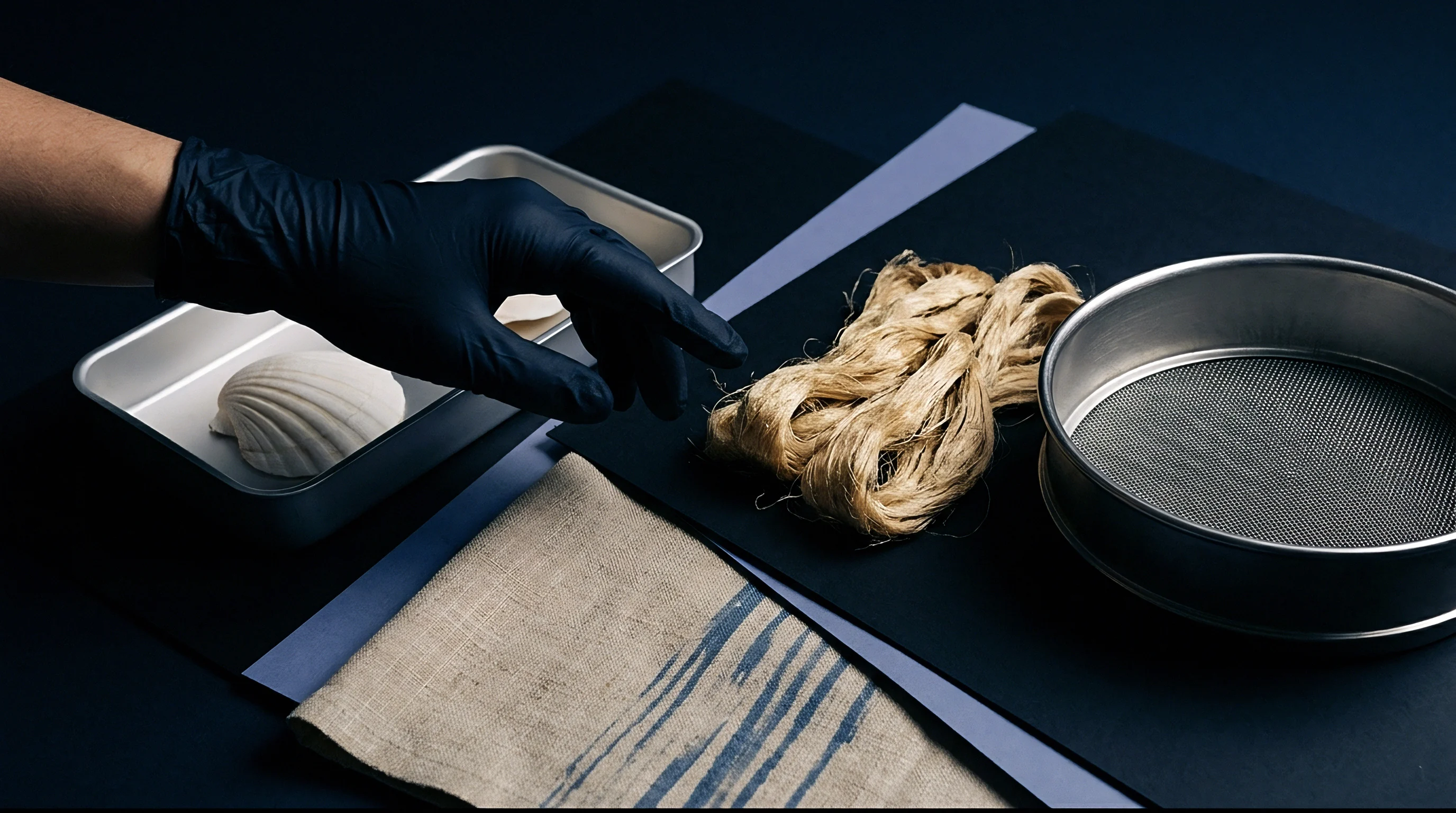
Rinse
Accurate analysis depends on removing non-fibrous processing aids first. Raw yarns and mill-finished piece goods carry lubricants, spin finishes, sizing agents, paraffin waxes, and water-soluble mineral salts that distort dry mass measurements. ISO 1833-1 sets out the mandatory pre-treatment required before selective chemical dissolution.
A test specimen of at least five grams undergoes continuous Soxhlet extraction with petroleum ether for one hour, cycling the solvent at least six times. This step extracts water-insoluble oils, processing fats, and paraffin compounds without altering the polymer chains.
Under ISO 1833-1, solvent extraction comes before chemical dissolution, followed by water extraction to remove residual salts. After the petroleum ether wash, the specimen steeps in cold distilled water for one hour at room temperature, then transfers to boiling distilled water for thirty minutes at a liquor-to-material ratio of 100:1. This thermal wash strips water-soluble starches, polyvinyl alcohol sizes, and polyacrylate finishing gums.
If desizing enzymes or targeted scouring agents are required for synthetic resins, ISO 1833-1 mandates confirming that these agents do not react with the baseline fibres.
Processing additions left in the yarn shift gravimetric ratios before chemical separation starts.
Leaving these additives behind inflates the specimen’s dry mass, introducing systematic errors that corrupt final customs classifications. For example, a four-percent sizing residue on a cotton warp yarn counts as unaccounted mass in gravimetric calculations, throwing off the dry ratio of a target 60/40 cotton and polyester blend.
Contaminants Extracted Prior to Quantitative Testing
- Petroleum-Soluble Lipids encompass paraffin waxes, mineral lubricating oils, and spinning lubricants deposited during yarn spinning.
- Water-Soluble Sizes include native starches, modified carboxymethyl cellulose, polyvinyl alcohol films, and residual surfactant salts washed out in boiling baths.
- Inorganic Surface Residues comprise machine metal traces, airborne mineral dusts, and insoluble salts cleared through mechanical agitation and thorough rinsing.
- Finishing Crosslinkers involve temporary topical softeners, antistatic agents, and fugitive tinting dyes stripped to isolate clean dry fibrous polymers.
Spinning mills frequently point to batch-to-batch sizing differences on the loom to explain composition drift.

Dissolution
Chemical gravimetry isolates individual component percentages by dissolving specific polymers with target reagents. ISO 1833 details twenty-four standard methods, each pairing a solvent with a binary or ternary fibre combination. The process dissolves one fibre group completely while leaving the co-blended partner untouched as an insoluble dry residue.
The technician filters the digestion mixture through a sintered glass crucible of porosity grade 3 or 4, washes the residue, dries the crucible in a ventilated oven at 105 degrees Celsius to constant mass, and cools it inside a desiccator over activated silica gel.
Different reagents act on specific polymers: acetone dissolves secondary acetate, formic acid dissolves polyamide, and sulfuric acid degrades cellulosic chains while cold baths preserve wool. Zinc chloride liquefies cellulosics within designated temperature ranges.

Could Selective Dissolution Degrade the Insoluble Residue?
Reagents chosen to digest one polymer often cause slight surface degradation or chain cleavage in the undissolved companion fibre. Standard methods correct for this loss by applying an empirical d-factor, calculated as the dry mass of clean insoluble residue remaining after exposure divided by its initial clean dry mass. Failing to apply this factor understates the mass of the insoluble fibre, artificially inflating the percentage of the dissolved component.
| Standard Part | Soluble Polymer | Dissolving Reagent | Insoluble Residue | Assigned Factor (d) |
|---|---|---|---|---|
| ISO 1833-3 | Secondary Acetate | Acetone at ambient temperature | Polyamide, Polyester, Wool, Cotton | 1.00 |
| ISO 1833-4 | Polyamide 6 or 6.6 | 80% mass fraction Formic Acid | Polyester, Wool, Cellulosics | 1.00 (Polyester), 1.01 (Cotton) |
| ISO 1833-7 | Polyamide | 90% mass fraction Formic Acid | Polypropylene, Aramid | 1.00 |
| ISO 1833-11 | Cellulosics (Cotton, Viscose) | 75% mass fraction Sulfuric Acid | Polyester | 1.00 |
| ISO 1833-12 | Polyacrylic | Dimethylformamide (DMF) at 90°C | Wool, Polyamide, Cotton, Polyester | 1.01 (Wool), 1.00 (Polyester) |
| Values represent published correction factors under standardized bath times and designated reagent concentrations. | ||||
Consider an analysis under ISO 1833-11 evaluating an intimate ring-spun yarn sold as 60% cotton and 40% polyester. The clean pre-treated specimen has an initial dry mass of 1.2540 grams. Digestion in 75% sulfuric acid at 50 degrees Celsius for one hour dissolves the cellulose completely.
The recovered polyester residue, dried to constant mass at 105 degrees Celsius, weighs 0.5090 grams. Multiplying this by the polyester d-factor of 1.00 leaves the residue mass at 0.5090 grams. Dividing 0.5090 grams by the initial dry mass of 1.2540 grams gives an insoluble polyester mass fraction of 40.59% on an oven-dry basis, establishing the dry cellulosic fraction at 59.41%.
ISO 1833-1 mandates duplicate determinations per laboratory sample, compelling a third run when results diverge beyond the stated repeatability limit.

Chemical Gravimetry Workflows across Binary Mixtures
- Specimen Desiccation stabilizes the washed sample to constant mass inside an oven at 105 degrees Celsius.
- Volumetric Reagent Metering introduces the precise chemical solvent at the liquor ratio mandated by the specific standard part.
- Thermostatic Digestion maintains the reaction vessel at calibrated temperatures with continuous mechanical agitation.
- Vacuum Filtration draws the digestion slurry through a tared sintered glass crucible to capture the undissolved residue.
- Gravimetric Taring establishes the bone-dry mass of the residue after two hours of oven desiccation and desiccator cooling.
Contracts governed by international arbitration rules routinely reject test certificates that omit empirical d-factor corrections.
Allowance
Commercial invoices adjust clean oven-dry masses by applying official moisture regain values, as different fibre polymers absorb atmospheric moisture at widely varying rates based on their molecular structure. Because of this, a dry mass split of 50% cotton and 50% polyester does not yield a 50/50 commercial weight ratio on a customs bill of entry. ISO 6741-1 governs commercial mass calculations, while ISO 1833-1 converts dry gravimetric ratios into commercial composition declarations using standardized commercial allowances.

How Do Official Allowances Shift Invoiced Percentages?
Take a binary intimate yarn spun from combed cotton and virgin staple polyester. ISO 1833-1 sets official moisture regain allowances of 8.50% for combed cotton and 1.50% for polyester yarn. A gravimetric separation yielding an identical dry mass of 50.00 grams for cotton and 50.00 grams for polyester shifts once commercial allowances are applied.
Cotton absorbs 8.50% of its dry mass in moisture, adjusting to 54.25 grams of commercial mass. Polyester absorbs 1.50%, yielding 50.75 grams of commercial mass.
A dry fifty-fifty split between combed cotton and polyester converts to 51.67% cotton and 48.33% polyester under ISO commercial mass allowances.
The total commercial mass of that 100-gram dry specimen increases to 105.00 grams. Dividing 54.25 grams by 105.00 grams gives an official cotton commercial content of 51.67%, leaving polyester at 48.33%. This analytical correction changes how the fabric is classified for customs.
Under the Harmonized Tariff Schedule, Chapter 52 applies to items containing 50% or more by weight of cotton, while Chapter 54 or 55 covers fabrics dominated by synthetic staple fibres. A single percentage point shift from moisture calculations determines whether an importer pays a 7% tariff rate under a synthetic heading or an 11% rate under a chief-weight cotton classification.
| Fibre Classification | ISO Commercial Regain (%) | Dry Specimen Mass (g) | Commercial Invoiced Mass (g) | Dominant Tariff Direction |
|---|---|---|---|---|
| Combed Cotton | 8.50 | 50.00 | 54.25 | Pulls blend toward Chapter 52 |
| Carded Cotton | 8.50 | 50.00 | 54.25 | Secures natural vegetable status |
| Virgin Polyester | 1.50 | 50.00 | 50.75 | Surrenders weight dominance |
| Viscose Rayon | 13.00 | 50.00 | 56.50 | Drives blend into Chapter 55 |
| Scoured Fine Wool | 18.25 | 50.00 | 59.13 | Pulls blend into Chapter 51 |
| Polyamide 6.6 | 6.25 | 50.00 | 53.13 | Elevates synthetic mass fraction |
Omitting moisture regain corrections exposes importers to misdeclaration penalties, retroactive audits, and potential seizure of non-compliant inventory.


Dissection
Mechanical separation serves as the reference method when yarn structures contain distinct component filaments. ISO 5088 governs the quantitative analysis of multi-component textiles using manual physical dissection. This protocol avoids harsh chemical reagents by unraveling composite plies, core-spun filaments, or distinct warp and weft yarns with fine tweezers under stereomicroscopes.
Laboratories rely on physical dismantling for core-spun stretch materials where synthetic polyurethane elastane cores are hidden inside cotton or wool sheathings.
Dissolving polyurethane elastane in boiling dimethylacetamide poses safety risks and frequently degrades delicate protein sheaths, whereas manual dissection isolates the components cleanly. The analyst clamps a conditioned yarn sample of known cut length into a dissection board under calibrated tension, then uses micro-dissection needles to strip the cotton sheath fibers away from the elastic core. Both separated fractions transfer to individual weighing bottles, dry in an oven at 105 degrees Celsius, and reach constant bone-dry mass.
Mechanical versus Chemical Isolation Selection Rules
- Core-Sheath Separation Feasibility dictates manual dissection for low-count stretch yarns where continuous elastane monofilaments remain physically extractable without breakage.
- Chemical Degradation Risk prompts mechanical sorting when dealing with protein fibres blended with modacrylics where shared reagent solubility destroys both polymers simultaneously.
- Intimate Blowroom Mixtures disqualify physical dissection, forcing gravimetric dissolution because mechanical picking cannot disentangle randomly mingled short staples.
- Yarn Twist Multipliers limit physical unraveling speed, as highly twisted voile or crepe yarns break elastomeric cores during needle manipulation.
Intimate fibre mixtures drawn from opening lines require chemical extraction, whereas plied and cored yarn systems yield cleanly to mechanical dissection.
Maintaining proper tension during manual elastane extraction is essential. Polyurethane filaments deform plastically if pulled with excessive force, snapping into short fragments that stay embedded inside the cellulosic sheath. The technician works under low tension, easing the sheath back along the yarn’s natural twist.
Mechanical deconstruction succeeds best when yarn twist is untwisted by hand before pulling core filaments free.

Margin
Statutory labeling rules must account for natural measurement dispersion in quantitative testing, as no laboratory method yields identical mass percentages across repeated samples from the same fabric roll. ISO 1833-1 defines specific parameters for repeatability and reproducibility boundaries. Repeatability represents the maximum acceptable difference between duplicate tests run in the same laboratory by the same technician using identical apparatus on a single sample lot.
For most binary chemical dissolutions, ISO 1833-1 sets this repeatability limit at one percentage point in absolute terms at a 95% confidence level.
Reproducibility measures acceptable variance between two independent laboratories analyzing split samples of the same roll. Under ISO 1833-1, this limit widens to two percentage points for binary mixtures. If Laboratory Alpha measures 58.5% cotton and 41.5% polyester on an imported twill, while customs Laboratory Beta records 60.5% cotton and 39.5% polyester, the two results remain in statistical agreement within that two-percent margin.
Commercially, however, that two-percent difference can trigger tariff disputes.
European Union Regulation 1007/2011 allows a manufacturing tolerance of three percentage points between the declared commercial composition on a garment label and the test results obtained via ISO 1833 methods. The United States Federal Trade Commission 16 CFR Part 303 enforces a similar three-percent rule that prohibits intentional composition shading. When a mill consistently targets the lower boundary to save on material costs, normal process variation can easily sweep the bulk lot outside statutory compliance.
Spinning mills blending carded cotton waste with recycled polyester frequently see lot-to-lot composition shifts of up to four percentage points. While chemical extraction of recycled polyethylene terephthalate remains straightforward, variations in raw bale moisture and blowroom blending introduce persistent scatter. When test tolerances intersect strict customs thresholds, commercial contracts must specify whether borderline composition claims are arbitrated on dry gravimetric mass or moisture-corrected commercial weight.