Standard Oven Drying Procedures for Cotton Moisture Regain Determination
Oven drying establishes the anhydrous mass of cotton at 105 degrees Celsius, providing the singular gravimetric basis for commercial regain calculation.


Basis
Trading raw cotton or processed lint purely by gross mass invites commercial friction. Atmospheric humidity alters baled lint weight continuously during ocean transit, dock storage, and mill staging. Water typically makes up between six and ten percent of baled raw cotton’s physical mass under standard ambient regimes.
Settlement therefore relies on an absolute reference: the oven-dry or anhydrous mass, determined by expelling unbound hygroscopic water at controlled thermal equilibrium.
The trade separates moisture regain from moisture content based on their starting denominators. Moisture regain calculates water loss as a direct percentage of the fibre’s bone-dry mass. Moisture content measures water mass as a percentage of the initial, undried sample weight.
Confusing these two expressions can alter invoice valuations by tens of thousands of dollars on a single vessel shipment.
ASTM D2495 establishes standard forced-draft oven dehydration at 105 to 110 degrees Celsius until mass constancy defines anhydrous fibre mass.
International standard bodies set fixed commercial regain allowances for contract settlements. The standard commercial regain for raw cotton lint stands at 8.50 percent under ISO 6741 and rules published by the International Cotton Advisory Committee. When baled cotton reaches a mill with an actual moisture regain of 6.20 percent, a purchaser billed on raw gross weight without moisture testing receives 23 kilograms of dry cellulose per ton below the expected adjustment balance.
Conversely, when lint arrives at 10.50 percent regain, the spinning mill pays virgin staple prices for water that simply evaporates during opening, cleaning, and carding.
Cellulose contains three hydroxyl groups on every anhydroglucose unit. Water molecules form primary hydrogen bonds directly with exposed hydroxyl groups within amorphous regions of the fibre matrix, while secondary water layers accumulate through weaker dipolar condensation inside inter-crystalline capillaries. Heating lint expels both capillary liquid and multi-layer hydrogen-bonded water.
Drying below the boiling point leaves stubborn mono-layer moisture trapped inside the amorphous core. Heating beyond 110 degrees Celsius degrades low-molecular-weight hemicelluloses, oxidises surface waxes, and drives off non-aqueous volatiles, distorting the dry mass calculation downward.
In practice, clean lint harvested from humid regions carries different residual non-cellulosic volatile levels than crop picked in arid climates.
Chamber
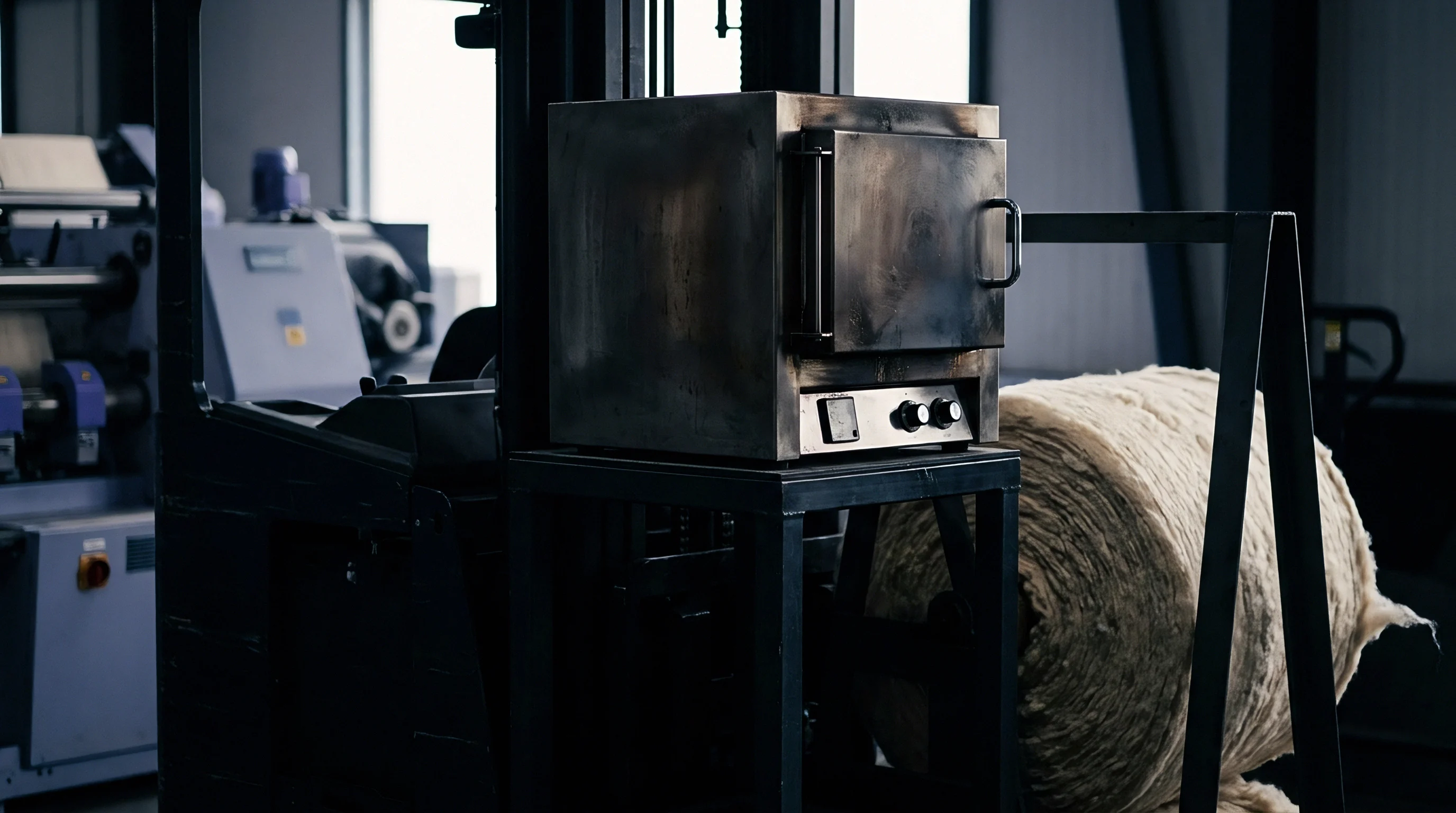
Commercial testing labs rely on electric forced-draft convection ovens designed specifically for textile fibres. The heating chamber circulates hot air rapidly, exceeding twenty complete air replacements per minute. Positive air displacement prevents stagnant pockets of humidity from gathering around drying samples.
Without a steady convective draft, water vapor escaping the core of a sample hovers inside the basket, creating an artificial microclimate of elevated vapor pressure that stalls further drying.
Air drawn into the chamber originates from the surrounding laboratory atmosphere, carrying its own moisture load. Relative humidity in an unconditioned testing facility fluctuates across shifts. Intake air holding 15 grams of water per kilogram of dry air at 25 degrees Celsius drops below 0.8 percent relative humidity when heated to 105 degrees Celsius inside the chamber, creating aggressive drying potential.
If laboratory air reaches extreme humidity levels during monsoons, incoming moisture reduces drying efficacy. High-precision laboratories equip their chambers with pre-conditioned air intake systems passing through desiccant beds to maintain dry-bulb stability.
| Standard Designation | Regulated Temperature | Drying Air Velocity | Endpoint Stability Criterion | Sample Mass Range |
|---|---|---|---|---|
| ASTM D2495 | 105 to 110 deg C | 0.1 to 0.5 m/s | Change below 0.1 percent across 15 min | 50 grams |
| ISO 6741-1 | 105 plus or minus 2 deg C | Positive forced circulation | Change below 0.05 percent across 20 min | 20 to 100 grams |
| USDA AMS Classing | 105 to 110 deg C | Forced displacement draft | Fixed cycle duration at verified air flow | 100 grams |
| IWTO-33 Modified | 105 plus or minus 3 deg C | Recirculated dry draft | Successive weighing within 0.02 percent | 50 to 200 grams |
Lint specimens dry from the outer surfaces inward, slowing down once heat reaches the interior core of dense fibre tufts. Compacting lint into the basket retards evaporation. Operators open specimens manually before charging the oven basket; fluffing the fibre bundles exposes surface area, permitting free thermal conduction and unimpeded vapor transfer.
Commercial contracts specify standard testing methods explicitly. When a contract designates ISO 6741-1, disputes over volatile loss during extended heating cycles are avoided because both parties bind their invoices to the specific endpoint mass criteria defined in that standard.
Tare
Accurate gravimetric testing depends heavily on container control, because bone-dry cotton acts as a potent desiccant. The instant bone-dry cotton contacts room air at 65 percent relative humidity, it regains moisture rapidly ~ a fifty-gram dry specimen gains over 0.15 grams of water weight within sixty seconds of open atmospheric exposure. Technicians balance speed against thermal accuracy by using internal weighing balances or airtight tare vessels.
Modern moisture ovens feature an analytical balance mounted directly above the heated chamber, connected to the sample basket by a heat-resistant wire extending through the ceiling. The technician weighs the basket while heated air circulates, closing the circulation damper for ten seconds before balance stabilization. This setup eliminates atmospheric exposure during intermediate drying intervals.
Internal weighing requires balance zero adjustments under full operating temperature to offset buoyancy errors caused by hot rising air currents.
Which Atmospheric Fluctuations Invalidate Laboratory Tare Records?
Rapid barometric shifts alter air density inside the weighing zone, while thermal expansion of metal suspension wires alters mechanical tare baselines during continuous multi-hour runs. When testing facilities use external balances without internal suspension links, technicians drop dried lint into airtight aluminum weighing canisters or ground-glass weighing bottles inside the drying oven. Containers must seal immediately before oven extraction.
Hot containers moved into ambient room conditions experience internal pressure reduction as internal air cools, drawing outside air through ungreased glass ground joints unless clamped firmly.
- Airtight weighing vessels prevent rapid absorption of ambient water vapor during transfer from heated oven shelves to external analytical balances.
- Desiccator cooling chambers bring sample containers down to room temperature without drawing in moist room air through cooling vacuum effects.
- External tare logs document individual container mass to four decimal places prior to every specimen insertion cycle.
- Precision suspension hooks shield the sample from internal chamber drafts during automated intermediate weighing routines within advanced convective housings.
Cooling hot canisters inside desiccators introduces delay, and the silica gel inside requires regular thermal regeneration. Spent silica gel leaves ambient moisture inside the desiccator chamber, allowing dried specimens to gain mass while cooling. Balances read to five decimal places, but uncalibrated tare mass introduces systematic bias across entire commercial lots.
Faulty container sealing skews dry mass readings upward, depressing calculated moisture regain and undercounting deliverable dry fiber.
Computation
Calculating final figures from raw balance readings produces two commercial values: actual moisture regain and official invoice weight. Moisture regain expresses the mass of expelled water divided by final oven-dry mass. Moisture content expresses the mass of expelled water divided by original gross mass.
Mathematical expressions govern these values without ambiguity. Let original sample mass equal mass initial, recorded as M1. Let dry sample mass equal mass anhydrous, recorded as M2.
Moisture Regain percentage equals open parenthesis M1 minus M2 close parenthesis divided by M2, multiplied by one hundred.
Moisture Content percentage equals open parenthesis M1 minus M2 close parenthesis divided by M1, multiplied by one hundred.
Commercial mass calculations adjust physical consignment weight to the contract baseline regain value. Contract commercial regain sits universally at 8.50 percent for standard carded or combed cotton lint transactions. Let M commercial represent billed commercial mass.
Let M physical represent the gross mass of the consignment weighed on certified dock scales. Let R actual represent the laboratory-determined moisture regain percentage. Let R commercial represent the standard contractual regain percentage of 8.50 percent.
Commercial mass is calculated through direct proportion:
M commercial equals M physical multiplied by open parenthesis one hundred plus R commercial close parenthesis, divided by open parenthesis one hundred plus R actual close parenthesis.
| Physical Lot Weight | Laboratory Regain Found | Anhydrous Mass Calculated | Official Commercial Mass | Net Invoiced Mass Variance |
|---|---|---|---|---|
| 100,000 kg | 6.50 percent | 93,896.71 kg | 101,877.93 kg | plus 1,877.93 kg |
| 100,000 kg | 7.50 percent | 93,023.26 kg | 100,930.23 kg | plus 930.23 kg |
| 100,000 kg | 8.50 percent | 92,165.90 kg | 100,000.00 kg | 0.00 kg |
| 100,000 kg | 9.50 percent | 91,324.20 kg | 99,086.76 kg | minus 913.24 kg |
| 100,000 kg | 10.50 percent | 90,497.74 kg | 98,189.05 kg | minus 1,810.95 kg |
| 100,000 kg | 11.50 percent | 89,686.10 kg | 97,309.42 kg | minus 2,690.58 kg |
| Calculations employ the official standard commercial regain of 8.50 percent over anhydrous mass in accordance with ISO 6741-2. | ||||
Take a 100-metric-ton lot traded at 2.10 dollars per kilogram base price. If actual regain lands at 10.50 percent, deliverable commercial mass drops to 98,189.05 kilograms. The buyer deducts 1,810.95 kilograms from the gross invoice, resulting in a credit adjustment of 3,802.99 dollars.
If the mill classer accepts gross scale receipts without drying testing, the purchasing firm pays virgin fibre prices for 1.8 tons of atmospheric water vapor.
A lot weighing 100,000 kilograms at 10.50 percent regain yields 90,497.74 kilograms of bone-dry cellulose.
Operational disputes sharpen when testing raw cotton containing non-cellulosic matter. Raw seed cotton carries waxes, pectins, fragmented seed coats, and soil micro-dust. Does the standard drying temperature expel non-aqueous volatile fractions alongside free moisture?
Arbitration
Commercial contracts resolve testing disputes through independent reference laboratories. Discrepancies between mill laboratory findings and trading house declarations stem from sampling procedure errors or thermal calibration drift. Cotton samples drawn from bale surfaces exhibit higher moisture volatility than core samples drawn with pneumatic tools, which penetrate at least thirty centimeters into the compressed bale body to extract fibre insulated from ambient warehouse humidity changes.
Sampling requires strict protocol chains. Technicians draw representative cores from ten percent of bales across a delivery lot and combine these subsamples immediately inside moisture-vapor-barrier foil laminate pouches. Heat-sealing these envelopes prevents evaporation during transit between dock warehouse sampling locations and testing ovens.
- Lot sampling extracts representative core plugs from ten percent of randomly selected bales, placing lint straight into pre-weighed hermetic vapor bags.
- Gross lot receipt documents total gross mass across certified weighbridges at the exact hour core sampling occurs, fixing baseline delivery weight.
- Laboratory subsampling splits bulk composite material into 50-gram test specimens using manual quartering techniques, avoiding mechanical blending that generates friction heat.
- Thermal drying cycles expose open specimens to continuous 105 degree Celsius airflow until consecutive weighings confirm mass stability.
- Calculation verification translates balance receipts into agreed commercial mass sheets, applying the contractual 8.50 percent standard regain allowance.
Drying greige cotton lint at 105 degrees Celsius drives off volatile components beyond water. Trace quantities of waxes vaporize during sustained multi-hour heating cycles, and seed coat fragments lose organic volatile fractions. In high-purity transactions involving medical or bleached cotton, solvent extraction precedes oven drying to isolate clean dry cellulose mass.
In commercial commodity trades, parties absorb minor volatile loss inside standard tolerances: testing houses regard two regain determinations on the same lot as congruent when balance outcomes fall within 0.20 percent absolute regain difference.
Independent arbitration panels rely on certified retained sample pouches held under unbroken seals. When test variances exceed the 0.20 percent tolerance, the referee laboratory dries the retained arbitration specimens under strict convection controls. That resulting referee regain value supersedes initial testing certifications, establishing final invoicing and duty valuation parameters across international customs checkpoints.