Adjusting Commercial Invoice Weights Based on Lab Oven Test Results
Adjust commercial invoices by recalculating landed weights using lab oven-dry mass plus official ISO regain allowances to issue precise credit notes.
Regain
Textile raw materials absorb atmospheric water vapor until reaching equilibrium with ambient air, meaning scale weight at a receiving dock often reflects local humidity and transit conditions rather than the actual weight of dry fiber delivered. Standard regain replaces this variable water mass with a fixed contractual allowance. Commercial trading rules set these standard regain values for each fibre category to provide a uniform basis for buying, selling, and invoicing shipments.
Moisture Content Differentiation from Commercial Regain
Calculations for commercial mass rely on dry mass as a stable denominator. Industry literature distinguishes clearly between moisture content and moisture regain: moisture content measures water mass as a percentage of total wet sample mass, while moisture regain measures water mass against the dry sample mass obtained after thermal desiccation. Commercial contracts calculate invoice adjustments exclusively on moisture regain percentages specified in standards such as ISO 6741-1 and ASTM D1909.
Raw wool shipments standard commercial regain calculation fixes official moisture allowance at 18.25 percent under ISO 6741 conditioning protocol.

Standard Allowances across Principal Fibre Categories
Official trade regulations establish uniform percentages to standardize contract valuations across raw material types. Synthetic fibres absorb minimal water vapor, whereas natural and regenerated cellulosic materials are highly hygroscopic. When yarns or fibres move along maritime transport corridors, ambient weight shifts do not alter the contractual commercial mass unless the measured dry mass itself changes.
| Fibre Type | Standard Regain (%) | Commercial Allowance (%) | Equivalent Content (%) |
|---|---|---|---|
| Combed Cotton Yarn | 8.50 | 8.50 | 7.83 |
| Scoured Wool Top | 18.25 | 18.25 | 15.43 |
| Viscose Rayon Staple | 13.00 | 13.00 | 11.50 |
| Polyester Filament | 1.50 | 1.50 | 1.48 |
| Nylon 6,6 Staple | 4.50 | 4.50 | 4.31 |
| Acrylic Staple | 2.00 | 2.00 | 1.96 |
Purchasing hydrophobic synthetic yarns on raw gross weight without moisture testing regularly transfers atmospheric water weight directly onto the buyer’s ledger.

Oven
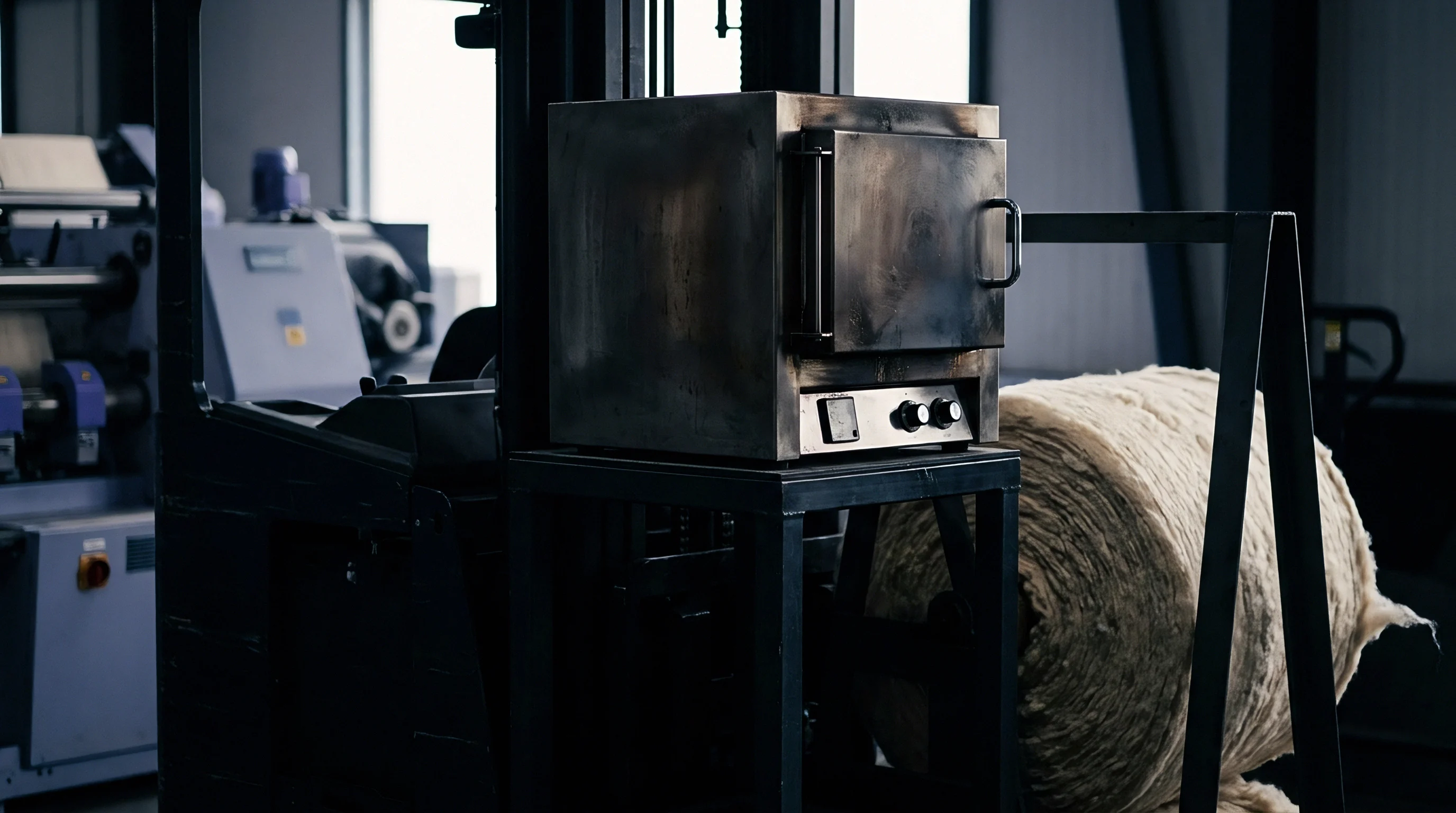
Laboratory thermal desiccation establishes the absolute dry weight of textile samples by evaporating free ambient water. Testing relies on a ventilated drying apparatus configured to maintain uniform thermal conditions throughout the chamber volume.

Standardized Drying Parameters and Temperature Controls
Testing protocols enforce a constant thermal zone of 105 degrees Celsius to 110 degrees Celsius inside forced-draft heating chambers. Forced air circulation removes vaporized moisture from the specimen surface and exhausts humid air outside the cabinet. Heating continues until successive weighings demonstrate complete moisture removal without thermally degrading the polymer structure.

Core Sampling and Weighing Protocol
Technicians extract representative sub-samples from internal bale zones using motorized specimen tubes. Sampling depth directly affects lab readings, and sample containers require precise tare recording. The extraction process follows standardized sequence rules to capture representative moisture distributions across the entire shipment lot.
- Extract core specimens from at least ten percent of bales in the shipment lot.
- Transfer samples immediately into sealed airtight containers to prevent ambient moisture absorption during transport.
- Record initial sample mass on a calibrated analytical balance before placement in the heated chamber.
- Maintain chamber airflow at 105 degrees Celsius until successive weighings spaced fifteen minutes apart differ by less than 0.05 percent.
- Record the final dried specimen mass while hot inside the chamber balance or inside an evacuated desiccator container.
Higher destination weight loss may stem from high humidity during maritime transit rather than excessive moisture at origin packing.

Formula
Converting raw scale arrivals into correct commercial mass requires mathematically adjusting dry specimen weights by official regain allowances. This commercial mass represents the exact net weight a buyer pays for under international contract terms.
Commercial Mass Calculation Parameters
Determining invoice adjustments relies on four distinct quantitative variables measured during physical testing.
- Gross arrived mass measures total weight recorded at the receiving dock including bale ties, packaging materials, and absorbed atmospheric moisture.
- Tare weight quantifies external packaging wrappers, straps, and protective coverings removed prior to fibre sampling.
- Oven dry mass ratio establishes the exact percentage of bone-dry solid material contained within extracted test core samples.
- Commercial regain percentage applies the standard moisture allowance designated for the specific fibre composition under trade contract terms.
Incorporating ISO 6741-1 commercial mass rules into the purchasing contract binds invoice pricing strictly to standard regain adjusted weight rather than raw scale arrivals.
Worked Shipment Weight Adjustment Calculation
A 20,000 kilogram lot of combed cotton yarn arrives with an invoiced gross weight based on ambient packing floor conditions. The buyer pays $4.50 USD per kilogram based on net invoice terms. Upon arrival at the receiving warehouse, receiving clerks log a gross scale weight of 20,400 kilograms.
Packaging materials and tare weigh exactly 400 kilograms, yielding a net arrived weight of 20,000 kilograms.
Laboratory technicians draw core samples from the shipment and subject them to thermal desiccation at 105 degrees Celsius per ISO 6741-1. The laboratory reports an actual moisture regain of 10.50 percent in the arrived yarn. The standard commercial regain allowance for combed cotton yarn under the sales contract equals 8.50 percent.
To determine the oven-dry mass of the net arrived lot, the technician divides the net arrived weight by 1 plus the sample moisture regain expressed as a decimal:
Oven Dry Mass = 20,000 kg / (1 + 0.1050) = 20,000 / 1.1050 = 18,099.55 kilograms bone-dry material.
To compute the correct contract Commercial Mass, the oven-dry mass is multiplied by 1 plus the official contract commercial regain allowance of 8.50 percent:
Commercial Mass = 18,099.55 kg x (1 + 0.0850) = 18,099.55 x 1.0850 = 19,637.99 kilograms commercial weight.
Excess water inflates landed shipping costs. Here, the calculated Commercial Mass of 19,637.99 kilograms demonstrates a short delivery of 362.01 kilograms against the invoiced net weight of 20,000 kilograms. Multiplying the 362.01 kilogram deficit by the contract price of $4.50 USD per kilogram yields a total financial invoice credit of $1,629.05 USD owed to the buyer.
| Shipment Scenario | Net Arrived Mass (kg) | Lab Test Regain (%) | Oven-Dry Mass (kg) | Commercial Mass (kg) | Invoice Adjustment ($) |
|---|---|---|---|---|---|
| High Moisture Origin Packing | 20,000.00 | 10.50 | 18,099.55 | 19,637.99 | -1,629.05 Credit |
| Standard Contract Condition | 20,000.00 | 8.50 | 18,433.18 | 20,000.00 | 0.00 Parity |
| Low Moisture Arid Packing | 20,000.00 | 6.50 | 18,779.34 | 20,375.58 | +1,690.11 Debit |
Inserting IWTO Draft Contract Rule 14 into raw wool procurement contracts automatically mandates invoice settlement against certified oven-dry mass testing rather than bill-of-lading net weight.

Discrepancy
Variations between seller shipping certificates and buyer arrival laboratory reports frequently trigger commercial financial disputes. When discrepancy claims require immediate core sampling, systematic evaluation isolates measurement errors from physical cargo weight loss during transit.
Why Do Destination Oven Results Drift from Certificates?
Environmental humidity shifts during ocean transit alter external bale surfaces while internal core areas maintain packing moisture. Sampling depth influences the resulting moisture regain calculation when technicians fail to drive core tubes into the center of dense textile bales.
Bale moisture gradients remain the primary source of laboratory weight discrepancy between dispatch and receiving ports.
Inter-Laboratory Testing Tolerances and Calibration Standards
Accredited testing facilities operate within established precision limits for moisture determination. When seller and buyer laboratories return differing moisture regain figures, technical managers review analytical procedures for procedural variances.
- Buoyancy weighing errors occur when laboratory technicians weigh hot desiccated specimens outside sealed balance chambers without density corrections.
- Inadequate thermal duration leaves chemically bound or deep internal moisture unevaporated prior to final sample weight recording.
- Atmospheric reabsorption alters bone-dry mass values when sample containers transfer through ambient room air without desiccant protection.
- Non-representative core sampling extracts specimens solely from dry outer layers or damp inner centers rather than proportional lot zones.
| Fibre Blend Category | Repeatability Limit (%) | Reproducibility Limit (%) | Claim Threshold (%) |
|---|---|---|---|
| 100% Cotton Spun Yarns | 0.20 | 0.50 | 0.50 |
| 100% Scoured Wool Top | 0.30 | 0.70 | 0.75 |
| Viscose Cellulosic Blends | 0.25 | 0.60 | 0.50 |
| Polyester Cotton Blends | 0.15 | 0.40 | 0.35 |
Industry trade groups continue to debate whether ambient moisture fluctuations during forty-day container shipping warrant automatic price adjustments when total weight shifts stay within one half percent.
Ledger
Translating laboratory moisture test certificates into formal accounting adjustments protects profit margins during raw material procurement. Systematic administrative auditing ensures commercial invoice totals align precisely with physical fiber delivered.
Commercial Claim Documentation Requirements
Filing a valid debit note against an overbilled yarn or fibre invoice demands complete test reports from certified independent laboratories. Commercial claim dossiers present complete physical sampling logs alongside mathematical conversion workings.
- Certified sampling certificates document exact container numbers, bale identification tags, and sampling dates signed by an independent inspector.
- Oven dry test reports detail initial specimen mass, drying temperatures, final constant weight logs, and calculated moisture regain percentages.
- Formal recalculation worksheets present step-by-step arithmetic deriving commercial mass from gross arrival weights and net invoice units.
- Official debit note invoices state the precise dollar amount deducted from supplier payables based on audited commercial weight shortfalls.
Invoices based on scale weight without moisture testing transfer atmospheric humidity costs directly onto the buyer.

Landed Cost Accounting and Tariff Impact
Adjusting commercial weight downwards reduces customs duty obligations assessed on specific weight tariffs. When customs authorities assess duties on net weight kilograms, filing corrected commercial mass documentation prevents overpayment of import taxes. Accurate mass accounting aligns raw material inventory valuations with actual yield on spinning frames and weaving looms.
Failing to audit commercial invoice weights against accredited lab oven test results forces buyers to pay premium yarn prices for absorbed environmental water.