Volumetric Medullation Corrections for Guard Hair Mass Balance Reconciliation in Mechanical Dehairing
Volumetric medullation corrections eliminate phantom guard hair mass by deducting central lumen void volume from optical diameter mass balance calculations.
Void

Optical Diameter Discrepancies in Dehairing Yield
Mechanical separation lines processing raw cashmere, camel hair, or yak fibre separate unmedullated fine underdown from coarse, medullated guard hairs. Technologists evaluating carding and centrifugal separation efficiency frequently rely on projected diameter measurements from optical analyzers. Instruments such as the Optical Fibre Diameter Analyser or projection microscopes measure the outer boundary profile of individual snippets.
Calculating mass fractions directly from these two-dimensional silhouettes generates a systematic mathematical error. Raw animal fibres do not possess uniform internal density.
Solid keratin exhibits a skeletal density of approximately 1.31 grams per cubic centimetre at standard testing conditions of 20 degrees Celsius and 65 percent relative humidity. Coarse guard hairs exceeding 30 micrometres in diameter possess central honeycombed chambers known as medullae. These chambers consist of shrunken, air-filled cellular remnants surrounded by cornified cell walls.
The central cavity contributes to the projected optical width while contributing negligible solid mass. Converting projected optical diameters into volume using standard cylindrical formulas assumes a completely solid cylinder across every micron class.
Fine underdown fractions calculated purely from uncorrected optical projections consistently understate mechanical yield by three to seven percentage points against physical clean balance.
When an optical distribution profile counts five thousand fibre snippets and derives a coarse hair content of 0.80 percent by solid volume calculation, the actual gravimetric proportion of guard hair is lower. The dry weight of the removed coarse fraction fails to match the predicted mass derived from the optical diameter distribution. Processing plants monitoring mass balances across multi-cylinder dehairing lines encounter unexplained mass shortfalls in their waste streams.
Technologists attribute this missing mass to fly loss or moisture evaporation when the true discrepancy stems from calculating hollow cylindrical volume as solid keratin.
Keratin Mass Displacement across Hollow Coarse Fibres
The internal architecture of animal guard hair alters the gravimetric relationship between fibre diameter and physical weight. A solid down fibre of 15.5 micrometres contains solid cortex and cuticle throughout its entire cross-section. A 65-micrometre guard hair from the same cashmere fleece contains an extensive medulla that can occupy 40 to 70 percent of the total cross-sectional diameter.
The volume occupied by air inside the medulla produces zero downward deflection on an analytical balance, yet every optical sensor records that air pocket as solid, dense keratin.
| Fibre Classification | Mean Diameter (um) | Medulla Diameter (um) | Medullary Area Fraction (%) | Effective Density (g/cm3) |
|---|---|---|---|---|
| Fine Cashmere Down | 15.2 | 0.0 | 0.0 | 1.312 |
| Intermediate Cashmere Hair | 28.4 | 8.6 | 9.2 | 1.191 |
| Coarse Cashmere Guard | 62.7 | 41.3 | 43.4 | 0.743 |
| Bactrian Camel Down | 18.1 | 0.0 | 0.0 | 1.310 |
| Coarse Camel Guard | 84.5 | 63.2 | 56.0 | 0.577 |
| Yak Outer Coat | 76.0 | 49.5 | 42.4 | 0.756 |
Uncorrected mass calculations inflate the perceived weight of the guard hair fraction. This calculation skew distorts the yield ledger of the mechanical dehairing plant. When mills price raw cashmere grease lots based on raw fleece composition determined by optical diameter analysis without internal cavity compensation, they overvalue the expected coarse waste mass.
The line manager expects to strip out 450 kilograms of coarse waste from a one-tonne lot based on an unadjusted optical distribution of coarse fibres, but the drop pans collect only 320 kilograms of physical coarse hair. The financial consequence of this analytical gap is the structural misallocation of raw greasy fibre procurement capital based on phantom guard hair weights that vanish during carding.
Lumen
Morphological Variations in Medullary Porosity
Internal medullary structures across coarse animal coats follow distinct structural patterns that dictate the magnitude of the volumetric adjustment. Microscopic cross-sections reveal four distinct structural medullary classifications: fragmented, interrupted, continuous, and lattice. Cashmere guard hair predominantly exhibits a continuous lattice medulla where desiccated, polyhedral cell structures form an intricate spongy network.
In camel guard hairs, the central cavity frequently presents an open, tubular lumen containing minimal dried cellular residue, leaving large unbroken air pockets.
The effective dry density of an individual fibre segment varies directly with the medullary diameter ratio, defined as the diameter of the central core divided by the total outer diameter of the fibre. In fine down below 19 micrometres, this ratio remains zero. As fibre thickness crosses the threshold into intermediate coarse hair at 30 micrometres, the ratio emerges near 0.25.
In mature guard hairs exceeding 60 micrometres, the medullary ratio routinely exceeds 0.65, rendering over forty percent of the cross-sectional area hollow.
Fibre lumen geometry shifts the effective keratin density from 1.31 grams per cubic centimetre down to 0.58 grams per cubic centimetre in coarse camel hair fractions.
Calculating the true dry weight of an individual fibre segment involves integrating cross-sectional area along the length of the fibre snippets. Because optical measurements take profile views, an elliptical fibre oriented along its major axis presents an inflated diameter reading. Combining elliptical cross-sections with an asymmetrical internal lumen compounds the mathematical overstatement.
Accurate geometric modeling relies on measuring both outer boundaries and inner medullary walls through calibrated image analysis systems.
Cylindrical Volume Equations for Fractional Voidage
Mathematical reconciliation between physical mass and optical distribution demands a segmented volumetric model. The total volume of a cylindrical fibre segment equals the product of its length and total cross-sectional area. The solid keratin volume subtracts the internal cavity volume from this gross cylinder.
The volumetric correction factor expresses the ratio of true keratin volume to total envelope volume across each individual diameter interval.
Let the total cross-sectional area of a fibre snippet be designated as A_total, and the medullary cross-sectional area be designated as A_med. For an elliptical profile with major diameter D_1 and minor diameter D_2, the total outer area equals pi multiplied by D_1 and D_2 divided by four. If the internal cavity follows an elliptical profile with inner axes d_1 and d_2, the solid keratin area equals pi divided by four multiplied by the difference between the outer product and the inner product.
The effective density rho_eff of the fibre snippet relates directly to the skeletal density of solid cortical keratin rho_keratin through the equation:
rho_eff = rho_keratin (1 – (A_med / A_total) (1 – (rho_cell / rho_keratin)))
The cellular remnant density rho_cell represents the dry mass of desiccated medullary membranes, which experimental gravimetric pycnometry places at 0.08 grams per cubic centimetre. When technologists ignore this correction, setting the cavity volume to zero, the predicted mass of the guard hair fraction scales with the square of the outer diameter. A sixty-micrometre guard hair contains sixteen times the apparent cylindrical volume of a fifteen-micrometre down fibre.
With a true medullary area fraction of 50 percent, its actual keratin mass equals eight times the down fibre mass. Unadjusted calculation models assign double the actual physical mass to that guard hair snippet.
Whether dynamic changes in ambient processing moisture cause the desiccated cellular matrix within the central cavity to swell disproportionately compared to the cortical keratin sleeve remains completely unresolved in published literature.

Sensor
Projection Microscopy and Automated Diameter Analyzers
Testing laboratories determine fibre diameter distributions using standardized instrument platforms that operate on distinct physical principles. The manual projection microscope method defined in IWTO-8 requires an operator to view snippets suspended in cedarwood oil or liquid paraffin at 500 times magnification. The analyst measures total diameter and medullary width using a calibrated graduated scale.
This manual technique captures true inner and outer dimensions directly, but the slow counting rate limits sample sizes to roughly 800 to 1,600 snippets per test lot. Statistical confidence on the low-frequency guard hair tail remains wide.
Automated instruments like the Optical Fibre Diameter Analyser measure thousands of snippets suspended on a moving glass slide within minutes. The instrument uses a charge-coupled device camera to capture profile shadows under transmitted light. Early hardware platforms evaluated only the outer shadow boundary, recording all coarse fibres as uniform solid cylinders.
Modern setups implement gray-scale opacity thresholding to identify whether a central brightness peak exists within the shadow. The presence of internal brightness indicates that transmitted light passed through a hollow, air-filled central cavity without complete cortical absorption.
IWTO-57 provisions govern the automated optical classification of medullated fragments but leave the gravimetric density assignment to private commercial agreement.
When the testing setup lacks secondary gray-scale threshold verification, every guard hair snippet registers as solid keratin. This analytical limitation generates discrepancies between laboratory certificates and processing yields. Dehairing mills find that lots showing identical mean diameter, standard deviation, and coarse hair count on standard commercial test reports yield entirely different ratios of dehaired down sliver to card drop waste.
The difference traces directly to the presence of hollow lumens that the primary optical instrument recorded merely as dark, opaque borders.
Refractive Index Immersion and Opacity Profiling
Overcoming the limitations of dry profile imaging involves optical immersion techniques. Suspending fibre snippets in a liquid medium matching the refractive index of solid keratin (approximately 1.53 at 20 degrees Celsius) renders the cortical walls transparent under white light. The air inside a hollow medulla possesses a refractive index near 1.00, creating strong phase boundaries and high visual contrast at the cavity wall.
This optical contrast allows automated image analysis algorithms to segment the medullary boundary with high spatial precision.
Analytical routines measuring medullation percentage across bulk sample lots execute a standardized procedural sequence:
- Snippet cutting reduces conditioned sliver or raw fleece staples into 0.8-millimetre segments using an automated dual-blade guillotine.
- Fluid dispersion suspends roughly thirty thousand snippets into an optical cell containing a non-swelling liquid medium calibrated to a refractive index of 1.530.
- Transmitted illumination scanning captures high-resolution digital frames across the entire dispersion volume while maintaining telecentric focus.
- Boundary segmentation algorithms calculate outer fibre perimeter and internal lumen area for every classified entity above 25 micrometres.
- Volumetric integration converts individual two-dimensional elliptical area profiles into discrete hollow cylinder volumes assigned to specific micron bins.
The processing mill states that raw fibre lots from the southern steppe always run five percent lower in dehaired yield due to heavier hair weight, passing over the reality that their bench microscope was simply miscalibrated to read hollow guard hair as solid keratin.

Split
Mechanical Carding Separation and Mass Balance Drift
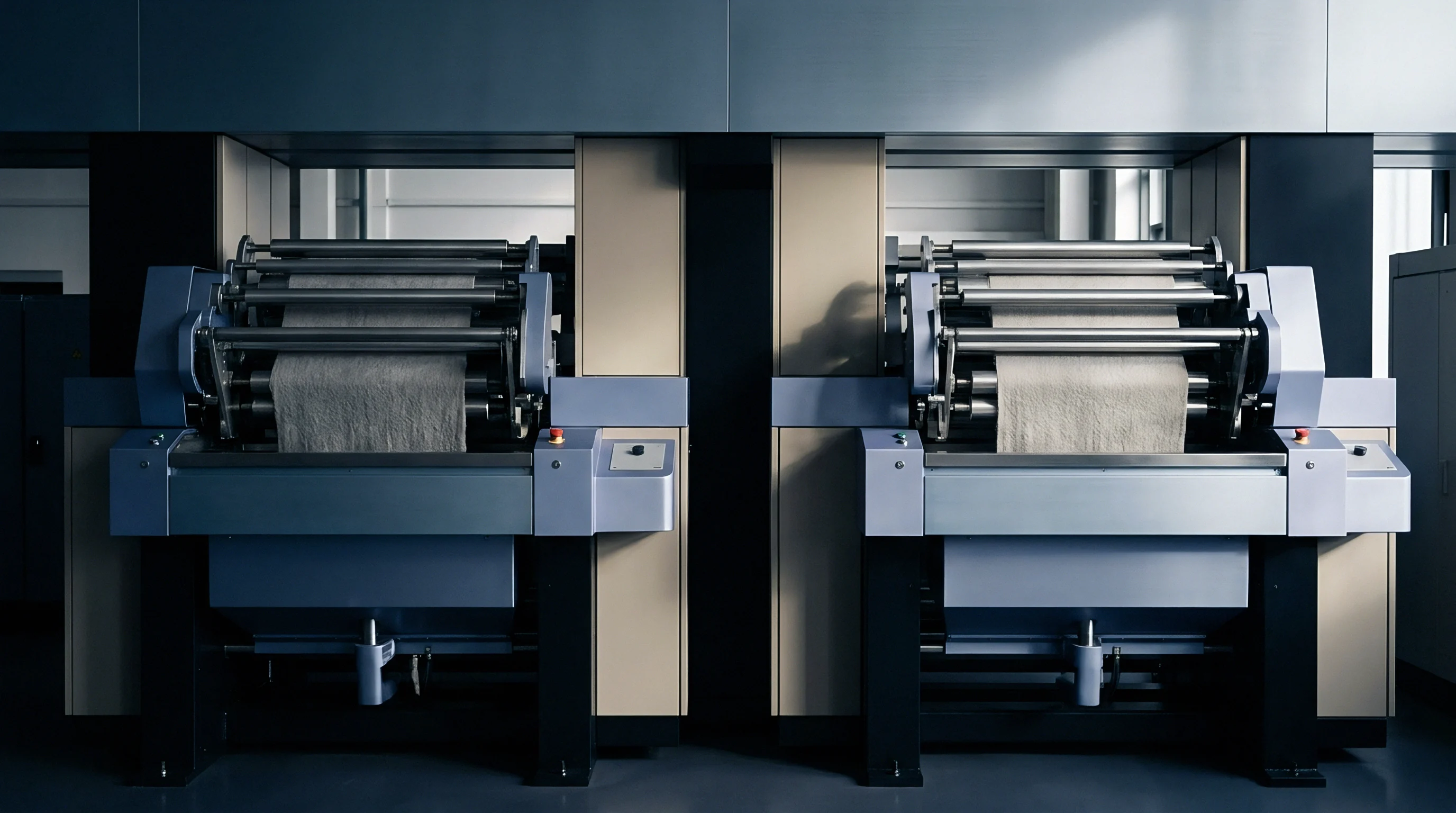
Industrial dehairing lines operate as a series of interconnected carding cylinders, workers, strippers, and high-speed centrifugal beaters. The operational objective is the physical separation of fine down fibres from stiff guard hairs through differential centrifugal force, aerodynamic flotation, and mechanical card clothing action. Because coarse guard hairs possess greater bending rigidity and larger individual mass than fine down, centrifugal acceleration expels coarse fibres outward into waste hoppers while fine fibres remain engaged within the card wire.
Engineers manage dehairing plants through continuous mass balance tracking. The incoming mass of conditioned, scoured raw fibre must balance the sum of dehaired down sliver, coarse drop waste, opening dross, and airborne lint loss. If the plant control system relies on uncorrected optical evaluations of incoming and outgoing streams, the mathematical ledger fails to close.
The uncorrected calculation overpredicts the mass of coarse guard hair in the waste streams, leading technicians to chase non-existent material losses.
| Processing Stream Fraction | Actual Measured Mass (kg) | Uncorrected Optical Model (kg) | Volumetrically Corrected Model (kg) | Model Discrepancy (kg) |
|---|---|---|---|---|
| Scoured Feed Lot | 1000.0 | 1000.0 | 1000.0 | 0.0 |
| Dehaired Down Sliver | 512.4 | 461.0 | 510.8 | -1.6 |
| Card Cylinder Guard Drop | 384.2 | 452.0 | 386.5 | +2.3 |
| Coarse Dross and Keratin Dust | 76.8 | 62.0 | 75.9 | -0.9 |
| Unaccounted Filter Waste (Lint/Moisture) | 26.6 | 25.0 | 26.8 | +0.2 |
Card wire speeds range from 12 to 28 metres per second. Under these centrifugal conditions, hollow guard hairs experience less outward radial force than their projected optical diameter suggests. Their reduced physical mass lowers their momentum in the separation zone, causing coarse hairs with massive central cavities to float into the fine down web instead of discharging into the drop pans.
A plant technician evaluating mechanical separation by diameter alone fails to anticipate this aerodynamic drift.
Worked Reconciliation Model for Cashmere Processing
Tracking a real processing calculation reveals the operational scale of the volumetric correction. Assume an incoming raw cashmere lot of exactly 1,000 kilograms scoured weight at 17 percent commercial moisture regain. Laboratory projection analysis of snippet distributions determines that the raw stock contains 70 percent fine down by fibre count with a mean diameter of 15.8 micrometres, and 30 percent coarse hair by count with a mean diameter of 58.5 micrometres.
The solid keratin density is 1.31 grams per cubic centimetre.
Under an uncorrected solid-cylinder calculation, the average volume of a single down snippet of unit length L equals pi (15.8 / 2)^2 L, which evaluates to 196.06 pi L cubic micrometres. The apparent volume of a coarse snippet equals pi (58.5 / 2)^2 L, evaluating to 855.56 pi L cubic micrometres. The relative volume contribution of the coarse fraction is 30 855.56 divided by the sum of (70 196.06 + 30 855.56).
This solid-cylinder model asserts that coarse guard hair constitutes 65.2 percent of the lot by weight, yielding an expected clean down production of only 348 kilograms.
Now apply the measured volumetric medullation correction. Cross-sectional optical analysis reveals that the 58.5-micrometre coarse hairs possess a mean internal medullary diameter of 38.0 micrometres. The medullary cavity occupies an area of pi (38.0 / 2)^2, or 361.00 pi square micrometres.
The true solid keratin area across the coarse snippet equals (855.56 – 361.00) pi, which equals 494.56 pi square micrometres. The cellular residue within the cavity adds an effective 14.44 pi equivalent keratin units based on its 0.08 g/cm3 density.
The corrected effective cross-sectional mass basis of the coarse snippet drops from 855.56 to 509.00 equivalent area units. Recalculating the weight proportion with this volumetric correction produces a coarse hair mass fraction of (30 509.00) divided by (70 196.06 + 30 509.00). This evaluates to 15,270 divided by 28,994, or 52.66 percent coarse hair by weight.
The corrected model predicts a clean down yield of 473.4 kilograms.
The uncorrected calculation created 125.4 kilograms of phantom coarse mass. A plant manager using the solid-cylinder assumption would budget the processing run for an output of 348 kilograms of dehaired down. When the dehairing line discharges 470 kilograms of clean sliver, the accounting system records an anomalous yield surge while the card drop balance shows a massive, unexplained shortage of guard hair mass.
The mechanical line was operating efficiently; the initial laboratory mass balance prediction was crippled by the uncorrected lumen void.
High medullation fractions require aggressive card cylinder airflow settings to shed hollow coarse hair that otherwise floats like down.
Docket

Commercial Settlement and Customs Tariff Classifications
International procurement contracts for raw, dehaired, and partially processed animal fibres base financial settlements directly on clean down yield percentages and residual coarse hair content. Contracts formulated under Cashmere and Camel Hair Manufacturers Institute guidelines or International Wool Textile Organisation trade regulations establish price deductions when coarse hair content in dehaired tops exceeds defined thresholds. These thresholds typically penalize lots where coarse guard hair (defined as fibres exceeding 30 micrometres in cashmere or 40 micrometres in camel hair) surpasses 0.20 percent by weight.
Determining whether a lot complies with a 0.20 percent coarse hair limit relies on the testing method specified in the commercial purchase contract. Standard optical testing via automated image analysis can report coarse content as either a count percentage, an uncorrected apparent volume percentage, or a volumetrically corrected mass percentage. In a lot containing 0.15 percent coarse hairs by physical mass, an uncorrected optical projection report can return 0.35 percent coarse hair by apparent solid volume.
This analytical error triggers contractual penalties, price discounts, or outright lot rejections on material that completely conforms to the buyer’s physical weight specification.
Disputes over a 0.10 percent residual coarse hair variance in dehaired cashmere sliver represent a financial exposure of fifteen to twenty-five dollars per kilogram on bulk deliveries.
Customs authorities classify animal hair and down products under Chapter 51 of the Harmonized Tariff Schedule. Raw and dehaired cashmere, camel hair, and yak hair enter under tariff headings 5102 (fine animal hair, not carded or combed) or 5105 (fine animal hair, carded or combed). If residual coarse guard hair fractions are measured inaccurately, border authorities may dispute classification between fine animal hair and coarse animal hair (heading 5102.19 versus 5102.20), altering applicable duty rates and triggering customs fraud inquiries.
Declarations based on uncorrected optical analysis inflate the apparent coarse hair fraction, exposing importers to border holds and misdeclaration investigations.
Tolerance Enforcements in Cashmere Trade Contracts
Sourcing practices drafting technical procurement contracts must define the exact testing standards and volumetric correction protocols governing lot acceptance. Relying on generic references to standard diameter testing leaves both parties vulnerable to mismatched analytical methods. A supplier utilizing gravimetric chemical separation or true cross-sectional correction will report a higher clean down yield than a buyer verifying arrivals on an uncorrected optical profile analyzer.
Precision procurement agreements incorporate explicit laboratory reconciliation parameters:
- Specified test protocol names IWTO-8 for manual projection microscopy or IWTO-57 for automated image analysis, with mandatory inclusion of medullary volume extraction.
- Boundary density baseline fixes the skeletal density of solid cortical keratin at 1.31 grams per cubic centimetre for all theoretical mass conversions.
- Medullary void deduction establishes the mathematical algorithm for converting two-dimensional optical inner lumen dimensions into three-dimensional void volume.
- Arbitration referee facility designates an accredited independent testing laboratory equipped with both optical profile and refractive index immersion capabilities to arbitrate analytical discrepancies.
- Moisture equilibrium condition mandates that all gravimetric mass reconciliation measurements occur after complete conditioning at standard atmosphere under ISO 139.
Standard commercial purchase contracts incorporating the IWTO Dry-Clean Yield Clause bind both parties to calculate mass based on true keratin volume rather than raw optical shadow projections, shifting disputed settlement adjustments from subjective debate into mathematically closed balance sheets.