Weighted Moisture Regain Formulas for Intimate Fibre Yarn Blends
Commercial mass in intimate fibre mixtures derives from oven-dry component weights adjusted by individual official moisture regain values under ISO 6741.


Skein
Commercial moisture regain calculations establish the legal invoiced mass of intimate multi-fibre yarn shipments across international borders. Fibre composition governs commercial mass. Atmospheric humidity changes the physical weight of hygroscopic materials on the loading dock, while the absolute polymer content remains unchanged.
Trade settlements rely on dry mass determination combined with standard commercial allowances defined in consensus standards such as ISO 6741-1 and ASTM D1909.
Moisture shifts invoice weight. When two or more generic fibres intermingle within a single intimate spun structure, their individual moisture affinities do not equalize into a single physical constant. Each constituent fibre retains its distinct sorption behavior.
Clean dry mass remains constant. Calculating the invoice weight of an intimate combination requires a mathematically rigorous weighted regain formula based strictly on the oven-dry mass proportions of each component.

Commercial Mass Calculation Formula
The calculation of commercial mass for binary or ternary intimate yarn structures derives from drying specimens to constant weight in a ventilated oven at one hundred and five degrees Celsius. Standard testing protocols remove unbound surface water and interstitial moisture without thermal degradation of the polymer chains. Once the individual clean, oven-dry masses of the constituent fibres are determined via quantitative chemical extraction under ISO 1833, official moisture regains are applied.
The standard weighted commercial moisture regain percentage, denoted as R subscript w, expresses the legal moisture allowance of the intimate structure relative to its collective oven-dry mass:
R subscript w = (m subscript 1 × R subscript 1 + m subscript 2 × R subscript 2 +. + m subscript n × R subscript n) / (m subscript 1 + m subscript 2 +. + m subscript n)
In this equation, m subscript 1 through m subscript n represent the oven-dry masses of the individual fibre components after extraction of non-fibrous matter, while R subscript 1 through R subscript n represent their respective official commercial moisture regains specified by contract or international standard. The resulting commercial mass, denoted as C M, becomes:
C M = M subscript d × (1 + R subscript w / 100)
Here, M subscript d is the total clean oven-dry mass of the yarn lot. In contracts where commercial mass includes an allowance for processing extractables, an additional chemical finishing factor joins the numerator.
ISO 6741-1 fixes commercial allowance at eight point five percent for combed cotton and zero point four percent for polyester, reallocating commercial invoice mass away from ambient scale readings.
Distinguishing moisture regain from moisture content eliminates extensive transactional friction. Regain calculates the mass of water expressed as a percentage of the bone-dry fibre weight. Content calculates the mass of water expressed as a percentage of the moist fibre weight.
Conflating these two mathematical baselines distorts commercial invoices by hundreds of kilograms on a typical container load.
| Fibre Generic Class | ISO 6741 Commercial Regain (%) | ASTM D1909 Commercial Regain (%) | Equilibrium Regain at 65% RH (%) | Fiber Water Retention Value (%) |
|---|---|---|---|---|
| Combed Cotton | 8.50 | 8.50 | 7.00 to 8.00 | 45 to 50 |
| Carded Cotton | 8.50 | 8.50 | 7.20 to 8.20 | 48 to 55 |
| Viscose Rayon | 13.00 | 11.00 | 12.50 to 13.50 | 65 to 80 |
| Lyocell | 13.00 | 11.00 | 11.00 to 12.00 | 60 to 70 |
| Polyester (PET) | 0.40 | 0.40 | 0.35 to 0.45 | 3 to 5 |
| Polyamide 6,6 | 6.25 | 4.50 | 4.00 to 4.50 | 12 to 18 |
| Wool (Clean Worsted) | 18.25 | 13.60 | 14.50 to 16.00 | 40 to 45 |
| Acrylic | 2.00 | 1.50 | 1.50 to 2.00 | 8 to 12 |
Discrepancies between international standards create immediate commercial exposure. A shipment of intimate 60/40 combed cotton and polyester yarn evaluated under ISO 6741 carries an official weighted regain of five point two six percent. Evaluated under ASTM D1909, the identical blend yields an identical five point two six percent because cotton and polyester carry identical values in both catalogs.
When replacing polyester with viscose or nylon, the spread between ISO and ASTM regain allowances generates substantial mass divergence.
ASTM D1909 commercial allowance provisions bind the transaction to standardized regain constants, eliminating ambient climate variations from settlement tallies.
Draft
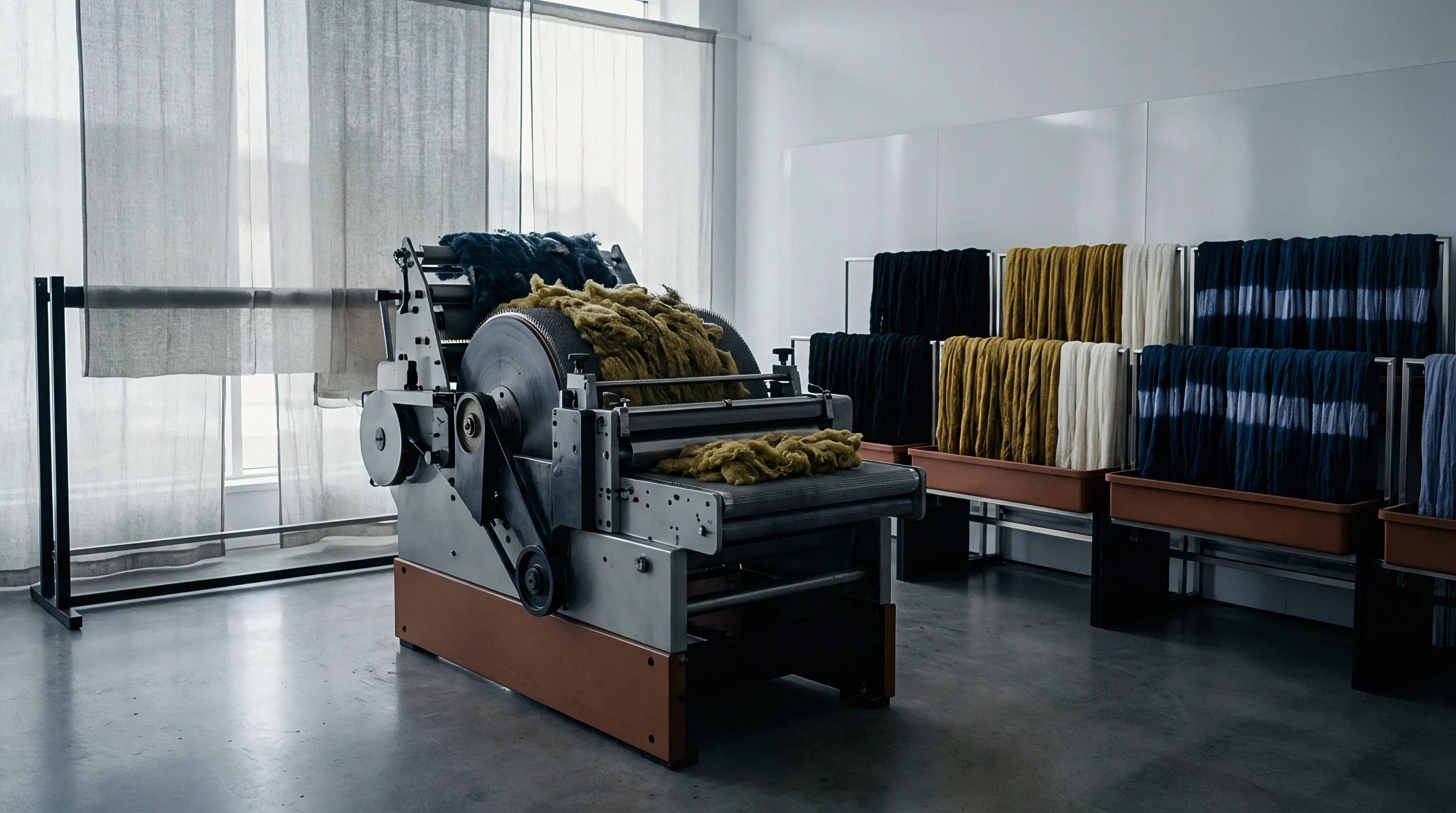
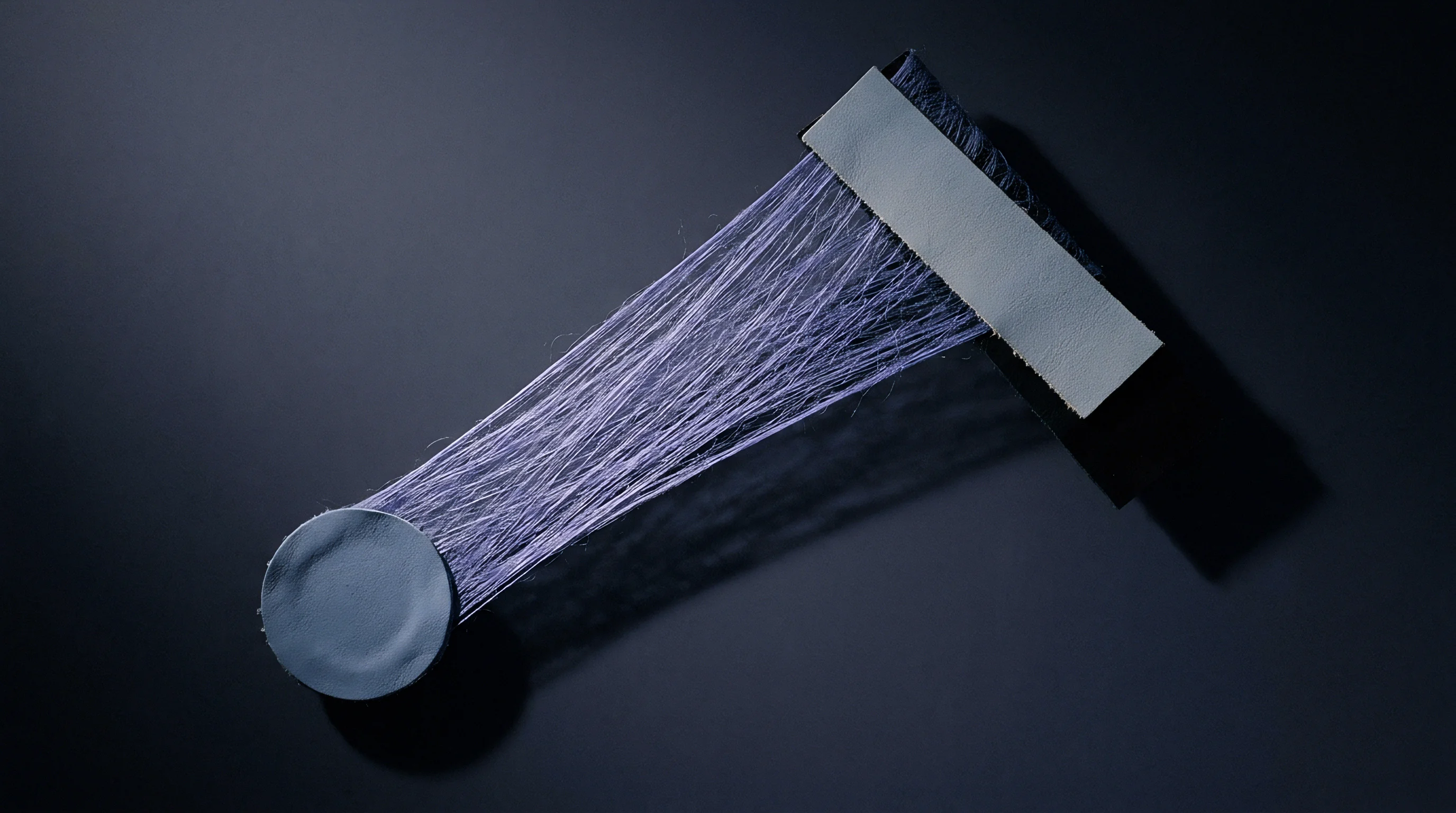
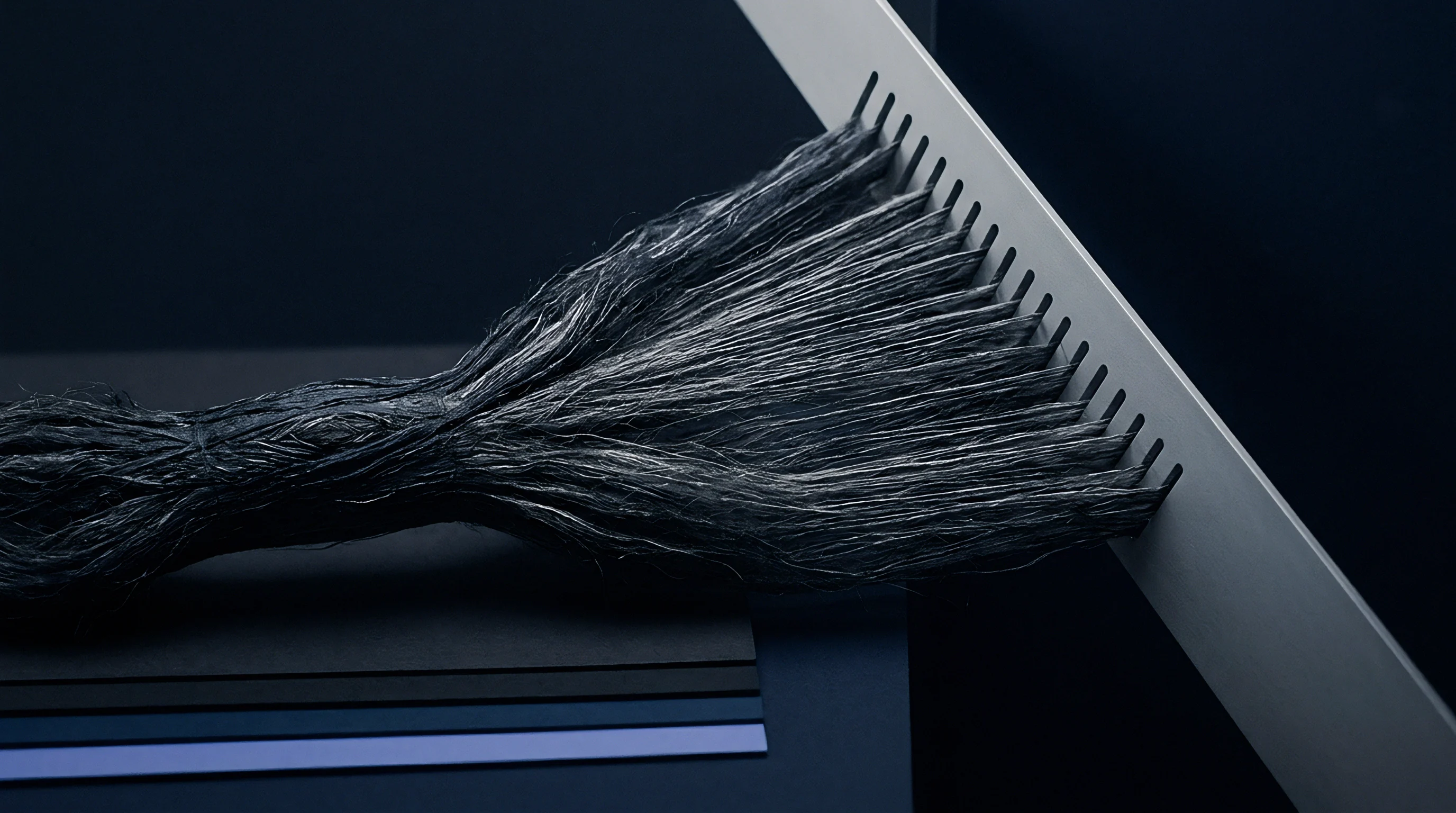
Mechanical integration during opening and carding determines whether the nominal recipe matches the finished spun cross-section. Blowroom hopper blending places separate bales into automated weigh-pan feeders, discharging dry tufts onto conveyor systems prior to pneumatic opening. Drawframe blending combines pre-formed slivers at the breaker head, utilizing roller speed differentials to attenuate slivers into a composite web.
Carding lines reject short fibres. Natural fibres such as carded cotton carry substantial quantities of short staple, fragments, and vegetable trash that drop out in licker-in screens and revolving flats. Polyester resists atmospheric moisture.
Synthetic staple fibres experience virtually zero cleaning waste during initial processing. Consequently, an opening-room intake weighed at exactly 65/35 cotton/polyester shifts systematically toward polyester in the drawn sliver.
What Exact Proportion Governs Wet versus Dry Intake?
Bale moisture content at the laydown directly warps the true dry blend ratio if spinners meter raw fibres strictly by scale weight. Raw cotton delivered from humid storage environments frequently registers nine to ten percent moisture content on incoming bale probes. Polyester bales wrapped in foil barrier films register less than zero point four percent moisture.
Weighing raw stock directly into automated hoppers without compensating for ambient moisture creates immediate formulation error.
Consider a spinning line set to feed 60 kilograms of raw cotton and 40 kilograms of raw polyester to achieve a 60/40 recipe. Cotton holding ten percent moisture delivers 54.0 kilograms of actual dry cellulose. Polyester holding zero point four percent moisture delivers 39.84 kilograms of dry synthetic polymer.
The actual oven-dry ratio entering the machinery becomes 57.54 percent cotton and 42.46 percent polyester.
High-regain natural fibres shed shorter fragments in mechanical cleaning while synthetic filaments pass unbroken into the drawframe sliver.
Precise multi-fibre production lines monitor specific processing conditions to maintain target ratios:
- Laydown Moisture Compensation establishes corrected scale setpoints by measuring moisture on five core samples per raw material lot with high-frequency electronic probes.
- Differential Combing Extraction offsets the six to fourteen percent noil loss characteristic of combed cotton lines, adjusting the drawframe sliver delivery rates accordingly.
- Pneumatic Waste Differential accounts for the elevated loss of short cellulosic fibrils drawn into lint filtration ductwork during high-speed rotor or ring spinning.
- Roller Slip Variance monitors synthetic staple crimp retention inside drafting zones to eliminate drafting waves that cause periodic count fluctuations.
Relative humidity drives ambient sorption. The cardroom environment itself shifts the weight of exposed sliver cans across multi-day manufacturing schedules. Cotton absorbs water vapor during delays in humid preparation halls, while adjacent polyester slivers remain inert.
Spinning technicians monitoring linear density frequently make false drafting adjustments based on wet mass gain rather than true polymer density.
Spinners frequently claim that opening room ambient swings explain discrepancies between intended recipe percentages and incoming card sliver ratios.


Solvent
Quantitative verification of multi-fibre yarns isolates constituent polymers through standardized selective chemical dissolution under ISO 1833. Gravimetric separation dissolves one component while preserving the insoluble residue for drying and weighing. The laboratory report proves whether the yarn complies with contractual composition targets and statutory labeling limits.
Dry weights anchor quantitative analysis. Before introducing chemical reagents, specimens must undergo non-fibrous extraction to strip lubricants, spin finishes, winding oils, and sizing starches. Petroleum ether washing followed by warm water extraction purifies the substrate.
Without preliminary solvent washing, processing auxiliaries report erroneously as dissolved fibre mass.

Chemical Separation Mechanics and Mass Correction
Separating intimate cellulosic and synthetic structures relies on seventy-five percent sulfuric acid to hydrolyze cotton, viscose, or lyocell, leaving polyester intact. Alternatively, cold eighty-five percent formic acid dissolves polyamide components while leaving polyester and acrylic unaltered. Glacial acetic acid cleans acetate fibres from mixtures containing cotton and wool.
Reagents alter the insoluble component. Even highly resistant polymers lose minute fractions of surface mass during acid digestion. Standardized correction factors calibrate the final arithmetic.
Factor d compensates for mass loss of the insoluble residue caused by reagent attack. Factor b accounts for the minor mass loss experienced during pre-treatment wash cycles.
Specimen desiccation at one hundred and five degrees Celsius until consecutive weighings agree within zero point one percent establishes the exact oven-dry baseline for chemical extraction.
- Dry the cleaned yarn specimen in a tared weighing bottle inside a ventilated conditioning oven at one hundred and five degrees Celsius until consecutive weighings spaced fifteen minutes apart differ by less than zero point one percent.
- Transfer the dried specimen to an Erlenmeyer flask, introduce one hundred milliliters of seventy-five percent sulfuric acid per gram of specimen, and shake vigorously at fifty degrees Celsius for thirty minutes.
- Filter the slurry through a tared sintered glass crucible under vacuum, washing the insoluble polyester residue thoroughly with dilute acid followed by deionized water until litmus confirms neutrality.
- Dry the crucible containing the insoluble synthetic residue at one hundred and five degrees Celsius to constant mass, recording the final dry weight to the nearest zero point zero zero zero two grams.
Solvents dissolve specific polymer chains. The calculated dry mass percentage of the insoluble component, denoted as P subscript 2, follows the relationship:
P subscript 2 = (100 × r × d) / m
In this equation, r is the oven-dry mass of the residue, d is the correction factor for reagent action, and m is the initial oven-dry mass of the specimen. The soluble percentage P subscript 1 equals 100 minus P subscript 2. Once these dry percentages are settled, the weighted moisture regain formula converts laboratory dry mass into official invoiced commercial mass.
| Fibre Combination | Selective Reagent | Dissolved Phase | Residue Correction Factor (d) | ISO 1833 Tolerance Limit (±%) |
|---|---|---|---|---|
| Cotton / Polyester | 75% Sulfuric Acid | Cotton | 1.01 | 1.00 |
| Viscose / Polyester | 75% Sulfuric Acid | Viscose | 1.00 | 1.00 |
| Wool / Polyester | Alkaline Sodium Hypochlorite | Wool | 1.01 | 1.00 |
| Polyamide / Polyester | 85% Formic Acid | Polyamide | 1.00 | 1.00 |
| Cotton / Acrylic | Dimethylformamide (DMF) | Acrylic | 1.01 | 1.50 |
| Acetate / Cotton | Acetone | Acetate | 1.00 | 1.00 |
| Wool / Cotton | 75% Sulfuric Acid | Cotton | 1.03 | 1.50 |
Whether minor chemical degradation of the insoluble polyester residue during concentrated acid washing introduces a systematic bias into large lot settlement calculations remains unsettled across international commercial laboratories.
Swell
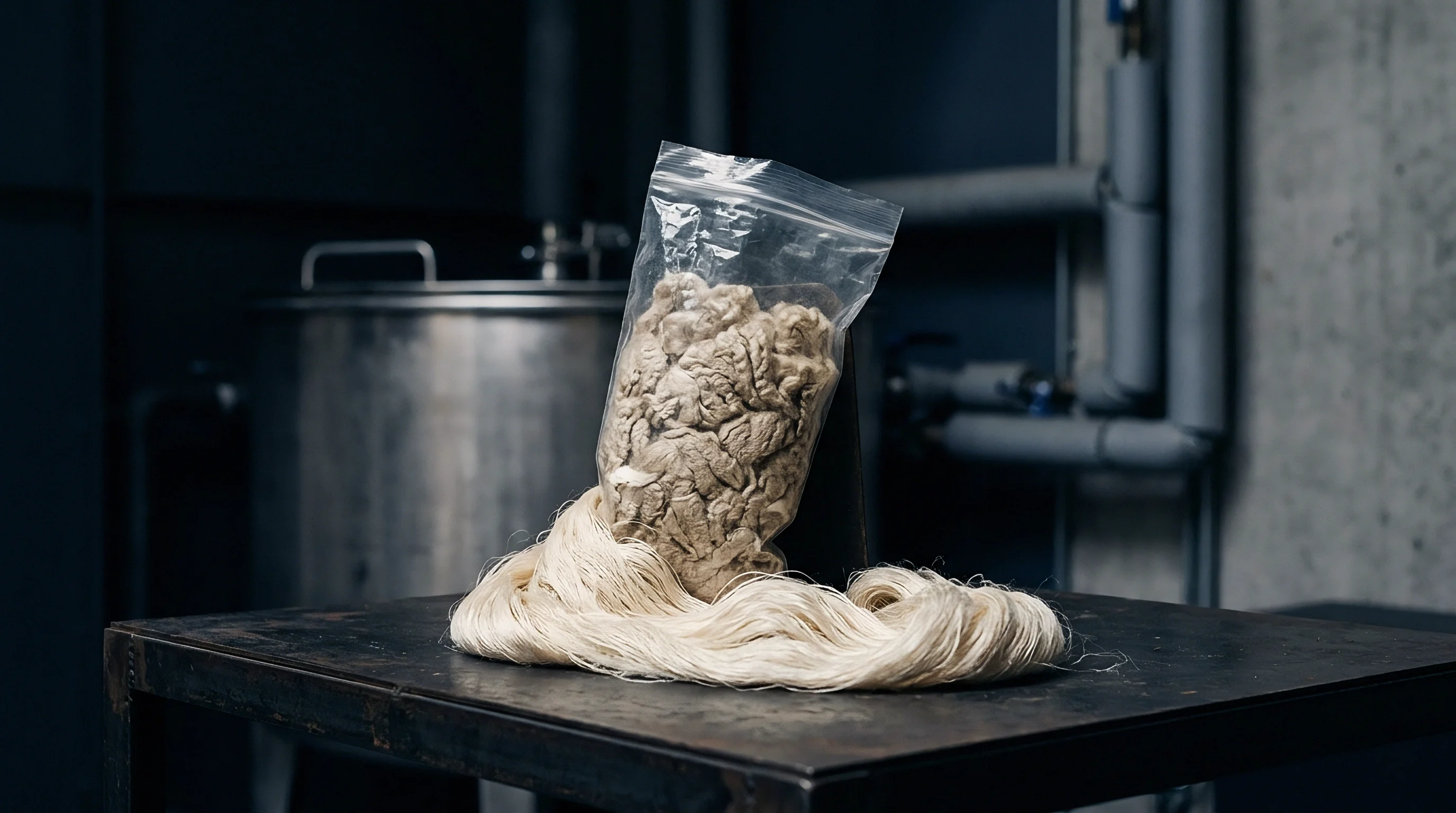
Sorption behavior in intimate yarn structures introduces mechanical instability when packages transfer between varying atmospheric climates. Unprocessed natural fibres contain crystalline fibrils held within amorphous cellulosic matrices that bind water molecules through hydrogen bonding. Synthetic polyester chains possess tightly packed crystalline morphologies that reject water absorption.
Viscose absorbs ambient water quickly. When hygroscopic fibres absorb moisture, their transverse diameter expands substantially while axial length changes minimally. Cotton swells up to fourteen percent in cross-sectional area, while viscose expands by more than thirty percent.
This volumetric change alters the internal geometry of the yarn package.

Mechanical Disruption from Environmental Regain
Sorption curves show marked hysteresis. The moisture content attained by a yarn equilibrating from a damp state consistently exceeds the moisture content attained by an identical yarn equilibrating from a bone-dry state under identical ambient humidity. Yarn shipped from monsoon regions retains elevated moisture content that resists desorption in dry destination warehouses.
Wet counts register heavier numbers. Direct yarn numbering systems like tex or denier increase in nominal value when moisture enters the yarn, indicating a false coarsening. Indirect systems like English Cotton Count (Ne) decrease, falsely suggesting heavy yarn delivery.
Mill operators unaware of weighted regain mathematics frequently alter spinning drafts unnecessarily when laboratory climate control drifts.
Severe physical yarn failure modes stem from unmanaged moisture absorption:
- Cone Package Crushing develops when internal layers of high-viscose intimate mixtures absorb ambient moisture, expanding radially until paper and plastic cones collapse.
- Twist Snarl Propagation intensifies as hydrogen bond relaxation lowers torsional rigidity, generating kinking defects during high-speed knitting unwinding operations.
- Tension Spikes In Warping occur because moisture-swollen yarn surfaces exhibit elevated inter-fibre friction against ceramic thread guides and steel drop wires.
- Dynamic Count Dispersion emerges across production lots when bobbin outer shells condition rapidly while package cores remain trapped at laydown moisture levels.
Desorption curves exceed adsorption values. Tensile properties respond directly to internal moisture. Cotton increases in tenacity as moisture lubricates crystalline chains, allowing more uniform load sharing across internal fibrils.
Polyester tenacity remains completely flat across all relative humidity ranges. Viscose loses nearly half of its dry tensile strength when wet, rendering high-viscose combinations vulnerable to tension breaks inside sizing boxes.
| Fibre Intimate Recipe | Regain at 35% RH (%) | Regain at 65% RH (%) | Regain at 85% RH (%) | Tenacity Shift (35% to 85% RH) | Count Shift (Ne 30s Basis) |
|---|---|---|---|---|---|
| 100% Combed Cotton | 4.20 | 7.50 | 11.80 | +18% Tenacity Gain | 30.8 Ne to 28.9 Ne |
| 100% Polyester | 0.25 | 0.40 | 0.60 | Zero Tenacity Change | 30.1 Ne to 29.9 Ne |
| 100% Viscose Rayon | 7.50 | 13.00 | 21.50 | -42% Tenacity Loss | 31.4 Ne to 27.8 Ne |
| 60/40 Cotton / Polyester | 2.62 | 4.66 | 7.32 | +8% Tenacity Gain | 30.5 Ne to 29.3 Ne |
| 50/50 Viscose / Polyester | 3.88 | 6.70 | 11.05 | -20% Tenacity Loss | 30.7 Ne to 28.7 Ne |
Dry yarn packages conditioned from the dry state never attain the absolute mass of identical packages equilibrating downward from saturated air.


Ledger
Commercial transactions and customs duty liabilities settle entirely upon official mass declarations. Commercial yarn invoices settle on calculated dry mass plus official regain rather than ambient dock weights. Discrepancies between physical scale weights and invoiced commercial weights spark commercial claims unless clear standardized moisture formulas govern the underlying sales contract.
Customs classifications track mass thresholds. Under Section XI of the Harmonized Tariff Schedule, textile articles composed of two or more textile materials classify under the heading that covers the material predominating by weight. In borderline intimate formulations, moisture regain determines whether goods fall into natural or synthetic tariff schedules.

Commercial Settlement Arithmetic in a Fifty Tonne Shipment
A worked example demonstrates the financial exposure. Consider an intimate spun yarn consignment contracted as 50 percent combed cotton and 50 percent staple polyester, with an agreed gross shipment scale weight of 50,000.0 kilograms on arrival. The transaction terms mandate commercial mass invoicing under ISO 6741-1.
Testing laboratory desiccation yields a total lot dry mass of 46,200.0 kilograms, indicating that 3,800.0 kilograms of unbound physical water resided in the packages at delivery. Quantitative chemical analysis via ISO 1833 verifies the clean oven-dry composition as exactly 50.0 percent cotton (23,100.0 kg dry) and 50.0 percent polyester (23,100.0 kg dry).
The weighted commercial regain calculation applies official standards: combed cotton earns eight point five zero percent; polyester earns zero point four zero percent. The weighted regain R subscript w becomes:
R subscript w = (23,100.0 × 8.50 + 23,100.0 × 0.40) / 46,200.0 = 4.45%
Applying this figure to the total dry mass yields the invoiced commercial mass:
C M = 46,200.0 × (1 + 0.0445) = 48,255.9 kilograms
The buyer pays for 48,255.9 kilograms rather than the 50,000.0 kilograms registered on the delivery scale. At a contract price of 4.20 US dollars per kilogram, this correction saves the buyer 7,325.22 US dollars, stripping unearned revenue derived from absorbed atmospheric humidity.
| Parameter | Physical Scale Baseline | ISO 6741 Commercial Mass | Tariff Predominance Consequence |
|---|---|---|---|
| Gross Lot Mass (kg) | 50,000.0 | 48,255.9 | 1,744.1 kg Ambient Water Deducted |
| Cotton Fraction (kg) | 25,000.0 (Nominal) | 25,063.5 (With Regain) | 51.94% Legal Commercial Mass |
| Polyester Fraction (kg) | 25,000.0 (Nominal) | 23,192.4 (With Regain) | 48.06% Legal Commercial Mass |
| Chief Weight Status | 50/50 Dead Heat | Cotton Predominates | Classifies Under Chapter 52 (Cotton) |
| Applicable Duty Rate | Disputed Tariff Line | 4.5% (Cotton Yarn) | Avoids Chapter 55 Synthetic Penalty (8.0%) |
| Total Invoiced Cost ($) | $210,000.00 | $202,674.78 | $7,325.22 Raw Invoice Reduction |
| Landed Duty Amount ($) | $16,800.00 (Synthetic Est.) | $9,120.37 (Actual Cotton) | $7,679.63 Duty Savings |
Tariff shifts alter profit margins. In the Harmonized Tariff Schedule, General Note 2(A) classifies mixtures based on the component that predominates by weight. Legal commercial weight includes official moisture regain allowances.
While dry mass is equal at 23,100.0 kilograms for each component, cotton with its eight point five percent allowance reaches 25,063.5 kilograms of commercial mass. Polyester with its zero point four percent allowance reaches only 23,192.4 kilograms. Cotton officially predominates by 1,871.1 kilograms, securing Chapter 52 classification and lowering import duty.
Calculated weights govern final payment. Without precise contractual definition of weighted moisture regain calculations, import declarations face aggressive audit challenges from customs administrations disputing borderline classification lines.
Miscalculating weighted commercial moisture regain shifts yarn consignments across statutory tariff boundaries, triggering customs impoundments, retrospective duty penalties, and invalidated trade preference certificates.