Isotopic Ratio Mass Spectrometry for Recycled Synthetic Fiber Origin Audits
Stable isotope mass spectrometry detects virgin polymer dilution in recycled synthetic yarns by measuring natural carbon and oxygen ratios in the fiber matrix.


Baseline
A bill of lading declares twenty metric tons of drawn texturized yarn as post-consumer recycled polyethylene terephthalate, yet the stable carbon isotope ratio registers at -29.8 per mil against the Vienna Pee Dee Belemnite standard. That value aligns with virgin paraxylene cracked from Arabian light crude rather than municipal bottle collection streams in East Asia. Commercial buyers routinely accept transaction certificates without confirming the physical matrix of the polymer.
When customs investigators or independent auditors pull spools from the shipping container, bulk chemical testing fails to distinguish virgin polyester from recycled resin because the repeating ester units share identical molecular weights and infrared spectra. Stable isotope analysis bypasses document matching by measuring the natural nuclear variations fixed within the polymer backbone.
Crude oil origins dictate carbon values. Petroleum reservoirs across the Middle East, North America, and Southeast Asia formed under distinct geological conditions, generating characteristic distributions of carbon-13 and carbon-12. Synthetic polymers preserve these ratios through refining, polymerization, and spinning.
When petrochemical plants synthesize terephthalic acid and monoethylene glycol, the thermal conversions induce minimal fractionation, locking the geographic carbon signature into the polyester chain. The detector records four mass channels. A raw material audit therefore relies on establishing an empirical database of regional petroleum baselines before evaluating whether an alleged recycling stream reflects genuine bottle collection or diverted virgin fiber.
| Feedstock Category | Chemical Intermediate | δ13C VPDB Range (‰) | δ18O VSMOW Range (‰) | Geographic Provenance |
|---|---|---|---|---|
| Petroleum Naphtha | Purified Terephthalic Acid | -28.5 to -31.2 | +12.8 to +15.4 | Persian Gulf Basin |
| Coal-to-Chemicals | Monoethylene Glycol | -21.4 to -24.1 | +8.2 to +11.5 | Shaanxi Province, China |
| Natural Gas Condensate | Ethylene Glycol | -32.0 to -35.6 | +14.1 to +16.9 | US Gulf Coast |
| Petroleum Benzene | Caprolactam (Nylon 6) | -27.8 to -30.4 | +11.2 to +13.6 | Western Europe |
| Recycled Municipal PET | Flaked Beverage Packaging | -24.8 to -27.2 | +17.5 to +22.8 | Multi-Source Domestic Blend |
Calibration runs every six injections. Establishing these reference baselines demands continuous sampling of primary petrochemical crackers alongside municipal scrap sorters. Spinning mills often defend depleted isotope readings by claiming their monomer purifiers source feedstock exclusively from older regional reserves with atypical geological histories.


Flake
Baled municipal bottles arrive at the wash plant carrying paper labels, polyolefin caps, and regional beverage residues. Processing lines shred this container waste into cold-washed and hot-washed regrind before extruding it into pellet form or feeding it directly to filament spinning blocks. During bottle manufacture, blow-molding equipment introduces surface orientation, but the fundamental chemical composition remains intact.
Ten grams yield sufficient combustible carbon. The mechanical wash stage introduces process water carrying local oxygen-18 signatures, though this surface moisture leaves the core covalent bonds of the terephthalate rings unaltered. Extrusion drying removes water before solid-state polycondensation rebuilds intrinsic viscosity.
A mechanical recycling batch mirrors the isotopic average of the regional packaging market that supplied the waste.
Hot washing removes exterior sizing compounds. Chemical auditors inspect the regrind to verify that sorting facilities segregated colored bottles from clear packaging. Green and amber containers contain mineral additives, titanium dioxide, and iron oxide colorants that alter combustion efficiency in analytical instruments if left uncorrected.
Pure transparent bottle regrind yields consistent elemental percentages of carbon, hydrogen, and oxygen, allowing precise stoichiometric gas conversion during combustion. Contaminated regrind containing five percent polyvinyl chloride releases hydrochloric acid during thermal decomposition, poisoning the reduction reactors of analytical equipment and skewing carbon isotope readings.

Does Mechanical Processing Shift Isotopic Signatures?
Thermal extrusion leaves carbon-13 distributions inside polyethylene terephthalate chains completely undisturbed. Because carbon-carbon and carbon-oxygen bonds require substantial activation energies to break, melting dried polymer at two hundred eighty degrees Celsius does not generate measurable carbon fractionation. Polymerization locks the isotopic ratio.
Minor mass loss occurs through the volatilization of cyclic oligomers, acetaldehyde, and residual moisture, yet these fugitive compounds carry negligible mass fractions relative to the main polymer chain.
Oxygen isotope ratios display subtle vulnerability to thermal reprocessing. When reclaimers subject regrind to vacuum solid-state polycondensation to elevate intrinsic viscosity from 0.64 to 0.84 deciliters per gram, ester exchange reactions release ethylene glycol and take up residual water vapor. High-vacuum drying mitigates this exchange.
Commercial operations maintaining strict moisture control below fifty parts per million prevent isotope exchange between process steam and the polyester backbone, preserving the historical signature of the original beverage bottle.
Consistently low oxygen isotope ratios indicate unreacted petrochemical intermediates rather than consumer packaging waste.
Virgin filament plants running on molten polymer straight from continuous polymerization towers display absolute uniformity across a thirty-day production run. Post-consumer reclaimers draw from thousands of municipal deposit points, creating a blended product whose isotopic signature converges on the population mean of regional beverage consumption. A virgin resin lot mimics a single petrochemical cracker output, while a legitimate recycled lot demonstrates the blended isotopic variance of an entire municipal territory.
Spectrometer
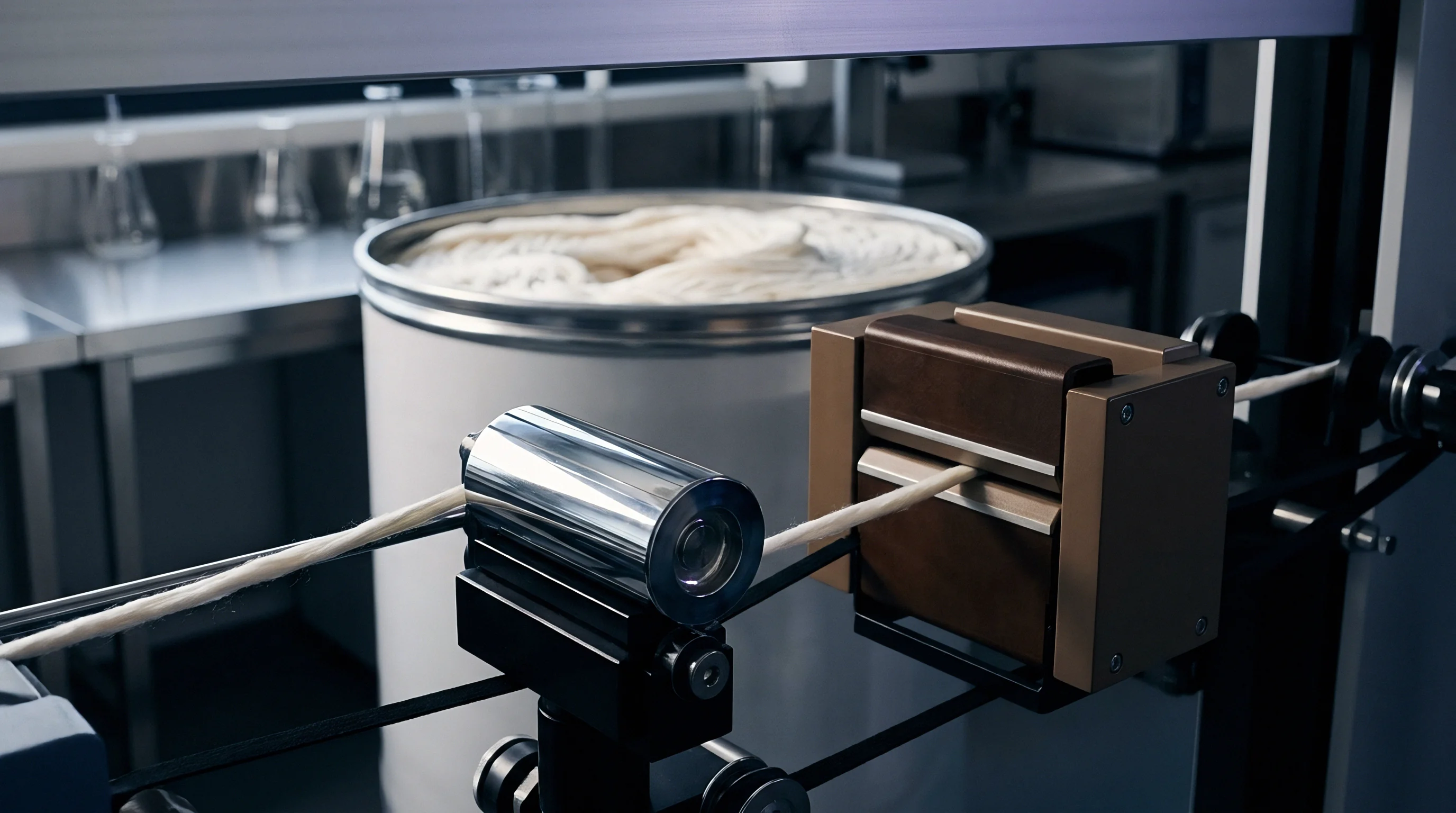
Elemental analysis coupled with isotope ratio mass spectrometry isolates individual stable isotopes through high-temperature oxidation followed by magnetic sector separation. The analytical sequence converts solid synthetic filaments into purified carbon dioxide, nitrogen, and carbon monoxide gases without chemical fractionation. Technicians weigh two hundred micrograms of cleaned fiber into tin capsules, crimping the metal to exclude atmospheric gases.
An automated autosampler drops the capsule into a quartz combustion tube packed with chromium oxide and silvered cobaltous oxide maintained at one thousand twenty degrees Celsius. A helium carrier stream transports the volatile products through the system.
Combustion converts solid polymer to gas. An injection of pure oxygen into the helium stream triggers an exothermic flash combustion, raising the local temperature within the tin capsule above one thousand seven hundred degrees Celsius. Carbon oxidizes entirely to carbon dioxide.
Nitrogen forms elemental nitrogen gas alongside nitrogen oxides. The gas mixture passes through a reduction reactor containing elemental copper held at six hundred degrees Celsius, which removes excess oxygen and reduces nitrogen oxides back to diatomic nitrogen. A magnesium perchlorate trap strips water from the gas stream.
The combustion reactor reaches one thousand degrees. A gas chromatography column subsequently separates the nitrogen and carbon dioxide peaks before the molecules enter the mass spectrometer ion source.
| Instrument Module | Analytical Parameter | Target Specification | Tolerance Limit |
|---|---|---|---|
| Combustion Reactor | Oxidation Temperature | 1020 °C | ± 5 °C |
| Reduction Furnace | Copper State Temperature | 600 °C | ± 3 °C |
| Carrier Flow | Helium Purity and Rate | 99.999% at 100 mL/min | ± 2 mL/min |
| GC Separation | Column Retention Window | 180 seconds for CO2 | ± 4 seconds |
| Ionization Chamber | Electron Impact Energy | 70 eV | ± 0.5 eV |
| Faraday Collectors | Simultaneous Mass Detection | m/z 44, 45, 46 (CO2) | Linear across 0.5–10 V |
Each sample run takes ten minutes. Within the mass spectrometer source, an electron beam ionizes the carbon dioxide molecules, and electrostatic lenses accelerate the ions into a curved flight tube bounded by an electromagnet. The magnetic field deflects the ions according to their mass-to-charge ratios, focusing mass 44, mass 45, and mass 46 into discrete Faraday cup collectors.
Calibration against international reference standards permits calculation of delta values expressed in parts per thousand relative to international materials.
System errors distort isotope ratios when analysts ignore baseline instrumentation parameters:
- Incomplete sample combustion deposits refractory carbonaceous soot inside the combustion tube, causing significant fractionation of subsequent injections.
- Exhausted reduction copper allows unreduced nitrous oxide to enter the carbon dioxide detection channel, distorting mass 44 and 45 ratios.
- Atmospheric moisture incursion through dried perchlorate traps introduces foreign oxygen atoms that exchange with carbon dioxide in the ionization chamber.
- Faraday cup saturation occurring from oversized fiber samples overloads the detector preamplifiers, truncating signal peaks and invalidating calculated ratios.
Laboratories testing recycled textiles maintain strict drift controls. Analysts bracket every five commercial yarn samples with certified reference materials, monitoring ion source linearity and instrument sensitivity throughout the shift.


Variance
Geographic origin establishes the primary isotopic separation between synthetic textiles. In China, coal-gasification routes account for a substantial volume of chemical intermediates, transforming synthesis gas into monoethylene glycol through oxalate pathways. This coal-based glycol exhibits an elevated carbon-13 value, typically clustering between -21.0 and -24.0 per mil.
Petroleum-derived ethylene glycol sourced from Western refineries displays distinctly depleted values, routinely measuring between -30.0 and -34.0 per mil. Coal synthesis routes elevate carbon ratios. When a spinner blends coal-based glycol with petroleum terephthalic acid, the resulting virgin polyester mimics the blended carbon isotope ratio of international bottle flake, obscuring single-element origin verification.
Under laboratory test standard ASTM D6866, bio-content reports quantify modern carbon but reveal nothing regarding post-consumer plastic history.
Resolving this challenge demands dual-isotope or triple-isotope testing matrices. Combining carbon-13 measurements with oxygen-18 analysis separates blended virgin petrochemicals from genuine post-consumer packaging waste. Municipal bottles originate in populated consumer centers where water supply isotope signatures depend on local precipitation and latitude.
Water used in bottle washing plants reflects continental precipitation gradients, leaving isotopic traces on the surfaces and transesterified end-groups of recycled polymer chains. Petroleum synthesis plants operate closed steam and process water loops that do not reflect ambient environmental precipitation.

Do Bio-Based Feedstocks Confuse Radiocarbon Audits?
Bio-based synthetic polymers derived from corn starch, sugarcane, or castor oil incorporate contemporary atmospheric carbon through photosynthetic fixation. Measuring carbon-14 content via accelerator mass spectrometry separates bio-based synthetic polymers from fossil-derived polymers because fossil carbon contains zero detectable carbon-14. Fossil PET, virgin or recycled, displays modern carbon fractions below 0.5 percent.
Bio-based polyethylene terephthalate contains approximately twenty percent modern carbon because the monoethylene glycol portion derives from plant ethanol while the purified terephthalic acid originates from petroleum.
Regional rainfall alters oxygen values. Evaluating alleged recycled synthetic fiber requires a disciplined testing sequence that screens out false positives before issuing a non-compliance determination:
- Solvent de-sizing extraction strips silicone oils, spin finishes, and paraffin waxes using Soxhlet extraction with petroleum ether for eight hours.
- Colorant and additive digestion separates inorganic pigments and titanium dioxide dulling agents through concentrated hexafluoroisopropanol filtration.
- Radiocarbon screening confirms the zero-modern-carbon baseline, eliminating bio-based monomers from the stable isotope calculation.
- EA-IRMS dual-isotope combustion measures carbon-13 and oxygen-18 values across five duplicate sample specimens.
- Multi-variable matrix cross-referencing plots the measured delta values against the regional recycling baseline database to establish authenticity probability.
The tolerance band spans two per mil. A fiber lot measuring outside this statistical boundary indicates either adulteration with virgin fiber or intentional diversion of prime resin into certified recycling channels. Current analytical models continue to confront difficulty in setting definitive isotopic boundaries for recycled nylon 6 derived from recovered maritime fishing nets compared to prime virgin resin synthesized from benzene, leaving open the degree of physical certainty such testing can deliver without regional precursor records.
Scope
Paper trails generated by the Global Recycled Standard and the Recycled Claim Standard rely on chain-of-custody reconciliation. Certification bodies issue scope certificates to manufacturing facilities based on annual management audits, validating that an extrusion plant possesses the machinery, storage capacity, and administrative procedures necessary to process secondary plastics. When a yarn order ships, the certifier issues a transaction certificate linking the raw material input to the specific invoice volume.
Transaction certificates track paper volume balances. A transaction certificate does not test the physical yarn inside the cartons, creating an administrative vulnerability where prime virgin yarn flows under valid recycled paperwork.
The testing fee totals eight hundred dollars. High commercial price premiums for recycled synthetic fibers incentivize unethical yarn extruders to mix virgin chip directly into spinning hoppers while maintaining pristine volume balances on paper. A single chemical fiber line running fifty metric tons daily can consume prime resin purchased at standard commodity pricing while selling drawn yarn at a thirty percent recycled premium.
The physical audit file must bridge the gap between administrative certification documents and laboratory isotopic confirmation.
| Assurance Parameter | Chain-of-Custody Certification | EA-IRMS Isotope Audit | Enforcement Authority |
|---|---|---|---|
| Primary Verification Basis | Mass-balance accounting ledgers | Direct nuclear mass ratios (δ13C, δ18O) | Customs and Border Protection |
| Batch-Level Traceability | Volume allocation per invoice | Physical fiber spool confirmation | Brand compliance auditors |
| Adulteration Limit of Detection | Zero detection capability | 10–15% virgin blend threshold | Accredited ISO 17025 laboratories |
| Sampling Protocol Requirement | Quarterly desk review of inputs | Randomized container core sampling | Independent inspection agencies |
| Audit Cycle Time | 2 to 4 weeks for certificate issuance | 48 to 72 hours bench analysis | Supply chain assurance desks |
| Operational Cost per Lot | Standard annual certification fee | Testing fee per shipment batch | Importer of record |
This audit discrepancy stops customs clearance. Incorporating physical testing into raw material contracts requires specific quality criteria that bind the mill to chemical accountability. Buyers enforce batch testing by drafting explicit analytical clauses into purchase orders:
- Lot sampling rights permit independent inspectors to enter spinning mills unannounced and cut five-gram fiber swatches directly from active winding frames.
- Isotopic threshold conformity binds the shipment to regional delta ranges established by agreed third-party laboratory reference panels.
- Retesting cost allocations assign all analytical charges, demurrage fees, and third-party laboratory expenses to the vendor upon confirmed isotopic failure.
- Transaction certificate revocation triggers compel the certifying body to review and suspend site certificates when physical testing confirms unevidenced virgin additions.
A procurement contract specifying that fiber deliveries must clear stable isotope verification before payment release transforms laboratory testing into an active commercial defense. Standard purchase order language mandating that all delivered synthetic yarns demonstrate an empirical isotopic match against certified regional recycling baselines immediately shifts financial liability back to the spinning mill.

Tariff
Customs agencies and trade enforcement authorities utilize stable isotope analysis to enforce anti-dumping orders, tariff rate quotas, and import restrictions. When trade authorities impose punitive tariffs on virgin polyester staple fiber from specific manufacturing territories, unscrupulous converters misdeclare shipments as recycled fiber or route virgin polymers through third-party nations to conceal true country of origin. Because customs tariffs classify recycled polyester under distinct Harmonized Tariff Schedule subheadings that frequently enjoy preferential duty treatment, false classification constitutes customs fraud under federal trade laws.
A commercial container held under customs seizure accrues storage charges while laboratory spectrometers determine polymer authenticity.
The customs broker holds the bill. Border authorities targeting synthetic textiles pull core samples from shipping containers, routing the specimens to government laboratories equipped with continuous-flow isotope mass spectrometers. Virgin imports face punitive countervailing duties.
Importers who rely entirely on vendor transaction certificates discover that customs agencies dismiss paper compliance when physical testing reveals virgin isotopic signatures. Customs enforcement laboratories do not litigate administrative record keeping. They measure the carbon-13 and oxygen-18 ratios of the seized textile, cross-referencing the values against established databases of primary virgin resin crackers.
The carrier charges demurrage daily. The financial consequences of failing an isotopic customs verification cascade through the balance sheet:
- Container detention penalties accumulate at terminal demurrage rates ranging from one hundred fifty to four hundred dollars per day per container.
- Customs bond forfeiture strips the importer of immediate release privileges, forcing all subsequent entries into manual physical examination.
- Administrative asset seizures freeze the shipment indefinitely while civil or criminal fraud penalties equal to the domestic value of the goods are assessed.
- Contractual supply cancellations trigger downstream production stoppages, exposing the importing merchant to severe commercial breach-of-contract liabilities.
When an import file lacks physical isotopic validation, the buyer bears total liability for commercial detention, back duties, and trade penalties, resulting in cargo seizure and permanent exclusion from fast-track customs clearance programs.