Reconciling Subcontractor Facility Scopes against Border Traceability Dossiers in Organic Supply Chains
Unlisted subcontract processing facilities break the organic chain of custody, causing customs border detentions under USDA SOE and EU TRACES enforcement.


License
Border authorities examine organic textile shipments through the strict boundary of legal title and certified physical possession. When an import declaration lists certified organic cotton apparel, the chain of custody documented on transaction certificates links directly to accredited operations. The Global Organic Textile Standard version 7.0 and the Organic Content Standard version 3.0 demand that every manufacturing entity in the conversion chain maintains certification under an accredited certifying body.
Under the United States Department of Agriculture Strengthening Organic Enforcement regulation, exemptions for subcontracted processors disappeared. The European Union applies identical scrutiny under Regulation 2018/848 through the TRACES trade control database. Customs inspectors seize ambiguous cargo.
A Scope Certificate names the primary licensee in Box 1 and details audited processing steps in Box 2. Audited secondary addresses, toll processors, and commission finishers appear in Box 3 or designated annex tables. A failure occurs when a primary tier-one garment assembly plant sends circular knit yardage to an off-site washing or dyeing plant omitted from the certified facility annex.
The resulting transaction certificate identifies the primary plant as the seller, yet customs import declarations cross-examine the commercial invoice, the packing list, and bill of lading shipping marks. When those freight manifests show collection from or handling by an unlisted external facility, the document chain breaks. Discrepancies invite penalty assessments.

Statutory Chains and Scope Certificate Topography
Official certifier databases record exact street coordinates, production capacities, and processing steps authorized for each facility. An operational site audited solely for cutting, sewing, and packing holds an authorization code restricted to mechanical garment assembly. If that same facility dispatches cut garment pieces to an outside print shop for screen printing with water-based organic pigment inks, that printing unit functions as an outsourced processing subcontractor.
The primary licensee retains title to the substrate, but physical transformation occurs within external walls.
Auditors categorize subcontractors under two distinct administrative mechanisms. Under the first mechanism, the subcontractor possesses an independent Scope Certificate, issuing its own Transaction Certificate for services rendered back to the primary brand contractor. Under the second mechanism, the primary contractor incorporates the subcontractor into its own Scope Certificate as a covered site, subjecting that external facility to annual physical inspections by the primary certifier.
Problems emerge when converters assume informal subcontracting remains invisible to customs officers.

Cross-Border Regulatory Demands
The entry filing package demanded by customs revenue officers extends beyond high-level summary certificates. United States Customs and Border Protection personnel routinely issue formal requests for documentation via Form 28 to test organic veracity. They demand full transport manifests, cutting tickets, chemical purchase records, and tolling contracts.
Importers unable to produce proof that subcontracted wet processing plants held active certification during the exact production dates see their shipments reclassified as conventional merchandise. Processors lose certification rights.
Importers facing such administrative disqualification discover that conventional duty rates apply immediately alongside the total forfeiture of organic marketing claims. The port authority issues a formal notice demanding redelivery or assessed civil penalties equal to the domestic value of the goods under 19 USC 1592, terminating the commercial viability of the seasonal delivery program.


Vat
Commission dyehouses and piece-dye mills handle material transformations that introduce significant contamination exposure. Greige yarn loops through high-temperature jets where wetting agents, scouring surfactants, leveling chemistries, and reactive dyestuffs alter chemical properties. In organic manufacturing, every chemical input applied inside an aqueous bath complies with strict toxicological parameters defined in standard limit tables.
When an uncertified subcontractor finishes greige rolls, third-party certification bodies lack oversight of wastewater discharge, auxiliary chemical lists, and banned alkylphenol ethoxylates. Uncertified dyers destroy provenance.
Tracing wet processing requires inspecting internal machine logs and chemical dispensing ledgers. Certified dyehouses operate dedicated staging bays for organic goods to avoid accidental contact with conventional dye baths containing restricted formaldehyde donors or heavy-metal salt fixatives. Subcontracted facilities lacking rigorous standard operating procedures frequently interlace organic production on machinery immediately following conventional disperse-dyed polyester production runs without validated machine flush protocols.
The paper trail ruptures.
Physical possession of raw grey goods transfers to outside finishing mills far more frequently than certification records indicate.

Which Facility Qualifies under Scope Boundaries?
Determining whether an external operation requires standalone certification depends on operational control, legal title transfer, and the physical nature of the processing step. Sizing, scouring, bleaching, mercerizing, dyeing, printing, mechanical raising, and chemical softening alter the fundamental chemistry of the fiber. These activities never qualify as low-risk logistics activities like warehousing or cross-dock sorting.
The table below delineates the certification thresholds applied across common subcontracted textile processing tiers.
| Subcontracted Process Node | Primary Physical Activity | Certification Scope Requirement | Mandatory Border Dossier Proof |
|---|---|---|---|
| Commission Yarn Sizing | Application of starch or synthetic sizing polymers | Separate listing under spinning or weaving scope | Sizing recipe approval and facility audit annex |
| Toll Piece Dyeing | Aqueous reactive or vat dyeing in pressurized jets | Independent Scope Certificate or primary annex addition | Input chemical conformances and lot dye slips |
| Outsourced Screen Printing | Application of decorative pigment pastes and binders | Explicit printing scope endorsement on facility certificate | Approved formulation list and batch dispatch records |
| Commission Laundry | Enzyme washing, garment softening, ozone bleaching | Wet finishing scope listing for specific physical plant | Washing lot tickets cross-referenced to cut numbers |
| Off-Site Embroidery | Mechanical stitching of decorative patterns | Mechanical processing scope entry | Thread certification dossiers and machine inventory audit |
| Third-Party Packing | Folding, bagging, tagging, master carton boxing | Storage and distribution scope endorsement | Packing slips linked to finished garment container codes |
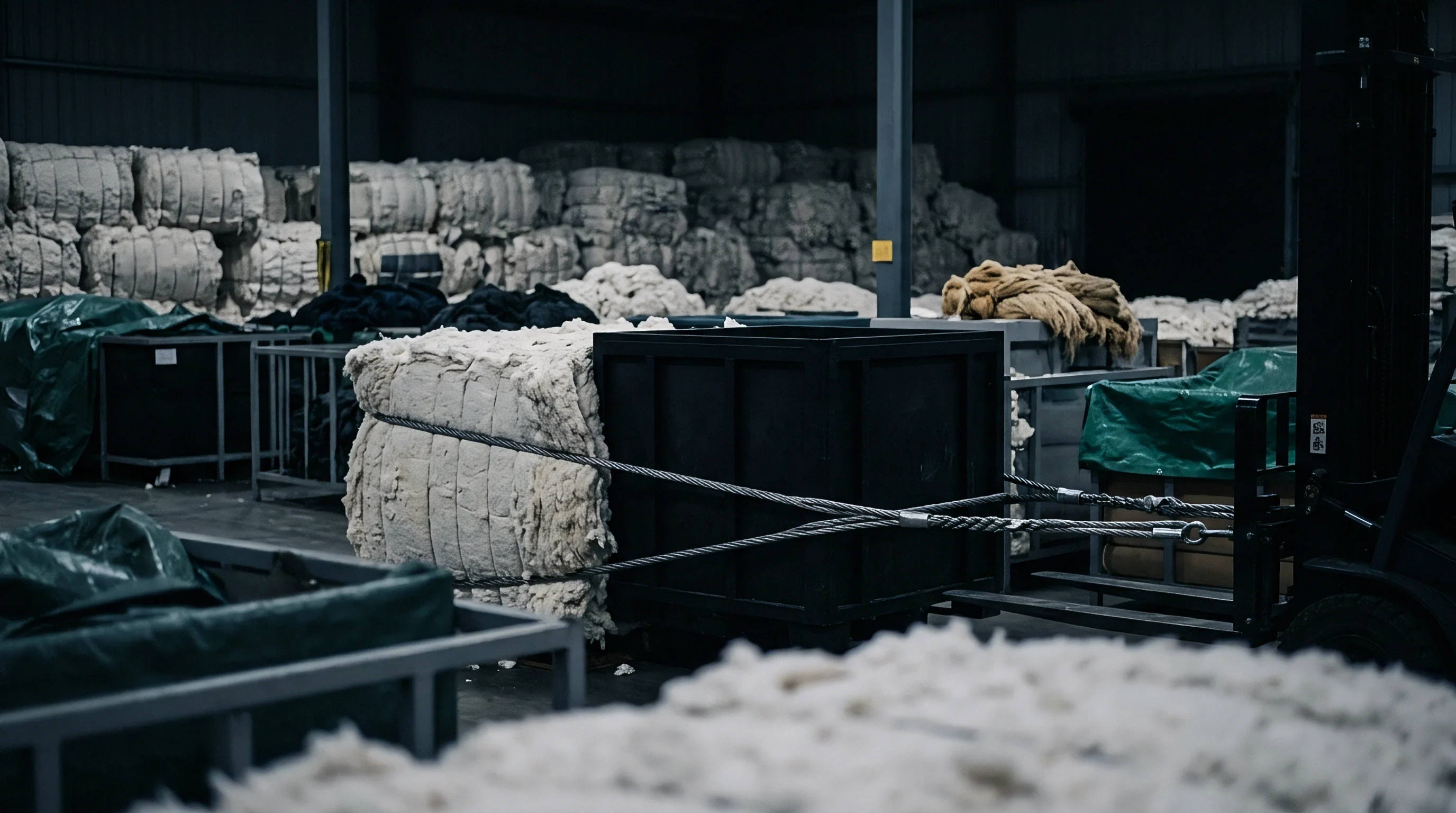
Auxiliary Chemistries and Toll Processing Realities
Textile mills regularly encounter capacity bottlenecks during peak harvest conversion cycles. When internal stenter frames or dye vats reach maximum capacity, mill schedulers divert excess grey yardage to neighboring local commission plants. Common compliance failures follow distinct operational vectors across these distributed conversion steps:
- Unregistered toll processors receive truckloads of certified organic greige goods accompanied only by generic internal transfer chits, leaving no auditable chain of custody in certifier tracking databases.
- Chemical inventory mismatches happen when commission processors apply unapproved non-ionic leveling agents or silicone softeners from bulk stock containers, violating Global Organic Textile Standard input criteria.
- Machinery cleaning lapses allow cross-contamination from adjacent conventional production runs, introducing trace synthetic fibers or banned halogenated carriers into organic yardage lots.
- Fabric substitution schemes occur when uncertified commission dyehouses blend cheaper conventional lots to compensate for processing defects or high scouring losses.
When questioned regarding absent scope endorsements for satellite finishing units during border audits, mill managers routinely claim that outside toll dyehouses merely act as temporary extensions of certified main machinery banks without independent custody rights.


Docket
Customs reconciliation packages depend entirely on documentary concordance across international borders. An importer filing entry under Harmonized Tariff Schedule Chapter 52 or 61 claiming organic certification presents a customs packet comprising commercial invoices, bills of lading, packing lists, single customs declarations, and Transaction Certificates. The Transaction Certificate functions as the legal bridge between manufacturing lots and commercial line items.
Every data field on the document faces forensic scrutiny from customs import specialists. The entry officer issues Form 28.
Box 10 of a standard Transaction Certificate lists the certified seller, while Box 11 details the buyer. Box 10 often lists the head office of a multi-tier sourcing agency. Box 1 lists the certification body granting authorization.
Crucially, Box 3 and Box 5 capture the certified facilities responsible for the physical handling of the specific merchandise. When an invoice details 12,000 units of women’s organic cotton jersey t-shirts shipped from an export port, yet the Transaction Certificate names only a spinning mill and a sewing unit, customs auditors spot the missing intermediate links. Circular knitting, wet bleaching, reactive piece dyeing, and stenter finishing occurred somewhere between the spinning frame and the sewing needle.
The shipment stalls at port.
Every geographic location where fabric touches liquid or blade belongs on the scope certificate before the goods clear export customs.

Entry Filings and Transaction Cross-Checks
Import specialists utilize automated trade interfaces alongside physical inspections to match declared Harmonized System codes against transaction certificate product categories. If an entry declaration specifies dyed woven organic cotton trousers, the underlying Scope Certificate must explicitly authorize wet processing and weaving. A Scope Certificate restricted to raw cotton ginning and yarn spinning cannot legally underpin finished dyed garments.
| Dossier Document | Specific Verification Point | Subcontractor Reconciliation Action | Critical Discrepancy Trigger |
|---|---|---|---|
| Scope Certificate Annex | Audited facility physical addresses and certified process steps | Cross-reference physical address against bill of lading origin terminal | Process step missing from subcontractor listing |
| Transaction Certificate | Net certified weight, consignee name, raw material input references | Verify that declared output weight aligns with upstream raw input certificates | Net weight exceeds upstream raw fiber capacity |
| Commercial Invoice | Harmonized Tariff codes, unit counts, seller registration identities | Confirm invoice seller matches certified entity named in Box 10 | Seller differs from certified entity without trading scope |
| Bill of Lading | Container loading ports, shipper entities, cargo marks and numbers | Trace inland origin trucking chits back to certified finishing addresses | Container packed at uncertified regional logistics consolidation shed |
| Cutting Tickets | Lot allocations, roll numbers, fabric consumption per garment unit | Match cut numbers to internal dyehouse batch dye cards | Garment cut count exceeds verified roll yield metrics |

Documentary Triangulation across Commercial Records
Constructing a border traceability file capable of surviving regulatory challenge requires rigorous documentary harmonization. Importers maintain an unbroken dossier assembled from source records generated at each transformation stage:
- Scope certificates with complete facility annexes confirm that all primary plants and subcontracted washing, printing, and dyeing units maintained active certification coverage throughout the exact production timeline.
- Input transaction certificates demonstrate that the primary spinner procured verified raw cotton lint from ginneries possessing active scope certification under USDA NOP or equivalent standards.
- Subcontract processing agreements establish unambiguous contractual requirements for toll processors to adhere to approved chemical formulations and third-party inspection schedules.
- Batch dye cards and finishing slips tie physical roll identification numbers to specific vat numbers, temperature logs, and certified dyestuff lot codes.
- Inland freight manifests document the chain of custody during truck transit between primary sewing facilities and outsourced embellishment or washing workshops.
Demurrage charges accumulate daily. Contractual language across modern purchase orders addresses these risks by stipulating that final vendor payment remains contingent upon the importer securing unconditional customs release based on fully reconciled transaction certificates covering all registered subcontractor facility locations.


Balance
Quantitative audit methods reveal supply chain diversion that administrative document reviews miss. Every textile transformation process incurs predictable physical mass losses and chemical gains. Raw combed cotton lint converted into ring-spun yarn loses short fibers during carding and combing.
Yarn knitted into jersey loses scrap during edge slitting. Wet finishing introduces moisture fluctuations, sizing wash-off, and chemical uptake from dyestuffs and finishing agents. Garment manufacturing loses cloth during pattern cutting.
The mass balance equation fails.
When an uncertified subcontractor introduces conventional yarn or cloth into a production run to conceal high defect rates, the mass balance equation shifts out of tolerance. Certifiers enforce strict yield loss thresholds. A spinning mill converting certified organic cotton lint into combed yarn typically operates at a yield of 78 to 82 percent.
Weaving greige cloth yields 94 to 96 percent of yarn weight. Piece dyeing and finishing yields vary between 92 and 98 percent depending on scouring weight loss and dye uptake. Cutting woven cloth into tailored apparel yields between 80 and 85 percent depending on pattern geometry.
Discrepancies invite penalty assessments.
A five percent unaccounted mass surplus in dyed yardage indicates non-certified fiber substitution at the commission dyehouse.

Mass Conservation Equations in Subcontracted Lots
Consider a typical commercial production run of certified organic cotton crewneck t-shirts. The initial procurement transaction involves 20,000 kilograms of certified organic combed cotton yarn (Ne 30/1 ring-spun). The primary manufacturing contractor commissions an external, subcontracted circular knitting mill, followed by an independent commission piece-dyeing plant, before delivering finished cloth to its internal cutting and sewing facility.
The operational calculation traces mass progression through each stage:
The knitting stage converts 20,000 kilograms of yarn into raw circular knit fabric. Knitting yield loss from yarn waste, lint shedding, and defective setup runs averages 3.5 percent. The output mass equals 19,300 kilograms of raw tubular greige jersey.
The greige jersey transfers to a subcontracted piece-dye facility. Wet processing involves enzymatic scouring, peroxide bleaching, reactive dyeing, and stenter drying. Scouring removes residual natural cotton waxes, pectins, and knitting oils, reducing dry fiber mass by 4.0 percent.
Reactive dyeing, leveling agents, and softeners add dry chemical mass equal to 2.5 percent. Edge slitting and stenter pin-hole trimming remove an additional 3.0 percent. The net yield factor through the wet finishing mill equals 95.5 percent.
The finished dyed cloth dispatched to the garment factory weighs 18,431.5 kilograms.
The garment assembly plant spreads the finished jersey for marker cutting and sewing. Pattern layout efficiency across multiple t-shirt sizes averages 83.5 percent. Cutting waste scrap equals 16.5 percent.
Thread additions and neck ribbing trim adjustments contribute a negligible 0.5 percent net adjustment. The total mass of finished sewn t-shirts equals 15,390.3 kilograms. Assuming an average finished garment unit weight of 170 grams (0.170 kilograms), the batch yields 90,531 complete t-shirts.
Importers bear detention demurrage.
| Conversion Node | Operating Entity | Starting Mass (kg) | Yield Factor (%) | Ending Mass (kg) | Loss and Waste Detail |
|---|---|---|---|---|---|
| Circular Knitting | Subcontract Facility Alpha | 20,000.0 | 96.50 | 19,300.0 | Yarn tails, lint shedding, machine setup scrap |
| Piece Scouring and Bleaching | Commission Dyehouse Beta | 19,300.0 | 96.00 | 18,528.0 | Wax removal, pectin dissolution, residual seed loss |
| Reactive Dyeing and Finishing | Commission Dyehouse Beta | 18,528.0 | 99.48 | 18,431.5 | Chemical uptake (+2.5%) against stenter trim (-3.02%) |
| Garment Marker Cutting | Primary Licensee Factory | 18,431.5 | 83.50 | 15,390.3 | Pattern cut waste, seam end trimmings |
| Garment Sewing and Packing | Primary Licensee Factory | 15,390.3 | 100.00 | 15,390.3 | Sewn garment mass matching 90,531 boxed t-shirts |
| Net Lot Conversion | Multi-Tier Distributed Chain | 20,000.0 | 76.95 | 15,390.3 | Overall fiber conversion tolerance: plus or minus 1.8% |
If the final Transaction Certificate submitted to customs claims an output weight of 17,200 kilograms for those same 90,531 t-shirts from an input of 20,000 kilograms of yarn, an impossible conversion yield of 86.0 percent emerges. Physical cutting constraints render such efficiency unattainable in standard apparel manufacturing. The discrepancy reveals that the commission dyehouse supplemented certified cloth rolls with 1,809.7 kilograms of conventional cotton goods.
Border authorities impound the goods.
Commercial contracts assigning detention demurrage to the importer fail when the root cause stems from unlisted subcontractor facilities on foreign scope certificates.

Whose Entity Bears Border Detention Liability?
Customs detentions trigger immediate financial liabilities that escalate daily. When containers sit on terminal pavement awaiting secondary inspections or document validation, demurrage fees range from 150 to 350 dollars per twenty-foot equivalent unit per day. After five days, ocean terminal operators transfer containers to bonded central examination stations, adding drayage charges of 800 to 1,500 dollars plus recurring bonded storage rates.
Legal counsel charges thousands of dollars to compile customs petitions.
Auditing the physical mass balance across distributed subcontracting networks requires an exacting sequence of investigative actions on the mill floor:
- Extract certified net input weights directly from upstream Transaction Certificates, disregarding estimated purchase order weights.
- Obtain historical machine tare weight logs and physical moisture regain measurements for yarn and greige fabric lots.
- Audit commission dyehouse recipe tickets to quantify exact chemical solids uptake percentages versus scouring weight losses.
- Measure cutting room marker efficiency percentages through computerized marker layout software rather than manual estimates.
- Weigh complete master pack cartons across random statistical samples to verify individual unit finished garment weights.
A persistent unresolved question concerns whether customs enforcement services will eventually implement mandatory isotopic analysis or synthetic DNA tagging at border terminals to bypass paper reconciliation entirely, validating subcontractor facility origins directly from the chemical physical composition of the fiber itself.


Exclusion
Regulatory authorities enforce statutory compliance through strict administrative measures. When customs officers conclude that an importer cannot reconcile subcontractor scopes against transactional dossiers, they issue formal exclusion notices. Under United States legal precedents governing textile origin, unevidenced production nodes violate 19 CFR 134 marking statutes alongside 19 USC 1592 civil fraud provisions.
Merchandise subject to exclusion orders must be exported under customs supervision or destroyed in bonded incinerators. Organic claims demand unbroken lineage.
A striking conceptual parallel exists in pharmaceutical contract manufacturing. In the synthesis of active pharmaceutical ingredients, regulatory agencies refuse to approve a medicinal batch if a contract chemical laboratory synthesizes an intermediate molecule at an unlisted secondary facility, regardless of purity test results. Textile assurance operates under an identical legal reality.
Analytical testing cannot retrospectively legitimize an uncertified facility scope. A gas chromatography mass spectrometry screen showing zero pesticide residues or zero aromatic amine cleavage products proves the absence of targeted analytes, but it cannot prove that the goods were processed exclusively within certified facility borders. Auditors cross-reference machine serials.

Enforcement Thresholds and Commercial Risk Allocation
The practical commercial exposure confronting brands sourcing organic textiles centers on contract structure. Historical purchase order templates frequently treated organic scope certificates as broad annual corporate warranties rather than transactional constraints. When customs holds a shipment, standard force majeure clauses fail to protect the vendor.
The failure to list a commission dyehouse on a certifier annex constitutes operational negligence rather than an unforeseeable disaster.
Field data from international customs enforcement demonstrates clear financial thresholds. Retesting and certifying a disputed batch through independent accredited laboratories costs between 3,500 and 8,000 dollars per style colorway for comprehensive pesticide and heavy metal analyte profiles. Bonded re-warehousing charges during a sixty-day review routinely exceed 25,000 dollars per forty-foot high-cube container.
If customs issues a formal redelivery demand that the importer cannot satisfy because goods entered retail distribution, liquidated damages equal the total entered value of the merchandise plus calculated duties. Enforcement officers reject missing annexes.

Remediation Mechanics for Detained Merchandise
When an administrative detention occurs, the importer faces binary options. The first option entails petitioning the certification body to issue an extraordinary retroactive Scope Certificate amendment. Certifiers almost universally reject retroactive additions because standard operating procedures forbid certifying historical production that occurred without active audit oversight.
The second option involves petitioning customs to permit entry of the merchandise under conventional Harmonized Tariff Schedule headings. This step requires the physical removal, over-stickering, or destruction of all organic marketing labels, hangtags, inner care labels, and polybags.
Relabeling apparel in a bonded customs warehouse costs between 0.75 and 1.85 dollars per unit, depending on whether care labels require de-stitching or simple thermal over-labeling. On a shipment of 50,000 garments, bonded manipulation expenses quickly surpass 60,000 dollars, excluding storage fees and shipping delays. The commercial value of the inventory plummets to conventional apparel price points, wiping out anticipated retail margins.
Subcontracted washing voids transaction validity.
A verified manufacturing license shields retail inventory only when every physical processing address matches the transaction dossier before the vessel slips its mooring line.