Resolving Inter-Laboratory Divergence in Chromatographic Quantification of Bound Dipolar Aprotic Solvents across Densely Crosslinked Synthetic Polymers
Exhaustive cryogenic milling combined with swelling solvent extraction and liquid chromatography resolves inter-laboratory divergence in bound solvent assays.

Discrepancy
Testing laboratories regularly report conflicting concentrations for identical production lots of coagulated polyurethane coatings and dense polyimide films. One accredited facility issues a clean certificate showing N,N-dimethylformamide below the reporting limit of 50 milligrams per kilogram. A second laboratory tests the matching roll and issues an adverse finding of 1,420 milligrams per kilogram, triggering an immediate commercial block under European Union REACH Annex XVII Entry 72.
That regulation restricts dimethylformamide, N,N-dimethylacetamide, and 1-methyl-2-pyrrolidone to 3,000 milligrams per kilogram in apparel and 1,000 milligrams per kilogram in footwear materials. OEKO-TEX Standard 100 enforces a stricter combined limit of 500 milligrams per kilogram across Product Classes I through IV under Annex 4.
The conflict does not originate from administrative oversight or instrumental baseline instability. Dipolar aprotic solvents possess high boiling points and strong dipole moments: N,N-dimethylformamide boils at 153 degrees Celsius, N,N-dimethylacetamide at 165 degrees Celsius, and 1-methyl-2-pyrrolidone at 202 degrees Celsius. Synthetic resin manufacturers rely on these properties to dissolve high molecular weight polymers during wet coagulation and direct blade coating.
Processing mills subsequently pass the coagulated textile through heated water baths to extract residual chemistry. In dense, crosslinked polyurethane and polyimide architectures, diffusion rates drop precipitously as the outer polymer skin forms. The residual solvent becomes trapped within the crosslinked matrix rather than remaining on the fiber exterior.
A laboratory extracting unground polyurethane swatches with methanol at room temperature measures only twenty milligrams per kilogram while the polymer core retains hundreds.
Analytical laboratories select contrasting extraction procedures because international standards permit latitude in sample preparation. ISO 16189 outlines the chromatographic determination of dimethylformamide in footwear materials using ultrasonic extraction in acetone or methanol. DIN EN 17131 details methods for dimethylformamide in coated fabrics using thermal desorption or solvent dissolution.
When technicians handle thermoset or chemically crosslinked polymers, total dissolution is chemically unachievable without destroying the backbone. Laboratories that perform gentle ultrasonic shaking extract only the unbound solvent residing on exposed surface pores. Laboratories that employ high-pressure solvent extraction or total swelling release the bound fraction trapped within the tight network chains.
The difference between these mechanisms generates divergent numbers on identical swatches.
| Laboratory Identifier | Preparation Method | Extraction Medium | Condition | Reported DMF (mg/kg) |
|---|---|---|---|---|
| Facility Alpha | Manual Scissors Cut (5 mm) | Methanol | Ultrasonic, 60 min, 40 C | 42 |
| Facility Beta | Cryogenic Milling (500 um) | Methanol | Ultrasonic, 60 min, 40 C | 310 |
| Facility Gamma | Cryogenic Milling (250 um) | Tetrahydrofuran | Soxhlet, 4 hours, 70 C | 1,180 |
| Facility Delta | Cryomilled Powder (150 um) | Dichloromethane Swelling | PFE, 100 bar, 100 C | 1,420 |
Discrepant results paralyze supply chains and expose importers to severe border enforcement penalties. A consignment released under an incomplete extraction protocol faces impoundment when market surveillance authorities apply exhaustive solvent swelling at customs entry points. Importers bear the entire cost of cargo destruction, testing defense fees, and brand contract indemnities when low initial test readings crumble under regulatory re-examination.
Grind
Diffusion distance controls extraction kinetics in crosslinked glassy polymers. Solvent molecules cannot travel through dense polymer networks within standard analytical extraction timeframes when sample dimensions remain coarse. Fickian diffusion rates depend directly on particle radius squared.
Cryogenic milling reduces this physical barrier by transforming ductile elastomers into fine, brittle particles.
Mechanical Comminution Dynamics
Elastomeric polymers exhibit glass transition temperatures well below freezing. Polyurethane soft segments flex down to minus 40 degrees Celsius. Subjecting room-temperature textile coatings to rotary blade cutters produces stretched, torn shreds with minimal surface area expansion.
Cryogenic impact milling immerses the polymer in liquid nitrogen at minus 196 degrees Celsius. Liquid nitrogen hardens soft segments instantaneously. The high-energy mechanical hammer shatters the vitrified matrix along cleavage planes, yielding spherical and irregular granules without generating thermal degradation zones.
Particle size distribution dictates the analytical recovery curve. Laboratory technicians frequently sift milled material through standard wire cloth sieves to classify fractions. When particle diameter drops below 250 micrometers, internal diffusion paths shrink from millimeters to microns.
Dipolar aprotic solvent molecules migrate out of the shattered cellular network in minutes rather than days.

Particle Size Recovery Profiles
Extraction recovery curves level off once particle sizes reach true micronization. Grinding synthetic textiles too aggressively can generate localized frictional heat if mill cooling cycles run dry. Localized heat volatilizes residual N,N-dimethylformamide prematurely.
Milling schedules require liquid nitrogen immersion before, during, and between grinding cycles to protect trapped volatiles.
- Vitrified impact grinding shatters crosslinked networks down to eighty micrometers without generating localized thermal plumes that volatilize low-boiling targets.
- Sieve fraction segregation eliminates oversized elastomeric ribbons that impede solvent access during standardized extraction cycles.
- Pre-chilled chamber controls maintain internal vessel temperatures below minus one hundred degrees Celsius throughout mechanical cycles.
- Sealed recovery vessels collect micronized particulates without exposing cold condensation to ambient laboratory moisture.
A coarse swatch cut with scissors leaves over ninety percent of entrapped dipolar solvents locked deep within the polymer core. Cryomilling the identical swatch to two hundred micrometers exposes the entire interstitial volume to incoming wash media. Analytical parity across testing houses remains unachievable while sample preparation leaves particle sizing unstandardized.
The finest grind yields the true solvent quantity.
Bath
Extraction fluid thermodynamics decide whether an extraction cycle penetrates crosslinked synthetic networks. Selecting an extraction fluid based solely on solvent miscibility ignores polymer-solvent interaction parameters. A test tube containing methanol readily dissolves free dimethylformamide.
Methanol fails to swell heavily crosslinked polyimide, polyurethane, or aramid matrices. The extraction bath must expand the polymer chains to release trapped dipolar molecules.
Hansen Solubility Parameter Matching
Polymer swelling reaches maximum volume when the Hansen solubility parameters of the extraction solvent match those of the polymer network. Hansen parameters divide total cohesion energy into three distinct forces: dispersion interactions, polar forces, and hydrogen bonding. Crosslinked polyurethanes present total solubility parameters near 21 megapascals to the one-half power.
Methanol carries a total parameter of 29.6, driven by an excessive hydrogen bonding value of 22.3. Methanol shrinks the crosslinked polyurethane surface layer, creating an impermeable barrier against internal solvent migration.
Tetrahydrofuran and dichloromethane act as aggressive swelling agents for synthetic resins. Tetrahydrofuran possesses a dispersion parameter of 16.8, a polar parameter of 5.7, and a hydrogen bonding parameter of 8.0, yielding a total parameter of 19.4 megapascals to the one-half power. Dichloromethane features a total parameter of 20.2.
Immersing a crosslinked coating in these media causes rapid network relaxation. Solvent molecules penetrate the interstitial voids, relaxing the coiled chains and extracting trapped dipolar aprotic molecules into the surrounding bath.
A contract laboratory using pure methanol acts like a dry rinse rather than an exhaustive extract.

Swelling Thermodynamics and Solvent Penetration
Extraction temperature dictates the velocity of solvent penetration. Raising extraction bath temperatures accelerates thermodynamic diffusion rates up to the solvent boiling point. Standard Soxhlet extraction apparatuses maintain continuous reflux, exposing crosslinked polymers to freshly condensed liquid.
Pressurized fluid extraction increases recovery further by operating above ambient boiling points under pressures between 100 and 150 bar. Liquid tetrahydrofuran heated to 100 degrees Celsius under 100 bar forces polymer expansion within fifteen minutes.
| Solvent Name | Dispersion (dD) | Polar (dP) | Hydrogen (dH) | Total Parameter | Swelling Ratio (%) | DMF Recovery (%) |
|---|---|---|---|---|---|---|
| Methanol | 15.8 | 8.8 | 22.3 | 29.6 | 108 | 18 |
| Acetone | 15.5 | 10.4 | 7.0 | 19.9 | 145 | 46 |
| Tetrahydrofuran | 16.8 | 5.7 | 8.0 | 19.4 | 280 | 96 |
| Dichloromethane | 18.2 | 6.3 | 6.1 | 20.2 | 265 | 98 |
| Toluene | 18.0 | 1.4 | 2.0 | 18.2 | 115 | 12 |
Laboratories that utilize low-polarity or high-hydrogen-bonding solvents fail to liberate bound dipolar species. The swelling ratio represents the swollen sample weight divided by dry weight multiplied by one hundred. Dichloromethane and tetrahydrofuran push crosslinked polyurethane networks past 250 percent swelling, unlocking the entrapment sites.
Methanol achieves less than ten percent volume expansion. The trapped solvent remains inside the unexpanded polymer core throughout the sonication cycle.
Worked Calculation of Bound Phase Recovery
Assume an analytical evaluation of a microporous polyurethane film lot weighing 10,000 kilograms with an actual residual dimethylformamide concentration of 1,200 milligrams per kilogram. The total mass of restricted chemical in the shipment equals 12.0 kilograms. An unstandardized laboratory draws a five-gram representative specimen, cuts it manually into small squares, and extracts it with methanol in an ultrasonic bath at 40 degrees Celsius for 60 minutes.
The method yields an eighteen percent recovery rate, liberating only 216 milligrams per kilogram. The laboratory certifies the batch as compliant under REACH Annex XVII Entry 72.
A surveillance authority pulls an equivalent specimen from the same shipment. The state testing laboratory cryogenically mills the polymer to 150 micrometers and executes pressurized fluid extraction using tetrahydrofuran at 100 degrees Celsius and 100 bar for 40 minutes. The exhaustive procedure achieves a ninety-six percent recovery rate, revealing an extracted value of 1,152 milligrams per kilogram.
On footwear linings governed by the 1,000 milligram per kilogram threshold, the cargo fails immediately.
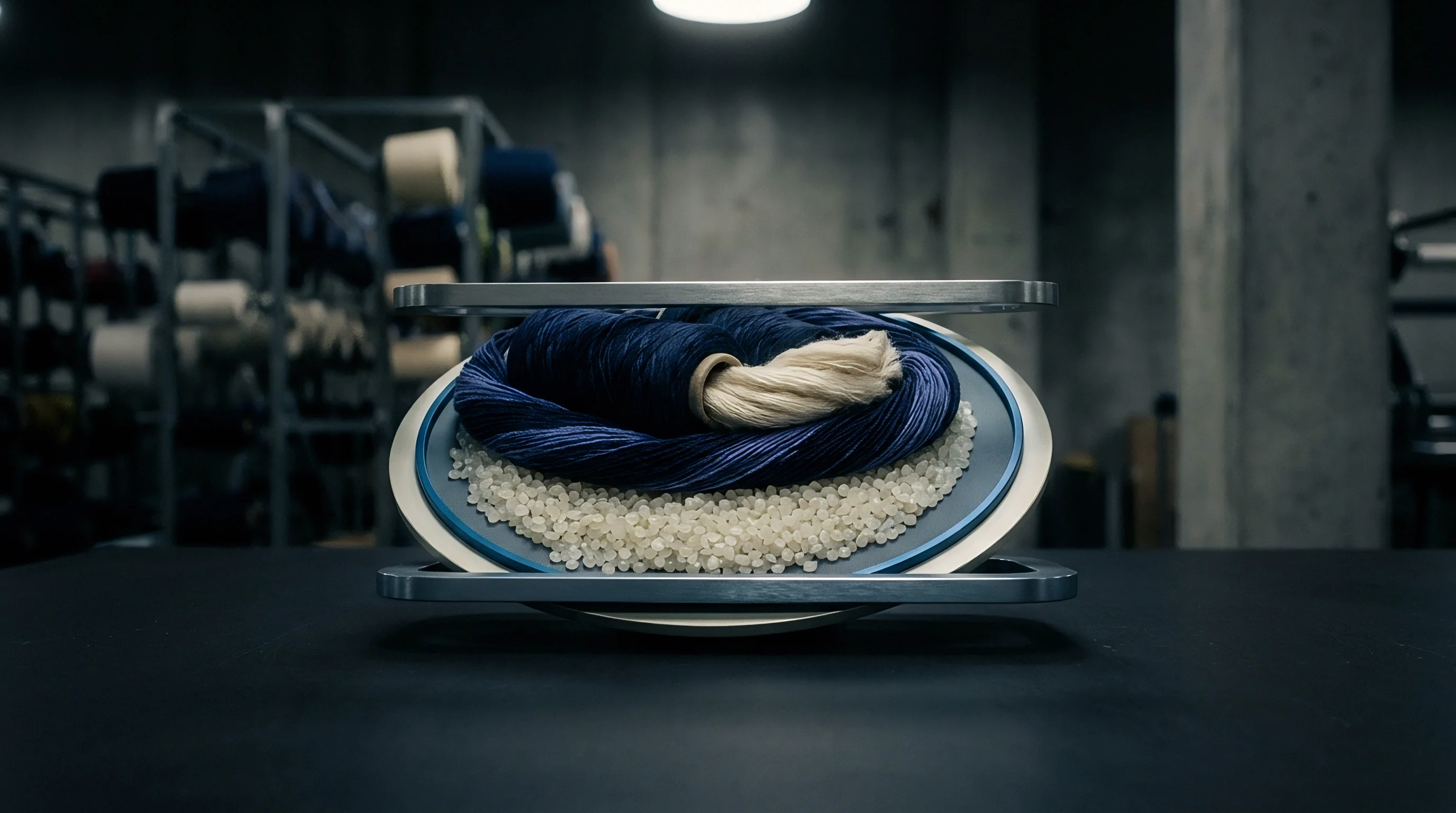
- Mill intake inspection verifies incoming base resin certificates and reviews batch safety files before production begins.
- Specimen cryogenic fragmentation shatters the crosslinked test coupon below glass transition thresholds to maximize surface area.
- High pressure swelling introduces tetrahydrofuran at elevated temperatures to open intermolecular chain voids completely.
- Chromatographic quantification detects desorbed dipolar species on calibrated mass spectrometers against internal isotope standards.
Spinning mills frequently insist that gentle methanol extraction reflects genuine consumer dermal exposure conditions during regular wear.

Degradation
Quantification divergence does not stem entirely from under-extraction. Analytical procedures also produce false-positive spikes through thermal degradation of the polymer backbone inside injection ports and headspace ovens. Synthetic polymers synthesized with isocyanate linkages decompose when subjected to extreme heat.
Polyurethanes containing aromatic diisocyanates, like 4,4-diphenylmethane diisocyanate, break down into volatile amine fragments and cyclic oligomers under thermal stress.

Inlet Thermolysis Mechanisms
Gas chromatography splitless injection ports operate between 250 and 280 degrees Celsius. When crude extracts containing dissolved oligomers or micro-particulates pass into the hot injection liner, non-volatile components deposit onto the glass wool. At 270 degrees Celsius, urethane bonds undergo thermal dissociation.
The dissociation pathway generates free amines, carbon dioxide, and olefins. When residual solvent precursors or dimethylamine salts remain in the sample matrix, secondary thermal reactions assemble dimethylformamide inside the hot inlet.
Headspace gas chromatography introduces similar artifact risks. Static headspace systems heat sealed sample vials containing solid polymer flakes to 120 or 150 degrees Celsius for 60 minutes to drive volatile solvents into the vapor phase. Prolonged heating of crosslinked polyurethanes at 140 degrees Celsius initiates hydrolytic and thermal cleavage of allophanate and biuret crosslinks.
Trapped amine degradation products react with formylating agents present in trace additives, elevating the headspace concentration of dimethylformamide beyond the true solvent concentration of the original roll.
A heated injection port acts like a chemical micro-reactor when dirty polymeric extracts contact glass wool at two hundred and seventy degrees.
Gas chromatography combined with mass spectrometry requires careful inlet maintenance to prevent baseline artifact generation. Liquid chromatography coupled to tandem mass spectrometry avoids high thermal envelopes entirely. Chromatographers operating triple quadrupole mass spectrometers separate dimethylformamide, dimethylacetamide, and 1-methyl-2-pyrrolidone using reversed-phase C18 columns at 40 degrees Celsius with electrospray ionization.
The low temperature prevents back-end formation of target compounds.
| Analytical Platform | Inlet / Column Temperature | Sample Type | Observed Artifact DMF | Limit of Quantification |
|---|---|---|---|---|
| GC-MS (Splitless) | 280 C Inlet / 60-240 C Oven | Crude THF Extract | 85 mg/kg | 10 mg/kg |
| GC-MS (Programmed Temp) | 50-250 C PTV / 60-240 C Oven | Cleaned Hexane Partition | < 5 mg/kg | 5 mg/kg |
| Static Headspace GC-MS | 140 C Vial (60 min) | Solid Polymer Shards | 140 mg/kg | 20 mg/kg |
| LC-MS/MS (ESI Positive) | 40 C Column / Ambient Source | Filtered Methanol/Water | None Detected | 1 mg/kg |
How much of the historical solvent data generated across global supply chains represents true trapped solvent rather than inlet breakdown products?
Arbitration
Commercial resolution of conflicting solvent certificates demands a unified technical protocol embedded in purchase contracts. Disputed shipments arise when buyers and suppliers evaluate identical lots against undefined testing parameters. Relying on generic references to ISO standards leaves critical sample preparation choices open to individual bench chemists.

Standardized Extraction Hierarchy
Testing agreements must define sample reduction, extraction solvent, time, temperature, and instrumental detection. The analytical hierarchy begins with cryogenic pulverization below minus 100 degrees Celsius to achieve a verified particle size under 250 micrometers. The second parameter fixes the extraction fluid as tetrahydrofuran or dichloromethane to guarantee polymer network swelling.
Ultrasonic agitation runs for 60 minutes at 50 degrees Celsius, or pressurized fluid extraction executes at 100 degrees Celsius under 100 bar. The final stage mandates liquid chromatography tandem mass spectrometry or programmed temperature vaporization gas chromatography to prevent inlet thermolysis.
Internal standard selection governs quantitative accuracy. Laboratories analyzing dipolar aprotic solvents must incorporate isotopically labeled analogues: deuterated N,N-dimethylformamide-d7, N,N-dimethylacetamide-d9, and 1-methyl-2-pyrrolidone-d9. Adding internal standards directly to the dry milled powder prior to solvent contact corrects for matrix suppression and incomplete extraction recovery.
Calibration curves require matrix-matched blank extracts to eliminate matrix enhancement effects on mass spectrometer ion sources.
Contractual Retest Protocols
Purchase orders require strict dispute resolution language to govern inter-laboratory discrepancies. Sourcing offices eliminate ambiguity by writing binding analytical criteria directly into chemical compliance exhibits. When conflicting laboratory findings emerge, a neutral referee laboratory receives sealed split specimens from the retained master sample.
The contract stipulates that if certified test values diverge by more than twenty percent between accredited facilities, the referee laboratory must test duplicate cryomilled specimens under pressurized fluid extraction using tetrahydrofuran and liquid chromatography tandem mass spectrometry, with costs allocated entirely to the losing party.