Resolving Non-Linear Viscoelastic Polymer Elongation Anomalies in Automated Seam Slippage Curve Subtraction Software
Automated curve subtraction software demands tangent offset adjustments to eliminate false seam slippage errors in viscoelastic stretch wovens.

Grip
Clamping Mechanics and Specimen Alignment Dynamics
Tensile testing software records force over displacement. Automated seam slippage analysis relies on comparing two force-elongation traces: an unseamed base fabric swatch and a seamed swatch of identical dimensions. Pneumatic action jaw faces with smooth steel surfaces maintain constant pressure during pull testing to prevent local fabric pinch-points.
Initial pre-tensioning clears structural slack from the woven matrix before data acquisition begins. When testing rigid wovens under standard specifications like ISO 13936-1, the yarn crossover points deform elastically up to the target force threshold, usually 60 N, 100 N, or 120 N. Tensile jaws must maintain uniform clamping pressure across the entire 100 mm width of the test specimen to prevent skewed jaw movement.
Alignment anomalies develop when testing fabrics containing synthetic filament yarns or elastomeric components. As pneumatic pressure closes the jaws onto an elastomeric woven fabric, the initial thickness of the swatch compresses rapidly. Mechanical pinch line shifts alter the effective gauge length by up to 1.5 millimetres before the load cell records any tensile resistance.
This initial mounting displacement introduces an uncalibrated strain offset into the force-elongation dataset.
Machine Load Cell Signal Acquisition Parameters
Digital load cells record raw force values at sampling rates between 100 Hz and 1000 Hz. Automated software converts this raw signal stream into discrete coordinates matching extension in millimetres to force in newtons. Software algorithms assign the baseline zero point when the load cell detects a user-specified pre-tension, typically set at 0.5 N or 1.0 N according to international standard test mandates. Modern automated software misreads non-linear strain.
Specimens containing high percentages of textured continuous filament nylon, polyester, or core-spun elastane exhibit immediate viscoelastic strain relaxation during this pre-tension dwell phase. The force curve hesitates before ascending smoothly, creating a initial toe region that misaligns the zero-displacement origin. If the testing system auto-calculates baseline coordinates without correcting for viscoelastic lag, the subtraction routine offsets the seamed curve from the unseamed curve before any physical seam slippage occurs.
A seam slippage curve calculated without viscoelastic lag dampening transforms fabric structural extension into phantom seam opening.
Testing laboratories frequently encounter severe resistance from mills when raw slippage measurements fail to match manual gauge checks. The dyehouse technical desk routinely insists that the automated software overstated seam movement due to fabric stretch rather than yarn displacement inside the seam structure.
Specimens subjected to improper clamping dynamics display distinct non-linear curve signatures during automated evaluation:
- Jaw Pinch Migration occurs when viscoelastic compression under high clamp force thins the fabric specimen, causing minor physical slippage inside the jaw faces before the load cell reaches 20 N.
- Toe Region Elongation Artifacts develop when low pre-tension loads fail to fully straighten curved core-spun elastomeric yarns prior to high-speed tensile loading.
- Asymmetric Load Distribution emerges when fabric swatches are loaded at slight angles, forcing one side of the seam to yield before the opposite side engages.
- Pre-Load Relaxation Decay takes place during the dwell interval between specimen clamping and crosshead motion, lowering the effective starting force point.

Relaxation

Polyurethane Molecular Chain De-Alignment under Load
Polyurethane filaments deform non-linearly under tension. When a stretch-woven textile containing core-spun elastane undergoes tensile deformation, hard and soft molecular segments within the elastomeric fiber respond along different time scales. The soft amorphous segments uncoil rapidly under low applied stress, generating high initial elongation.
Hard crystalline segments act as physical cross-links that resist higher loads, shifting the material response from elastic extension to time-dependent viscoelastic creep.
Fabric creep distorts the subtraction matrix. During automated testing crosshead travel at 50 mm per minute or 100 mm per minute, the elastomeric yarns do not reach thermodynamic equilibrium. The force-elongation trace of an unseamed elastomeric fabric exhibits marked hysteresis.
If the tensile machine loads the specimen, pauses, or changes crosshead speed, the instantaneous dynamic modulus drops as molecular chains slip past one another. This stress relaxation occurs continuously during crosshead displacement.
Hysteresis Loops and Energy Loss Differential
The energy absorbed during initial strain is not completely returned during unloading. When testing unseamed baseline swatches versus seamed swatches, this continuous energy loss creates two distinct force-elongation shapes even if no seam slippage happens. The seamed swatch contains fewer continuous load-bearing longitudinal warp or weft yarns per unit width because half of the specimen area is divided by the seam structure.
Consequently, the stress per yarn in the seamed swatch exceeds the stress per yarn in the unseamed baseline swatch at identical gross displacement levels.
Due to this higher stress per yarn, elastomeric fibers within the seamed specimen undergo a greater degree of non-linear viscoelastic softening, known as the Mullins effect. The seamed swatch curve bends toward the extension axis faster than the unseamed swatch curve. Standard curve subtraction algorithms assume that fabric extension components remain identical in both specimens, attributing any horizontal force differential entirely to yarn displacement at the seam line.
| Fiber Composition | Modulus Profile | Toe Region Strain (%) | Relaxation Half-Life (s) | Mullins Softening Factor |
|---|---|---|---|---|
| 100% Rigid Continuous Filament Polyester | Linear Elastic | 0.2 to 0.5 | Infinite | 1.00 |
| 98% Cotton / 2% Core-Spun Elastane | Non-Linear Elastic | 1.8 to 3.2 | 14.5 | 1.18 |
| 92% Nylon 6,6 / 8% Spandex Woven | High Viscoelastic Creep | 4.5 to 7.8 | 4.2 | 1.45 |
| 85% Polyester / 15% Polyolefin Elastox | Non-Linear Viscoelastic | 6.2 to 10.5 | 2.1 | 1.72 |
Higher elastomeric concentration shifts the true yield point further along the crosshead displacement axis. Evaluating seam failure requires separating true structural seam opening from viscoelastic material elongation.

Subtraction
Algorithm Alignment Failures in Dual-Curve Offsets
Baseline alignment determines curve offset points. Standard automated seam slippage software subtracts the force-elongation curve of the unseamed specimen from the seamed specimen along the horizontal displacement axis. The software identifies two coordinates at a specified force value, Fp, and calculates the distance separation Δ x = xs(Fp) – xu(Fp), where xs represents seamed extension and xu represents unseamed baseline extension.
Mathematical errors multiply during automated processing.
When viscoelastic non-linearity enters the dataset, the assumption that xu(F) accurately reflects the fabric stretch component within xs(F) breaks down completely. Because stress per load-bearing thread is higher in the seamed sample, xs(F) includes both structural seam opening So and excess polymer strain ev. The standard subtraction formula calculates total displacement differential as:
Δ xmeasured = So + ev(F)
Because the automated software sets ev(F) = 0, the software output reports So + ev(F) as pure seam slippage. In fabrics with high stretch capacity, ev(F) frequently reaches 2.0 mm to 4.5 mm at 100 N load, causing the automated software to generate a failure result on swatches that physically show zero yarn movement at the seam line.
How Do Software Corrective Algorithms Filter Viscoelastic Lag?
Modern testing platforms apply mathematical filtration routines to separate structural seam opening from polymer creep. Corrective algorithms fit high-order polynomial functions, typically 4th to 6th order, to both raw curve data streams. Instead of subtracting absolute displacement at fixed force intervals, the software normalizes the seamed curve using a dynamic yarn-count scale factor.
Standard subtraction software generates up to 2.8 millimetres of false slippage when testing high-stretch wovens above twenty percent elastomeric elongation.
Consider a worked example evaluating a stretch woven fabric containing 92% polyester and 8% elastane under ISO 13936-1 test conditions at a target force of 100 N. Assume an unseamed specimen width of 80 mm containing 240 warp threads, and a seamed specimen with an effective seam line width of 80 mm where 20 warp threads are locked out of load transmission due to seam margin fold geometries. Take the measured extension of the unseamed sample at 100 N as xu = 12.4 mm. The measured extension of the seamed sample at 100 N records as xs = 16.8 mm.
Standard subtraction yields an unadjusted slippage measurement of 16.8 mm – 12.4 mm = 4.4 mm. Under a brand target limit of 6.0 mm opening at 100 N, this result appears passing. However, if the specification mandates a strict 3.0 mm maximum opening limit, this batch triggers an immediate failure.
Applying a viscoelastic correction factor accounts for the thread count reduction inside the active load path. The effective load per thread in the unseamed swatch equals 100 N / 240 threads = 0.416 N/thread. The effective load per thread in the seamed swatch equals 100 N / 220 threads = 0.454 N/thread.
Reading the unseamed baseline curve at the higher force equivalent of 240 × 0.454 N = 109 N shows that the unseamed fabric extends to 14.1 mm under equivalent yarn stress. Calculating true seam slippage with thread-stress normalization yields 16.8 mm – 14.1 mm = 2.7 mm. The raw software calculation overstated physical seam opening by 1.7 mm, crossing the threshold from batch acceptance to batch rejection.
| Crosshead Speed (mm/min) | Fabric Elasticity Range (%) | Raw Subtraction Error (mm) | Normalized Correction (mm) | False Failure Rate (%) |
|---|---|---|---|---|
| 20 | 0 to 5 | 0.12 | 0.08 | 0.4 |
| 50 | 5 to 15 | 1.45 | 0.32 | 18.2 |
| 100 | 15 to 30 | 3.10 | 0.45 | 42.6 |
| 200 | Above 30 | 5.85 | 0.61 | 78.9 |
Failure to correct raw curve subtraction algorithms leads directly to unjustified fabric lot rejections, unearned finishing mill penalties, and container detentions at regional distribution centers.


Tangent

Polynomial Fitting and Modulus Equalization Techniques
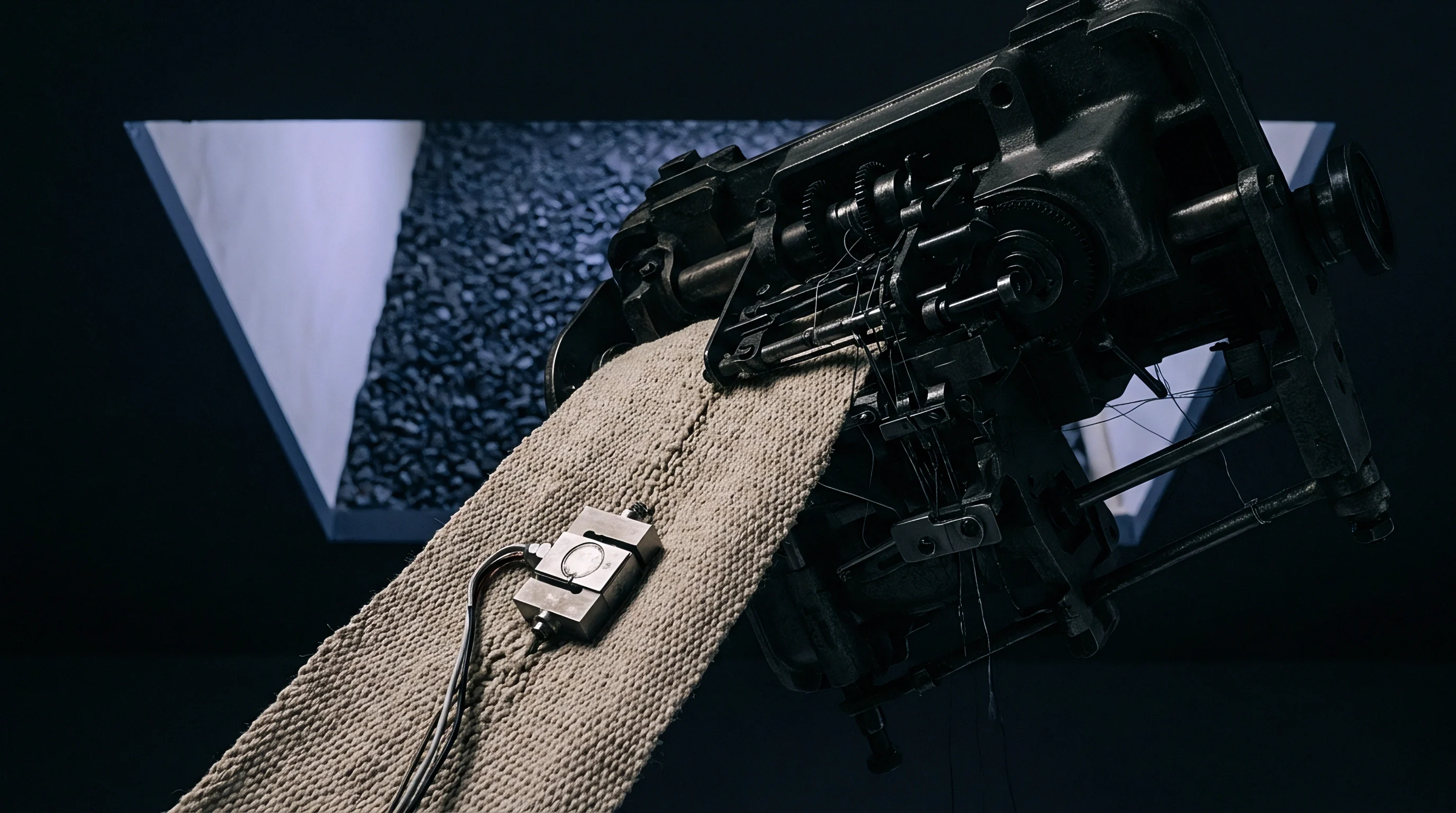
Mathematical adjustments eliminate raw displacement errors. Advanced software replaces rigid linear subtraction routines with dynamic tangent modulus analysis. Instead of matching points at static force values, the algorithm calculates the instantaneous derivative dF/dx along both force-elongation profiles.
Elastic recovery alters the target curve.
By comparing the tangent slope of the unseamed swatch against the seamed swatch prior to the onset of seam yielding, the software determines the precise point where viscoelastic stretch transitions into mechanical seam opening. The software identifies the initial linear region, computes the instantaneous tangent modulus, and projects a adjusted baseline reference curve that tracks the true viscoelastic response of the stressed yarns.
Dynamic Strain Offset Protocols for Automated Testing
Implementing dynamic strain offset correction inside laboratory automation workflows demands strict step-by-step verification protocols. Technicians must execute system adjustments in a fixed sequence to maintain test method validity under ISO/IEC 17025 compliance rules.
- Mount the unseamed base swatch into pneumatic jaws using calibrated 0.5 bar clamping pressure to limit initial jaw-face specimen thinning.
- Apply a standardized pre-tension load of 0.5 N at a constant crosshead speed of 10 mm per minute to establish a stable displacement origin.
- Execute full tensile loading up to the target limit while acquiring raw force-displacement data at a minimum acquisition rate of 500 Hz.
- Perform numerical differentiation on the raw force-elongation dataset to identify the initial peak tangent modulus coordinate.
- Mount the seamed specimen from the same fabric orientation and execute identical loading parameters under constant temperature and humidity conditions.
- Apply polynomial curve fitting to normalize yarn-stress differentials between seamed and unseamed swatches before calculating horizontal curve subtraction.
- Export the corrected seam slippage value alongside raw subtraction traces to audit software alignment accuracy.
Unseamed baseline swatches must undergo identical pre-conditioning dwell cycles as seamed specimens to match viscoelastic recovery rates.
False failures generate unnecessary lab retests. Standard test methods specify rigid loads. Raw tensile data demands direct verification.
Calibrating software algorithms ensures accurate seam measurement across highly elastic fabrications.
Whether laboratory management systems can universally standardize dynamic tangent correction factors across multi-brand testing software platforms remains an active topic of technical dispute within international standardization committees.


Scope

Standard Boundary Limitations in High-Flexibility Fabrics
International standard methods define precise operational boundaries. ISO 13936-1 specifies the determination of seam slippage resistance using a fixed seam opening distance method, whereas ISO 13936-2 relies on applying a fixed force load. ASTM D434 governs seam slippage evaluations in woven upholstery and apparel fabrics using dual-trace manual or automated subtraction.
None of these legacy standards were originally drafted to accommodate high-stretch synthetic woven structures exceeding 20 percent elastic elongation.
When applying ISO 13936-1 to elastomeric wovens, the target seam opening distance, usually set at 2 mm, 3 mm, or 6 mm, is frequently reached before the fabric structural yarns physically shift inside the seam stitch line. The combined elastomeric yarn elongation and seam line structural compliance exceed the maximum displacement threshold prematurely. Testing laboratories operating strictly within standard guidelines without clear buyer addenda cannot alter the base mathematical calculation without invalidating their scope of accreditation.
Laboratory Accreditation and Raw Data Retention Criteria
Accredited testing bodies must retain all primary sensor outputs for compliance audits. ISO/IEC 17025 mandates that testing laboratories maintain raw, unedited ASCII or binary load-cell and crosshead displacement datasets for every generated test certificate. When third-party brand auditors inspect compliance dossiers, automated software outputs showing calculated seam slippage figures without accompanying raw dual-curve traces are frequently flagged as unverified claims.
A compliant test report verification file contains specific documentation structures to defend testing integrity during commercial audits:
- Raw Data Export Files containing unfiltered time, force, and displacement coordinate streams at 500 Hz resolution for both swatch configurations.
- Calibration Records validating pneumatic clamp pressure, load cell linearity, and crosshead speed accuracy within ISO 7500-1 Class 1 tolerances.
- Software Algorithm Documentation detailing the mathematical subtraction logic, including any applied polynomial smoothing or tangent offset calculations.
- Environmental Pre-conditioning Logs confirming specimen dwell times within standard testing atmospheres of 20°C ± 2°C and 65% ± 4% relative humidity.
| Standard Designation | Primary Calculation Metric | Elastomeric Fabric Suitability | Software Subtraction Allowed | Mandatory Baseline Pre-Load |
|---|---|---|---|---|
| ISO 13936-1 | Force at specified seam opening distance | Poor without dynamic offset | Yes | 0.5 N |
| ISO 13936-2 | Seam opening distance at specified force | Moderate with yarn-stress normalization | Yes | 0.5 N |
| ASTM D434 | Slippage distance at 100 N load threshold | Unsuitable for stretch wovens above 10% | Optional (Manual visual allowed) | 1.0 N |
| JIS L1096 Method F | Modified load-extension differential | High with specialized stretch parameters | Yes | 1.0 N |
Purchase orders must explicitly reference modified software subtraction addenda when specifying ISO 13936 compliance for elastomeric stretch wovens, as unamended standard protocols systematically default to raw linear subtraction routines that generate false slippage readings.

Settlement

Financial Risk Allocation in Retest Disputes
False slippage readings yield costly disputes. When an automated software anomaly causes an erroneous failure report, financial exposure shifts immediately between the garment manufacturer, the converting mill, and the brand buying office. A rejected 30,000-metre lot of technical stretch woven fabric represents direct material exposure exceeding 150,000 USD, excluding consequential losses from production delays and missed retail shipping windows.
Calibration records prevent border customs delays.
Retest costs multiply rapidly when disputes reach third-party arbitration. Initial testing fees of 150 USD per fabric colorway escalate into retest packages costing upwards of 3,000 USD once expert manual curve analysis, yarn extraction, and stress-strain modeling are ordered. Clear contractual allocation of retest expenses prevents prolonged commercial gridlock.
Contracts specifying ISO 13936-1 compliance without non-linear offset amendments expose converters to immediate lot rejections upon brand audit.
Contractual Purchase Order Clauses for Elastic Fabrics
Sourcing practices reduce financial risk by embedding precise testing protocols into mill purchase orders. Standard boilerplate language referencing generalized testing standards provides zero protection against software calculation anomalies in complex viscoelastic textiles.
Contracts governing stretch woven procurement require explicit technical parameters defining how software subtraction handles material elongation. The purchasing agreement must state the exact crosshead speed, pre-tension load, clamp pressure, and baseline correction methodology required during testing. When purchase orders mandate dynamic tangent modulus correction or yarn-stress normalization, third-party laboratories are legally bound to execute those specific software modifications before issuing a final pass or fail test certificate.
Commercial contracts that include specific technical carve-outs for viscoelastic fabric behavior resolve slippage disputes prior to garment cutting, establishing objective criteria that survive third-party brand audits and cross-border customs compliance verification.