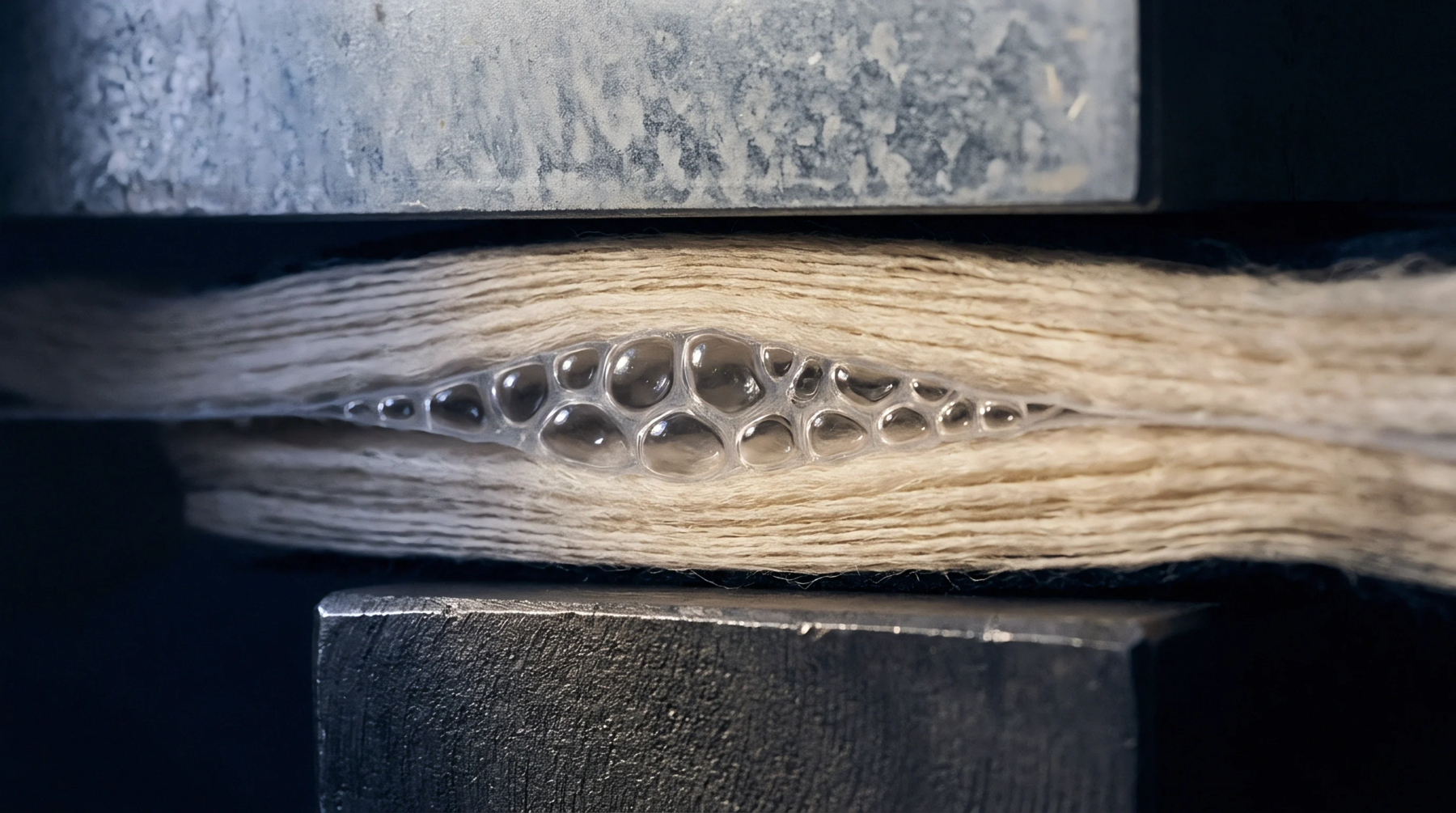
Micro Shed Dusting Accumulation Dynamics inside Air Jet Relay Nozzles under High Humidity
Humid air plasticizes sizing dust into sticky cakes inside relay nozzle bores, distorting airflow profiles and causing costly pick insertion stops.
Gas dynamics dictates the maximum achievable linear speed of a compressible fluid passing through a constriction when the downstream pressure drops below the thermodynamic critical pressure ratio. In industrial air-jet weaving, choked flow velocity represents the sonic threshold reached at the minimum cross-sectional throat of main insertion nozzles and relay jet orifices. The fluid velocity at this constriction locks at local sonic speed, governed by the upstream temperature and the specific heat ratio of the compressed dry air.
Further reductions in receiver pressure downstream cannot accelerate the gas beyond this limit inside the physical throat. The boundary of this condition breaks down when converging-diverging supersonic nozzle geometries expand the exiting fluid, or when line pressure drops below the critical pressure ratio of roughly zero point five two eight for dry air.
Achieving critical pressure across a sub-millimetre nozzle orifice forces compressed air to reach local acoustic velocity within the nozzle bore. When pneumatic delivery lines supply compressed air at four to six bar gauge into atmospheric pressure, choked flow velocity manifests instantly across the throat cross-section. Upstream pressure increases expand the mass flow rate by elevating air density, yet linear throat velocity remains constant at the local speed of sound, approximately three hundred and forty-three metres per second at standard shop temperatures.
Expansion past the nozzle exit creates a rapid pressure equalization, yielding a supersonic core immediately downstream that quickly dissipates into turbulent subsonic jet stream layers. High deceleration gradients follow this expansion, defining the usable zone where yarn propulsion occurs through surface skin friction.
Yarn propulsion dynamics depend directly on the momentum transferred from the high-velocity air jet to the yarn body. Operating nozzles under choked flow velocity conditions can cause severe structural shock to fine-count yarns if pressure drops across the orifice create steep velocity spikes. Filament yarns subjected to abrupt supersonic expansion waves suffer filament spreading, loop pull-out and filament shearing at the main nozzle exit.
Staple yarns encounter hairiness elevation and untwisting when subjected to the sonic transition zone. If loom technicians mistakenly raise line pressure to correct trailing-end yarn drop, mass flow increases linearly while throat velocity stalls, consuming plant compressor energy without generating downstream velocity gains. Incomplete pick insertion, tip fraying and broken picks appear systematically on the fabric face as a direct result of improper sonic throat management.
Balancing pneumatic efficiency across air-jet weaving machinery requires calculating the precise upstream pressure that sustains required yarn velocity without generating unnecessary shock waves. Relay nozzles operate most efficiently just below the choked threshold or at moderate supercritical pressures, keeping auxiliary jet plumes coherent across the profiled reed channel. Downstream velocity sensors and pressure transducers mounted on loom sley assemblies monitor whether air delivery profiles achieve optimum aerodynamic drag.
Over-pressurization causes shock diamonds at nozzle exits, which scatter the jet trajectory away from the profiled tunnel centreline. Maintaining nozzle pressures within calibrated sub-sonic or minimally choked windows preserves compressed air reserves, stabilizes yarn arrival timing and prevents structural damage to delicate warp and filling systems.
Humid air plasticizes sizing dust into sticky cakes inside relay nozzle bores, distorting airflow profiles and causing costly pick insertion stops.
Expertise is a utility, not a secret. sentiention™ publishes its working knowledge as open reference: intelligence layer covering the materials it sources, the markets it enters, and the reference that serves both.