Thermal Conductance
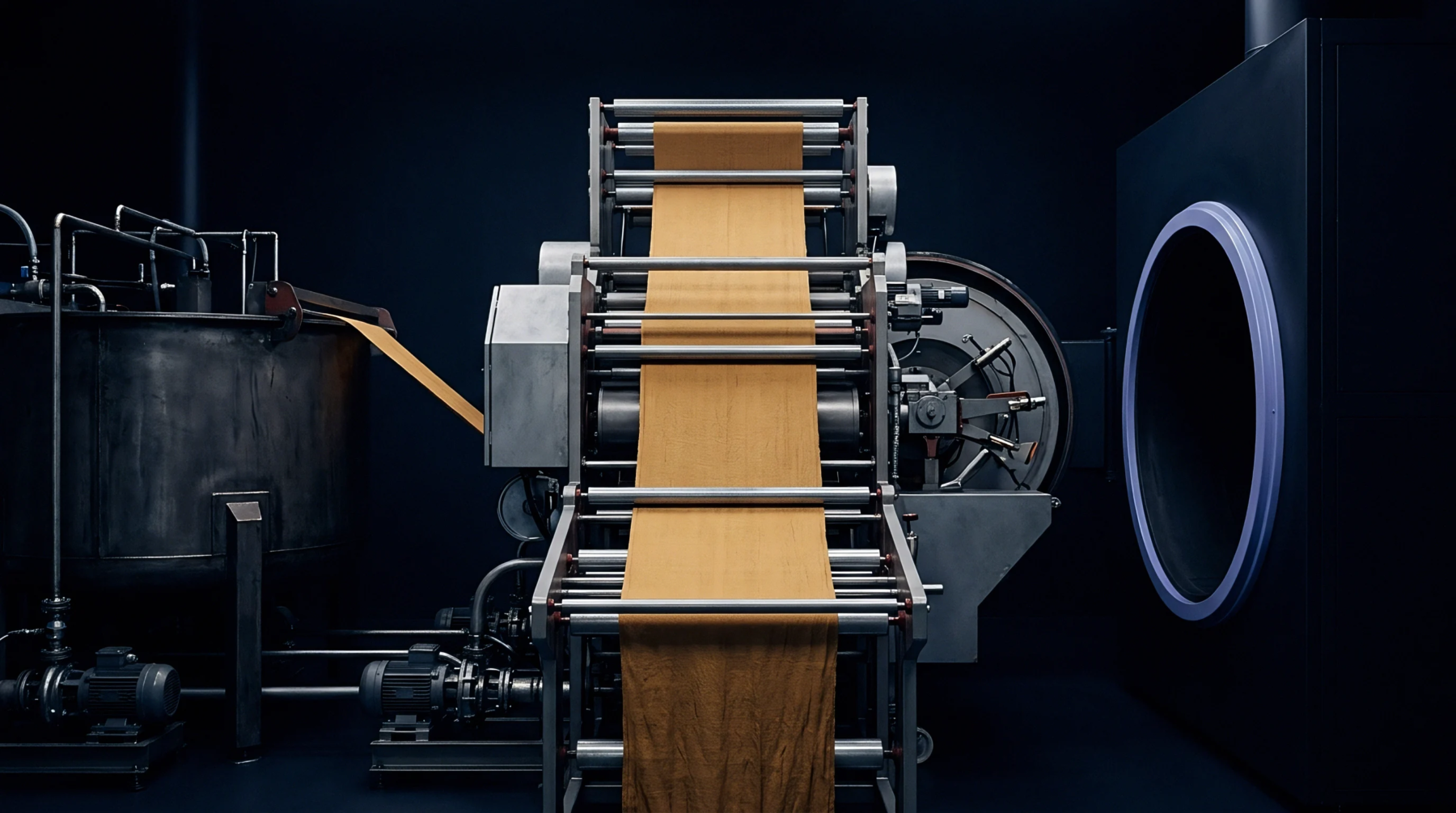
Proportionality constant between the heat flux and the thermodynamic driving force defines the rate at which thermal energy moves across a boundary. In fabric stenters and pre-heating cylinders, the heat transfer coefficient quantifies the efficiency of energy transfer from the heating medium to the running textile web. This value governs the speed at which the fabric reaches its target drying or heat setting temperature, allowing production managers to balance energy consumption with machinery line speed.
Convective Mechanism
Boundary layer thickness and fluid velocity dictate the magnitude of this thermal metric. When using high velocity air nozzles, the heat transfer coefficient increases because the turbulent air stream strips away the insulating layer of cooler air next to the fabric. This mechanism allows for faster processing times without requiring higher oven temperatures.
Process Influence
Incorrect estimation of this parameter leads to incomplete drying or thermal degradation of delicate synthetic fibres. In the production of nylon fabrics, the heat transfer coefficient must be calculated precisely to ensure the material is heated uniformly across its entire width. This control prevents differential shrinkage and uneven dye uptake in subsequent dyeing stages.
Mathematical Boundary
Calculations are based on Nusselt number correlations that depend on the dryer geometry. In dry fabric regions, the heat transfer coefficient is lower than in wet zones due to the absence of evaporating moisture. This difference limits the applicability of a single heating model.