Quantifying Inter Layer Plasticizer Mass Transfer Coefficients in Weathered Architectural PVC Laminates
Quantifying inter-layer plasticizer mass transfer coefficients requires batch-level GC-MS depth profiling to enforce retention limits under UV weathering.


Core
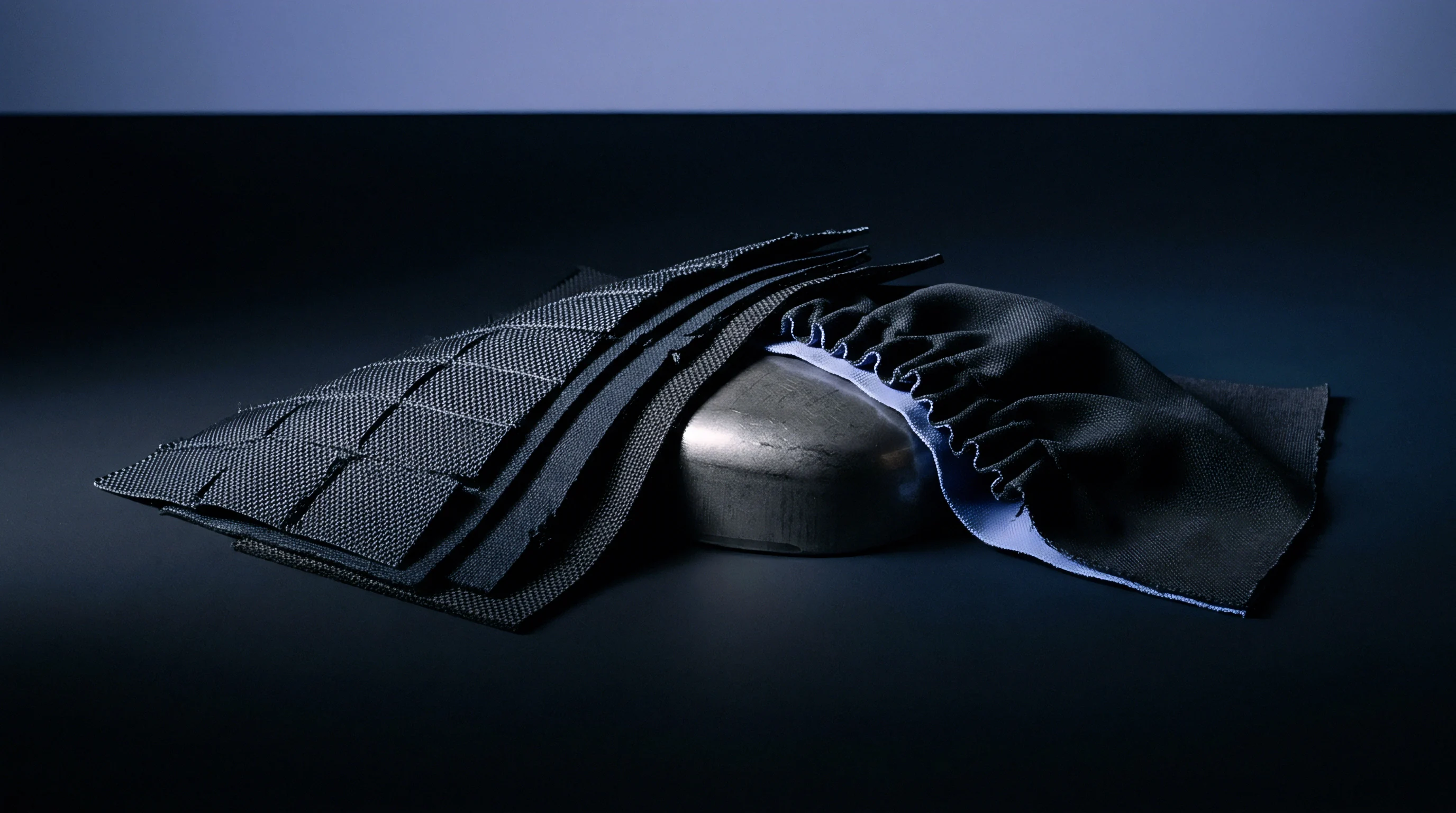
Architectural polyvinyl chloride laminates rely on a multi-layer polymer architecture engineered to balance tensile strength, flexibility, UV endurance, and soil resistance. Structural fabrications incorporate a woven polyester filament base fabric, a tie-layer adhesive, an inner bulk plastisol layer heavily plasticized for flexibility, and a exterior fluoropolymer protective topcoat, typically polyvinylidene fluoride or acrylic resin. The primary function of low-molecular-weight phthalates and high-molecular-weight polymeric adipates within the bulk PVC core centers on lowering the glass transition temperature of the polymer matrix below sub-zero outdoor service limits.
Internal mass transfer begins immediately upon lamination, driven by chemical potential gradients existing between adjacent layers of varying formulation density.
Plasticizer concentration equilibrium remains rare in newly manufactured rolls. Freshly laminated membranes exhibit sharp step-changes in plasticizer activity across the interface separating the heavily plasticized inner core layer from the thin, unplasticized or low-plasticizer topcoat. Dynamic diffusion processes move plasticizer molecules toward regions of lower chemical potential.
High processing temperatures during thermal lamination increase initial migration rates, establishing an early flux before the material reaches ambient storage conditions.
Plasticizer loss or redistribution across inter-layer boundaries directly impairs structural performance through specific mechanical and chemical degradation pathways:
- Inter-Layer Delamination Stress occurs when plasticizer molecules accumulate at the adhesive interface, softening the polyurethane or acrylic tie-layer and reducing mechanical peel strength.
- Topcoat Crazing and Micro-Cracking happens as plasticizer depletes from the underlying PVC matrix, inducing differential volumetric shrinkage relative to the rigid fluoropolymer skin.
- Surface Plasticizer Exudation creates a tacky surface film that attracts airborne particulates, accelerates biological growth, and impairs solar reflectance index ratings.
- Flexural Modulus Stiffening manifests when bulk core plasticizer content drops below critical design thresholds, shifting the ductile-to-brittle transition temperature into winter service ranges.
The chemical structure of the plasticizer determines its intrinsic mobility through the PVC network. Monomeric species such as diisononyl phthalate and diisodecyl phthalate possess molar volumes that allow rapid translational movement between polymer chains. Higher molecular weight polymeric plasticizers, including linear polyadipates, show lower diffusion rates due to steric hindrance and extensive molecular entanglement within the PVC matrix resin.
Converters often claim that low initial migration rates observed during standard short-term quality checks ensure multi-decade operational resistance against plasticizer depletion under harsh atmospheric exposure.

Degradation
Solar ultraviolet radiation disrupts the surface chemistry of architectural PVC membranes, altering mass transfer boundaries. Photons in the UVB spectrum split chemical bonds within the PVC polymer backbone and topcoat resins, generating free radicals that initiate photo-oxidative chain reactions. Hydroperoxides form along the polymer chain, leading to chain scission, cross-linking, and the generation of carbonyl groups.
Surface cross-linking hardens the outer boundary, while photo-oxidative micro-fissuring destroys the continuous barrier properties of the PVDF topcoat.
Thermal cycling accelerates mass transfer through temperature-dependent diffusion enhancement. Solar absorption raises membrane surface temperatures above sixty degrees Celsius during peak summer exposure. Elevated kinetic energy increases the fractional free volume of the PVC matrix, lowering the energy barrier for plasticizer jump diffusion between polymer segment interstitial sites.
Rain and dew condensation exacerbate this loss through extraction at the exposed boundary layer.
Solar UV radiation coupled with peak surface temperatures of sixty-five degrees Celsius increases inter-layer plasticizer flux through weathered PVDF topcoats by up to four hundred percent relative to unexposed control swatches.
Water immersion creates an additional extraction mechanism at the surface boundary layer. Plasticizer molecules that reach the outer membrane skin partition into the aqueous liquid film, maintaining a continuous concentration sink that drives internal diffusion. Leaching severity depends on the aqueous solubility of the plasticizer and the boundary-layer mass transfer coefficient of the water film.
Continuous outdoor weathering combines photo-oxidative topcoat degradation with thermal flux and rain leaching, transforming a steady Fickian diffusion system into a complex, non-steady-state mass transfer process with time-dependent surface boundary conditions.
As the protective topcoat suffers micro-fissuring, the effective mass transfer resistance at the exterior interface approaches zero. Under these conditions, internal Fickian diffusion within the PVC bulk core becomes the rate-limiting step for plasticizer loss. The mass transfer coefficient across the weathered interface transitions from a boundary-controlled resistance regime to an internal diffusion-controlled regime.
It remains uncertain whether photo-induced cross-linking of the underlying PVC sub-layer can form a self-limiting barrier capable of slowing long-term plasticizer migration after complete topcoat erosion.

Sorptivity
Quantifying plasticizer mass transfer coefficients across weathered lamination interfaces demands analytical instruments capable of spatial depth resolution and precise chemical identification. Attenuated Total Reflectance Fourier Transform Infrared spectroscopy enables non-destructive depth profiling near the exterior interface. By varying the angle of incidence or changing the refractive index of the internal reflection element crystal, infrared radiation probes specific depths from zero point five to three micrometers into the laminate, tracking carbonyl and ester absorption peaks associated with phthalate and adipate species.

Why Does Micro-ATR-FTIR Depth Profiling Yield Variable Migration Coefficients?
Local surface topography variations and contact pressure inconsistencies between the sample and the ATR crystal introduce signal intensity fluctuations. Weathered samples exhibit micro-roughness that alters crystal optical contact, distorting quantitative absorbance ratios. Gas chromatography-mass spectrometry combined with microtome sectioning provides absolute quantitative plasticizer mass fractions across depth profiles.
Microtome sectioning cuts the laminate into consecutive ten-micrometer slices parallel to the membrane interface, followed by solvent extraction and chromatographic separation.
| Analytical Technique | Depth Resolution | Limit of Detection | Primary Test Parameter | Standard Reference |
|---|---|---|---|---|
| 10.0 μm | 0.01 wt% | Absolute concentration profiles | EN ISO 177 | |
| 0.5 μm | 0.10 wt% | Surface ester peak ratio | ASTM E1252 | |
| Bulk Average | 0.05 wt% | Thermal volatilization loss rate | ISO 11358-1 | |
| Interface Boundary | 0.001 g/m²·h | Cross-membrane mass flux rate | ASTM D1203 |
Thermogravimetric analysis determines plasticizer loss kinetics by measuring sample mass reduction under isothermal heat conditions. Combining TGA with mass spectrometry allows real-time monitoring of volatile degradation products versus plasticizer volatilization. Gravimetric transport cells isolate specific inter-layer interfaces, placing donor PVC core layers in direct physical contact with receiver topcoat films under controlled mechanical pressure and temperature regimes.
Compliance files referencing ASTM D1203 plasticizer loss reports fail to clear port customs unless accompanied by lot-specific mass transfer verification for the exact shipped roll thickness.
Inter-laboratory test variability often traces back to sample preparation technique and environmental conditioning prior to extraction. Swatches held at fluctuating relative humidity show altered absorption rates due to moisture interference at polymer interfaces. Standardized test swatches require seventy-two hours of pre-conditioning at twenty-three degrees Celsius and fifty percent relative humidity to generate reproducible mass transfer values.
Analytical accuracy hinges on complete solvent extraction of the plasticizer species without dissolving the underlying polymer backbone. Tetrahydrofuran swells the PVC matrix to release entrapped plasticizers, but complete dissolution invalidates microtome section spatial tracking. Selective extraction using hexane or methanol removes unbound phthalates while preserving structural layer orientation.
A reliable rule of thumb dictates that solvent extraction times must scale with the square of the sample layer thickness to avoid underestimating internal concentration gradients.

Arithmetic
Mathematical modeling of plasticizer transport across weathered architectural PVC laminates applies non-steady-state mass transport equations derived from Fick’s second law. Plasticizer concentration within a given layer varies over time and spatial position according to the partial differential formulation:
∂C / ∂t = ∂ / ∂x
In this equation, C represents plasticizer concentration in grams per cubic centimeter, t denotes time in seconds, x is the depth coordinate across the laminate thickness in centimeters, and D represents the concentration-dependent and temperature-dependent inter-layer mass diffusion coefficient in square centimeters per second. Boundary conditions at the outer topcoat interface incorporate a mass transfer film coefficient, h_m, which governs the convective and volatilization loss from the surface to the surrounding atmosphere:
– D · (∂C / ∂x)|_{x=0} = h_m ·
The variable C_infinity represents the ambient equilibrium concentration of volatile plasticizer in air or contacting water, which approaches zero under continuous outdoor ventilation or rain wash conditions. Weathering modifies the diffusion coefficient D through an aging factor that accounts for UV photo-oxidation and chain scission, expressing temperature dependence through an Arrhenius relationship:
D(T, t_w) = D_0 · exp( – E_a / (R · T) ) ·
The parameter D_0 represents the pre-exponential diffusion factor, E_a is the activation energy for plasticizer diffusion in kilojoules per mole, R is the universal gas constant, T is absolute temperature in Kelvin, t_w is cumulative weather exposure hours, while alpha and beta are empirical photo-degradation reaction constants calibrated via accelerated weathering chambers.
| Plasticizer Type | Matrix Layer State | Temperature (°C) | Diffusion Coeff D (cm²/s) | Surface Coeff h_m (cm/s) |
|---|---|---|---|---|
| Unweathered Bulk Core | 23 | 1.2 × 10⁻¹⁰ | 4.5 × 10⁻⁸ | |
| UV-Weathered Topcoat Interface | 23 | 8.7 × 10⁻¹⁰ | 1.2 × 10⁻⁶ | |
| Unweathered Bulk Core | 23 | 6.4 × 10⁻¹¹ | 2.1 × 10⁻⁸ | |
| UV-Weathered Topcoat Interface | 60 | 3.1 × 10⁻⁹ | 8.4 × 10⁻⁶ | |
| Unweathered Bulk Core | 23 | 3.5 × 10⁻¹² | 1.0 × 10⁻¹⁰ | |
| UV-Weathered Topcoat Interface | 60 | 1.8 × 10⁻¹⁰ | 5.2 × 10⁻⁸ |
Quantifying mass transfer parameters for a architectural membrane deployment requires a structured computational approach:
- Initial Baseline Concentration Setup defines the spatial distribution C(x, 0) across all core, adhesive, and topcoat zones based on fresh roll GC-MS extraction data.
- Boundary Condition Assignment fixes surface film mass transfer resistance values corresponding to seasonal wind speeds and average solar irradiance exposures.
- Temperature Field Integration inputs historical hourly ambient temperature records into the Arrhenius rate equation to yield time-varying diffusion rates.
- Differential Numerical Integration solves the Fickian transport matrix using finite-difference spatial discretization across a minimum of one hundred node points per layer.
Predictive mass transfer models assuming constant diffusion coefficients undercount multi-year plasticizer loss by up to sixty percent in high-UV outdoor deployments.
Consider a practical engineering calculation involving a two-millimeter thick PVC architectural membrane containing thirty-five weight percent diisononyl phthalate in the bulk core, covered by a twenty-micrometer PVDF topcoat. Assume the initial uniform plasticizer concentration in the core equals 0.42 grams per cubic centimeter. Under accelerated weathering test conditions at sixty degrees Celsius, the effective mass diffusion coefficient D through the core equals 4.5 × 10⁻⁹ cm²/s, while the degraded topcoat mass transfer coefficient h_m increases to 5.0 × 10⁻⁶ cm/s.
Calculating the instantaneous mass flux J across the exterior surface per unit area using Fick’s first law yields:
J = – D · (ΔC / Δx) = h_m ·
Setting C_infinity to zero and using a discretized surface boundary layer thickness Δx of 0.002 centimeters, the system equations yield a surface concentration C_surface of 0.28 grams per cubic centimeter. The calculated instantaneous surface flux equals 1.4 × 10⁻⁶ grams per square centimeter per second. Over a continuous five-hundred-hour weathering interval, integration of this flux predicts a total plasticizer mass loss of approximately 2.52 grams per square meter of membrane surface, corresponding to a two point eight percent drop in absolute bulk core plasticizer concentration.
This reduction shifts the measured Shore A hardness of the membrane core from eighty-five to ninety-one, increasing stiffness and lowering cold-bend resistance.

Sampling
Verifying plasticizer migration compliance across production shipments requires strict batch-level sampling protocols executed directly at the converting plant prior to container loading. Certificates of analysis generated from laboratory-cast hand sheets fail to represent continuous line production realities. Tension fluctuations during web coating create micro-voids at the adhesive-PVC interface that alter mass diffusion channels.
Swatches cut from the outer lap of a roll routinely exhibit reduced plasticizer content due to edge volatilization during heat-setting and roll storage.
Field verification follows a standardized sequence designed to capture representative batch data:
- Cut full-width specimen strips measuring thirty centimeters along the warp direction, discarding the first three complete outer wraps of the selected master roll.
- Extract three distinct square swatches measuring ten by ten centimeters across the web, representing left-edge, center, and right-edge manufacturing positions.
- Hermetically seal each swatch in an aluminum-laminated barrier pouch immediately after cutting to prevent volatility loss during transit to the testing facility.
- Perform baseline gravimetric mass determinations within two hours of unsealing, followed by extraction testing under EN ISO 15701 thermal stress conditions.
- Determine residual adhesive peel strength across the inter-layer interface using an ISO 2411 mechanical tensile tester at a constant rate of traverse.
Auditing scope certificates requires matching test report article numbers against purchase order line items. A compliance file carrying a valid test report for a monomeric-plasticized architectural membrane offers zero legal or technical coverage for a structural contract specifying a polymeric-plasticized laminate. Certificates quiet on exposure temperature limits leave buyers fully liable for field failures occurring outside standard twenty-three degree testing regimes.
Batch compliance testing carried out on outer roll wraps systematically underestimates actual lot migration coefficients due to pre-test surface evaporation.
Standard purchase order compliance clauses require explicit mass transfer performance criteria linked to batch lot numbers. Contract language specifying EN 15619 architectural membrane compliance must incorporate a maximum allowable plasticizer mass loss limit of four percent by weight after two thousand hours of accelerated weathering under EN ISO 4892-2 exposure, accompanied by a post-exposure inter-layer adhesion retention threshold of at least thirty-five Newtons per fifty millimeters width.

Exposure
Product failure caused by uncontrolled plasticizer migration creates immediate structural and financial liabilities for project developers and membrane converters. As plasticizer depletes from the bulk core into the adhesive interface, inter-layer shear strength drops below wind-uplift design thresholds. Dynamic wind loads on tensioned fabric structures induce micro-delamination zones that expand rapidly along seam lines.
Structural failure during storm events frequently originates from plasticizer-softened adhesive joints that suffer progressive peel propagation.
Warranty claims surrounding architectural PVC membranes regularly focus on surface staining, crazing, and loss of flexibility. Membrane manufacturers write explicit exclusions into commercial warranties, denying liability for plasticizer migration issues caused by incompatible secondary topcoats, field-applied clean-down chemicals, or contact with unapproved structural sealants. Importers and converters who buy unverified overseas roll goods carry full product liability under regional consumer safety and building code regulations when the original manufacturer lacks legal presence in the destination jurisdiction.
Remediation costs for failed architectural structures exceed simple membrane replacement bills. De-tensioning, dismantling support cables, disposing of contaminated structural fabric, custom fabricating replacement panels, and reinstalling under tight site schedules drive costs to three to five times the initial material procurement purchase order value. Specifying verified low-migration polymeric plasticizers and demanding batch-level inter-layer mass transfer test documentation remains the sole effective strategy for protecting capital investments against premature environmental weathering degradation.