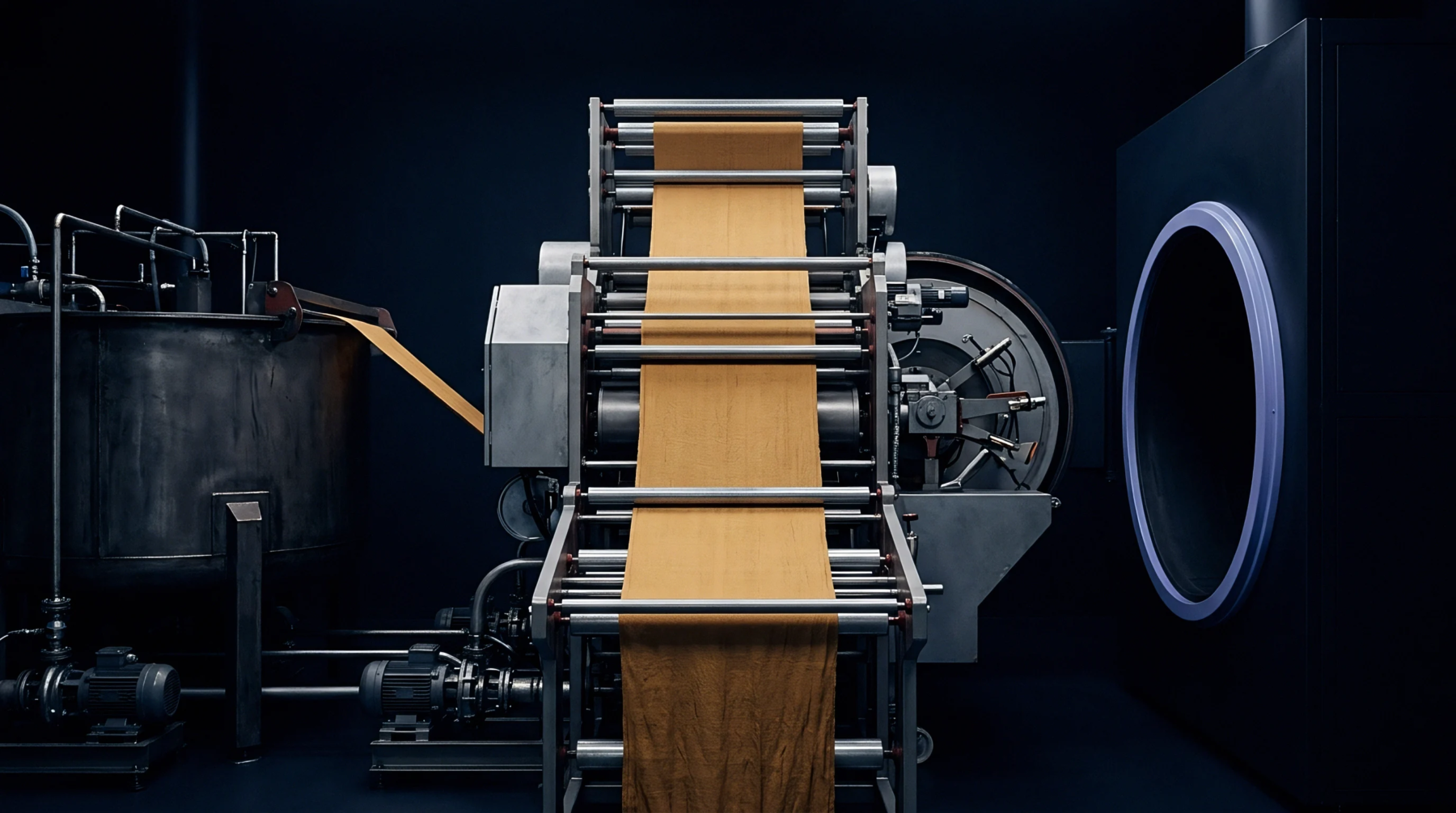
Controlling Continuous Dyeing Particulate Migration across Thermal Intermediate Dryers
Intermediate drying needs balanced radiative heat, controlled convection air speed, and pseudoplastic antimigrants to eliminate dye migration across woven fabric.
Aqueous print paste formulation demands precise viscosity management during rotary screen application to prevent motif bleeding across woven cotton grounds. A polyacrylate thickener functions as a synthetic anionic macromolecule that swells upon alkali neutralization, forming a swollen three dimensional network that traps free water within the dispersion medium. Mill technicians add this rheology modifier directly into pigment printing formulations at concentrations typically ranging between one and three percent by weight.
High shear forces generated by the squeegee passing through the mesh cylinder temporarily disrupt the polymer chains, reducing apparent viscosity to facilitate clean pattern transfer through the screen openings. Once the shear stress ceases immediately after deposition, intermolecular hydrogen bonding quickly restores resting viscosity to hold the printed paste outline sharp against capillary spreading into adjacent warp and weft yarns.
Molecular weight distribution and degree of neutralization govern how efficiently the polymer coils uncoil and immobilize solvent molecules. Carboxylic acid groups pendent along the carbon backbone remain tightly coiled in acidic environments because electrostatic repulsion stays low between uncharged moieties. Neutralization with aqueous ammonia or sodium hydroxide converts those pendant groups into carboxylate anions, generating strong intramolecular charge repulsion that forces the polymer chain to extend outward into a rigid conformation.
That chain extension multiplies the hydrodynamic volume occupied by each macromolecule, restricting the mobility of surrounding water molecules and building high resting viscosity at low shear rates. Temperature variations during storage alter this hydration equilibrium, requiring careful pH monitoring to maintain consistent paste consistency before the goods enter the drying chamber.
Electrolyte concentration inside the print paste heavily influences overall thickening efficiency because added salt shields the charged carboxylate groups on the polymer chain. Divalent cations such as calcium or magnesium present in hard water or metallic dye salts bind directly to the anionic sites, causing the extended polymer network to collapse prematurely and drop viscosity sharply. Formulators prevent this viscosity loss by incorporating sequestering agents into the print paste recipe to bind free ions before those ions reach the polymer chains.
Synthetic thickeners also exhibit severe viscosity reduction when mixed with cationic dye formulations, creating immediate precipitation that clogs fine screen meshes during high speed production runs.
Viscosity recovery kinetics dictate whether a printed textile pattern maintains edge definition during the brief time window between mechanical deposition and thermal fixation. Polymer chains subjected to intense mechanical deformation during doctor blade rotation align parallel to the shear vector, but they rapidly randomize their orientation as soon as the stress is removed. This rapid structural reconstitution prevents the printed paste from sagging on vertical drying frames or losing fine half tone dot definition on synthetic blends.
Laboratory rotational viscometers measure this thixotropic recovery by tracking apparent viscosity changes across step change shear profiles, providing quality control laboratories with numerical verification before bulk printing commences.
Intermediate drying needs balanced radiative heat, controlled convection air speed, and pseudoplastic antimigrants to eliminate dye migration across woven fabric.
Expertise is a utility, not a secret. sentiention™ publishes its working knowledge as open reference: intelligence layer covering the materials it sources, the markets it enters, and the reference that serves both.