Yarn Guiding Geometry
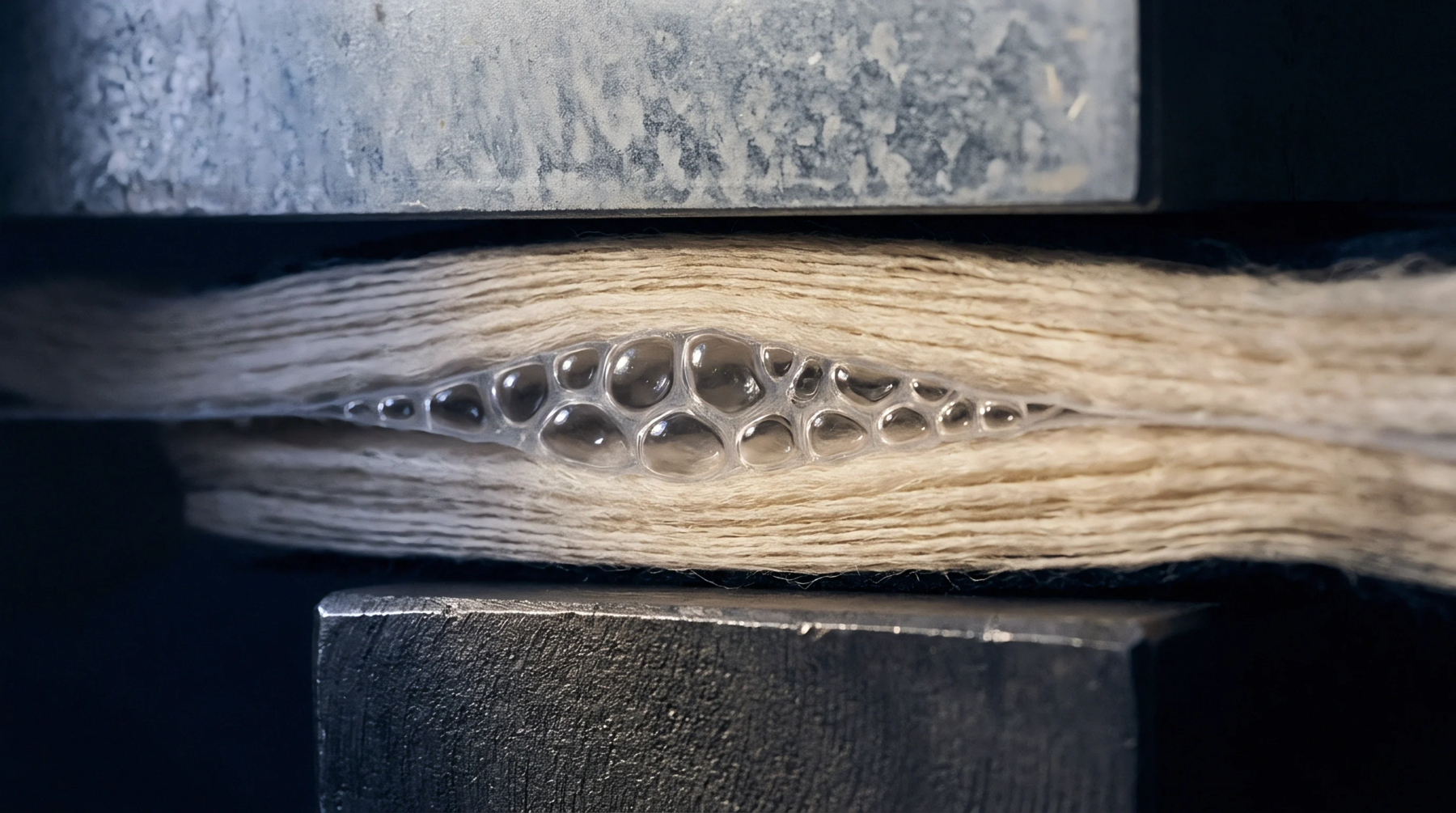
Structural aerodynamic channels formed by aligned concave recesses in the forward edge of specialized weaving reed dents constitute an enclosed fluid guidance conduit across the weaving width. Profiled reed tunnel describes the continuous guide trough established when individual profiled dents are clamped together within the sley assembly of an air-jet loom. The channel gathers, directs and preserves the kinetic energy of compressed air jets during weft insertion, isolating the expanding air column from the surrounding open warp shed.
Forward propulsion of the filling yarn occurs entirely within this geometric boundary. The design stops applying to standard flat-dent reeds used in rapier, projectile or shuttle weaving machines, which lack aerodynamic profile indentations.
Conduit Fluid Dynamics
Modern high-speed insertion relies on controlling fluid expansion as air travels across weaving widths exceeding three metres. The profiled reed tunnel forms an open-front channel where compressed air pulsed from main and relay nozzles creates a continuous downstream air current. Symmetrical dent contours guide the air plume, preventing premature radial dissipation and maintaining forward velocity over the complete pick flight path.
Relay nozzles mounted along the sley fire compressed air bursts angled precisely into the open face of the channel. These timed auxiliary pulses replenish the static and dynamic pressure inside the tunnel, counteracting wall friction losses and keeping the traveling weft pick suspended in the center of the air stream away from surrounding dent walls.
Weaving Accuracy Consequences
Alignment precision of the reed channel governs insertion reliability and overall fabric surface quality. Any dent deviation or vertical misstep distorts the fluid velocity field, triggering air leakage that causes weft yarn stalling, tip looping or complete insertion failure. Such disruptions result in loose picks, kinked filling and localized fabric bands visible in the final textile.
A worn or misaligned profiled reed tunnel causes abrasive friction between reed dents and delicate warp ends, yielding broken warp filaments, reed marks and streaky greige cloth. Clean, undamaged channel profiles preserve yarn twist stability, suppress filling snarls and support high loom speeds while maintaining low machine stop frequencies per hundred thousand picks.
Maintenance and Verification Protocols
Optical and mechanical inspection standards govern the manufacturing and maintenance of aerodynamic reed profiles. Technicians measure the uniformity of the profiled tunnel using laser measurement gauges, optical comparators and physical depth probes to ensure dent-to-dent depth variance remains within micrometre tolerances. Reeds undergo periodic ultrasonic cleaning to remove baked-on sizing dust, fiber lint, and oil films that alter the aerodynamic profile and generate drag.
Proper sley timing and reed alignment relative to relay nozzle discharge brackets guarantee that airflow enters the channel without hitting dent shoulders. Sustaining precise tunnel geometry preserves pneumatic efficiency, reduces compressed air consumption and maintains the structural integrity of high-grade woven textiles.