Mass Transport Diffusion Limitations in High Density Continuous Woven Washing Ranges
Intra-yarn diffusion governs continuous washing of dense wovens, demanding mechanical dewatering and high temperatures to breach stagnant hydrodynamic layers.


Drag
A finished downproof cotton poplin woven at 133 ends by 72 picks per inch leaves the inspection frame with a cover factor of 24.8. Running these goods through a continuous open-width preparation range at ninety meters per minute generates fluid shear forces that cannot break into the tight yarn interface. Instead, process liquor clings to the moving cloth, creating a hydrodynamic boundary layer that travels alongside it.
Right at the fiber surface, water molecules sit at zero relative velocity, leaving mass transfer across this fluid film dependent on molecular diffusion rather than convective mixing.
This stagnant fluid film grows thicker in proportion to the square root of the distance from the leading nip and inversely with web velocity. Because dense plain weaves present such a uniform surface, turbulence rarely develops inside the bath. The resulting boundary layer acts as a barrier to clearing unfixed sizing, alkali, and hydrolyzed dye complexes.
Without active liquor impingement, standard wash boxes simply circulate water over the clinging film while contaminants remain trapped between yarn interstices.
External fluid turbulence strips the boundary film but leaves the interior yarn voids stagnant.
Viscous Film Retardation on Dense Plain Surfaces
Water moving parallel to the fabric forms a virtually static liquid sheath travelling at line speed. The physical resistance of that sheath sets the overall rate of mass transfer in high-speed washing ranges. Within the inner millimeter of the layer, solute concentration quickly reaches equilibrium with the cloth surface, flattening the concentration gradient needed for passive diffusion.
If liquor at the immediate boundary is not continuously renewed, washing efficiency falls toward zero no matter how large the total bath volume.
In high sett constructions with a yarn cover factor over twenty-two, interstitial openings between warp and weft yarns measure under five micrometers. Micro-apertures that small block bulk liquor from passing through the sheet. The bath simply skims over the peaks of the interlaced knuckles, maintaining a laminar film that protects the recessed valleys of the weave.
Fluid Shear Decay across Interlacing Crossovers
Warp knuckles form surface crowns that generate tiny localized eddies, but these fail to reach beneath the outer yarn plane. Mechanical energy from driven guide rollers dissipates into the outer boundary layer before reaching the yarn crossovers, and kinetic energy in the bulk bath decays through viscous resistance as liquor nears the fabric surface ~ an effect that worsens in cold baths where viscosity doubles.
- Laminar sublayer resistance creates an immobile fluid envelope that suppresses convective mixing within three hundred micrometers of the moving cloth.
- Inter-yarn stagnation zones trap concentrated electrolytes and caustic residues inside structural recesses protected from bath cross-flow.
- Surface tension pinning arrests liquor penetration through microscopic void openings whenever wetting agent concentrations drop below operational minimums.
- Hydrodynamic drag acceleration pulls contaminated boundary liquor into downstream compartments, degrading the chemical concentration gradient across the continuous cascade.
Higher line speeds thicken this clinging film, forcing the wash box to exchange surface liquor rather than penetrate the yarn bundle.

Yarn
Filament packing and twist determine the internal void volume of individual yarns. A 40s combed cotton yarn spun with a twist multiplier of 4.2 reaches an internal fiber volume fraction over sixty-five percent. That tight structure presses individual cellulose fibers into direct contact, bringing the inter-fiber capillary radius below two micrometers.
Solutes trapped inside the bundle cannot escape by convective flow; mass transfer depends entirely on Fickian diffusion.
Inside the yarn bundle, the effective diffusion coefficient of solutes drops by an order of magnitude compared to free aqueous solution. High tortuosity factors in dense yarns force diffusing molecules through long, winding paths between tightly packed cell walls. On tightly woven goods like 3/1 twill workwear or parachute-grade ripstop, the bottleneck for the entire continuous washing line shifts from boundary layer removal to diffusion out of the yarn core.
At ninety-five degrees Celsius, reactive dye hydrolysis products exhibit an intra-yarn diffusion coefficient of 4.2 times ten to the minus eleven square meters per second inside combed cotton yarn bundles.
Intra Bundle Capillary Porosity and Tortuosity
Ring-spun cotton fibers lie in helical paths that force solutes through winding interstitial channels. Mercury intrusion porosimetry on 30-milligram cut bundles under ISO 15901-1 puts the tortuosity factor of ring-spun combed yarn at 3.8 at 130 turns per meter. Raising the twist multiplier from 3.8 to 4.5 tightens inter-fiber capillaries, pushing the tortuosity factor past 5.2 and cutting mass diffusion rates by thirty percent.
Solute molecules navigating these constrained channels constantly bump against swollen fiber walls, restricting flux into the wash bath.
In synthetic filament goods, like high-density polyester micro-taffeta woven from seventy-five denier seventy-two filament yarns, inter-yarn capillaries shrink further and lock in hydrolysed dye. Water trapped inside the filament bundle stays isolated from bath agitation, held by capillary forces that outstrip the shear from submerged guide rolls by several orders of magnitude.
| Cloth Construction | Sett (Ends x Picks / Inch) | Cover Factor | Capillary Void Fraction | Apparent Diffusion (m²/s) | Washout Half-Life (s) |
|---|---|---|---|---|---|
| Downproof Poplin (40s/1 Cotton) | 133 x 72 | 24.8 | 0.31 | 3.8 x 10⁻¹¹ | 14.2 |
| Workwear Twill (20s/1 Cotton) | 108 x 56 | 26.5 | 0.28 | 2.9 x 10⁻¹¹ | 18.6 |
| Micro-Taffeta (75D/72F Polyester) | 165 x 90 | 28.2 | 0.22 | 1.4 x 10⁻¹¹ | 27.4 |
| High-Density Oxford (50s/2 Cotton) | 144 x 76 | 25.4 | 0.26 | 2.5 x 10⁻¹¹ | 21.0 |
Swelling Dynamics in Concentrated Alkaline Media
Mercerized cellulose expands radially by twenty percent when wetted with aqueous caustic soda. During preparation and washing after mercerization, concentrated sodium hydroxide inside the yarn hydrates the cellulose macro-fibrils, closing internal capillaries. This collapses accessible pore volume during early wash stages, physically trapping alkali molecules within a gel-like fiber matrix.
Clearing this trapped sodium hydroxide requires longer residence times and stepped temperature gradients. Hitting the fabric with hot water right after the mercerizing stenter causes thermal shock, locking residual caustic into the yarn core before it can dilute. Managing the effect requires tight control over structural yarn parameters before wet processing starts.
- Twist factor limits dictate the baseline porosity of the yarn bundle before chemical expansion begins. Higher twist levels lock in residual contaminants.
- Yarn hairiness distribution controls whether protruding fibers disrupt the hydrodynamic boundary layer or trap additional stagnant boundary water against the substrate face.
- Radial fiber maturity ratio governs the absolute swelling volume of cotton lots during mercerizing and reactive color washing stages.
Prolonged dwell in the downstream steamer is often relied on to offset incomplete clearance of hydrolysed color inside dense yarn centers.
Bath
Continuous washing relies on serial dilution across successive compartments to drive mass exchange. On open-width ranges running high-density wovens, a counter-current cascade is the standard setup: fresh water enters the final delivery compartment, flows over intermediate weir gates against fabric travel, and drains at the entry tank. This opposing flow keeps a steady chemical concentration gradient between fabric and bath through every section of the range.
Maintaining that gradient becomes difficult when running high-cover wovens at normal commercial speeds. Under DIN EN 1453 criteria with clean water at 80 degrees Celsius, steady-state flat-plate equations yield a boundary layer thickness of 85 micrometers at a line speed of 45 meters per minute. Adding surfactants to lower bath surface tension from 72 to 32 millinewtons per meter disrupts this laminar film, compressing it to 45 micrometers.
Unless chemical or mechanical measures disrupt this fluid sheath, boundary layer carryover pollutes downstream compartments, flattening the gradient and bringing diffusion to a halt.
Buyer contracts enforcing AATCC Test Method 61 Condition 2A wash fastness ratings of 4.5 penalize continuous lines that operate above forty meters per minute on dense poplins.
Pulp and paper bleaching lines run into the exact same boundary layer bottleneck when washing high-consistency cellulose mats. The chemical industry eventually bypassed it by swapping open dilution troughs for pressurized displacement presses.
Counter Current Cascade Concentration Gradients
Fresh water feeds into the exit compartment as contaminated liquor overflows at the entry. Washing dense wovens effectively requires enough liquor throughput to keep bulk bath concentration far below what remains inside the yarn. On a 20,000-meter run of 195 g/m² 3/1 combed cotton twill, the fabric carries about 160 percent of its dry weight in liquor after reactive dyeing ~ meaning 6,240 kilograms of unwashed solution carrying sixty kilograms of unreacted, hydrolysed dye.
Running the continuous cascade under high mechanical tension stretches warp ends flat against each other, closing interlacing apertures and further compressing inter-yarn voids. That mechanical strain shuts down flow through the fabric plane, leaving washing dependent on slow boundary-layer diffusion. Tension rolls need to keep fabric elongation low ~ typically under 1.5 percent warp stretch ~ to maintain porous permeability through the tanks.
- Initial caustic dilution strips surface chemicals and unreacted auxiliary salts within the first two wash boxes through turbulent surface washing.
- Intermediate thermal neutralization expands the fiber matrix at ninety degrees Celsius, promoting outward molecular migration of entrapped hydrolysed dyes.
- Surfactant-assisted core dispersion lowers interfacial tension between fiber walls and trapped liquor, accelerating capillary drainage.
- Final polishing rinses eliminate trace ionic residues under high water flow conditions, locking in finished fastness properties.
Thermal Acceleration of Molecular Diffusion Rates
Raising bath temperature from sixty to ninety-five degrees Celsius triples the kinetic energy of dissolved dye hydrolysates. The Stokes-Einstein equation ties diffusion directly to absolute temperature and inversely to dynamic viscosity. As water warms from 50 to 95 degrees Celsius, viscosity drops from 0.547 to 0.298 millipascal-seconds.
Halving the fluid viscosity thins the hydrodynamic boundary layer while doubling the rate of diffusion out of tight yarn bundles.
Enclosing high-temperature wash boxes prevents steam loss and stabilizes the thermal boundary layer. If temperature drops below eighty-five degrees Celsius in the middle compartments, hydrolyzed reactive dyes start redepositing onto cellulose. Once that happens, surface sorption forces override concentration-driven diffusion, fixing unwashed dye to the cloth face.
Modern ranges seal their housings to keep saturated steam above the liquid line, avoiding evaporative cooling over exposed guide rolls.
| Compartment Stage | Liquor Flow (L/kg Goods) | Counter-Current Flow Direction | Contaminant Concentration (g/L) | Boundary Layer Thickness (µm) | Stage Efficiency (%) |
|---|---|---|---|---|---|
| Box 1 (Entry / Wetting) | 4.5 | Counter to Web | 12.4 | 110 | 38 |
| Box 2 (Intensive Agitation) | 4.5 | Counter to Web | 6.8 | 65 | 54 |
| Box 3 (Thermal Diffusion) | 5.0 | Counter to Web | 3.1 | 50 | 68 |
| Box 4 (Neutralization) | 5.0 | Counter to Web | 1.2 | 45 | 72 |
| Box 5 (Final Polish Rinse) | 6.0 | Counter to Web | 0.2 | 40 | 85 |
| Data measured across eight-box range processing 195 g/m² combed cotton twill at 45 m/min. | |||||
A purchase order specifying ISO 105-C06 test condition C2S with an adjacent multi-fiber staining grade of four forces the dyehouse to slow continuous ranges below thirty-five meters per minute.
Extraction
Intermediate mechanical extraction sets how much chemical carryover moves into downstream dilution tanks. Between wash boxes, ranges rely on intermediate squeeze nips or high-velocity vacuum slots. High-deflection rolls squeeze the fabric under hydraulic loads from twenty to sixty kilonewtons per linear meter, flattening yarn cross-sections and driving out liquor trapped between yarns.
Mechanical squeezing has clear limits on dense constructions. Published models cite a seventy percent liquor exchange efficiency for high-deflection nips working at forty kilonewtons per meter on dense goods, though boundary layer re-absorption occurs milliseconds after the nip contact line before sensors detect concentration changes. Given that uncertainty, buyers often specify residual alkali titration on incoming cuts rather than relying on dyehouse line-efficiency logs.
Where Does Boundary Layer Shear Fail?
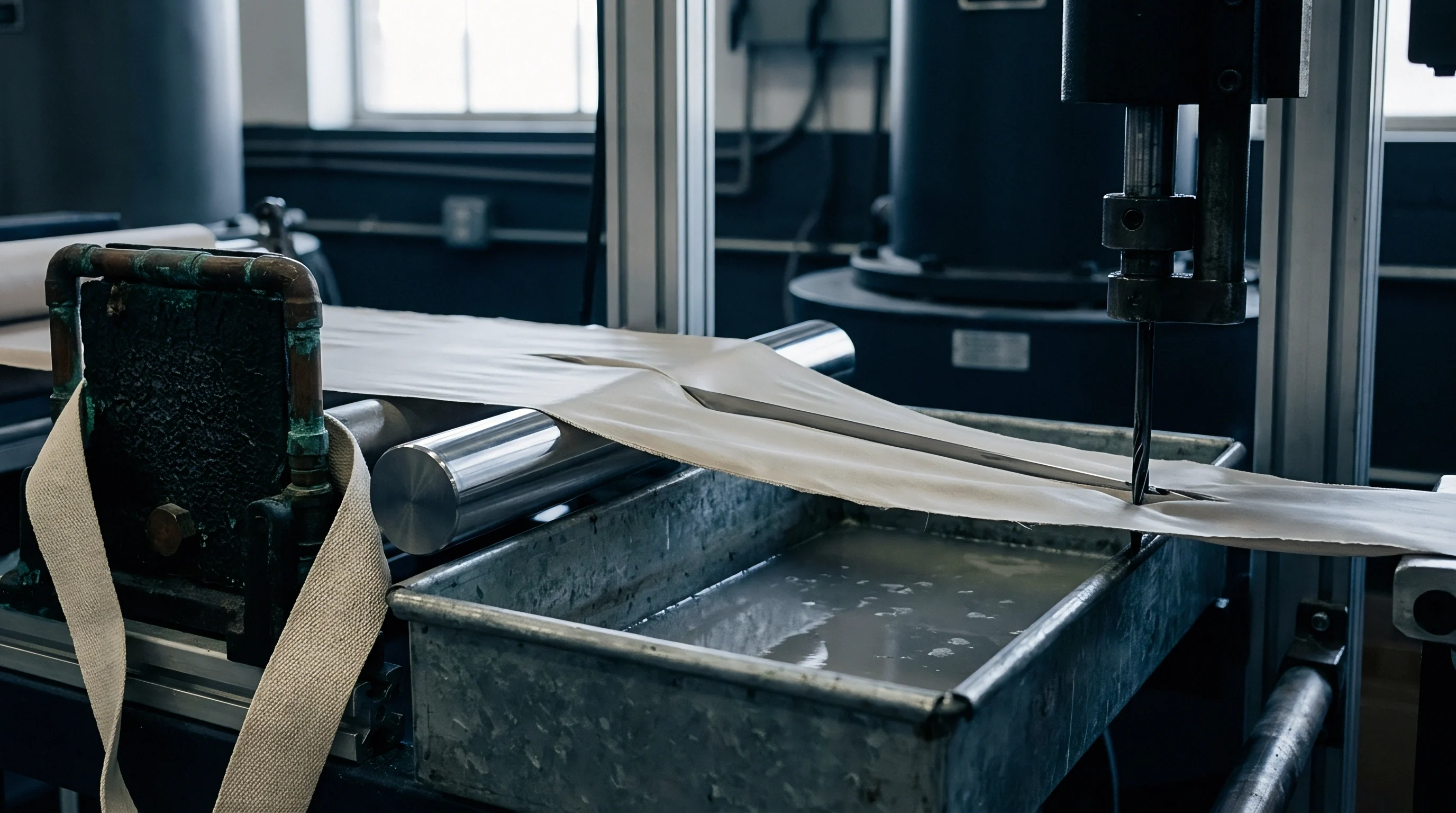
Running continuous open-width ranges above sixty meters per minute suppresses hydrodynamic mixing in the clinging fluid film. Submerged guide rollers move the fabric along, but fluid speed matches web speed across the whole submerged pass. As fabric exits the bath and heads into the squeezer, the boundary layer remains intact, entering the nip alongside the cloth.
The nip then compresses the fabric plane, forcing expelled liquor backward against fabric travel.
This backward splash creates local turbulence that strips some external surface liquid. Inside dense yarn bundles, however, capillary pressure retains the contaminated liquor. As compressed fabric leaves the nip line, elastic recovery acts like a mechanical sponge: rebounding yarns draw surrounding surface liquor straight back into their interior voids.
If liquor pooling at the nip entry is heavily contaminated, the yarn reabsorbs it just before entering the next compartment.
Differential Pressure Distribution in Vacuum Dewatering
Suction slots pull air through the porous matrix to strip capillary liquor from yarn intersections. Creating a pressure differential of three to five hundred millibars across the fabric forces high-velocity air through micro-voids between warp and weft yarns. That airflow shears out the water column held at interlacing gaps, pulling off both boundary layers and free capillary moisture.
Applying vacuum extraction to dense plain wovens involves trade-offs. The low permeability of cover factor 25 fabrics creates high resistance, stalling air velocity across dense intersections. Under strong vacuum, light or medium poplins can suffer fabric distortion, edge curling, or local warp tension spikes.
Slots require exact aperture calibration and even air distribution to avoid width-wise moisture variations before stenter drying.
| Mechanical Unit | Linear Load / Vacuum Level | Residual Moisture (%) | Boundary Layer Removal (%) | Energy Demand (kWh/1000m) |
|---|---|---|---|---|
| Standard Squeeze Nip | 25 kN/m Load | 85 | 42 | 3.5 |
| High-Deflection Squeeze Nip | 55 kN/m Load | 68 | 61 | 7.2 |
| Submerged Impingement Rotor | 1200 RPM Rotor Speed | 110 | 78 | 12.4 |
| Transverse Vacuum Extractor | 400 mbar Differential | 52 | 89 | 18.6 |
Whether high-differential vacuum slots distort filament alignment in micro-denier warps before agitation displaces trapped caustic remains an open engineering debate in continuous finishing plants.

Settlement
Production economics dictate margins on continuous desizing, scouring, and washing lines. On dense wovens, the trade-off between line speed and diffusion physics directly affects finishing costs. Running an open-width range at eighty meters per minute cuts conversion costs per meter but drastically shortens dwell time.
In an eight-compartment range with forty meters of fabric immersion per box, eighty meters per minute gives just thirty seconds of submerged wash time ~ whereas dense poplins need at least seventy seconds to clear internal diffusion channels.
To compensate for shorter dwell times at high line speeds, plants increase water usage and chemical dosing. Water flow climbs from four liters per kilogram of fabric to twelve liters. Steam valves open wide to hold temperatures near boiling, pushing energy costs to twenty-five percent of total wet-processing expenses.
If speed stays high while water is throttled to meet effluent limits, fastness ratings drop and unwashed hydrolysed dye remains locked inside the yarn.
Unwashed alkali concentrated inside the warp cross-over points neutralizes downstream acid finishes and ruins water-repellent durability.
Commercial Penalties from Incomplete Chemical Clearance
Residual hydrolysed reactive dyes trapped in dense cottons migrate to the surface during tumble drying. When finished garments undergo laundering under ISO 6330 or AATCC 135 standards, this unwashed dye bleeds into the wash bath. Staining on polyester or polyamide test strips triggers immediate rejection by brand auditors.
Fixing the issue post-shipment requires re-washing entire bulk lots at specialized laundries, costing thirty to sixty cents per meter in freight and rework.
Beyond fastness failures, trapped sodium hydroxide undermines downstream chemical finishing. Durable water repellent systems, whether fluorinated polymers or fluorine-free dendrimers, require a neutral or slightly acidic fabric pH between 5.5 and 6.5 for effective cross-linking. Concentrated alkali bleeding out of yarn cores pushes surface pH above 8.5, destabilizing pad baths, hydrolyzing catalysts, and dropping initial spray ratings from 100 down to 70 after a single commercial wash.

Line Speed Restrictions on High Density Goods
Running an eight-compartment range on high-cover technical twills requires balancing machine speed against dwell time in the tanks. Take a 50,000-meter production run of downproof cotton poplin (40s warp, 40s weft, 133×72 sett, 120 g/m²). At sixty meters per minute, total submerged dwell across a standard 320-meter fabric path is 5.3 minutes, giving an output of 3,600 meters per hour.
At this speed, internal yarn diffusion reaches eighty-eight percent completion, clearing fastness audits.
Pushing range speed to ninety meters per minute raises theoretical output to 5,400 meters per hour, trimming labor and depreciation by thirty-three percent per meter. But dwell time drops to 3.5 minutes, and internal diffusion clearance falls to sixty-two percent. Meeting fastness targets at that speed requires adding surfactant auxiliaries at twelve grams per liter ~ adding four cents per meter in chemical costs ~ and raising fresh water usage by six liters per kilogram.
In the end, running past the physical diffusion limits of the weave increases net cost per finished meter while raising the risk of severe quality claims.
Failing to clear hydrolysed reactive dye precursors from dense poplins causes crocking failures during garment assembly and risks systematic rejection of export rolls.