Optimizing Radiative Energy Transfer in Heavy Cotton Canvas Drying
Medium-wave infrared emitters matching the 2.95-micrometre water absorption peak optimize heavy cotton duck drying when paired with low-velocity boundary layer air purging.
Band
Drying heavy wet woven cotton duck relies on matching the thermal emission wavelengths of heating units to the molecular absorption states of moisture held within plied yarns. Liquid water and cotton cellulose absorb electromagnetic energy at specific spectral bands, determined by their molecular vibrational modes. Water exhibits strong infrared absorption bands centered at 1.45 micrometres, 1.94 micrometres, and 2.95 micrometres, with a broad fundamental hydroxyl absorption band extending beyond 6.0 micrometres.
Dry cotton cellulose exhibits absorption peaks near 3.0 micrometres and 9.0 micrometres. Water absorbs medium infrared radiation rapidly. The spectral match between the emitter output and the wet web controls the conversion efficiency of electrical or thermal energy into evaporative mass transfer.

Spectral Matching of Water and Cellulose Absorption Peaks
Liquid water within wet cotton web structures exhibits discrete optical absorption coefficients across the electromagnetic domain. Short-wave infrared emitters operating between 1800 degrees Celsius and 2200 degrees Celsius generate peak radiation between 0.8 micrometres and 1.2 micrometres. At these short wavelengths, liquid water has an absorption coefficient below 0.1 reciprocal centimetres.
Short-wave radiation passes through the surface liquid layer with minimal absorption, penetrating deep into the cotton web or reflecting off white un-dyed fibers. Medium-wave infrared emitters operating between 800 degrees Celsius and 1200 degrees Celsius produce peak emission between 2.0 micrometres and 3.2 micrometres. This emission band coincides with the 2.95 micrometres absorption band of water, where the absorption coefficient rises to approximately 3000 reciprocal centimetres.
Medium-wave radiation transfers energy directly to the liquid phase at the yarn surfaces, driving rapid vaporization without wasting energy on deep fiber heating.
| Emission Band | Peak Wavelength (μm) | Water Absorption Coefficient (cm⁻¹) | Thermal Coupling Efficiency (%) | Penetration Depth in Wet Web (mm) |
|---|---|---|---|---|
| Short-Wave IR | 0.8 – 1.2 | 0.05 – 0.12 | 32 | 2.40 |
| Medium-Wave IR | 2.0 – 3.2 | 2800 – 3200 | 84 | 0.45 |
| Far-Wave IR | 5.6 – 10.0 | 1200 – 1800 | 76 | 0.15 |
| Methods Note: Spectral measurements conducted on 600 g/m² number four cotton duck at 70% wet pick-up using a Fourier-transform infrared spectrometer equipped with an integrating sphere. Thermal coupling efficiency measured via energy balance during continuous web pass at 20 metres per minute. | ||||

Energy Coupling Mechanics in High-Moisture Duck Webs
Radiant flux striking a wet textile web transfers kinetic motion directly to polar hydroxyl groups. When wet pick-up levels exceed 60 percent, free water coats the outer yarn sheath, forming continuous liquid bridges inside the interstitial spaces of the weave. Medium-wave energy converts to thermal motion within this outer water film.
The temperature of the wet surface layer rises to the wet-bulb temperature, initiating phase change. Far-infrared radiation above 5.6 micrometres offers high liquid absorption but exhibits low penetration depth, absorbing within the first 0.15 millimetres of the web surface. Far-infrared radiation overheats the immediate surface layer while failing to reach water trapped in intermediate yarn spaces.
Medium-wave infrared balances surface absorption with sufficient optical depth, making it the targeted spectral range for heavy cotton duck drying.
Equipment vendors frequently claim that short-wave quartz tubes deliver superior drying rates due to higher nominal electrical wattage per square metre, ignoring the reality that eighty percent of short-wave emission passes through wet cotton duck without coupling to the molecular bonds of bound moisture.

Penetration
Heavy cotton duck constructions present significant structural resistance to heat movement owing to dense yarn packing. Number one cotton duck weighing 810 grams per square metre utilizes coarse plied yarns woven into a tight plain weave with cover factors exceeding 96 percent. Plied yarns create a tortuous pore network that restricts optical transmission and fluid movement.
Radiative energy entering this dense fibrous matrix attenuates rapidly according to the Beer-Lambert law of optical extinction.
Medium-wave infrared energy at 2.9 micrometres penetrates exactly 0.45 millimetres into 600 gram per square metre cotton duck at seventy percent moisture content before ninety percent of the radiant flux converts to thermal motion.

Beer Lambert Attenuation in Plied Duck Yarns
Electromagnetic radiation passing into a dense web experiences exponential intensity loss. The attenuation coefficient depends on yarn density, fiber packing fraction, and web moisture content. Thick duck retains core moisture longer.
In heavy number four duck woven from 10/3 warp and 7/4 filling yarns, optical extinction occurs within the outer third of the cloth thickness. The core receives zero direct radiant irradiance. Heat must reach the center of the web through thermal conduction through water-filled inter-fiber capillaries.
Pore volume dictates thermal extinction. When radiant flux exceeds internal conduction rates, steep thermal gradients form between the web face and the interior core.
Operational failure modes emerge when radiative drying protocols ignore internal attenuation rates inside thick cotton goods:
- Internal moisture entrapment leads to uneven residual moisture distribution across bulk rolls, causing regional damp spots that emerge during storage.
- Dye and finish migration occurs when rapid surface evaporation pulls unfixed soluble chemistries to the face, leaving shade listing and uneven water repellency across the web thickness.
- Cellulose degradation happens when prolonged surface exposure exceeds 140 degrees Celsius before core water vaporizes, reducing cellulose degree of polymerization and lowering tear strength.
Core Conduction versus Surface Radiative Flux
Thermal transport inside heavy woven duck transitions rapidly from optical absorption at the outer sheath to physical molecular transfer toward the interior. The thermal conductivity of wet cotton duck ranges from 0.15 to 0.35 Watts per metre-Kelvin depending on moisture saturation. As surface water vaporizes, the dry outer fiber layer forms an insulating barrier with a lower thermal conductivity near 0.05 Watts per metre-Kelvin.
High power density applied to high-gsm cotton duck causes surface temperature spikes while the interior remains cold and saturated. Radiative drying systems operating on heavy duck must throttle power density to match the conductive thermal transfer speed of the wet yarn matrix.
| Duck Grade | Mass (g/m²) | Yarn Count (Warp / Weft) | Attenuation Coefficient (mm⁻¹) | Penetration Depth (mm) | Core Heating Rate (°C/s) |
|---|---|---|---|---|---|
| Number 10 Duck | 400 | 10/2 / 10/2 | 3.8 | 0.68 | 14.2 |
| Number 6 Duck | 550 | 10/3 / 10/3 | 5.1 | 0.51 | 9.6 |
| Number 4 Duck | 600 | 10/3 / 7/4 | 5.8 | 0.45 | 8.1 |
| Number 1 Duck | 810 | 7/5 / 7/5 | 7.4 | 0.32 | 4.8 |
Setting radiative emitter output above the thermal conductivity threshold of plied cotton yarns burns the outer sheath fibers while leaving thirty percent residual moisture in the fabric core, triggering mildew growth inside wrapped shipping rolls.

Vapour
Evaporative mass flux during intense radiative heating depends on stripping the stagnant gaseous boundary layer from the moving textile web. High radiant flux generates high steam production at the cloth surface. Without convective air management, a saturated vapor film builds up immediately above the web face.
This stagnant vapor layer reduces the vapor pressure differential between the wet cotton cloth and the surrounding air, choking further mass transfer. Dry air accelerates moisture withdrawal.
High radiative heat transfer without instantaneous boundary layer air stripping forces dissolved dye molecules to move with evaporating water toward the web surface, ruining shade uniformity.
Boundary Layer Saturation and Evaporative Mass Flux
High thermal density at the web exterior causes instantaneous phase change of surface water. The local relative humidity in the boundary air layer reaches 100 percent within milliseconds of radiant exposure. Steam accumulation acts as a thermal shield, reflecting a portion of incoming medium-wave infrared radiation and lowering total thermal efficiency.
Hot air sweeps boundary moisture. Introducing low-velocity angled air streams removes this saturated boundary film without destabilizing web movement, sustaining high evaporative mass flux throughout the radiant heating zone.
Solute Transport Mechanics and Migration Prevention
Liquid phase flow within wet cotton duck carries dissolved finishing chemicals and dye molecules toward points of high surface evaporation. The dimensionless Péclet number for drying governs this solute transport behavior. The Péclet number expresses the ratio of convective liquid flow to molecular diffusion of the solute.
When radiant heat drives rapid surface evaporation, liquid water flows from the core to the face at high velocity. If the Péclet number exceeds unity, dye molecules cannot diffuse back into the yarn interior against the outward liquid stream. Solutes accumulate at the outer yarn tips, generating severe face-to-back shade variations, listing, and surface resin crusting.
Dye migration ruins solid shades. Surface crusting traps internal steam.
Engineers evaluate specific aerodynamic parameters when configuring boundary layer purging systems over radiant zones:
- Air knife angle set between 45 and 60 degrees against web travel strips stagnant moisture boundary layers without forcing steam back into the cloth matrix.
- Impeller air temperature matched to web wet-bulb temperature prevents surface chilling while maintaining high mass flux across the exposed zone.
- Exhaust fan volumetric flow adjusted to keep plenum relative humidity below fifteen percent prevents re-condensation on structural machinery frame members.
Drying heavy cotton duck with pure radiant heat without sweeping away the surface steam cushion guarantees listing and face-to-back shade variation across the production lot.
Grid
Industrial emitter arrays require structured mechanical placement to deliver uniform thermal irradiance across wide woven webs. System design involves balancing electrical or gas energy consumption against physical floor space and line speed goals. Electric medium-wave carbon tube emitters offer precise digital zone power control, while gas catalytic ceramic panels provide low cost per kilowatt hour of emitted heat.
Gold-coated parabolic reflectors reflect ninety-five percent of medium-wave infrared radiation back onto the cotton web, whereas oxidized aluminum reflectors drop thermal output by thirty percent within six months of continuous dyehouse operation.
Emitter Module Selection and Spectral Efficiency
Electric quartz tubes and gas catalytic panels exhibit fundamentally different surface operating temperatures and spectral radiance curves. Electric medium-wave carbon emitters operate near 1000 degrees Celsius, generating peak radiance at 2.2 micrometres with rapid modulation capabilities. Power adjustments take effect in under two seconds, allowing automated link to web stoppage sensors.
Gas catalytic panels operate at lower surface temperatures between 450 degrees Celsius and 550 degrees Celsius via flameless natural gas oxidation over a platinum catalyst bed. Gas catalytic emission peaks between 3.0 micrometres and 5.0 micrometres, perfectly covering the fundamental absorption bands of liquid water.
Where Does Gas Catalytic Emission Outperform Electric Quartz?
Gas catalytic radiant panels generate thermal energy through the flameless oxidation of natural gas over a platinum catalyst bed. Natural gas combustion produces water vapor and carbon dioxide as reaction products, releasing radiant heat without open flame. This process converts natural gas energy directly into long-medium infrared radiation centered between 3.5 micrometres and 6.0 micrometres.
Operating costs for gas catalytic grids run 40 to 60 percent lower than electric short-wave or medium-wave quartz arrays per kilogram of evaporated water, depending on local industrial utility tariffs. Gas panels require constant gas pressure. Capital equipment payback times for gas catalytic conversions on heavy duck lines average 14 months under three-shift production profiles.
| Emitter Type | Peak Wavelength (μm) | Response Time to Full Power | Energy Efficiency (% Radiant) | Energy Cost per Evaporated kg Water (USD) | Capital Cost Ratio |
|---|---|---|---|---|---|
| Electric Short-Wave Quartz | 1.0 – 1.2 | 1 second | 45 | 0.18 | 1.0 |
| Electric Medium-Wave Carbon | 2.0 – 2.4 | 2 seconds | 72 | 0.14 | 1.4 |
| Gas Catalytic Ceramic Panel | 3.2 – 4.5 | 15 minutes | 85 | 0.06 | 1.8 |

Reflector Maintenance and Spatial Power Tuning
Polished reflector surfaces direct stray radiation back toward the textile web to maximize energy transfer. Parabolic reflectors using high-purity gold coatings reflect over 95 percent of medium-wave infrared energy. Dust, lint, and condensed dye volatiles rapidly coat reflector surfaces in continuous textile operations.
Uncleaned aluminum reflectors oxidize, dropping reflective efficiency to below 65 percent. Reflector dirt reduces radiant flux. Line speed controls dwell time.
Automatic air-purge curtain systems protect optical reflectors from lint deposition, preserving design radiant energy density across multi-year operational shifts.
Whether gas catalytic panels can maintain precise zone control when processing variable-weight duck runs under fluctuating gas line pressure remains an open question for plant engineers balancing energy costs against shade tolerances.
Draft
Combining infrared radiative pre-dryers with forced-convection stenter zones balances high evaporative speed with energy efficiency. Pure convective drying of heavy cotton duck suffers from low heat transfer coefficients, requiring long stenter housings and slow line speeds. Pure radiative drying risks surface overheating once moisture levels fall below 15 percent.
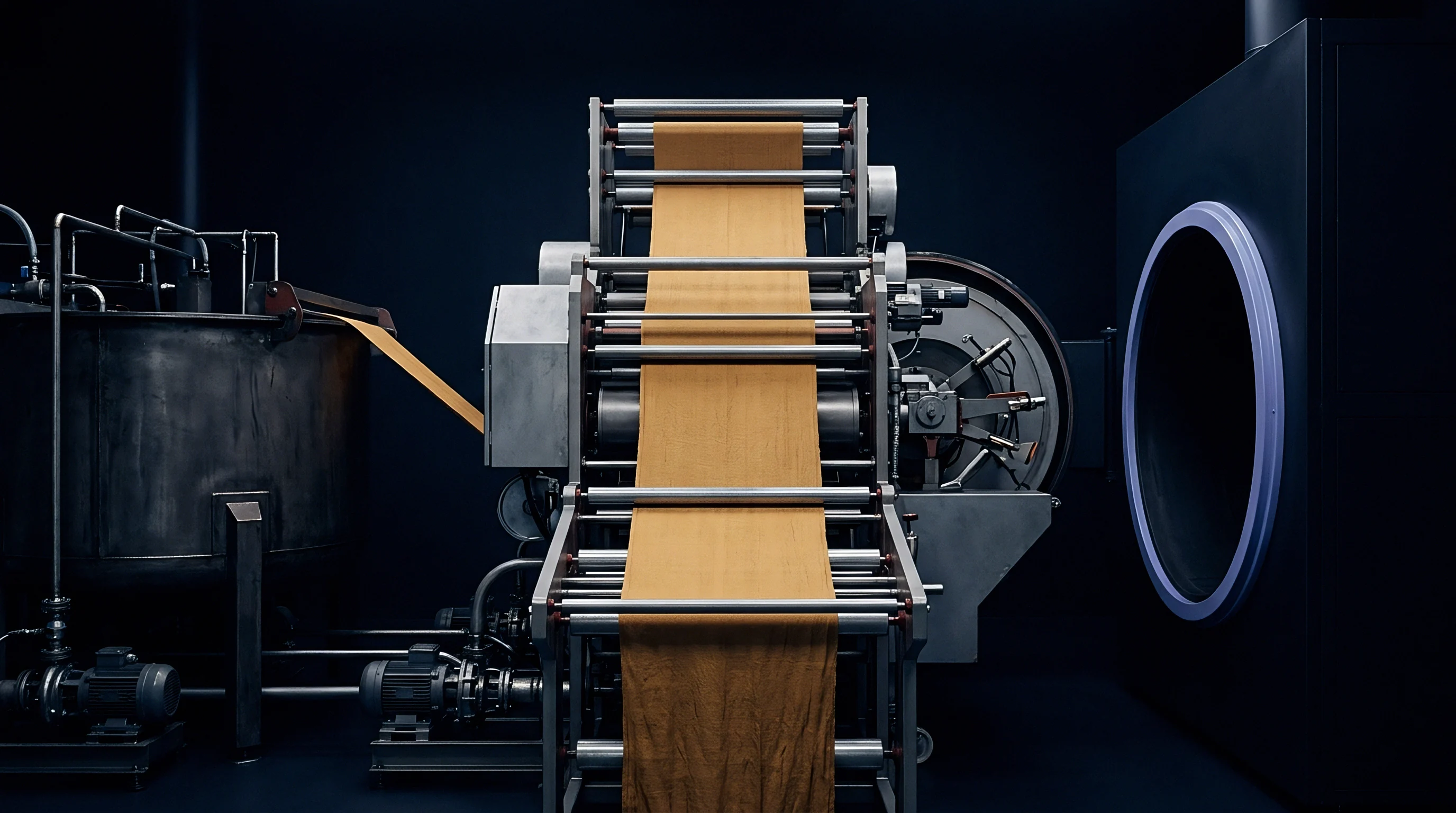
Hybrid processing installs medium-wave infrared banks at the entry rail, rapidly raising wet web temperatures to the evaporative point before the cloth enters high-velocity hot air convection bays.
Standard test method ISO 5077 requires dimensional stability testing after five wash cycles, and duck fabric dried under uneven thermal profiles exhibits warp shrinkage variations exceeding four percent across the roll width.
Hybrid Dryer Architecture and Thermal Balance
Installing medium-wave radiant banks prior to convection drying zones elevates web temperatures to eighty degrees Celsius before hot air entry. Pre-heating eliminates the long sensible heating zone typically needed inside convection stenters. The initial wet pick-up after padding sits between 65 and 80 percent.
Radiative pre-dryers lower this moisture to 30 percent, fixing unfixed dye and finish chemistries in place. Once moisture drops to 30 percent, convective air streams complete the drying process down to the target 8 percent residual moisture without risking solute migration. Shorter waves penetrate deeper layers.

Worked Calculation of Evaporative Load and Energy Allocation
A baseline continuous processing line running six hundred gram per square metre number four cotton duck illustrates the thermodynamic allocation between radiant and convective energy. Assume a 1.8-metre wide finished web moving at 25 metres per minute with an initial wet pick-up of 75 percent, targeting a final moisture content of 8 percent.
Calculate dry web throughput mass per hour:
Dry Mass Rate = 0.600 kg/m² × 1.8 m × 25 m/min × 60 min/hr = 1620 kg dry cloth per hour.
Calculate total water entering wet web per hour:
Water Initial = 1620 kg/hr × 0.75 = 1215 kg water per hour.
Calculate residual water leaving dry web per hour:
Water Final = 1620 kg/hr × 0.08 = 129.6 kg water per hour.
Calculate total mass of water evaporated per hour:
Evaporative Load = 1215 kg/hr – 129.6 kg/hr = 1085.4 kg water per hour.
Sensible heating energy to raise web temperature from 20 degrees Celsius to 80 degrees Celsius (specific heat of dry cotton = 1.34 kJ/kg·K; water = 4.18 kJ/kg·K):
Sensible Energy = × (80 – 20) = 434,600 kJ/hr = 120.7 kW.
Latent heat of vaporization at 80 degrees Celsius (2309 kJ/kg):
Latent Energy = 1085.4 kg/hr × 2309 kJ/kg = 2,506,188 kJ/hr = 696.2 kW.
Total Net Thermal Power Required = 120.7 kW + 696.2 kW = 816.9 kW.
Allocating 40 percent of total evaporative load to the medium-wave infrared pre-dryer zone removes 434.16 kg of water per hour using 326.8 kW of radiant power. The remaining 60 percent evaporative load passes to the convective stenter zones requiring 490.1 kW of thermal air energy. This hybrid split increases maximum line velocity by 42 percent while reducing total energy consumption per kilogram of evaporated water from 1.35 kWh down to 0.92 kWh compared to an all-convective stenter system.
- Measure initial wet pick-up at the padder exit using a high-frequency microwave moisture sensor.
- Adjust medium-wave infrared emitter bank power to achieve web surface heating to sixty-five degrees Celsius within three seconds of entry.
- Set initial convective air knife velocity to eighteen metres per second to purge surface steam without displacing unfixed liquor.
- Reduce infrared power density in secondary drying zones as moisture content drops below twenty percent to prevent thermal scorching.
- Calibrate exhaust damper positions to maintain an exhaust moisture ratio of zero point twelve kilograms of water per kilogram of dry air.
Incorporating standard finishing specification ISO 3801 into mill contracts obligates converters to maintain weight tolerances within plus or minus three percent across the entire lot width, forcing dyehouses to install automated infrared power modulation tied to inline mass sensors.
Proof
Continuous process monitoring validates that radiative energy transfer dries heavy cotton duck without causing thermal damage or shade variance. Process control requires continuous feedback loops integrating non-contact pyrometry, high-resolution inline moisture measurement, and physical test protocols. Over-drying heavy cotton duck degrades cellulose chains, while under-drying leads to storage mildew and dimensional instability during automated cutting and sewing operations.
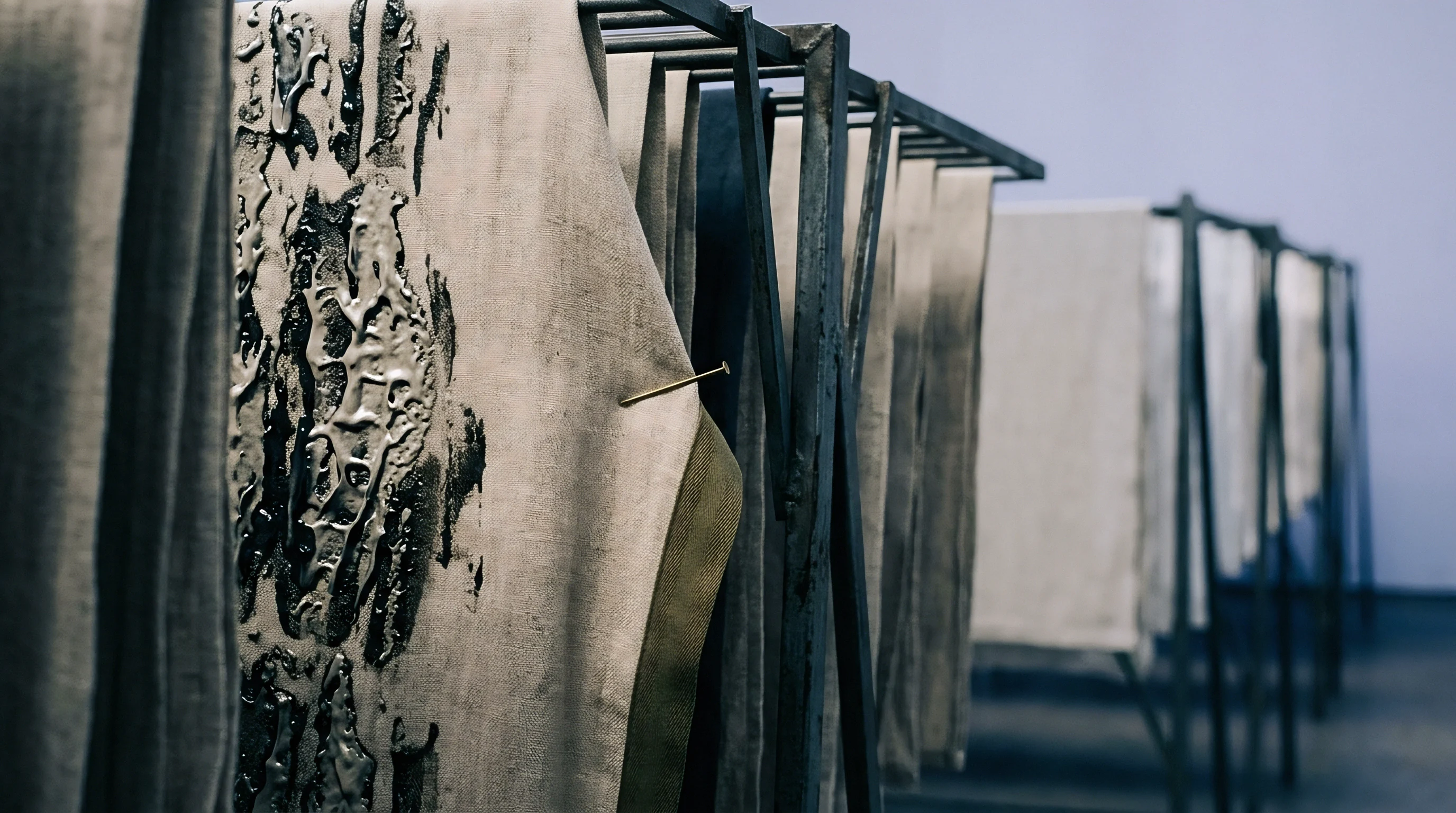
Inline Non-Contact Process Pyrometry and Moisture Sensing
Infrared pyrometers positioned at dryer discharge zones measure real-time web surface temperatures. Optical sensors calibrated for target emissivity values between 0.92 and 0.96 monitor the exact moment web evaporative cooling ends. While moisture remains, web surface temperature stays near the wet-bulb temperature (60 to 70 degrees Celsius).
As the web dries below 8 percent moisture, evaporative cooling stops and web temperature rises rapidly toward ambient air temperatures. Pyrometer feedback signals lower emitter power density immediately when web surface temperatures exceed 95 degrees Celsius, preventing thermal damage. High-frequency microwave sensors measure total moisture mass across the fabric width, detecting edge-to-center moisture gradients before cloth winds onto batching A-frames.
Core wetness causes seam failure. Tension variations distort shrinkage readings.
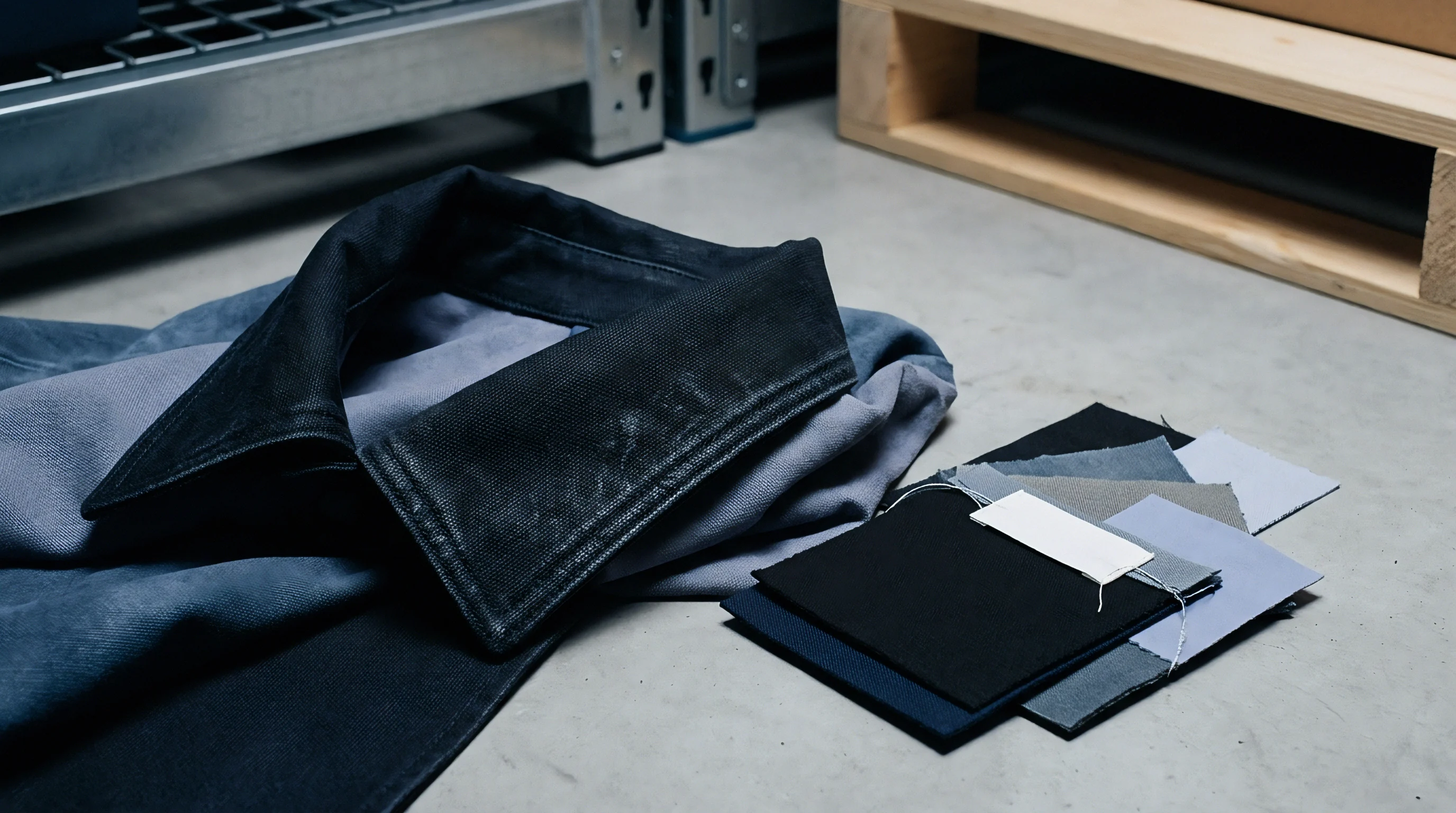
Tensile Retention and Structural Integrity Verification
Exposing cellulose to high radiative flux risks thermal depolymerization if fabric surface temperatures exceed critical thresholds. Standard test method ISO 13934-1 dictates warp and weft strip tensile testing, while ISO 13937-2 measures wing tear strength on heavy cotton duck. Overheated cotton duck exhibits significant drop in mean breaking force due to thermal degradation of cellulose macromolecular chains.
Testing laboratories evaluate shade fastness under ISO 105-X12 for rubbing fastness and ISO 105-B02 for light fastness to confirm that rapid radiative pre-drying does not induce surface dye crystallization. Dimensional stability verification under ISO 5077 requires five wash and dry cycles to confirm that infrared exposure has not locked residual stress into heavy plied yarns.
Mill qualification protocols demand that bulk lots demonstrate less than three percent tensile strength loss compared to un-dried greige control samples, establishing that medium-wave radiant pre-drying optimizes energy efficiency without altering the mechanical service life of heavy number duck fabrics.