Predicting CIEDE2000 Tolerance Threshold Failures under Mixed Narrowband Store LED Lighting Conditions
Calculating spectral reflectance integrals against retail diode emission profiles identifies metameric shifts before bulk dye application commits yardage.


Phosphor

Spectral Emission Anomalies in Commercial Solid State Diodes
Solid-state retail luminaires alter the perceived colour of dyed textiles because their discontinuous spectral power distributions deviate sharply from daylight and incandescent sources. Standard light booth evaluations rely on CIE Illuminant D65 or fluorescent simulators such as TL84 and CWF. On retail shop floors, however, mixed luminaire arrays combine blue-pump gallium nitride chips with garnet coatings, generating intense radiant energy peaks between 440 and 460 nanometres alongside pronounced emission deficits in the cyan band near 480 nanometres and deep red regions beyond 630 nanometres.
When cloth dyed with secondary or tertiary formulations hangs beneath these spot and troffer combinations, incoming radiant energy fails to energise dye absorption bands in balanced proportions. A dyed cotton twill engineered to match a master standard under D65 experiences significant metameric shifts under narrow emission spikes, creating severe deviations between the colour perceived by retail buyers and numerical ratings recorded in standard mill pass dossiers.
A formulation balanced solely under standard daylight fails when non-linear radiant energy excites individual dye components unequally.
Standard light sources distribute energy smoothly across the visible spectrum from 380 to 780 nanometres. Commercial point sources, by contrast, concentrate radiation within isolated wavelength intervals determined by host crystals and rare-earth dopants. Gallium nitride emitters generate an acute spike in radiant output at the pump wavelength, followed by a wide drop before the yellow yttrium aluminium garnet emission rises.
Deep red saturation values collapse because standard commercial diodes lack output beyond 620 nanometres to meet energy efficiency ratings.

Narrowband Failure Points across Common Commercial Fibres
Textile substrates respond to irregular radiation according to the chemical nature of the polymer and the specific chromophores embedded within the yarn core. Differences in dye site availability, fiber cross section, and finishing additives generate divergent reflectance factors across the visible range.
- Tripack Disperse Formulations applied to polyester filament microfibres exhibit acute red hue deviations when the 450 nanometre blue pump excites anthraquinone components while azo red partners lose complementary reflectance past 630 nanometres.
- Heterobifunctional Reactive Combinations on combed cotton interlock drift toward yellow cast because vinyl sulfone yellows absorb excess energy beneath blue diode emission while companion blue phthalocyanines remain under-stimulated.
- Premetallised Acid Formulations on worsted wool twill undergo chroma collapse beneath fixtures deficient in deep red radiation, flattening saturated burgundy and plum standards into lifeless grey tones.
- Cationic Dye Mixes on modified acrylic fleece show total colour difference spikes exceeding numerical tolerances when uneven retail emission bands cross the absorption thresholds of basic dyestuffs.
Rejected yardage frequently satisfies buyer purchase order tolerances under D65 even as point-of-sale fixtures fall outside standard mill liability limits.


Coordinate

How Narrowband Spikes Reshape Tristimulus Integrals?
Colorimetric assessment derives numerical values by integrating spectral reflectance, illuminant power distribution, and standard observer functions across discrete wavelength steps. Standard practice per ISO 105-J01 uses ten-nanometre or five-nanometre intervals from 360 to 750 nanometres. When the illuminant term contains radical peak-to-valley power ratios, the resulting products yield skewed tristimulus sums X, Y, and Z.
The calculation evaluates CIEDE2000 total colour difference through parametric adjustments for lightness, chroma, and hue differences, with non-linear distortions occurring primarily within the hue rotation factor and chroma weighting terms. If a pair of dyed goods exhibits slight reflectance differences precisely at the 450 nanometre pump spike, multiplying that difference by illuminant emission magnifies the resulting tristimulus deviation, dropping tristimulus values across green wavelengths.
A measured shift of 0.4 units beneath standard daylight routinely widens beyond 1.3 units under mixed solid-state luminaires.
The following dataset outlines spectral characteristics and resulting colour deviations for standard tertiary dyed poplin across representative commercial retail luminaires compared against CIE D65 values.
| Luminaire Type | Correlated Temperature | Pump Wavelength | Cyan Deficit Band | General CRI | Mean CIEDE2000 Shift |
|---|---|---|---|---|---|
| CIE D65 Standard Simulator | 6500 K | Continuous | None | 98 | 0.32 |
| Commercial Blue Pump Troffer | 4000 K | 452 nm | 475 to 495 nm | 82 | 1.28 |
| Accent Retail Track Fixture | 3000 K | 456 nm | 480 to 500 nm | 90 | 0.94 |
| Narrowband High Output Emitter | 3500 K | 448 nm | 470 to 490 nm | 78 | 1.64 |
| Mixed Floor Array Average | 3800 K | Multiple | 475 to 505 nm | 84 | 1.41 |
Small spectral reflectance disparities between lots interact with isolated diode spikes, producing sharp local slopes in the calculated colour space coordinates. A production lot showing acceptable visual balance in daylight displays pronounced hue rotation under shop floor track heads. Because the CIEDE2000 formula applies compensatory factors developed for daylight and continuous fluorescent spectra, it fails to penalise localized tristimulus distortions correctly, causing red dyestuff components to shift fastest.
Dye selection based on broad spectral absorption curves eliminates metameric failure risks across varied commercial store lights.

Curvature

Where Retail Fixture Variations Alter Colour Coordinates?
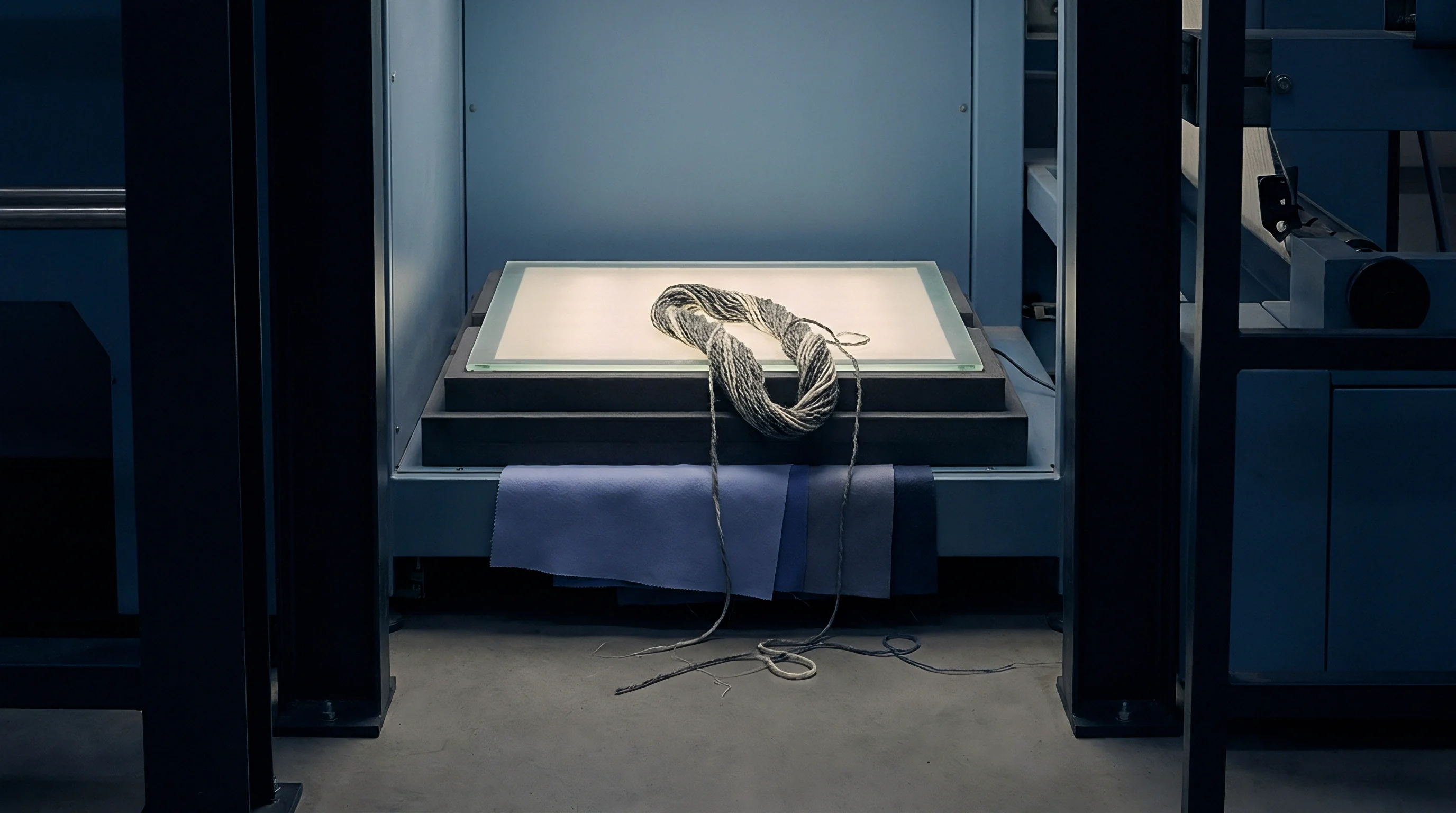
Reflectance curves of dyed materials possess distinct geometric profiles dictated by dyestuff chemistry and yarn packing density. A dye combination with steep slopes between 430 and 490 nanometres proves highly vulnerable to solid-state lighting shifts. When the spectral slope of the dyed substrate aligns with the ascending or descending edge of a diode emission peak, small lot variations yield immense differences in absorbed radiation, particularly since standard calculations assume planar geometry.
Yarn manufacturing parameters govern internal light scattering and modify how energy penetrates the substrate. Ring spun yarns present circular cross-sections with progressive radial twist that trap light within surface fiber bundles, while rotor yarns possess disordered wrapper fibres that reflect light diffusely across wider surface angles, though high twist yarns consistently reflect less light.
Weave architecture alters the effective reflectance curve by changing yarn float lengths and shadow ratios. Plain weave constructions exhibit dense interlacing that maximizes specular reflection from fiber crests, whereas satin weaves feature extended floats that allow photons to penetrate deeper into the yarn core, increasing dye absorption interactions.
Structural yarn floats modulate internal optical scattering and amplify colorimetric shifts caused by uneven retail light emission.
When assessing production lots against master standards under non-standard light sources, engineering teams must evaluate physical construction parameters alongside spectrophotometric curves.
- Interlacing Frequency Verification to verify that float lengths match approved construction dockets, preventing yarn shadow discrepancies under directional track spots.
- Dyestuff Selection Protocols requiring three-dye combinations with flat spectral absorption across the 440 to 500 nanometre window.
- Finishing Chemistry Screening to ensure cationic softening agents and durable press resins do not yellow the substrate or alter short-wavelength reflectance.
- Surface Hairiness Control through singing and bio-polishing to remove loose surface fibrils that scatter narrow diode emission rays unevenly.
Physical parameters work in unison with chemical dyestuffs to determine final surface reflectance under mixed fixtures.
Does the industry possess the mathematical apparatus to adjust CIEDE2000 parametric weighting factors for discontinuous solid-state emission curves without compromising established historical production archives?


Bolt

Spectrophotometric Screening Workflows across Converting Lots
Finished yardage arriving from the stenter frame requires structured optical verification before cutting and garment assembly commence. Relying on visual light booths configured exclusively with legacy fluorescent lamps guarantees shipping rejections once garments arrive beneath store arrays, even if the lab dip passed under D65. Sourcing managers must deploy multi-illuminant spectrophotometric screening directly on cut swatches taken from outer, middle, and inner roll segments.
Spectrophotometers must measure spectral reflectance at ten-nanometre intervals from 360 to 750 nanometres using diffuse eight-degree geometry with specular component included. The resulting reflectance values feed into digital color calculation engines programmed with verified spectral power distributions of client retail stores, calculating CIEDE2000 values across daylight, fluorescent, and target diode lighting simultaneously while accounting for disperse dye migration during drying.
| Dyestuff Component Mix | Dye Class Group | CIEDE2000 under D65 | CIEDE2000 under TL84 | CIEDE2000 under Store LED | Commercial Lot Verdict |
|---|---|---|---|---|---|
| Standard Yellow 145, Red 195, Blue 221 | Monochlorotriazine Reactive | 0.42 | 0.58 | 1.45 | Rejected for Store Shift |
| Modified Golden Yellow, Rubine, Navy | Heterobifunctional Reactive | 0.38 | 0.45 | 0.68 | Approved for Bulk Cutting |
| Legacy Brown Disperse Mix | Azo and Anthraquinone | 0.51 | 0.62 | 1.58 | Rejected for Store Shift |
| Engineered Tertiary Disperse Mix | High Energy Thiophene | 0.45 | 0.48 | 0.72 | Approved for Bulk Cutting |
| Data measured on 240 gsm 65/35 polyester cotton twill conditioned at 20 degrees Celsius and 65 percent relative humidity. Store LED profile calibrated to 3500K retail array. | |||||
Screening rolls prior to shipment prevents downstream assembly of garments containing metameric mismatches between body pieces and knitted trims. A systematic roll sorting and shading protocol establishes clear boundaries across individual dye lots.
- Reflectance Capture across three swatches per roll taken across full usable width to map lateral shading variations.
- Digital Integration combining lot reflectance with specific retail luminaire emission tables downloaded from fixture suppliers.
- Threshold Filtering flagging any roll displaying CIEDE2000 exceeding 0.8 units against the master digital standard under shop conditions.
- Physical Segregation of flagged yardage into distinct production groups dedicated to separate retail markets with compatible lighting.
- Cutting Room Clearance granting cut authorization only after electronic verification of trim match across all designated lighting environments.
Under international purchase agreements governed by standard retail tolerance clauses, shipments failing specified point-of-sale illuminant tolerances remain subject to immediate rejection and return at supplier expense.


Debit

Allocating Losses from Retail Colour Rejections
Financial liability for goods that shift excessively beneath store lighting rests on purchase contract documentation and agreed shade submission protocols. Converting houses frequently accept shade targets under D65 without verifying store fixture data. When thousands of sewn garments arrive at retail distribution hubs exhibiting side-to-side shading or trim mismatch under store track lights, retailers issue debit notes against finished garment invoices.
Garment manufacturers pass these chargebacks directly to the textile mill that supplied the roll goods. If the mill failed to conduct multi-illuminant predictive evaluations during lab dip approvals, the firm absorbs the landed cost of finished garments rather than merely the greige fabric value. Air freight fees to replace failed stock further escalate commercial losses, and cut yardage cannot be returned to the dyehouse for chemical re-stripping without catastrophic loss of physical tensile strength.
Finished garment chargebacks enforce full retail value recovery against mills that certify shade approval under daylight alone.
Textile mills must price multi-illuminant dye formulation testing into initial development quotes to insulate operations against retail penalties. Sourcing teams reduce commercial vulnerability by demanding spectral distribution data sheets from retail clients before signing bulk contracts. Testing dyes against store illuminants during recipe development adds days to initial lab dipping, yet eliminates catastrophic bulk rejections ~ a missed delivery deadline costs significantly less than a rejected shipping container.
Failure to predict narrow emission failures shifts the financial burden of defective shade matching entirely onto the wet processor, resulting in canceled credit lines and sustained enterprise loss.