Sizing Removal Mechanisms in Woven Greige Fabric
Effective size removal hinges on matching polymer cleavage chemistry with water temperature above film solubility thresholds before counter-current extraction.
Slurry
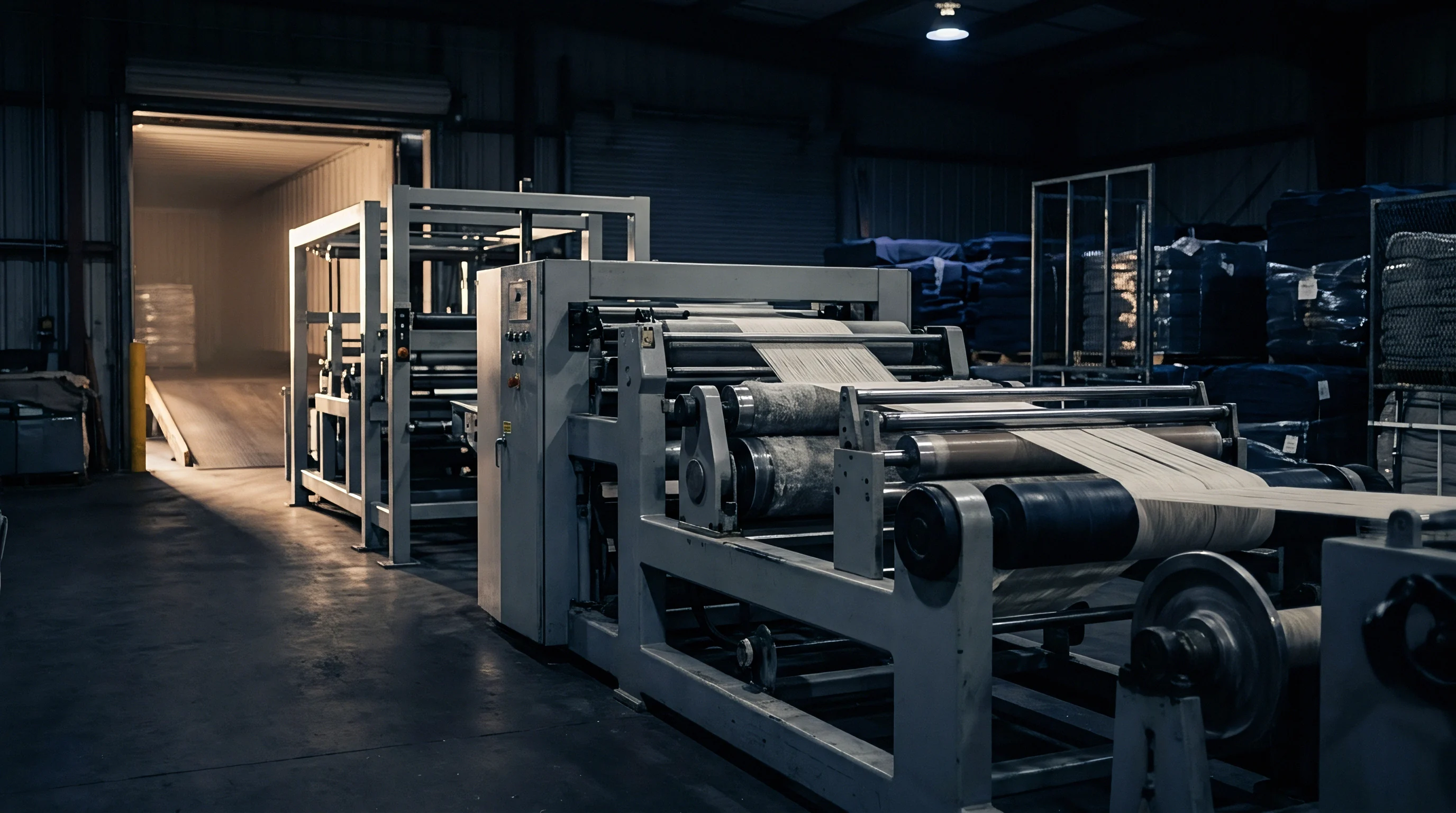
A three-leaf twill woven cotton at 240 grams per square metre enters the desize range carrying nine percent dry add-on across its warp yarns. The greige warp carries 9% size. Modern high-speed air-jet looms demand tough, adhesive films to withstand shedding friction, cyclic tension peaks, and reed abrasions exceeding eight hundred picks per minute.
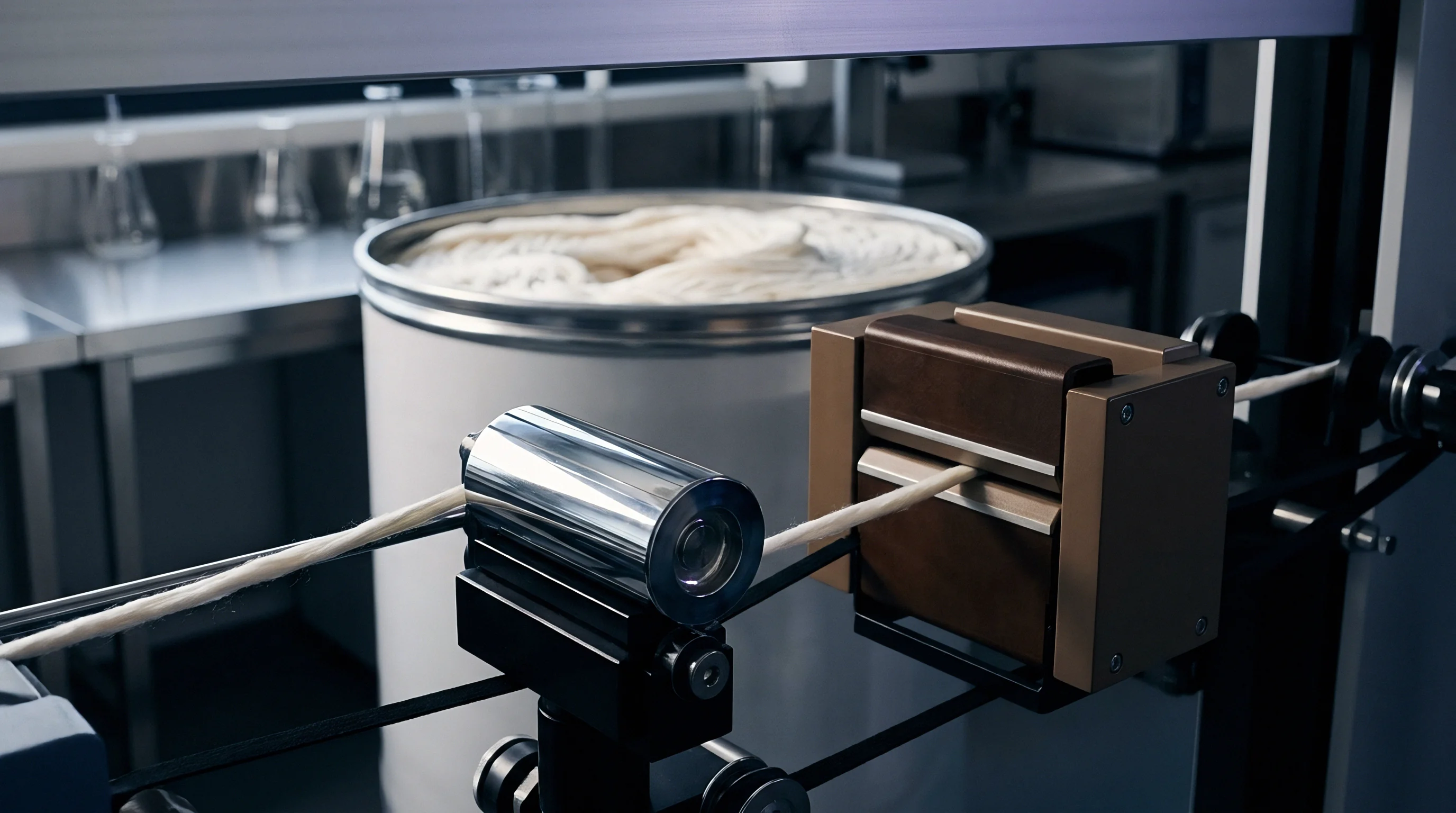
Weavers coat the warp yarn in aqueous formulations built on polymeric film formers, plasticizers, and lubricants. Removing this composite shell constitutes the initial gate in wet processing, dictating whether subsequent scouring, bleaching, and dye fixation proceed uniformly or fail across thousands of metres.
Native starches from corn, tapioca, and potato represent traditional film formers. Native corn starch swells at 68°C. Their high molecular weight delivers film strength, but amylose retrogradation creates crystalline, insoluble domains upon drying. To improve water solubility, chemical suppliers produce modified starches through etherification, esterification, or oxidation.
Hydroxyethyl and carboxymethyl starches dissolve at lower wash temperatures than native starch. Synthetic warp yarns and intimate cotton-polyester blends rely instead on polyvinyl alcohol, polyacrylic acid copolymers, and carboxymethyl cellulose. Polyvinyl alcohol films yield tensile strength, yet their water solubility depends strictly on the degree of hydrolysis.
Fully hydrolyzed polyvinyl alcohol, defined by 98 to 99 mole percent hydrolysis, crystallizes under the dry heat of slasher drying cylinders. It forms tough films that resist cold dissolution.
High loom speed demands film elasticity while wet processing demands rapid aqueous dispersion.
Lubricants incorporated into sizing baths complicate wet processing. Loom operators introduce hydrogenated tallow waxes, paraffin wax emulsions, and synthetic triglycerides to reduce yarn-to-metal friction coefficients. Residual wax creates patchy dye resist.
These lipids do not dissolve in water. They form a hydrophobic barrier across the yarn surface, shielding the underlying starch or synthetic binder from chemical reagents and aqueous wetting. Incomplete emulsification or incomplete saponification leaves wax deposits embedded in yarn crevices, causing localized resist spots in subsequent piece dyeing.
- Hydrophobic Wax Barrier prevents aqueous wash liquor from contacting the inner starch core, resulting in patchy enzyme penetration.
- Thermal Polyvinyl Alcohol Crystallization generates insoluble polymer skins during excessive slasher cylinder drying, creating stubborn resist streaks in finished goods.
- Retrograded Amylose Precipitates form hard gels within yarn voids when hot desize baths cool below sixty degrees Celsius, blocking dye liquor uptake.
- Incompatible Acrylic Co-Binders resist standard enzymatic degradation, leaving film residues that attract cationic softeners and cause uneven shade marks.
Weaving managers routinely argue that excess tallow wax was unavoidable to prevent warp breaks under high loom air pressure.
Cleavage
Bacterial alpha-amylase targets the alpha-1,4-glucosidic bonds inside amylose and amylopectin macromolecular chains. Enzymes attack only specific chemical bonds. The biological catalyst acts as an endo-enzyme, randomly cleaving internal bonds along the polysaccharide chain rather than clipping terminal glucose units.
This fragmentation reduces long-chain starch polymers into short dextrins and water-soluble maltose units. The reaction drops solution viscosity, allowing loosened fragments to leave the yarn bundle.
Commercial alpha-amylases derived from Bacillus subtilis and Bacillus licheniformis function within well-defined operational envelopes. Classical bacterial amylases operate efficiently between 60°C and 70°C at pH 6.0 to 7.0. Thermostable amylases extracted from modified strains withstand temperatures from 95°C to 110°C, permitting continuous desizing directly inside atmospheric or pressurized steam chambers.
Amylase denatures above 85°C. Water hardness influences enzyme durability. Calcium ions bind to the protein tertiary structure, preserving catalytic activity under high thermal loads. Sodium chloride additions further stabilize the active site.
Surfactants selected for the enzyme bath must display non-ionic character, because anionic wetting agents disrupt the enzymatic enzyme-substrate docking complex.
A ten-minute steam dwell at 100 degrees Celsius with three grams per litre sodium persulfate depolymerizes ninety-five percent of modified starch size.
Oxidative decomposition provides an alternative pathway that bypasses the substrate specificity of biological catalysts. Persulfate cuts the sizing polymer backbone. Formulations utilizing sodium persulfate, potassium peroxydisulfate, or hydrogen peroxide attack starch, polyvinyl alcohol, and polyacrylates through free-radical oxidation.
In the presence of alkali and thermal activation, persulfate generates sulfate free radicals that cleave carbon-carbon and carbon-oxygen linkages. This radical cascade breaks the vinyl backbone of polyvinyl alcohol and hydrolyzes cellulose-like starch chains simultaneously. Hydrogen peroxide activated with sodium hydroxide achieves similar outcomes while advancing the base whiteness of the substrate, combining desizing and partial scouring into a unified step.
| Reagent Mechanism | Active Chemistry | Operating Temperature (°C) | Working pH Range | Typical Dwell Time | Polymer Specificity |
|---|---|---|---|---|---|
| Enzymatic Hydrolysis | Thermostable Alpha-Amylase | 95 to 105 | 6.2 to 6.8 | 2 to 4 minutes | Native and modified starches only |
| Free Radical Oxidation | Sodium Persulfate | 98 to 102 | 10.0 to 11.5 | 1 to 3 minutes | Starch, PVA, acrylic copolymers |
| Peroxide Degradation | Hydrogen Peroxide + NaOH | 98 to 104 | 11.0 to 12.0 | 3 to 5 minutes | Broad-spectrum starch and synthetics |
| Alkaline Saponification | Sodium Hydroxide | 85 to 95 | 12.0 to 13.0 | 15 to 30 minutes | Polyacrylates, polyester resins |
Alkaline saponification clears synthetic acrylic sizes and polyester resins without oxidative radical risks. Polyacrylic acid homopolymers and co-polymers with acrylic esters contain carboxylic acid groups. Bathing the cloth in hot dilute sodium hydroxide converts these carboxyl groups into water-soluble sodium carboxylate salts.
The electrostatic repulsion along the ionized polymer backbone causes the coiled chain to expand, hydrate, and detach from the cotton fiber. Formulators run this alkali treatment between 85°C and 95°C, coupling it with scouring agents to saponify natural fatty acids and sizing waxes concurrently.
- Enzymatic Cleavage Speed accelerates under elevated temperature until thermal denaturing collapses the tertiary protein configuration.
- Radical Attack Severity demands strict peroxide stabilizer dosing to prevent pinhole formation from localized catalytic cellulose degradation.
- Alkaline Swelling Force expands synthetic polyester size films, allowing rapid displacement under mechanical washer turbulence.
Failure to terminate enzyme action or neutralize alkaline baths degrades natural cellulose fibres and triggers irreversible tensile strength loss across the batch.
Rinse
Solubilized sizing fragments remain trapped inside dense yarn structures until hydrodynamic displacement washes them into the surrounding bath. High yarn twist impedes water penetration. Greige goods possess tightly interlaced warp and weft bundles where molecular diffusion alone cannot clear dissolved polymers within commercial cycle times.
Washing equipment generates pressure differentials and convective fluid flow through the cloth matrix, displacing the concentrated chemical boundary layer adhering to individual fibers.
Thermal regulation in the initial washing boxes governs synthetic size clearance. Polyvinyl alcohol exhibits complex thermal dissolution behavior. Partially hydrolyzed polyvinyl alcohol dissolves in warm water, but fully hydrolyzed grades require water temperatures above 85°C to break intermolecular hydrogen bonds.
Cold wash water precipitates polyvinyl alcohol. Introducing cold or lukewarm rinse water directly after desize padding re-hardens dissolved polyvinyl alcohol onto the warp yarns, anchoring the polymer into a crystalline film that resists subsequent washing. Continuous open-width ranges combat this by running the first three wash boxes at 90°C to 95°C, ensuring dissolved polymers stay in liquor dispersion.
Water exchange inside a dense warp core proceeds by mechanical displacement rather than passive molecular diffusion.
Counter-current open-width washing ranges optimize mass transfer while reducing total water consumption. Counter-current piping saves half the water. Fresh water enters the delivery box at the dry exit end of the machine, cascading backward over weirs toward the entry box where greige goods enter.
The cloth travels forward against this counter-flowing stream, meeting cleaner water at each stage. High-efficiency squeeze rolls set between individual wash compartments strip off contaminated boundary liquor, preventing chemical carryover from one tank to the next. Squeeze rolls expel contaminated boundary liquor.
| Cloth Construction | Sett (Ends × Picks/inch) | Areal Weight (g/m²) | Wash Box Temperature (°C) | Total Water Ratio (L/kg) | Washing Efficiency (%) |
|---|---|---|---|---|---|
| Plain Sheeting | 60 × 60 | 120 | 95 | 5.0 | 96.5 |
| Poplin Poplin | 133 × 72 | 135 | 95 | 6.5 | 94.2 |
| Heavy 3/1 Twill | 108 × 56 | 245 | 95 | 7.5 | 91.8 |
| Heavy Bull Denim | 70 × 42 | 380 | 98 | 9.0 | 88.4 |
| High-Density Gabardine | 140 × 75 | 280 | 98 | 8.5 | 89.1 |
| Washing efficiency measured by gravimetric loss against original size add-on across a five-box open-width washer at eighty metres per minute. | |||||
Dense constructions challenge mechanical displacement. High pick counts compress warp yarns, creating tortuous capillary paths that throttle fluid exchange. Steam collapse expels entrapped air pockets.
Steam application before the first wash tank displaces entrapped air from within the dry greige bundles, allowing hot wash water to flood internal voids instantaneously. Mechanical agitation devices, including submerged grooved squeeze rollers and high-velocity underwater spray nozzles, generate turbulence that strips viscous sizing gels out of the cloth weave.
Clean wash water entering at the exit box yields cleaner goods than excess chemistry applied at the impregnator.
Gauge
The potassium iodide reagent identifies residual sizing through instantaneous color changes on the desized textile. Technicians apply a standardized solution containing iodine and potassium iodide directly to spot-check processed yardage across the width of the roll. The iodine solution turns dark violet.
When triiodide ions enter the helical interior of amylose macromolecules, charge-transfer complexes form, yielding an intense blue-violet hue. Partially degraded starch or dextrins produce reddish-brown complexes, whereas synthetic polyvinyl alcohol reacts with iodine in the presence of boric acid to generate a distinct blue-green stain.
The Tegewa scale quantifies residual sizing based on colorimetric comparison. Ranging from grade 1 to grade 9, the visual scale correlates color intensity with residual polymer mass remaining on the yarn surface. Grade 1 corresponds to a deep violet-black tone indicating zero desizing activity.
Grade 9 signifies complete absence of size, marked by a pale yellow spot matching the base color of the iodine tincture. Piece goods designated for pale shades, continuous pad-steam dyeing with reactive dyes, or military-grade water-repellent finishes demand a minimum Tegewa rating of 6 to 7. Intermediate ratings of 4 or 5 indicate patchy polymer retention that threatens shade leveling.
Under standard commercial agreements referencing ISO 105 fastness benchmarks, a Tegewa rating below six authorizes buyer rejection before the dyehouse processes the bulk lot.
Quantitative verification relies on gravimetric extraction methods defined in test standards such as ASTM D334. Technicians condition a greige swatch to standard laboratory atmosphere, weigh the dry specimen, and subject it to progressive solvent extraction. Boiling water, dilute hydrochloric acid, or standardized enzyme solutions strip the sizing film.
Oven drying and conditioning yield the desize mass loss percentage. Subtracting known natural cotton wax and pectin content isolates the exact polymer add-on washed away during the processing run.
- Cut representative swatches across the left, centre, and right zones of the processed open-width roll.
- Dispense five drops of standardized Tegewa iodine-potassium iodide reagent onto each zone at twenty-five degrees Celsius.
- Compare the emergent coloration against the standard photographic violet scale within exactly sixty seconds of liquid contact.
- Record the rating number for each cross-roll position to verify edge-to-edge desizing consistency.
Incomplete size removal triggers severe surface faults in downstream processing. Polyvinyl alcohol residue acts as a physical resist against reactive dyes, causing cloudy, skittery dyeings. In disperse dyeing of polyester-cotton blends, residual size absorbs disperse dye molecules into its hydrophilic matrix, creating loose surface dye that washes away during laundry cycles and collapses color fastness ratings.
Furthermore, residual size film stiffens the cloth, degrades capillary wettability, and distorts water droplet absorption times tested under AATCC 79.
| Tegewa Violet Scale | Visual Hue Reaction | Estimated Residual Starch (%) | Coloration Suitability | Water Drop Absorbency (s) |
|---|---|---|---|---|
| 1 to 2 | Deep Blue-Black / Dark Purple | Greater than 4.0 | Unacceptable for wet finishing | Greater than 60 |
| 3 to 4 | Brownish Violet / Dull Violet | 1.5 to 4.0 | Dark shades, heavy pigment prints | 30 to 60 |
| 5 to 6 | Pale Reddish Brown | 0.5 to 1.5 | Medium shades, dark direct dyes | 5 to 15 |
| 7 to 8 | Faint Pale Brown / Cream | 0.1 to 0.5 | Pale reactive shades, vat dyeings | Less than 3 |
| 9 | Yellow (Reagent Color Only) | Below 0.1 | Critical pastel shades, fluorocarbon finishes | Instantaneous |
Tegewa score six secures level dyeing. Incorporating a mandatory Tegewa threshold into the grey purchase contract transfers full financial liability for dye shading rejections directly to the greige weaver.
Tariff
Processing costs divide sharply between rapid continuous ranges and extended cold-pad-batch installations. Continuous pad-steam ranges demand high capital expenditure, extensive floor space, and continuous steam generation, consuming twelve to twenty kilograms of steam per kilogram of cloth processed. Conversely, the continuous route processes eighty to one hundred and twenty metres per minute, delivering uniform chemical dwell times and low labor cost per linear metre.
Cold-pad-batch desizing slashes direct thermal energy demands by impregnating greige goods with enzymes and surfactants at room temperature, batching the rolled cloth under plastic wrap for eight to sixteen hours on slow-turning A-frames.
Cold-pad-batch cuts direct electrical load. However, cold-pad-batch processing ties up batching rolls, introduces lot-to-lot dwelling variance, and increases handling labor. Edge drying during batching induces border shade variations.
For orders below five thousand metres, the flexibility of cold-pad-batch offsets its slower output rate. Bulk orders exceeding twenty thousand metres demand continuous pad-steam processing to protect schedule delivery targets and maintain shade uniformity across consecutive dye lots.
Effluent compliance charges tilt the operating ledger. Desizing liquor generates fifty to seventy percent of the total chemical and biological waste load produced by an integrated textile finishing mill. Starch-based sizes exhibit high Biochemical Oxygen Demand, exhausting dissolved oxygen in municipal treatment reservoirs.
Starch feeds biological wastewater bacteria. Wastewater plants impose punitive surcharges on discharge exceeding standard BOD limits of three hundred milligrams per litre. Synthetic polyvinyl alcohol sizes display low BOD but high Chemical Oxygen Demand, resisting standard biological digestion in activated sludge ponds.
Mills discharging untreated PVA face regulatory fines and license revocations.
To control effluent costs, advanced operations install ultrafiltration recovery systems. Ultrafiltration loops recover valuable synthetic polymers. The hot rinse liquor containing dissolved polyvinyl alcohol passes through semipermeable ceramic or polymeric membranes under high hydraulic pressure.
The membrane retains the polymer chains while clean permeate water recycles back to the primary wash boxes. Concentrated polyvinyl alcohol solution returns to the slasher kitchen for reuse in warp sizing. This closed-loop recovery cuts raw polyvinyl alcohol sizing purchasing costs by seventy percent while eliminating downstream wastewater penalties.
Consider a production run of 20,000 metres of 240 gsm twill cotton greige goods, representing 4,800 kilograms of textile substrate carrying 432 kilograms of dry warp size. The continuous pad-steam route consumes 1.5 kilograms of steam per kilogram of cloth at a utility cost of $0.035 per kilogram of steam, totaling $252. Enzyme chemistry dosing at 4 grams per litre with a wet pick-up of 85% consumes 16.32 kilograms of commercial enzyme formulation at $4.20 per kilogram, adding $68.54.
Water consumption across five counter-current wash boxes at 7 litres per kilogram of cloth draws 33.6 cubic metres of fresh water at $1.80 per cubic metre, adding $60.48. Wastewater discharge tariffs calculated at $2.40 per cubic metre for high-BOD effluent contribute $80.64. Labor and direct machine depreciation run at $0.022 per linear metre, amounting to $440.00.
The continuous pad-steam desizing route totals $901.66, yielding an operational cost of $0.0451 per finished linear metre.
Switching this same 20,000-metre production lot to cold-pad-batch eliminates steam consumption in the saturator, reducing thermal energy costs by $180. However, the extended room-temperature dwell demands an increased enzyme concentration of 8 grams per litre to achieve equivalent starch hydrolysis, raising chemical costs to $137.08. Washing off the batched rolls on a jigger requires 14 litres of water per kilogram of cloth due to inefficient liquor exchange cycles, doubling water supply costs to $120.96 and effluent fees to $161.28.
Floor dwell time, A-frame crane transport, and jigger operator labor lift handling costs to $0.031 per linear metre, totaling $620.00. The cold-pad-batch route totals $1,111.32, translating to $0.0556 per finished linear metre. The continuous route secures a commercial cost advantage of $0.0105 per linear metre on large volume commitments.
The industry still disputes whether high-energy thermal recovery outweighs the capital amortization of membrane ultrafiltration plants on synthetic sizing blends.