Reconciling Master Greige Orders across Multi Tube Dyeing Vessel Capacities
Reconciling master greige orders across multi-tube jet vessels requires matching greige linear mass to individual tube capacities while maintaining fixed liquor ratios across all operational runs.
Kettle
Jet Vessel Design and Multi Chamber Mechanics
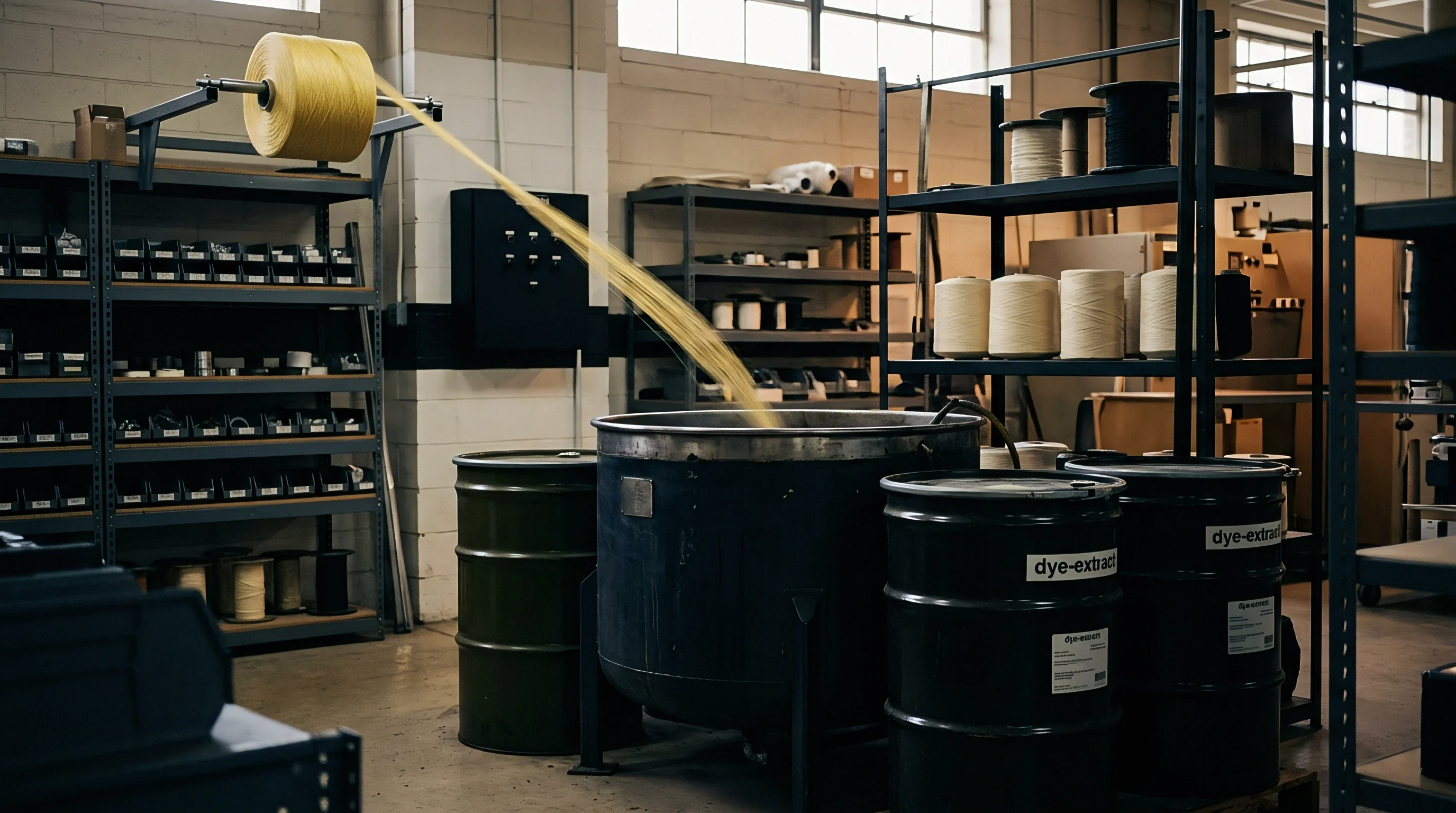
Dyeing plants run high-temperature jet and overflow machines that circulate fabric in continuous rope loops through pressurized tubes. These vessels group two, four, six, or eight identical tubes around a single shared circulation loop, heat exchanger, and dosing manifold. Inside each tube sit a Venturi nozzle, a transport reel, and a storage J-box holding the submerged cloth.
Consistency across the master batch depends on identical mechanical conditions inside every tube of the circuit. If tube diameter, nozzle clearance, or J-box friction vary even slightly, individual rope turnover rates change. When one rope makes fewer passes through the dye liquor than its neighbors during fixation, color depth strays across the lot.
Planning bulk dye runs starts with matching greige reel weights to tube payloads. Under standard liquor levels, industrial jet vessels carry nominal tube capacities between 150 kilograms and 250 kilograms. Overloading a chamber slows fabric rope velocity, packs cloth unevenly inside the J-box, and sets mechanical creases.
Underloading changes the vessel liquor ratio, builds up excess foam in the open volume, and pushes rope speed past safe mechanical limits. Matching greige linear mass directly to nominal vessel capacity keeps these operational deviations from developing.
Master greige orders arrive from mills as discrete rolls of varying yardage. An order specified at 10,000 kilograms of greige single jersey knit at 200 grams per square metre cannot just be split by nominal vessel weight. Operators must measure, sort, and stitch rolls end-to-end into uniform continuous loops for every tube.
The total wet weight of each sewn rope dictates the exact liquor volume required by the main circulation pump.
How master greige orders split across the dyehouse floor depends on tube counts, nominal chamber weights, and total machine capacities. Running four-tube vessels alongside two-tube units means adjusting batch structures on the fly. A 1,000-kilogram batch on a four-tube machine puts 250 kilograms in each chamber, whereas assigning that same 1,000-kilogram batch to two two-tube machines requires matching flow rates across separate vessels to prevent shade drift.
| Vessel Configuration | Chamber Count | Nominal Payload per Tube (kg) | Total Batch Capacity (kg) | Optimal Rope Speed (m/min) | Max Rope Length per Tube (m) |
|---|---|---|---|---|---|
| Compact Jet | 2 | 150 | 300 | 200 to 280 | 750 |
| Standard Jet | 4 | 200 | 800 | 250 to 350 | 1,000 |
| High Capacity Overflow | 6 | 250 | 1,500 | 300 to 400 | 1,250 |
| Extended Industrial Jet | 8 | 200 | 1,600 | 250 to 350 | 1,000 |
| Data based on 220 gsm tubular knit fabric at a 1:6 liquor ratio under standard operating pressure. | |||||
Rope Length Calculations and Velocity Calibration
Calculating maximum rope length per tube keeps fabric from tangling and stops dye from exhausting unevenly. Linear speed in modern jet vessels ranges between 200 and 400 metres per minute. A single rope loop ideally completes its revolution through nozzle, J-box, and reel in 60 to 90 seconds.
If cycle times stretch past 120 seconds, fabric rests too long in the storage chamber between passes through the Venturi nozzle, causing un-level shades.
Finding rope length comes down to dividing total chamber payload by fabric linear mass. A 200-kilogram load of fabric weighing 250 grams per linear metre yields 800 metres of rope per tube. At 300 metres per minute, that 800-metre loop takes 160 seconds per turn ~ exceeding the 90-second limit needed for level exhaustion on pale shades.
To correct this, the technician either cuts chamber weight to 150 kilograms, bringing loop length down to 600 metres and cycle time to 120 seconds, or bumps up reel speed within safe limits.
A four-tube jet vessel operating at eighty-five percent nominal load maintains shade delta E within zero point three units across all tubes under continuous circulation at three hundred metres per minute.
Physical roll joins within a tube require tight flat-seam construction. Splicing greige rolls with high-tensile polyester thread stops seams from blowing apart inside the Venturi nozzle under hydraulic pressure. If a seam fails inside a vessel running at 130 degrees Celsius, cloth packs up instantly, tangles, and ruins the batch.
Dyehouses enforce strict seam checks before loading fabric into the bath. Inspectors reject raw bath adjustment claims that omit pump frequency data.
Differential pressure transmitters continuously balance hydraulic flow across parallel tubes. If lint or debris chokes the Venturi nozzle on tube three in a four-tube machine, liquor diverts into tubes one, two, and four. The rope in tube three slows down while the others speed up.
That variance in cycle times creates intra-batch shade variations that no amount of stenter drying can fix. Modern vessels install individual flow meters on each tube to trigger automatic pump corrections whenever channel imbalances exceed two percent.
Minor variations in tube flow rates on an eight-hundred-kilogram batch fall within normal machine operational tolerances and resolve themselves during garment cutting.
Manifold
Greige Construction Dynamics under Wet Processing Conditions
Structural parameters govern how greige cloth behaves in chemical liquor under mechanical tension. Off-the-loom or off-the-frame specs shift the moment fabric hits hot scouring solution. A woven 3/1 twill cotton fabric at 30 ends per centimetre and 22 picks per centimetre contracts in length and gains pick density during open-width scouring.
Knits shift even more: single jersey knits distort at the loop and relax in length, raising linear weight per metre before dye absorption begins.
Yarn twist direction in the warp and weft drives structural torque inside the jet. High-twist yarns create spiral tightness in tubular knits, causing the rope to roll along its edges inside the storage J-box and blocking uniform liquor penetration across the width. Wovens constructed with dense filament warps and spun wefts shrink unevenly; the warp contracts fast under high bath temperatures while the weft stays stable, building internal stress that leaves warp-wise streaks if vessel speed runs too fast.
Cover factor calculations show where vessel chamber packing limits actually lie. A dense weave with a high cover factor resists liquor flow through capillary paths, forcing dye liquor around the fabric rope rather than through the yarn matrix. Overcoming that structural resistance takes lower rope speeds, higher nozzle pressure, and reduced batch weights to achieve complete liquor displacement.
Loose knits with lower cover factors let liquor pass easily through the loops, allowing full chamber loads and higher speeds without risking surface skitter.
Planners track greige reel numbers back to individual knitting heads before committing master orders to jet dyeing schedules. Rolls coming from different knitting frames or loom sheds carry subtle differences in tension and oil content. Mixing greige rolls from different production lots inside a single tube produces step-tone shade shifts along the continuous rope.
Sorting master greige inventory by mill lot, spin date, and physical grey weight keeps structural behavior consistent across all loaded tubes.

Reconciling Master Orders against Vessel Capacity Matrices
Splitting a 20,000-metre master greige order across multi-tube vessels means matching linear fabric weight against available machine payloads. Take an order delivered as 100 rolls at 200 metres each ~ 20,000 metres total raw length. At a finished weight of 300 grams per linear metre, total order mass equals 6,000 kilograms.
Distributing that tonnage across two 1,200-kilogram six-tube machines, three 800-kilogram four-tube machines, and three 400-kilogram two-tube machines demands precise allocation logic.
The planner assigns two 1,200-kilogram batches to the six-tube machines, three 800-kilogram batches to the four-tube machines, and one 400-kilogram batch to a two-tube machine, totaling 5,200 kilograms. The leftover 800 kilograms cannot fill a second four-tube machine without running at 100 percent load capacity, which increases creasing risk on heavy-weight constructions. The planner handles the balance by running a four-tube machine at a reduced load of 800 kilograms or taking the remnant through a short-load cycle.
Running vessels below seventy percent capacity alters liquor ratios and increases unit processing cost.
Machine gauge and yarn crimp govern fabric relaxation calculations during order reconciliation. A 28-gauge circular knit fabric relaxes by twelve percent in length during wet pre-treatment, while a 20-gauge knit relaxes by eight percent. The planner incorporates these exact relaxation percentages into master calculations.
Skipping this step leaves wet rope lengths exceeding chamber limits, causing tight packing and severe abrasion in the J-box.
- Master Roll Grouping ~ Group incoming greige rolls by yarn production lot, physical grey weight, and mill roll-length tickets to eliminate structural variation within single vessel runs.
- Greige Linear Mass Sorting ~ Weigh three swatches per roll under standard atmospheric conditions per ISO 3801 to establish exact linear mass per metre before planning batches.
- Seam Allowance Calculation ~ Allow for zero point four metres of fabric lost per roll join to cover flat-seam construction and sample tail allocation along the rope.
- Chamber Balance Verification ~ Calculate total wet mass per tube to confirm weight variation between parallel chambers remains strictly under one point five percent.
Dimensional changes during wet processing alter finished yield expectations. A greige order of 10,000 metres does not produce 10,000 metres of finished dyed cloth. Shrinkage across scouring, bleaching, dyeing, and stenter drying cuts final yardage while raising weight per square metre.
Baseline values come from ISO 5077 testing: a woven fabric showing four percent warp shrinkage yields 9,600 metres of finished goods from a 10,000-metre greige allocation. Sourcing contracts measure landed yield by finished linear mass rather than greige input length.
Splitting greige yarn lots without checking spinning dates creates problems. Mixing yarn lots within a single vessel introduces uneven shade uptake because synthetic fiber dyeability shifts between spinning batches, while natural fibers vary in maturity and wax content. Reserving dedicated vessels for single yarn lots protects shade consistency across bulk shipments.
Underloading a vessel to absorb excess master greige yardage changes liquor dynamics, but running full chambers with low liquor volumes guarantees severe mechanical creasing on delicate filament constructions.

Rope
Hydrodynamics and Mechanical Damage Mechanisms
Rope mark formation represents the primary mechanical risk during high-speed jet dyeing. Hydraulic pressure in the Venturi nozzle folds open-width cloth into a dense, compacted rope. If these folds remain locked in the same orientation throughout the cycle, permanent vertical creases form along warp or wale lines.
High-temperature synthetic dyeing accentuates crease retention when bath temperature drops past the fiber glass transition threshold while fabric remains tightly roped in the J-box.
Nozzle pressure calibration controls fabric velocity and hydraulic lubrication inside the transport tube. Venturi nozzle diameters range from 50 millimetres for delicate lightweight fabrics up to 140 millimetres for heavy pile knits. Operating a 100-millimetre nozzle at a differential pressure of 1.2 bar on fine 120 gsm polyester micro-filament fabric delivers excessive hydraulic force.
The high-velocity liquor jet strips filament fibers, leading to surface fuzzing and pilling measured under ISO 12945-2. Reducing nozzle pressure to 0.5 bar and opening the nozzle diameter to 120 millimetres restores gentle rope transport while maintaining linear speed.
Tension spikes occur when fabric exits the J-box and ascends to the overhead transport reel. High friction between wet fabric folds and the J-box lining creates drag, causing the reel to pull against stalled fabric. This drag stretches the fabric rope, inducing permanent longitudinal deformation and wale distortion in knitted structures.
Polishing stainless steel J-box internal surfaces or applying fluoropolymer slip sheets minimizes friction, permitting smooth rope elevation at high line speeds.
Technicians inspect nozzle throat gaps with feeler gauges during vessel setup to prevent surface abrasion on spun synthetic blends. Uneven clearance across the nozzle circumference forces dye liquor through narrow high-velocity channels, creating localized mechanical abrasion along one side of the moving fabric rope. This abrasion manifests as streakiness or differential shade depth running continuously down the roll length.
Which Vessel Loading Ratio Prevents Rope Marks?
Maintaining a vessel loading ratio between seventy-five and eighty-five percent of nominal chamber weight offers the broad window against mechanical creasing and rope marking. Loading above eighty-five percent packs fabric too tightly inside the J-box, preventing folds from opening and rearranging during circulation; static folds absorb dye unevenly along creased edges. Loading below seventy-five percent leaves excessive free space in the tube, causing fabric to float, tumble chaotically, and knot under turbulent liquor flow.
Rope speed must sync with pump turnover capacity to guarantee continuous fold shifting. In an optimal setup, the fabric rope shifts its fold geometry every time it exits the storage chamber and passes through the transport reel. If rope speed runs too slow relative to main pump circulation, high liquor flow pushes against a slowly moving fabric mass, locking creases into place under hydraulic pressure.
Speeding up the reel accelerates fold displacement and distributes dye liquor uniformly across the fabric surface.
Standard ISO 105-X12 crocking tests require batch rejection when tube-to-tube mechanical abrasion drops wet rub fastness below grade three.
Anti-crease agents added to the dye bath act as liquid lubricants, reducing friction between internal fabric folds. These polymer lubricants increase liquor viscosity slightly, forming a slip layer over fiber surfaces that allows folds to slide open smoothly as fabric falls into the J-box. Sourcing desks specify anti-crease auxiliary additions on heavy woven cottons, high-twist viscose knits, and micro-polyester blends prone to mechanical marking.
Controlling cooling rates before bath discharge prevents thermal shock creasing. Polyester dyed at 130 degrees Celsius must cool gradually at a rate not exceeding 1.5 degrees Celsius per minute down to 80 degrees Celsius before discharge. Flash-cooling freezes mechanical creases into the thermoplastic polymer structure, rendering them permanent even under subsequent stenter frame heat-setting at 190 degrees Celsius.
Automatic ramp-rate controllers manage cooling valves to ensure uniform temperature decline throughout the vessel body.
Accelerating vessel cooling from 130 to 60 degrees Celsius in eight minutes permanently set rope creases across four four-tube machines, causing a fourteen thousand dollar loss on a 15,000-metre lot of heavy viscose twill.
Liquor
Dyeing Bath Mechanics and Dosing Dynamics across Variable Volumes
The liquor ratio defines the mass relationship between fabric payload and total dye bath volume. A liquor ratio of 1:6 indicates that six litres of dye liquor circulate for every one kilogram of dry fabric. In multi-tube jet machines, total bath volume equals the sum of water inside individual transport tubes, the main circulation pump housing, the heat exchanger, and connecting pipework, plus liquid volume resting within the storage J-boxes.
Maintaining exact liquor ratios across different batch sizes forms the technical foundation of shade reproducibility.
Altering fabric load weight while keeping total water volume constant changes the operational liquor ratio. Loading 600 kilograms of fabric into a vessel filled with 4,800 litres of water creates a 1:8 liquor ratio. If the next batch drops to 450 kilograms of fabric while water volume remains fixed at 4,800 litres, the effective liquor ratio shifts to 1:10.7.
In reactive dyeing of cellulosic fibers, expanding the liquor ratio increases dye hydrolysis, reduces exhaustion yield, and lightens final shade depth. In disperse dyeing of polyester, higher liquor ratios shift chemical equilibrium, altering color build-up and requiring reformulating chemical additions.
Dye metering and chemical dosing schedules rely on precise volume calculations. Dyes, alkali, salts, and leveling auxiliaries are added via an auxiliary dosing tank connected to the main circulation line. Linear dosing injects chemical additions at a constant rate over a set period, while progressive dosing starts slowly and accelerates chemical delivery according to an exponential curve.
Progressive alkali dosing prevents premature dye fixation in reactive systems, allowing shade molecules to migrate evenly through thick fabric ropes before chemical bonding occurs.
Auditors review mill loading logs against wet-processing weight tickets to verify liquor ratio consistency. Discrepancies between recorded greige batch weight and metered water volumes highlight manual operator interventions that bypass standardized dyehouse automation. Automated liquor control systems utilize load cells under the vessel chassis to measure incoming dry fabric mass and automatically dose water to achieve the exact target liquor ratio within zero point one litres per kilogram.
| Operating Parameter | Nominal Design Run | Underloaded Chamber (-20%) | Overloaded Chamber (+15%) | Impact on Shade Fastness |
|---|---|---|---|---|
| Batch Weight (kg) | 800 | 640 | 920 | N/A |
| Total Water Volume (L) | 4,800 | 4,800 | 4,800 | Alters bath liquor concentration |
| Effective Liquor Ratio | 1:6.0 | 1:7.5 | 1:5.2 | Shifts dye exhaustion equilibrium |
| Reactive Salt Dosing (g/L) | 60 | 48 | 69 | Alters fixation rate and solubility |
| Exhaustion Yield (%) | 88.5 | 81.2 | 92.4 | Generates batch-to-batch Delta E > 1.5 |
| Rope Circulation Velocity (m/min) | 300 | 340 | 240 | Varies mechanical surface friction |
Worked Reconciliation Example: 12,500 Kilogram Master Greige Order Allocation
Reconciling a master order requires mapping greige roll allocations against an available jet vessel fleet while maintaining identical liquor ratios across all machines. Consider a master greige purchase order for 12,500 kilograms of 100% combed cotton 30/1 interlock knit fabric destined for navy blue reactive dyeing. The finishing facility operates three distinct jet vessel configurations: Machine Fleet A (two 4-tube vessels, 800 kg capacity each), Machine Fleet B (two 6-tube vessels, 1,200 kg capacity each), and Machine Fleet C (one 2-tube vessel, 400 kg capacity).
The total available fleet capacity across all machines in a single shift equals 4,400 kilograms (1,600 kg in Fleet A + 2,400 kg in Fleet B + 400 kg in Fleet C). Processing the 12,500-kilogram order requires three operational cycles across the dyehouse floor: Cycle One loads 4,400 kilograms, Cycle Two loads 4,400 kilograms, and Cycle Three requires loading the remaining balance of 3,700 kilograms across available vessels.
Dividing 3,700 kilograms for Cycle Three across the fleet demands adjusting machine load factors without changing the target 1:6 liquor ratio. The master planner calculates Cycle Three machine allocations as follows:
Machine Fleet A (Two 4-Tube Vessels): Assigned 1,350 kilograms total (675 kg per vessel, or 168.75 kg per tube). Target water volume per vessel equals 675 multiplied by 6, yielding 4,050 litres. The automatic water metering valve fills the vessel to 4,050 litres, preserving the 1:6 ratio despite operating at 84.3 percent of nominal mechanical capacity.
Machine Fleet B (Two 6-Tube Vessels): Assigned 2,000 kilograms total (1,000 kg per vessel, or 166.6 kg per tube). Target water volume per vessel equals 1,000 multiplied by 6, yielding 6,000 litres. The automated valve fills the vessel to 6,000 litres, maintaining the 1:6 ratio at 83.3 percent nominal capacity.
Machine Fleet C (One 2-Tube Vessel): Assigned 350 kilograms total (175 kg per tube). Target water volume equals 350 multiplied by 6, yielding 2,100 litres. The vessel maintains the 1:6 ratio at 87.5 percent capacity.
Unequal rope lengths in a shared bath cause the longer loop to complete fewer passes through the nozzle during reactive fixation, shifting depth of shade.
Chemical dosing for Cycle Three adjusts strictly to fabric mass rather than static machine volume. Reactive Navy dye concentration specified at 4.5 percent on weight of fabric (OWF) requires 30.375 kilograms of dyestuff for Fleet A vessels (675 kg x 0.045), 45.0 kilograms for Fleet B vessels (1,000 kg x 0.045), and 15.75 kilograms for Fleet C (350 kg x 0.045). Salt dosing specified at 60 grams per litre of liquor requires 243 kilograms of sodium sulfate for Fleet A (4,050 L x 0.060), 360 kilograms for Fleet B (6,000 L x 0.060), and 126 kilograms for Fleet C (2,100 L x 0.060).
Calculating salt dosing on total water volume while calculating dye dosing on fabric weight maintains identical chemical potential across all three vessel fleets during Cycle Three. Color difference evaluations performed under ISO 105-J03 confirm that shade variation between Cycle One (100% nominal load) and Cycle Three (84% average load) remains below Delta E 0.4 CMC (2:1) when liquor ratios stay locked at 1:6.0.
How far can a dyehouse expand its liquor ratio on short-loaded auxiliary cycles before dye exhaustion kinetics shift sufficiently to prevent spectrophotometric metamerism matching under secondary store lighting?

Split
Commercial Allocation Logic and Splicing Losses
Translating master purchase orders into physical dye vessel batch cards introduces scrap factors that shrink net finished yield. Greige rolls arriving from spinning and weaving mills never conform to exact theoretical lengths. A roll specified at 100 metres may measure 97.5 metres or 102.1 metres upon arrival.
When operators build continuous rope loops for a 200-kilogram tube capacity, they splice multiple rolls together. Splicing losses accumulate through seam allowance trimmings, damaged roll end removal, and physical scrap cut away during pre-inspection.
Tailings represent short remnants of greige rolls that cannot form a complete tube loop without introducing an additional seam or exceeding maximum rope weight limits. An operator building an 800-metre rope from 100-metre nominal rolls uses eight full rolls. If the eighth roll measures only 40 metres, the operator must cut into a ninth roll to extract 40 metres, leaving a 60-metre tailing.
Accumulating unassigned tailings across a 50,000-metre order generates hundreds of metres of un-dyed, isolated greige remnants that cannot be efficiently processed in standard jet equipment.
Splitting multi-tube batches unevenly across non-identical vessel pumps incurs a landed loss of twelve cents per metre. This loss stems from tailings accumulation, additional seam scrap, and mandatory re-handling fees charged by the dyehouse to scour and dye isolated remnant rolls on sample machines.
Order contracts establish clear rules for scrap absorption and tailing utilization. Converters must calculate total planned seam scrap before issuing cutting instructions. Joining twenty greige rolls per vessel tube across a four-tube machine creates eighty seam joins.
At zero point four metres of fabric lost per flat seam join, total seam scrap per batch equals 32 linear metres. Across a twenty-batch master order, seam scrap eliminates 640 metres of greige cloth. Sourcing allocations must account for this physical loss when converting greige purchases to finished garment units.
Master Roll Splicing Procedure for Vessel Loading
- Unroll greige fabric across the inspection table and trim dirty or torn leading edge fabric, recording header scrap length on the roll docket.
- Measure linear density with an inline wheel encoder to confirm fabric weight aligns with the planned tube payload matrix.
- Align trailing edge of roll one with leading edge of roll two, ensuring fabric face sides align to prevent face-to-back sewing errors.
- Sew a double-line flat chain stitch across the full width using high-tensile, heat-stabilized polyester thread with a minimum 15 millimetre seam margin.
- Inspect seam tension by manually pulling the fabric join laterally; reject seams displaying asymmetric stitch formation or edge curl.
- Repeat alignment and joining steps until total cumulative linear length matches the exact target loop length calculated for the assigned vessel tube.
- Cut trailing fabric from final roll, apply roll identification barcode tag to remaining greige tailing, and return tailing roll to rack storage.
- Feed completed continuous loop into assigned vessel chamber, verifying smooth entry through nozzle throat without structural twisting.
Short-shipment clauses in commercial agreements define acceptable variances between ordered greige yardage and delivered finished fabric. Standard market practice permits a plus-or-minus five percent quantity variance on total master order volume. On specialized custom shades or technical fabrics, converters push for ten percent allowances due to higher sampling scrap and setup waste.
Technical buyers negotiate narrower margins, stipulating that short shipments exceeding two percent trigger financial credits to cover lost garment cutting layout efficiency.
Color-matching minimums dictate the smallest lot size a dyehouse will execute without assessing short-run surcharges. If a buyer splits a 10,000-metre master greige order into six distinct colorways, some shades may drop below the minimum vessel fill capacity. Running a 400-kilogram capacity jet vessel with a 150-kilogram colorway forces the dyehouse to charge for full machine capacity to recover electrical, thermal, and chemical costs.
The buyer absorbs these surcharges unless color allocations align with machine payload increments.
Standard purchase contract clause 14.2 stipulates that total delivered finished yardage must land within minus two percent and plus three percent of original order volume, with all seam scrap, pre-treatment trim, and J-box tailing losses absorbed entirely within the agreed unit price per finished metre.
Settlement
Commercial Reconciliation and Invoice Auditing
Final invoice auditing requires comparing greige input ledger records against delivered, inspected, and accepted finished fabric rolls. Discrepancies between greige weight purchased and finished yardage invoiced arise from physical shrinkage, weight adjustments, moisture regain variations, and scrap subtractions. Dyehouse invoices must detail gross greige input mass, net processed mass, finished linear yardage, and shade-sorting yield breakdowns to enable precise financial audit.
Finished fabric weight specs carry strict tolerances measured under ISO 3801. A specification calling for 200 grams per square metre with a plus-or-minus five percent tolerance permits fabric to deliver between 190 gsm and 210 gsm. If a dyehouse over-stretches fabric on the stenter frame to maximize linear yardage output, fabric weight drops below 190 gsm.
The resulting thin hand-feel fails customer specs, leading to batch rejection. Conversely, under-stretching fabric produces heavy gsm readings that reduce total linear output from the greige lot, increasing landed cost per metre.
Yield calculations reconcile greige metres purchased against finished metres delivered. A master greige purchase of 10,000 metres yielding 9,400 metres of finished fabric represents a total length loss of six percent. The auditor checks this loss against baseline shrinkage data.
If pre-production testing established baseline process shrinkage at four percent, the extra two percent loss represents unexcused mill waste, seam scrap excess, or unrecorded tailing cuts. Sourcing desks debit the converter for unexplained yield losses exceeding contractual allowances.
| Cost Component | Target Budget ($/m) | Actual Landed ($/m) | Variance Source | Contractual Recourse |
|---|---|---|---|---|
| Master Greige Input | 2.10 | 2.10 | Zero variance on raw input price | Base price fixed by purchase order |
| Dyeing & Finishing Base Rate | 0.85 | 0.85 | Standard vessel processing rate applied | Agreed converter fee schedule |
| Under-Load Capacity Surcharge | 0.00 | 0.14 | Batch split created short-loaded vessel cycle | Debit converter if split was mill decision |
| Unexplained Shrinkage Waste | 0.00 | 0.08 | Yield dropped 2% below tested ISO 5077 baseline | Apply Clause 14.2 financial penalty |
| Shade Banding Scrap (555 Sort) | 0.00 | 0.11 | Inter-tube Delta E variance forced roll downgrades | Reject rolls exhibiting Delta E > 1.0 |
| Total Landed Finished Cost | 2.95 | 3.28 | Cumulative 11.2% cost inflation per metre | Enforce final invoice audit offset |
Shade Sorting and Yield Realization Mechanics
Shade sorting using 555 spectrophotometric classification codes organizes bulk output into uniform cutting blocks. Spectrophotometers read color values across head, middle, and tail end cuts of every dyed roll under ISO 105-J03. The resulting CIE L a b coordinates map to a three-dimensional grid where five-five-five represents the central target shade.
Rolls assigned codes such as 554 or 565 display minor color shifts that cannot be intermingled within a single garment assembly layout without creating visible panel distortion.
Inter-tube shade variations force roll re-assignments that disrupt cutting room schedules. When tube three of a four-tube vessel produces fabric sorting into 554 while tubes one, two, and four produce 555, the cutting room must separate the 554 rolls into isolated cutting tables. This separation increases marker making cost, generates marker waste, and slows garment assembly lines.
Sourcing desks penalize dyehouses when inter-tube shade spread forces more than two distinct 555 shade groups within a single dye vessel batch.
- Greige Tailings Accumulation ~ Unplanned short roll remnants left after building uniform continuous loops remain stranded in inventory, tying up capital in unusable yardage.
- Liquor Ratio Miscalculation Surcharge ~ Shifting water volumes on underloaded auxiliary runs alters chemical absorption rates, causing batch-to-batch color shifts that require costly re-topping additions.
- Shade Banding Rejection Loss ~ Hydraulic pressure imbalances between parallel vessel tubes generate intra-batch shade variations that force roll downgrades during final spectrophotometric 555 sorting.
- Unbalanced Tube Mechanical Friction Scrap ~ Variable rope velocities across individual chambers cause surface pilling, longitudinal drag marks, and permanent mechanical creasing that destroy commercial fabric value.
Audit protocols require verifying dyehouse weight tickets against landed roll packing lists. Weighing finished rolls on calibrated scales confirms that fabric moisture content sits within industry standard regain allowances (eight point five percent for cotton, two percent for polyester). Dyehouses occasionally ship over-moist fabric to artificially inflate roll weights and hit target gsm specifications.
Conditioning swatches under standard laboratory atmosphere (20 degrees Celsius, 65 percent relative humidity) prior to ISO 3801 testing strips excess moisture, revealing true fabric mass per unit area.
Dyehouse invoices carrying unaccounted surcharges for machine capacity under-utilization require immediate cross-checking against original vessel allocation cards. If the dyehouse elected to split a 2,400-kilogram order across three 800-kilogram four-tube vessels instead of two 1,200-kilogram six-tube vessels to manage their own floor schedule, the buyer bears no financial responsibility for the resulting short-load fees. Financial settlement proceeds only after deducting unexcused scrap penalties, shade-sorting downgrades, and unapproved capacity surcharges from the final landed invoice balance.