Calibrating Short Wave Infrared Sensors for Blowroom Contamination Removal
Calibrating short-wave infrared sensors using dynamic dual-band ratioing isolates white polypropylene from cotton lint while preventing false ejection cycles.


Optics
Clean cotton raw stock moving through pneumatic transport ducts carries foreign matter that standard visible-spectrum cameras pass without detection. White polypropylene baling twine, clear polyethylene bale wrap, and translucent polyamide strapping match the color coordinates of natural cotton fibers under quartz halogen or standard visible light emitting diode bars. Optical sorting systems identify these synthetic polymers through specific molecular absorption bands in the short-wave infrared region spanning 1000 to 2200 nanometers.
Natural cellulosic fibers present primary hydroxyl absorption peaks near 1450 nanometers and 1940 nanometers due to bound moisture and cellulose monomer structures. Polyolefin contaminants lack hydroxyl groups entirely. Polypropylene and polyethylene exhibit distinct carbon-hydrogen stretching and bending overtone absorption signatures between 1710 and 1760 nanometers, alongside secondary combination bands from 2150 to 2320 nanometers.
Indium gallium arsenide line scan arrays detect these reflected spectra against background reference illumination. Standard cameras operate between 400 and 700 nanometers, relying on color contrast or ultraviolet excitation to spot pigmented materials or optical brighteners. SWIR detection relies strictly on chemical composition.
When white polypropylene packaging shreds pass under an infrared line scanner, the sensor measures reflected radiation across two discrete wavelength bands. The reference band, positioned at 1200 to 1300 nanometers, shows high reflectance for both raw cotton tufts and polyolefins. The measurement band, centered at 1730 nanometers, experiences severe photon absorption by the carbon-hydrogen bonds of the synthetic polymer while the cotton tuft maintains steady reflectance.
This ratio separates non-pigmented plastics from raw lint.
Unstabilized sensor hardware drifts within hours of continuous mill operation. Indium gallium arsenide photodiodes exhibit strong dark current sensitivity to ambient temperature swings inside the spinning mill preparatory room. An uncooled photodiode array shifts its thermal baseline voltage by roughly six millivolts per degree Celsius of ambient temperature rise.
Blowroom environments routinely swing from 22 degrees Celsius during dawn shifts to 38 degrees Celsius under afternoon production loads. Without thermo-electric cooling regulation, thermal noise overwhelms subtle reflection drops caused by thin polypropylene film fragments weighing less than 0.5 milligrams.
A five-degree drift in sensor bench temperature alters the short-wave infrared ratio baseline by eight percent across uncooled photodiode arrays.
Optical geometry dictates how clean the reflected signal remains as fibers accelerate past the quartz viewing window. Illumination bars mounted at 45-degree angles relative to the optical receiver axis reduce direct specular glare off smooth plastic films. Specular reflection acts like a mirror, blinding the photodiode array and driving the signal into saturation across all channels.
Diffuse reflectance reveals true molecular absorption. Quartz protective panes must stay free of electrostatic lint adhesion. Cotton wax deposits accumulate on unprotected lenses, creating an artificial hydrocarbon absorption layer that mimics polyolefin contamination across the entire scanning line.
Technicians wipe optical glass with isopropyl alcohol every eight operating hours. Neglecting this maintenance window raises false ejection rates until the pneumatic valves dump three percent of usable lint into the waste house.

Duct
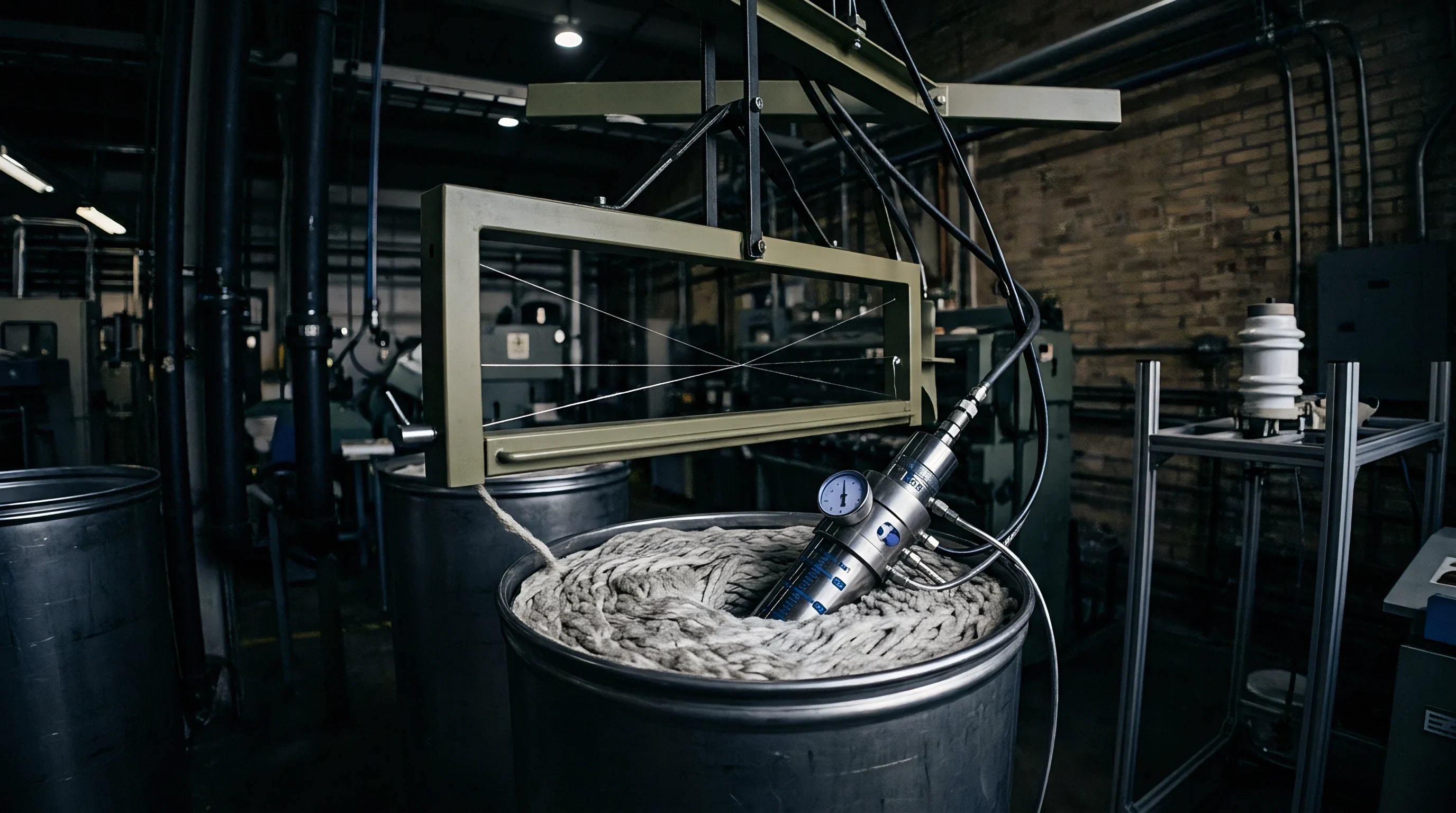
Material velocity inside blowroom conveying ductwork governs the integration time available for short-wave infrared sensor arrays. Pneumatic transport fans propel opened cotton tufts through rectangular inspection chutes at velocities between 10 and 16 meters per second. A contaminant particle measuring two millimeters across passes the optical scan line in less than 200 microseconds.
Sensor line scan rates operate at minimum frequencies of 10 to 15 kilohertz to capture at least two consecutive pixel lines on the moving particle. Line scan frequencies set below eight kilohertz create spatial blind spots across the chute width, allowing thin polypropylene fibers to pass between integration cycles.

Where Air Turbulence Deflects Passing Contaminants?
Static air pressure profiles inside the duct shift particle trajectories across the cross-sectional viewing area. Cotton tufts travel along central velocity streamlines, while dense polypropylene tape fragments migrate toward duct boundaries under centrifugal forces generated by upstream pipe elbows. Chute cross sections transition from round pipes into flattened rectangular inspection zones to enforce uniform fiber sheet presentation.
The depth of the inspection zone cannot exceed 80 millimeters. Deeper ducts allow heavy cotton tufts to physically occlude lightweight plastic films, shielding them from infrared illumination and photodiode line scan view.
| Transport Air Velocity | Line Scan Frequency | Pixel Exposure Time | Spatial Resolution Downstream | Ejection Latency Window |
|---|---|---|---|---|
| 8.0 meters per second | 8.0 kilohertz | 125 microseconds | 1.00 millimeter | 32 milliseconds |
| 10.0 meters per second | 10.0 kilohertz | 100 microseconds | 1.00 millimeter | 25 milliseconds |
| 12.0 meters per second | 12.0 kilohertz | 83 microseconds | 1.00 millimeter | 21 milliseconds |
| 14.0 meters per second | 15.0 kilohertz | 66 microseconds | 0.93 millimeter | 18 milliseconds |
| 16.0 meters per second | 20.0 kilohertz | 50 microseconds | 0.80 millimeter | 15 milliseconds |
Fiber tuft opening state directly affects transmission and surface reflectance of infrared photons. Dense, unopened cotton clumps suppress detection performance. Heavy tufts scatter short-wave infrared light randomly, attenuating the beam before it reaches embedded synthetic fragments.
Installing optical sorters immediately after fine openers, rather than behind bale plucking machinery, establishes ideal presentation conditions. Fine openers deliver individualized fiber tufts with mean diameters under 15 millimeters. Under these dimensions, the optical sensor measures light returning from the entire tuft volume rather than simply glancing off outer packaging surfaces.
Mechanical vibration transmitted from high-speed fans degrades camera focus over operating cycles. Rigid duct mounts couple blower motor vibrations directly into optical camera gantries. Heavy dampening isolators isolate the optical rail from sheet metal ductwork.
The supplier stated that mechanical duct vibration never exceeded camera sensor tolerances during factory testing.


Threshold
Setting trigger levels requires precise isolation of raw material variation from foreign matter signatures. Bale lots entering the laydown area display moisture regain values ranging from 5.5 to 8.5 percent under standard commercial conditions defined by international practice. Water absorbs strongly at 1450 and 1940 nanometers.
When wet cotton tufts pass through the inspection zone, overall signal levels drop across the spectrum. A static signal threshold configured for dry cotton flags moist cotton tufts as synthetic contamination, triggering unnecessary pneumatic valve activations.

Why Moisture Swings Alter Absorption Thresholds?
Dynamic ratioing counters baseline moisture fluctuations by evaluating differential absorption rather than absolute intensity. Two photodiode channels measure reflected short-wave infrared light simultaneously. The primary channel monitors 1730 nanometers for hydrocarbon absorption, while the reference channel tracks 1280 nanometers where moisture and cellulose maintain neutral reflectance profiles.
The system computes a continuous mathematical quotient between the two wavelength signals.
Clean cotton tufts yield an absorption quotient that remains constant regardless of moisture swings between 6.0 and 9.0 percent. Polypropylene and polyethylene drive this ratio downward instantly. Setting the trigger threshold involves establishing a baseline band through statistical evaluation of the running lot.
The threshold line sits three standard deviations below the mean quotient established by clean fiber stock. This margin prevents false triggers while catching polyolefin fragments down to one square millimeter.
- Dark Current Capture closes optical shutters to record ambient thermal voltages across all photodiode pixels.
- White Reference Target positions a standardized polytetrafluoroethylene calibration bar into the optical path to set baseline unity gain across the active spectral band.
- Cotton Stock Normalization samples clean running stock for two minutes to balance the dynamic ratio quotient to exactly 1.00 across all channels.
- Sensitivity Boundary Assignment programs the lower rejection threshold between 0.82 and 0.88 based on target yarn cleanliness criteria.
- Pneumatic Test Verification fires each individual air nozzle in sequence to confirm air delivery pressure exceeds 0.6 megapascals.
Raw cotton contains natural waxes ranging from 0.4 to 0.8 percent by weight according to solvent extraction tests. These ester waxes exhibit faint absorption near 1725 nanometers, closely tracking the polypropylene absorption footprint. Highly waxy cotton varieties produce lower baseline ratios.
Adjusting thresholds without checking fiber wax levels causes persistent valve firing errors.
Raw cotton with wax content above 0.75 percent suppresses the baseline optical ratio by 0.04 points.
Technicians verify sensor calibration curves using calibrated polymer test tabs before starting production runs. White polypropylene strips measuring two millimeters wide travel through an offline suction test tube to verify valve triggering. The machine records response times down to the nearest microsecond.
If sensor sensitivity degrades, the system fails to trigger on thin plastic films. Commercial contracts stipulate that yarn spinning lots contain zero foreign matter faults per 100 kilometers under automated winder sensor audits.

Ejection
Detection holds value only when coupled with accurate physical separation of contaminated lint. Pneumatic ejection manifolds sit downstream from the optical scanning line. Typical separation distances span 200 to 500 millimeters.
The physical gap grants the programmable logic controller sufficient processing time to calculate the contaminant position, track velocity vectors, and fire corresponding high-speed solenoid valves. When air flow velocity fluctuates, the arrival time of the contaminant at the nozzle bar drifts out of alignment with the air pulse.
Solenoide valve arrays use high-speed pneumatic nozzles spaced at 10 to 15 millimeter intervals across the duct width. When the infrared sensor detects polypropylene, it identifies the exact horizontal pixel coordinates of the particle. The controller activates two or three adjacent valves aligned with those spatial coordinates.
Firing single isolated nozzles risks missing contaminants that tumble transversely in turbulent duct flows. Valve open durations range between 15 and 30 milliseconds.
| Operating Air Pressure | Solenoid Actuation Time | Valve Open Duration | Lint Waste Per Blast | Removal Efficiency |
|---|---|---|---|---|
| 0.45 megapascals | 4.5 milliseconds | 35 milliseconds | 3.8 grams | 81.2 percent |
| 0.50 megapascals | 3.8 milliseconds | 30 milliseconds | 3.2 grams | 88.6 percent |
| 0.60 megapascals | 2.5 milliseconds | 20 milliseconds | 1.8 grams | 96.4 percent |
| 0.65 megapascals | 2.2 milliseconds | 18 milliseconds | 1.5 grams | 98.1 percent |
| 0.70 megapascals | 2.0 milliseconds | 15 milliseconds | 1.2 grams | 98.5 percent |
Excessive blast duration inflates clean lint loss. A valve pulse lasting 40 milliseconds ejects up to five grams of clean fiber alongside a tiny polyolefin fragment. Across a standard blowroom line processing 800 kilograms of cotton per hour, 200 ejection events per hour generate substantial material waste.
Shortening pulse duration to 15 milliseconds cuts lint loss to roughly one gram per blast while expelling the target particle.
Air pressure set above target values preserves lint while blowing contaminants clean into the extraction duct.
Operating pressure requires constant regulation. Compressed air supplied to the nozzle manifold must stay above 0.60 megapascals. Air supply pressures dropping below 0.50 megapascals increase valve opening delays by two milliseconds.
When delays stretch, the contaminant passes the nozzle orifice before the air jet achieves peak velocity. The foreign particle escapes downstream into the carding room.
- Pressure Drop Failure occurs when line pressure drops beneath 0.55 megapascals during concurrent multiple-valve firing cycles.
- Moisture Contamination Risk introduces oil droplets and condensed water into pneumatic manifolds, destroying solenoid responsiveness.
- Nozzle Orifice Clogging develops when lint dust settles inside inactive jet openings, reducing blast air velocity by 30 percent.
- Timing Misalignment Defect arises when upstream transport fan speed drifts without automatic recalculation of sensor-to-nozzle delays.
Card room waste records reveal pneumatic timing failures through spike counts in flat waste collections. Misaligned ejection timing allows synthetic tape to enter the licker-in zone of the carding machines. Rotating wire teeth shred continuous plastic films into thousands of microscopic fibrils.
These microscopic fibrils distribute uniformly throughout the sliver, rendering downstream optical removal impossible.

Audit
Downstream quality control verifies the true operating success of short-wave infrared blowroom installations. Contamination audits rely on clearing records generated during yarn winding operations. Electronic yarn clearers equipped with capacitive and optical sensors inspect every meter of spun yarn at speeds exceeding 1200 meters per minute.
Clearer classification channels separate foreign matter faults into distinct length and optical density categories. Classimat testing standards quantify residual foreign matter defects per 100,000 meters of spun yarn.
| Blowroom Optical Configuration | Short Polyolefin Faults | Long Plastic Filaments | Winder Cut Frequency | Total Defect Mass |
|---|---|---|---|---|
| Standard Visible Light Only | 42.5 cuts | 18.2 cuts | 60.7 per 100 km | 14.8 milligrams |
| Visible Light Plus Ultraviolet | 36.1 cuts | 15.4 cuts | 51.5 per 100 km | 11.2 milligrams |
| SWIR Without Dynamic Calibration | 14.2 cuts | 4.8 cuts | 19.0 per 100 km | 3.6 milligrams |
| SWIR With Dual Ratio Calibration | 1.8 cuts | 0.4 cuts | 2.2 per 100 km | 0.5 milligrams |
Spinning mills deliver carded and combed yarns under strict foreign matter defect guarantees. Knitted and woven textile operations reject lots displaying more than two foreign fiber cuts per 100 kilometers. Undetected white polypropylene escapes detection in greige cloth inspection.
During the dyeing process, synthetic polyolefins resist reactive dyestuffs formulated for cellulosic cotton. The uncolored plastic fragments create bright white streaks across dyed knitwear surfaces, resulting in entire dye lot downgrades.
The economic impact of contamination reaches beyond initial blowroom waste percentages. Finished knit cloth downgraded from first quality to second quality incurs price deductions ranging between 30 and 50 percent per kilogram. An individual 20-tonne shipment of dyed cotton single jersey cloth carries substantial financial exposure if polyolefin fragments pepper the finished rolls.
Sourcing agreements place full liability for finished product defects on the spinning facility whenever yarn winder cut files prove foreign matter origin.
Mill managers maintain daily log sheets recording baseline sensor ratios, ejection counts, and waste disposal masses. Calibrated blowroom machinery yields consistent contamination removal percentages above 95 percent without shedding excessive good lint. Quality control teams compare blowroom rejection records against winder clearer cut reports every morning.
Stable short-wave infrared sensor response establishes predictable spinning floor operations.