Greige Substrate Verification Metrics in Wet Processing
Greige qualification governs wet processing uptake through conditioned mass accounting, chemical size identification, capillary absorbency, and bow tolerances.
Dock
Receiving inspection starts on the delivery platform before unloading machinery lifts a single crate. Receiving teams verify gross delivery against the bill of lading, checking for moisture infiltration, crushed roll tubes, and breached polyethylene wrappers. Moisture meters are calibrated against ambient relative humidity.
Wet goods inside humid containers undergo rapid biological degradation, fungal staining, and localized size migration. A container arriving with ruptured moisture seals invalidates the mill warranty before wet processing even begins.
Loom-state cotton rapidly absorbs environmental moisture, altering gross invoice weights. Purchasing agreements settle transactions based on conditioned commercial mass rather than raw scale readouts. Standard conditioning under ISO 139 requires exposure to 20 degrees Celsius and 65 percent relative humidity until specimen mass stabilizes within 0.1 percent across consecutive two-hour weighings.
Commercial moisture regain allowances are standardized at 8.5 percent for pure cotton, 11.0 percent for viscose, and 0.4 percent for polyester. Shipping damp yardage inflates scale weights, effectively charging dry fiber prices for trapped water.
Incoming deliveries are expected to arrive dry.
A typical commercial adjustment illustrates the financial impact. Take a 20,000 kilogram delivery of loom-state cotton twill arriving from the weaving shed. The receiving lab takes core borer samples from ten percent of randomly selected rolls, drying them in a forced-air oven at 105 degrees Celsius until reaching constant mass per ASTM D2495.
If the lab records an average moisture content of 5.2 percent against a contractual regain allowance of 8.5 percent, calculating the conditioned mass yields 20,627.38 kilograms of billable fiber. The converter then credits the mill for an additional 627.38 kilograms of fiber weight, avoiding retroactive debit disputes.
Under ASTM D2495 oven-drying procedures, cotton lots delivered below standard moisture regain earn upward commercial mass corrections on the final invoice.
Moisture variations directly distort billable commercial mass.
Piece length verification runs alongside mass calculations. Automated inspection frames with rubberized measuring drums verify roll lengths against stamped piece tickets. Tension variations across the loom take-up roll create latent length discrepancies that release during initial scray accumulation.
Unrolling goods without mechanical braking allows elastic recovery, showing whether the roll was stretched to meet linear length targets. Width is measured across the face at the head, middle, and tail of each sampled roll. Usable width excludes the pin selvage or fringe, setting the true boundary for wet preparation stenters.
- Moisture regain percentage calculated from bone-dry oven weighings determines whether the scale ticket represents true fiber volume.
- Net roll mass recorded on calibrated platform scales detects systematic yarn density loss across successive production shifts.
- Loom ticket piece length measured under zero tension reveals synthetic elongation applied by loom winders to artificially inflate yardage.
- Packaging envelope integrity examined during unloading identifies sea spray penetration, diesel soot contamination, and exterior mold colonies.
Invoicing ultimately relies on conditioned weight calculations.
Standard purchase contract clause 14.2 stipulates that measured moisture deviations exceeding two percentage points from standard regain automatically transfer testing costs directly to the greige supplier.

Size
Warp yarns enter the loom coated with chemical sizing applied during slasher preparation. Natural starches, modified potato derivatives, carboxymethyl cellulose, polyvinyl alcohol, and polyacrylates protect the yarn from abrasion during shed formation. These compounds envelope the yarn perimeter, creating a hydrophobic shell that blocks aqueous dye liquors.
Preparation lines must eliminate these size compounds before bleaching or dyeing, as residual polymers cause resist spots, uneven dye uptake, and streakiness during pad-dry-cure coloration.
Synthetic sizing binders typically resist plain boiling water.
Desizing chemistry depends on the binder class used during slashing. Native corn starch breaks down under bacterial, malt, or fungal amylase enzymes within specific temperature and pH ranges, whereas polyvinyl alcohol dissolves in near-boiling water without chemical cleavage. Slasher operators often combine starch with polyvinyl alcohol to balance cost against yarn strength, which complicates wet extraction.
The laboratory identifies the chemical family on incoming lots using colorimetric reagent drops on greige swatches before setting up scouring and desizing wash boxes.
| Chemical Compound | Reagent Indicator | Color Response | Desize Extraction Wash Temp | TEGEWA Scale Target | Effluent COD Loading |
|---|---|---|---|---|---|
| Native Corn Starch | Iodine / Potassium Iodide | Deep Blue Violet | 70 to 80 °C (Enzymatic) | Grade 8 to 9 | 10,000 to 25,000 mg/L |
| Polyvinyl Alcohol (PVA) | Boric Acid / Iodine | Teal Green to Blue | 90 to 95 °C (Aqueous) | Grade 8 to 9 | 1,500 to 3,500 mg/L |
| Carboxymethyl Cellulose | Methylene Blue / Uranyl Nitrate | Light Sky Blue | 60 to 70 °C (Neutral) | Grade 7 to 8 | 5,000 to 12,000 mg/L |
| Polyacrylic Acid (PAA) | Basic Blue 9 Reagent | Reddish Pink | 50 to 60 °C (Alkaline) | Grade 8 to 9 | 800 to 2,000 mg/L |
| Tallow Wax Lubricant | Soxhlet Solvent Extraction | Oily Gravimetric Residue | 85 to 95 °C (Surfactant) | Grade 7 to 8 | 15,000 to 40,000 mg/L |
| Methods note: Color reactions evaluated under standard D65 illumination; TEGEWA ratings assessed against standardized photographic scale ISO 3074 where Grade 9 indicates total size elimination. | |||||
Enzymatic treatments specifically break down native starches.
The standardized TEGEWA violet scale quantifies residual starch removal on the plant floor. An analyst prepares spot reagent by dissolving 10.0 grams of potassium iodide and 1.3 grams of resublimed iodine in 100 milliliters of distilled water, diluting to one liter. Drops applied across the width of desized fabric react immediately with residual amylose.
Coloration ranges from dark purple-black (heavy residual starch at Grade 1) to pale yellowish-brown (complete extraction at Grade 9). Continuous dyeing operations require a consistent Grade 8 or higher across the full roll width to avoid edge-to-center shade variation.
- The technician cuts five specimens across the full width of the scoured substrate, avoiding the outer three centimeters of selvage.
- Specimens sit in an air-conditioned room until stabilizing at 20 degrees Celsius.
- Two drops of potassium iodide solution fall onto the center of each specimen from a height of twenty millimeters.
- Visual inspection against the standardized TEGEWA photographic scale within sixty seconds establishes the washing efficiency grade.
Iodine indicators reveal any residual sizing film.
Normal scouring runs fail to remove light starch films without an enzymatic bath, leaving residual carbohydrates to caramelize into permanent brown resist marks inside hot thermosol units.
Count
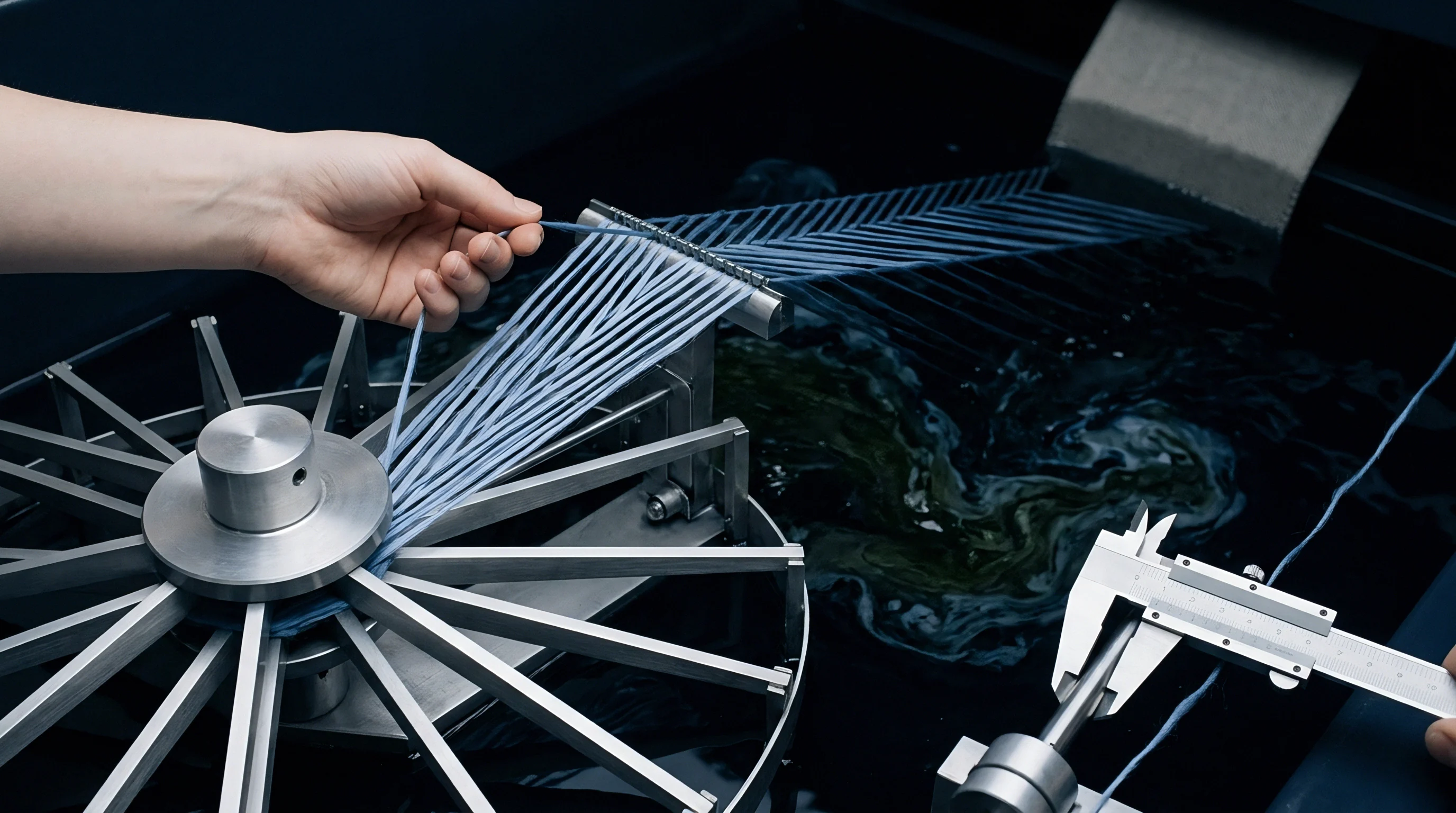
Loom construction specs dictate mass distribution and substrate porosity before chemical processing starts. Yarn count, expressed as English cotton number (Ne) or metric Tex, measures linear density. Lab technicians pull warp and weft yarns from representative swatches, conditioning them before using skein wrap reels and analytical balances per ASTM D1059.
Variations in linear density alter dye liquor pickup during pad operations ~ a shift of just two Ne numbers within a single lot creates noticeable shade depth differences across dyed panels.
Yarn twist direction directly governs structural torque.
Thread counts ~ ends per inch (EPI) and picks per inch (PPI) ~ determine structural tightness and cover factor. Technicians use optical pick glasses or traveling thread counters per ASTM D3775, taking ten readings in both warp and filling directions. Cover factor, calculated with Peirce formulas, directly affects liquor penetration speed in continuous preparation ranges.
When a weaving shed increases pick density to compensate for underweight yarn, the tighter weave slows capillary wetting, starving core fibers of dye during brief immersions in high-speed pad mangles.
A contract tolerance of plus or minus two percent on pick density prevents weaving sheds from altering yarn counts to salvage off-spec cloth weights.
Crimp percentage reflects the yarn path waviness created by interlacing. Technicians take twenty warp and twenty weft yarns, straightening them under calibrated pre-tension per ISO 7211-3 to measure extended length against the woven length. Crimp balance determines whether fabric shrinks mainly in length or width during desizing and scouring.
Imbalanced crimp ratios cause severe width necking in continuous washing ranges, forcing stenter operators to apply excessive lateral clip tension that compromises selvage integrity.
Heavier yarn counts noticeably stiffen fabric hand.
Uncontrolled yarn shifts lead to severe rejections downstream when finished garments shrink beyond commercial tolerances after laundering.

Bath
Absorbency is the core prerequisite for uniform chemical pickup during bleaching, mercerizing, and dyeing. Raw cotton contains natural waxes, fats, pectins, and protein debris within the outer fiber wall. These non-cellulosic impurities repel water, driving drop absorption times past three minutes in AATCC 79 testing.
Thorough scouring saponifies these fatty esters, stripping away the hydrophobic shell and exposing hydrophilic cellulose hydroxyl groups to processing baths.
Residual wax blocks aqueous liquor penetration.
Lab testing uses petroleum ether extraction in Soxhlet apparatus to quantify solvent-extractable matter per ASTM D2257. Raw cotton greige contains extractable fat and wax fractions between 0.6 percent and 1.3 percent of dry fiber mass. Fabric destined for high-speed pad dyeing must register wax levels below 0.2 percent; anything higher creates water-repellent spots that leave pinhole voids in pigmented coatings and reactive dyes.
What Governs Wet Pickup Inconsistency across Looms?
Variations in warp lubricants and sizing fats alter surface tension across greige lots. Paraffin waxes, hydrogenated tallow, and synthetic triglycerides applied to reduce loom friction dissolve unevenly during rapid scouring. When a finishing plant runs fabric mixed from different weaving sheds through one scouring line, uneven residual wax causes wet pickup to jump anywhere from 60 percent to 85 percent across roll joints.
| Fibre Substrate | Verification Parameter | Test Method | Loom-State Range | Preparation Target |
|---|---|---|---|---|
| Upland Cotton | AATCC 79 Drop Absorbency | AATCC 79 | Over 180 seconds | Under 3.0 seconds |
| Upland Cotton | Soxhlet Solvent Extractables | ASTM D2257 | 0.60 to 1.30 % | Under 0.20 % |
| Cellulosic Blends | Core Aqueous Extract pH | AATCC 81 | 5.5 to 7.0 pH | 6.5 to 7.5 pH |
| Polyester / Cotton | Capillary Wicking Height | DIN 53924 | Under 5 mm / 10 min | Over 35 mm / 10 min |
| Viscose Rayon | Total Ash and Silica | ISO 3451-1 | 0.30 to 0.80 % | Under 0.15 % |
Alkaline washes neutralize acidic warp lubricants.
Core alkalinity testing prevents destructive chemical reactions during peroxide bleaching. Technicians boil ten grams of cut fabric in one hundred milliliters of distilled water and record extract pH per AATCC 81. Unwashed alkaline sizing can leave core pH above 9.0, accelerating peroxide decomposition and damaging fibers.
Conversely, acidic spin finishes on synthetic filaments drop bath pH, causing disperse dyes to precipitate out of suspension in high-temperature jet dyeing vessels.
- Alkaline extraction pH measured on boiled distilled water extracts reveals unreacted scouring lye that causes harsh hand and fiber tendering.
- Capillary wicking velocity tracked over ten-minute intervals verifies uniform surface energy across the length of the scoured roll.
- Solvent-extractable wax content isolated by petroleum ether boiling quantifies hydrophobic residue capable of causing pale dye resist spots.
- Chelation threshold for metal ions determines whether residual iron or copper traces will catalytically rupture cellulosic chains in peroxide baths.
Whether chelating agents can fully neutralize deep-set iron deposits from spinning without degrading cellulose remains an ongoing challenge on continuous lines.
Skew
Alignment between warp ends and weft picks dictates whether finished garments hang straight or twist at the seams. Greige goods leave the loom with inherent distortions caused by uneven warp beam tension, asymmetric shed openings, or off-center take-up rolls. Bow measures arched weft displacement across the center, while skewness measures diagonal weft displacement relative to a line perpendicular to the selvage.
Both must be mapped per ASTM D3882 before wet processing.
Uneven warp tension skews structural grain.
Circular knits suffer from spirality driven by residual yarn twist torque. Single jersey knitting feeds yarn continuously along a helical path, tilting wales away from the vertical axis. This angle of spirality, measured under ISO 16322-2 or AATCC 179, frequently reaches seven to twelve degrees in greige tubes.
If wet processing relaxes this loop distortion without mechanical re-pinning on a biaxial stenter, the finished fabric yields twisted legs and spiraling side seams.
| Structural Construction | Governing Standard | Max Allowable Greige Bow | Max Allowable Greige Skew | Relaxation Shrinkage Target |
|---|---|---|---|---|
| Airjet 3/1 Cotton Twill | ASTM D3882 | 1.5 percent | 2.0 percent | Under 3.5 % (ISO 6330) |
| Rapier Plain Sheeting | ASTM D3882 | 1.0 percent | 1.0 percent | Under 2.5 % (ISO 6330) |
| Cotton Single Jersey Knit | AATCC 179 | Not Applicable | 5.0 degrees | Under 5.0 % (ISO 6330) |
| Interlock Double Knit | ISO 16322-2 | Not Applicable | 2.5 degrees | Under 3.0 % (ISO 6330) |
| Filament Polyester Taffeta | ASTM D3882 | 0.75 percent | 0.75 percent | Under 1.0 % (ISO 6330) |
Imbalanced yarn crimp drives differential shrinkage.
Differential overfeed settings on finishing stenters compensate for dimensional instability. Laboratories subject greige swatches to boiling water relaxation cycles to measure potential shrinkage. Cotton twills, for instance, often show eight percent warp shrinkage and two percent weft expansion.
Technicians set stenter overfeed wheels between six and twelve percent to push warp loops back into equilibrium, neutralizing internal stress before resin treatment or heat-setting locks the dimensions.
- Tubular torque spirality measured across perpendicular course lines determines if circular knit tubes require diagonal slit-opening before wet processing.
- Leading edge bow distortion mapped via straightedge across full cut widths identifies central lag produced by crowned calendar bowls.
- Differential selvage stretch detected by comparing side-to-center linear travel speeds highlights unequal take-up tension across the loom breast beam.
- Diagonal shearing displacement calculated from weft angle deviation flags asymmetric shuttle flight or unbalanced rapier tape transfer.
Garment cutters reject fabric with twisted legs.
Uncorrected weft distortion on the dock only multiplies during continuous wet processing.
Defect
Surface defects compromise yield long before cloth hits chemical processing. Weaving faults ~ such as broken picks, coarse yarns, starting marks, reed shadows, and drop wires ~ mar the appearance of dyed fabric. Inspection frames pass unrolled yardage over illuminated viewing tables at fifteen to twenty meters per minute, where inspectors mark faults using the four-point system detailed in ASTM D5430.
Four-point ratings trigger specific penalty deductions.
The four-point system assigns penalty values based on defect length: faults up to three inches incur one point; three to six inches receive two points; six to nine inches receive three points; and anything over nine inches gets the maximum four points. Major holes, tears, or missing warp ends automatically take four points. Total points are tallied per roll and normalized to a density per one hundred square meters or linear yards.
A lot averaging more than twenty-eight penalty points per one hundred square meters across ten percent of sampled rolls triggers immediate commercial rejection.
Oil spots from dirty loom cams cause major rejections in wet processing. Lubricants containing heavy metals or silicone anti-splatter agents repel scouring liquors entirely, showing up after dyeing as stark white or pale rings. Inspectors check suspect rolls under long-wave ultraviolet light; mineral oils fluoresce bright bluish-white, exposing lubricant spatters invisible to the naked eye on raw greige.
Converters ultimately settle transactions on net weight.
Commercial penalty agreements define financial adjustments for defective yardage. Weaving sheds provide defect logs with exact meter coordinates for every structural flaw. Converters deduct two full linear meters of usable goods for each major four-point fault in the log, debiting the supplier prior to final payment.
Any width falling below the specified cuttable limit triggers automatic chargebacks for the entire roll, holding the mill accountable for yield on the cutting table.