Calibrating Acid Dissolution Factors for Tariff Classification Disputes
Calibrating empirical d-factors prevents residue over-dissolution from shifting 50 percent cotton-polyester customs declarations.
Flask
When textile imports sit near weight boundaries, quantitative gravimetric separation serves as the legal benchmark for customs classification. For a shipment of co-spun cotton and polyester trousers, testing decides whether the entry belongs under Chapter 52 as cotton at a lower rate or Chapter 55 as synthetic carrying higher duties ~ a difference that often hangs on tenths of a percent. The chemist puts a dried, solvent-extracted specimen in an Erlenmeyer flask and adds 75 percent concentrated sulfuric acid, which rapidly cleaves glycosidic bonds to break cotton or viscose macromolecules into soluble fragments while leaving synthetic polyester intact.
Even insoluble synthetic residue loses a small amount of mass in the bath. During the standard sixty-minute immersion under ISO 1833-11, surface scission, chain end erosion, and secondary reactions strip minor fractions of polyester. To adjust for this loss, analysts apply a dissolution factor, designated as d, multiplying the dried recovered residue mass by this multiplier before computing the blend percentage.
Setting d to 1.00 assumes no substrate degradation at all, whereas setting it to 1.02 accounts for a two percent gravimetric loss during acid exposure. That margin alone can determine the tariff heading.
Direct chemical separation remains the single decisive benchmark in international customs disputes regarding fibre weight distribution.
Goods declared at 51 percent cotton and 49 percent polyester are often reclassified when official lab results come back at 49.6 percent cotton and 50.4 percent polyester. Customs testing frequently applies a default d-factor of 1.00, treating the synthetic polymer as inert and ignoring commercial adjustments. Yet surface attack depends heavily on filament diameter: coarse 3.3 dtex staple fibres have a low surface-area-to-volume ratio and lose very little mass, whereas fine 0.8 dtex microfibres expose far more surface area, losing substantial weight to ester cleavage.
Matching the dissolution factor to actual fibre specs prevents incorrect duty assessments before the technician logs the dry residue weight following seventy-five minutes of desiccation.

Hydrolysis
Acid reagents need strict densimetric verification before contacting test samples. Mixing concentrated acid into distilled water under external cooling should hit exactly 75.0 percent mass concentration at 20 degrees Celsius, yielding a relative density of 1.667 to 1.673 grams per cubic centimetre. A shift of even one percent changes reaction behavior: at 73 percent acid, crystalline cellulosic zones resist breakdown and stay on the crucible as false synthetic mass, while at 77 percent, the acid attacks polyester chains, dissolving short-chain oligomers and lowering the final residue yield.

Does Acid Temperature Skew Cellulose Mass Correction?
Temperature control during digestion governs reaction kinetics for both components. Standard methods call for keeping the flask between 49 and 51 degrees Celsius in a thermostatically controlled shaking bath. When running multiple lots, bath temperatures can jump to 58 degrees Celsius from exothermic heat as damp fabric enters acid.
That surge accelerates polyester chain scission sharply; as cellulose dissolves completely, the loss of synthetic mass artificially inflates calculated cotton content and skews customs entries. Keeping the bath truly isothermal requires active thermal monitoring and reliable circulation pumps.
Micro-denier polyester filament exposed to 75 percent sulfuric acid at 50 degrees Celsius for 60 minutes exhibits a dissolution mass loss of 1.8 percent.
Several recurring testing issues compromise gravimetric accuracy during acid digestion:
- Reagent Concentration Drift shifts acid density outside the 1.670 grams per cubic centimetre target, leaving undissolved cellulosic material behind.
- Bath Temperature Spikes accelerate ester cleavage along filament surfaces, creating uncorrected mass deficits on the filter crucible.
- Incomplete Nonfibrous Extraction leaves spin finishes, sizing agents, and oils on the sample, artificially inflating the calculated soluble portion.
- Extended Immersion Durations happen when automated filtration carousels stall, leaving fine microfibres in acid beyond the prescribed sixty minutes.
Agitation speed also plays a role: shaking beyond one hundred cycles per minute can break delicate synthetic filaments into tiny fragments that pass right through grade 3 or grade 4 sintered glass crucibles. The resulting loss of recovered mass distorts the final count, an effect easily overlooked during high-volume testing.
| Fibre Component | Nominal Factor d | Empirical Factor Range | Mass Change Percentage | Primary Mechanism |
|---|---|---|---|---|
| Polyethylene Terephthalate (Standard Filament) | 1.00 | 1.000 to 1.005 | -0.5% to 0.0% | Slight surface erosion |
| Polyethylene Terephthalate (Micro-denier < 1.0 dtex) | 1.01 | 1.012 to 1.025 | -1.2% to -2.4% | Increased specific surface hydrolysis |
| Polyamide 6,6 | Dissolves | Not Applicable | -100.0% | Complete chain scission |
| Acrylic (Polyacrylonitrile) | 1.00 | 0.998 to 1.003 | -0.3% to +0.2% | Impermeable nitrile backbone |
| Bleached Cotton Cellulose | Dissolves | Not Applicable | -100.0% | Glycosidic cleavage |
| Values reflect sixty-minute immersion in 75 percent sulfuric acid at 50 degrees Celsius following standard pet-ether Soxhlet extraction. | ||||
The standard 1.01 correction factor in ISO 1833-11 dates back to 1978 trials on 150 denier, 30-filament yarns. That older baseline assumed a low specific surface area. Today’s mills regularly process micro-denier yarns containing 144 filaments in a 75 denier bundle, quadrupling exposed polymer surface area.
Exposed to 75 percent sulfuric acid at 50 degrees Celsius for 60 minutes, these finer filaments can lose up to 2.4 percent of their dry mass, shifting the actual d-factor from 1.010 to somewhere between 1.012 and 1.024. Recycled polyester from bottles exhibits lower intrinsic viscosity and shorter chains, losing up to 2.0 percent mass and requiring a d-factor around 1.020. Using an unverified historical default distorts the gravimetric result.
Whether differences in crystalline orientation between virgin and chemically recycled polyester cause distinct surface sulfonation rates under identical acid exposure remains an open question in trade classification.


Residue
Filtration isolates the undissolved synthetic skeleton. Sintered glass crucibles rated at 16 to 40 microns hold the residue while spent acid and dissolved cellulosics pull into a vacuum flask. The sample is rinsed with 75 percent acid, flushed thoroughly with cold distilled water, neutralized with dilute ammonia, and given a final rinse with deionized water.
If neutralization is incomplete, residual acid trapped in the crucible pores will carbonize and degrade synthetic residue when dried at 105 degrees Celsius.
Which Extraction Variable Governs Insoluble Residue Recovery?
Thorough extraction before chemical dissolution establishes the true starting dry mass. Raw fabrics carry lubricants, waxes, silicone softeners, and warp sizing that dissolve along with cellulose if left untreated. A four-hour Soxhlet extraction with petroleum ether removes non-polar oils, followed by a warm water rinse for soluble gums.
Skipping this step counts all auxiliary finishes as dissolved cellulose, artificially distorting the blend baseline. In alkylation refining, engineers use continuous oscillating U-tube sensors to monitor hydrocarbon purity against acid separation because tiny impurities upset phase boundaries; textile testing requires similar care so processing aids do not skew the tariff declaration.
Residual solvent contamination within the extraction thimble consistently inflates the calculated mass of insoluble synthetic filaments.
Crucible handling and weighing require consistent controls at every step. Key verification steps include:
- Soxhlet Solvent Purity requires checking solvent boiling point between 40 and 60 degrees Celsius so heavy hydrocarbon residues are not left on extracted yarns.
- Crucible Tare Verification requires heating empty crucibles at 105 degrees Celsius until three consecutive weighings match within 0.0002 grams.
- Oven Desiccation Equilibrium requires cooling dried crucibles in a silica gel desiccator for exactly forty-five minutes before taking final weights.
- Commercial Regain Standardisation converts dry percentages to moisture-adjusted commercial values using official customs tables.
Trade rules do not assess textiles on bone-dry mass alone. Standard calculations adjust dry weights by adding legal moisture regain values ~ typically 8.5 percent for cotton and 1.5 percent for polyester under ISO 6741. The standard formula applies these allowances directly:
Cotton Percentage = ((Dry Cotton Mass × 1.085) / ((Dry Cotton Mass × 1.085) + (Dry Polyester Mass × d × 1.015))) × 100
The variable d acts as a multiplier on the synthetic term in the denominator. For intimate blends, the true dissolution behavior of partially drawn microfibres across acid concentrations from 74.5 to 75.5 percent can vary significantly without lot-specific calibration swatches. Routine lab tests show empirical d-values scattering between 0.995 and 1.023 under standard working conditions.
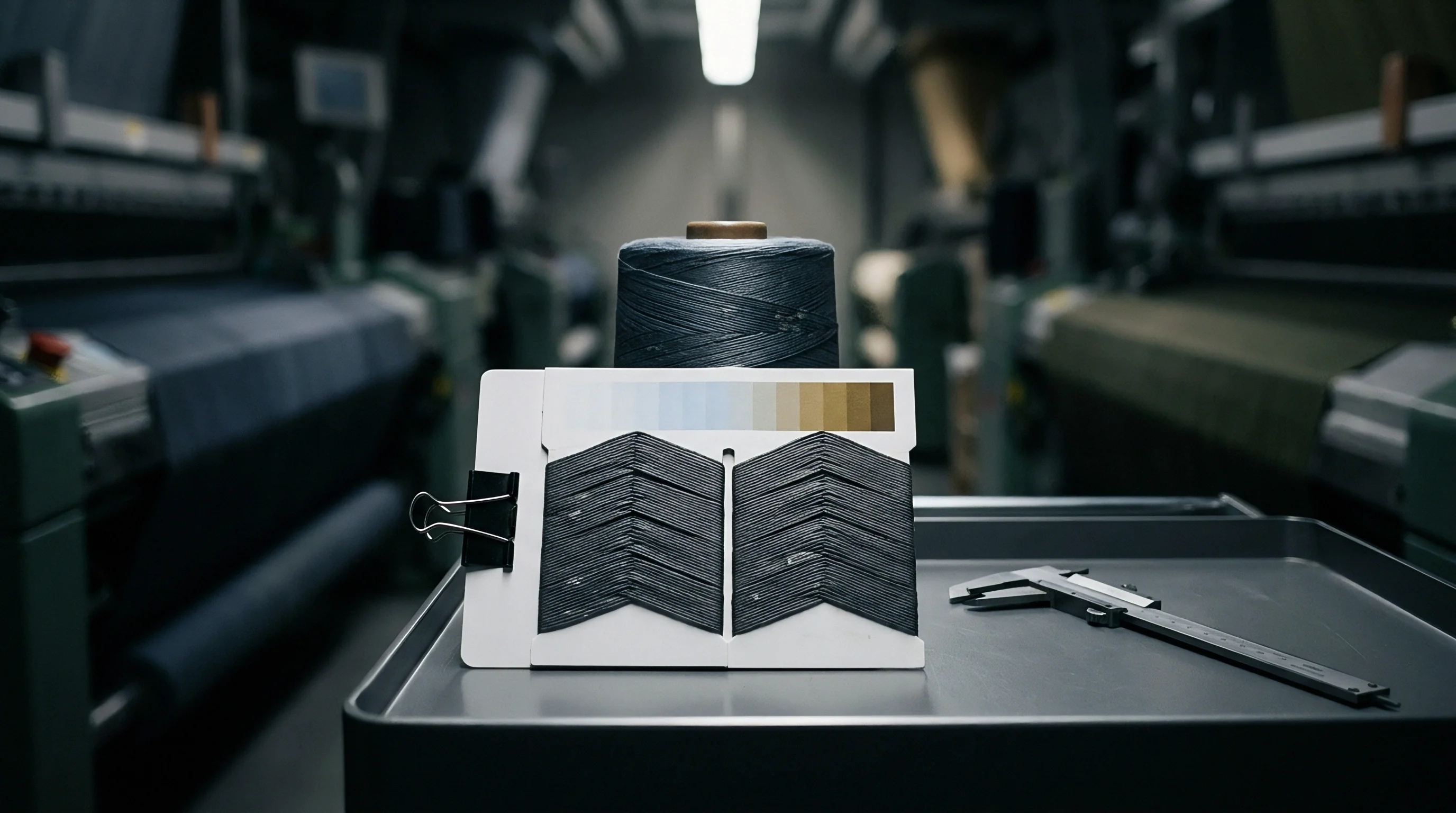
Running parallel controls on pure single-component yarns from the same production lot provides an empirical d-factor tailored to that specific batch.
Because acid treatment slightly degrades synthetic substrate, coarse filament residues yield more stable gravimetric baselines than fine microfibres.
Threshold
Tariff classification changes sharply at specific weight thresholds. Under the Harmonized Tariff Schedule of the United States, the EU Common Customs Tariff, and global customs systems, apparel is classified by chief weight. A garment at 50.1 percent cotton by weight enters under heading 6109.10 at a 16.5 percent MFN duty rate.
If testing puts cotton content at 49.9 percent, the garment falls under heading 6109.90 as man-made fibre, jumping to a 32.0 percent duty. A shift of just two-tenths of a percent can double duty liability on a million-dollar shipment.
Spinning mills aiming for a 50/50 blend usually combine equal weights of cotton sliver and polyester top at the draw frame. Raw cotton carries natural waxes, pectins, and variable moisture, whereas polyester staple has almost no extractable mass. Blending 50 kilograms of raw cotton at 8 percent moisture with 50 kilograms of dry polyester top actually creates a bone-dry ratio that favors polyester from the start.
If customs tests swatches using a default d-factor of 1.00 without accounting for synthetic polymer loss, the recorded polyester share can easily cross the 50 percent mark, especially since high-throughput government labs rarely build lot-specific control blanks.
Customs authorities operating under 19 CFR Section 174 routinely dismiss classification protests lacking third-party ISO 17025 test dossiers with empirical dissolution controls.
Understanding exposure to reclassification requires tracing how raw lab data feeds into final customs liquidation notices. Small changes in testing assumptions can shift identical goods into entirely different tariff categories:
| Analysis Scenario | Calibrated Factor d | Insoluble Polyester Share | Corrected Cotton Share | HTS Heading | MFN Duty Rate |
|---|---|---|---|---|---|
| Customs Standard Calculation | 1.000 | 49.40% | 50.60% | 6109.10 (Cotton Chief Weight) | 16.5% |
| Calibrated Empirical Factor | 1.018 | 50.29% | 49.71% | 6109.90 (Synthetic Chief Weight) | 32.0% |
| Under-Digested Cellulosic Residue | 0.985 | 48.66% | 51.34% | 6109.10 (Cotton Chief Weight) | 16.5% |
| Excessive Acid Temperature (60 °C) | 1.035 | 51.13% | 48.87% | 6109.90 (Synthetic Chief Weight) | 32.0% |
When disputing an adverse reclassification, importers typically take the following steps:
- Securing Split Sample Swatches from the customs testing vault preserves unwashed yardage for referee analysis before custody deadlines expire.
- Demanding Laboratory Bench Sheets uncovers actual reagent density logs, water bath temperature records, and crucible tares from the testing session.
- Commissioning Independent Referee Trials at an ISO 17025 accredited lab establishes empirical dissolution factors using pure control yarns from the original production lot.
- Filing Timely Administrative Protests within statutory limits halts automated liquidation and defers duty payments pending technical review.
An unexpected tariff shift at entry can turn profitable contract terms into duty surcharges or customs holds.

Recourse
Challenging a customs laboratory ruling hinges on showing measurement uncertainty. Obtaining raw bench sheets through administrative discovery often turns up operational flaws ~ omitted pre-extractions, overheating shaking baths, or applying a default d-factor of 1.00 without testing. A technical dossier showing actual degradation rates for modern microfibres can counter the presumption of correctness given to official testing.
Showing that uncorrected acid erosion reduced synthetic residue weight provides clear proof that calculated cotton content was artificially high.
Sourcing teams safeguard cross-border orders by setting technical buffers before fabric is cut. For instance, specifying a 53/47 cotton-polyester yarn blend rather than a nominal 50/50 mix builds in a cushion for cotton classifications. Keeping swatches of 100 percent pure component yarns from each lot in storage gives accredited labs the control material needed to run blank dissolution tests, determining an exact empirical d-factor if customs audits the shipment later.
Including ASTM D629 referee arbitration clauses in supply contracts ties both parties to empirical calibration values established on pure reference lots.