Determining Quantitative Fiber Ratios in Cotton Viscose Blends
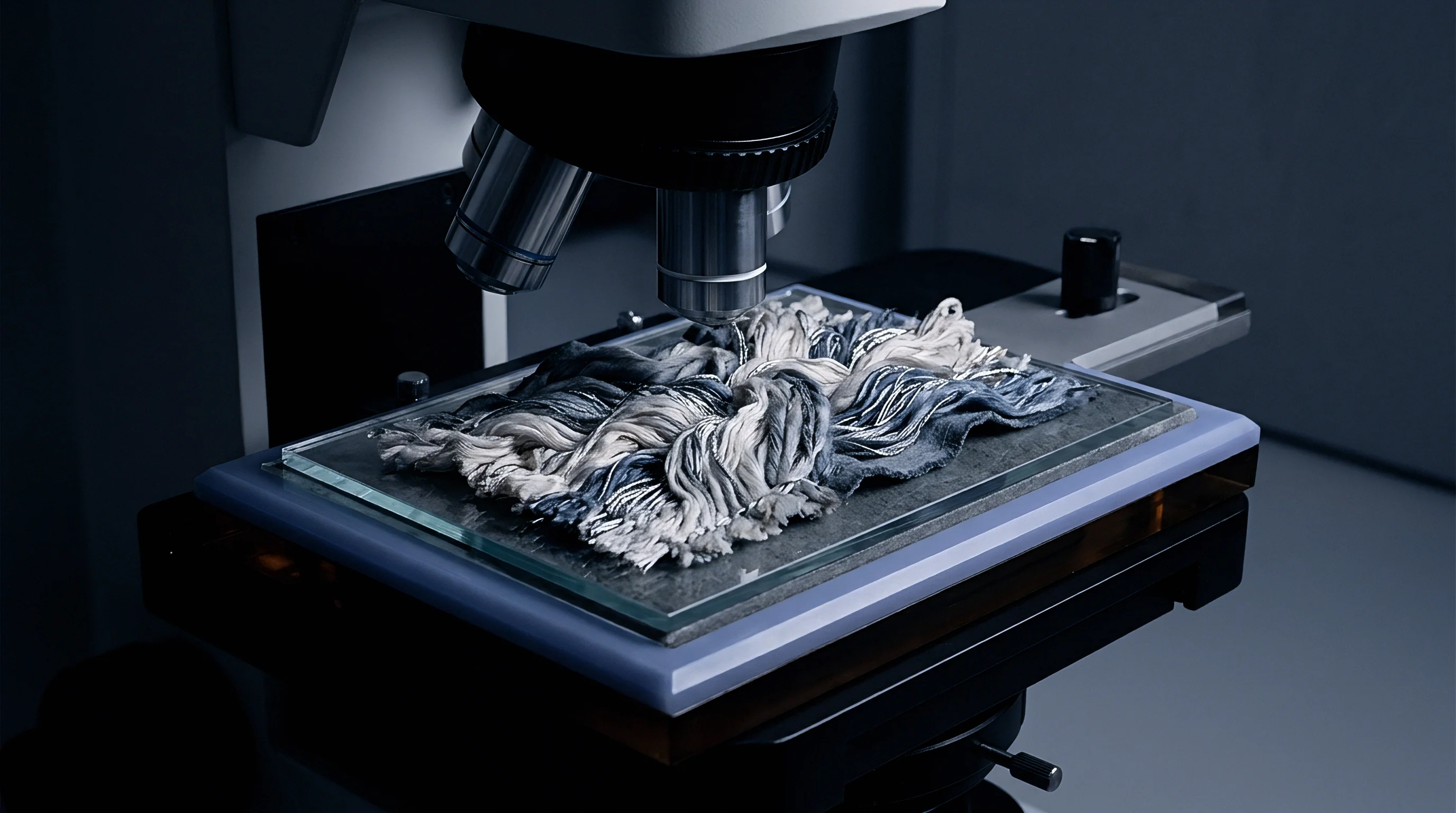
Selective dissolution via seventy-five percent sulfuric acid or formic acid zincate separates cotton from viscose after solvent scouring and mass correction.
Reagent
Analytical quantification of binary cellulosic materials begins with selective solvency. Cotton and viscose share an identical chemical formula, anhydroglucose units linked through beta-1,4-glycosidic bonds, yet their supramolecular morphology diverges completely. Native cotton exhibits cellulose I crystalline lattice geometry with crystallinity indices ranging between 65 percent and 70 percent, supported by a weight-average degree of polymerization between 2000 and 6000.
Viscose presents regenerated cellulose II morphology, where acid regeneration during the xanthate spinning sequence yields an open structure with crystallinity suppressed to 30 to 40 percent and a degree of polymerization collapsed to 250 to 400. This structural rift enables selective chemical destruction: solvent molecules penetrate the disordered amorphous zones of the regenerated filaments long before overcoming the tightly packed hydrogen bonding network within the native cotton secondary wall.
International standard ISO 1833-6 codifies the benchmark separation chemistry through a concentrated solution of zinc chloride and formic acid. The testing technician contacts the prepared textile with a reagent comprising 20 grams of anhydrous zinc chloride dissolved in 68 millilitres of 85 percent mass-fraction formic acid. Maintained at 40 degrees Celsius for 150 minutes under steady mechanical shaking, this ionic mixture complexly coordinates with hydroxyl groups, breaking the interchain bonds of regenerated cellulose and dissolving the viscose completely into a clear liquor.
Native cotton withstands this exposure with minimal attack, leaving an insoluble fibrous remnant for gravimetric isolation.
Formic acid with zinc chloride at forty degrees Celsius dissolves viscose while dissolving precisely 1.5 percent of combed cotton substrate.
Alternative standardized routes isolate components through varying chemical pathways, summarized in analytical standards such as ISO 1833-7 and AATCC 20A. Sulfuric acid at 75 percent concentration by mass hydrolyzes regenerated cellulosic chains rapidly at 50 degrees Celsius within 60 minutes. The sulfuric route demands strict thermal limits: a temperature elevation of merely three degrees accelerates native cellulose chain scission, causing catastrophic cotton mass destruction.
Conversely, the sodium zincate method dissolves the regenerated phase under intensely alkaline conditions using chilled solutions at zero to five degrees Celsius. Alkaline solvation prevents mineral acid degradation of native fibres, yet presents operational bottlenecks in industrial laboratories due to reagent crystallization and extended filtration cycles.
Formic acid leaves native cellulose untouched.

Chemical Dissolution Chemistry under Standard Methods
Laboratory execution demands verified solutions prepared from analytical grade precursors. Anhydrous zinc chloride absorbs atmospheric humidity rapidly, necessitating oven drying at 200 degrees Celsius prior to weighing. Deviations in reagent concentration distort the solvation kinetics.
A drop in formic acid strength below 84 percent mass fraction prevents complete dissolution of high-tenacity viscose types. An elevation of zinc chloride concentration above published targets initiates surface pitting on the cotton secondary cell wall.
Zinc chloride attacks both polymers identically.
Pre-treatment solvents strip non-cellulosic processing auxiliaries before the dissolution sequence begins. Natural cotton contains approximately four to eight percent non-cellulosic constituents, predominantly waxes, pectins, proteins, and inorganic ash located within the outer cuticle and primary wall. Industrial viscose carries spinning finishes, polyethylene glycol emulsions, and mineral oil lubrications deposited to facilitate yarn drafting.
When an analyst skips Soxhlet extraction with petroleum ether, these hydrophobic auxiliaries shield the fibres, generating incomplete dissolution and falsely elevating the calculated cotton fraction.
| Standard Designation | Reagent System | Bath Temperature | Duration | Target Phase | Nominal Cotton d-Factor |
|---|---|---|---|---|---|
| ISO 1833-6 | Formic acid (85%) / Zinc chloride | 40 °C ± 1 °C | 150 min | Viscose, modal, cupro | 1.015 |
| ISO 1833-7 | Sulfuric acid (75% m/m) | 50 °C ± 1 °C | 60 min | Viscose, cupro | 1.020 |
| ISO 1833-3 | Sodium zincate (aqueous) | 0 °C to 5 °C | 90 min | Viscose, modal | 1.005 |
| AATCC 20A-6 | Formic acid / Zinc chloride | 40 °C ± 1 °C | 120 min | Regenerated cellulose | 1.018 |
| Data gathered from ISO 1833 parts 3, 6, and 7, and AATCC 20A; nominal correction factor d compensates for native cellulose mass loss during dissolution. | |||||

Selectivity Limits in Concentrated Formic Acid Systems
Modern regenerated cellulosics challenge traditional gravimetric distinction. Modal fibres possess a modified crystalline structure achieved through altered zinc sulfate concentrations in the coagulating spin bath, yielding higher orientation and higher wet modulus. Lyocell, spun via direct dissolution in N-methylmorpholine N-oxide, exhibits extensive crystalline orientation that resists standard formic acid zinc chloride cleavage within specified timeframes.
Elevating the exposure duration to dissolve lyocell degrades the native cotton substrate, eroding analytical accuracy.
Correction factors, designated as d in standard calculation matrices, restore empirical integrity to the final mass values. The technician exposes an unmixed sample of pure cotton to identical chemical conditions, measuring the mass deficit caused by mild acid hydrolysis. The empirical d value for combed, bleached upland cotton in formic acid zinc chloride sits between 1.015 and 1.025.
Raw, unbleached cotton containing intact primary walls exhibits lower d values because the wax-rich outer cuticle slows acid penetration, whereas heavily bleached, mercerized yarns demonstrate d values reaching 1.035 due to increased accessible surface area.
Failure to calibrate bath temperatures during the dissolution phase causes aggressive acid hydrolysis of the native substrate, producing erroneous viscose readings that trigger customs misdeclaration penalties at importation.

Flask
Extraction glassware governs the physical phase of separation. Technicians weigh approximately one to two grams of the conditioned, desized yarn specimen into a ground-glass conical reaction container. Volumetric precision is non-negotiable: exactly 100 millilitres of the prepared solvent must cover the textile specimen, maintaining a liquor ratio of no less than 50 to 1.
An insufficient liquor volume permits local saturation of dissolved cellulosic chains, stalling the reaction kinetics and leaving partially solvated viscose gelatinous masses clinging to the cotton hairs.
Thermal stability inside the reaction vessel dictates the dissolution boundary. The reaction vessel sits submerged within a thermostatic water bath equipped with continuous mechanical circulation. Laboratory workers monitor internal flask temperatures using calibrated platinum resistance thermometers.
Ambient room drafts cooling the flask walls generate temperature gradients exceeding two degrees Celsius across the vessel radius. At 38 degrees Celsius, viscose dissolution stalls; at 42 degrees Celsius, cotton cellulose chain cleavage accelerates exponentially.
The analytical balance resolves five decimals.
Tenacious pectins resist boiling petroleum ether.

Extraction Hardware and Thermal Bath Regulation
Oscillating shakers provide uniform mechanical energy throughout the extraction period. Manual swirling introduces severe operator bias, generating inconsistent shear rates against the yarn strand bundles. Automated orbital shaking platforms operating at 120 cycles per minute displace the dissolved boundary layer away from the fibre surfaces, enabling fresh solvent to access the core of tightly twisted ring-spun yarns.
Without this mechanical energy, the exterior filaments dissolve while the inner yarn core remains shielded from the reagent.
Chemical safety requirements demand positive pressure ventilation during manipulation of concentrated formic acid systems. Operators handle the heated vessels inside dedicated fume extraction units to capture corrosive acid vapors. Acid vapors corrode copper wiring within standard laboratory ovens and analytical balances, shifting balance zeros and generating tare errors that cascade through subsequent mass calculations.
- Vessel sealing failures vent volatile acid vapors into the thermal bath, lowering the internal formic acid concentration and arresting the chemical solvation cycle.
- Shaking rate deceleration prevents adequate solvent penetration into dense yarn cores, leaving undissolved viscose residues trapped within the final cotton matrix.
- Temperature sensor drift permits bath heating elements to overshoot operational parameters, destroying up to five percent of the native cotton sample mass.
- Condenser coolant blockage causes rapid solvent evaporation during petroleum ether wax extraction, presenting flash-point flammability hazards inside the containment cabinet.
Can Formic Acid Dissolve Crosslinked Regenerated Cellulosics?
Resin-treated substrates resist typical solvation pathways. Functional textile finishes, specifically dimethyloldihydroxyethyleneurea applied for durable press performance or crease resistance, establish covalent ether linkages across adjacent cellulose polymer chains. These chemical crosslinks immobilize the macromolecular structure, blocking zinc chloride complexation.
When exposed to the formic acid bath, crosslinked viscose remains completely insoluble, registering gravimetrically as cotton.
Removing these chemical crosslinks requires a dedicated stripping sequence prior to gravimetric analysis. Technicians hydrolyze resin networks by refluxing the specimen in a 0.1 molar hydrochloric acid solution at 80 degrees Celsius for 30 minutes, followed by neutralization with dilute sodium carbonate. Omitting this resin stripping protocol inflates the calculated cotton content by whatever percentage of crosslinked viscose escaped dissolution.
Spinners frequently assert that unremoved spinning lubricants represent negligible mass that balances out across the final calculation.


Residue
Quantitative filtration captures the surviving native cotton fibres after the chemical bath completes its cycle. The mixture from the reaction vessel decants into a tared sintered glass crucible, typically of porosity grade 2 or 3 with pore diameters spanning 40 to 100 micrometers. A vacuum pump applies controlled suction, drawing the spent solvent containing dissolved viscose into an Erlenmeyer filtration flask while retaining the intact cotton hairs on the glass disc.
Suction pressures must stay below 0.3 bar to avoid pulling fine cotton fibril fragments through the sintered disc pores.
Washing the collected fibres eliminates every trace of acid and dissolved zinc compounds. The technician rinses the crucible contents sequentially: first with three separate 20-millilitre aliquots of 85 percent formic acid to wash out dissolved regenerated cellulosic remnants, followed by boiling distilled water until the effluent tests neutral on litmus paper. A single rinse with dilute ammonium hydroxide neutralizes any coordinated zinc ions trapped within the fibre bundle, concluding with room-temperature deionized water washes.
Viscose loses mass during neutralization.
Crucibles dry at precisely 105 degrees.
The tare weight drifts with humidity.
Cotton retains eight percent moisture regain.

Crucible Filtration and Quantitative Washing Cycles
Drying the washed crucible to constant mass establishes the dry residue value. Technicians place the loaded crucible into a ventilated drying oven controlled at 105 degrees Celsius plus or minus 3 degrees. Cellulosic materials exhibit significant hygroscopicity, absorbing ambient moisture within seconds of atmospheric exposure.
Upon removal from the oven, the crucible transfers directly into a sealed desiccator charged with freshly activated silica gel. The vessel cools for precisely 45 minutes before transfer to the balance pan.
Oven drying reaches true endpoint only when consecutive weighings across thirty minutes show complete gravimetric stability.
Consecutive weighings must agree within 0.001 grams to confirm moisture equilibrium. Standard gravimetric protocols mandate repeated drying cycles until this mass stability is documented. Glass crucibles possess substantial thermal mass; weighing a crucible that retains a temperature differential of merely two degrees Celsius above ambient air induces convection currents around the balance pan, yielding an apparent weight deficit of several milligrams.
- Dry the cleaned sintered glass crucible in the oven at 105 degrees Celsius for one hour and record the tare mass after desiccator cooling.
- Decant the chemical extraction liquor through the crucible under gentle vacuum aspiration to trap the native fibrous residue.
- Flush the residue bed with three successive rinses of fresh solvent, followed by deionized water until the wash liquid registers neutral pH.
- Saturate the fibrous mass with dilute ammonia solution to displace bound metallic ions, completing with a copious distilled water wash.
- Bake the loaded crucible at 105 degrees Celsius to constant mass, cooling within the desiccator prior to capturing the dry residue figure.

Gravimetric Determination and Correction Factor Equations
Converting dry residue values into commercially accurate yarn percentages requires multi-stage arithmetic. The laboratory balance produces the oven-dry mass of the clean, desized sample, denoted as m0, and the oven-dry mass of the collected cotton residue, denoted as m1. The raw uncorrected mass of cotton undergoes multiplication by the empirical factor d to offset native polymer losses during dissolution.
Commercial moisture regains fundamentally alter the declared yarn composition. International trade does not settle contracts or declare import customs codes on oven-dry mass. Commercial mass incorporates agreed legal moisture regain percentages, historically designated under ISO 6741 standards: 8.5 percent for cotton and 13.0 percent for viscose.
The application of these differing regain values shifts the calculated proportion, expanding the apparent viscose share due to its greater affinity for atmospheric moisture.
| Measurement Variable | Mathematical Notation | Observed Laboratory Value | Derived Calculation |
|---|---|---|---|
| Conditioned Sample Mass | m_initial | 2.0450 g | Direct balance reading |
| Oven-Dry Desized Mass | m0 | 1.8520 g | Solvent-extracted, dried at 105 °C |
| Tare Mass of Crucible | m_tare | 31.4210 g | Empty sintered crucible |
| Crucible plus Dry Residue | m_total | 32.5360 g | Dried to constant mass at 105 °C |
| Dry Cotton Residue Mass | m1 = m_total – m_tare | 1.1150 g | Uncorrected insoluble residue |
| Empirical Correction Factor | d | 1.018 | Cotton solubility compensation |
| Corrected Dry Cotton Mass | m_cotton_dry = m1 × d | 1.1351 g | 1.1150 × 1.018 |
| Dry Viscose Mass | m_viscose_dry = m0 – m_cotton_dry | 0.7169 g | 1.8520 – 1.1351 |
| Oven-Dry Cotton Content | P_cotton_dry | 61.29 % | (1.1351 / 1.8520) × 100 |
| Oven-Dry Viscose Content | P_viscose_dry | 38.71 % | (0.7169 / 1.8520) × 100 |
| Cotton Commercial Regain | a_cotton | 8.50 % | Standard commercial allowance |
| Viscose Commercial Regain | b_viscose | 13.00 % | Standard commercial allowance |
| Commercial Cotton Mass | M_cotton = m_cotton_dry × 1.085 | 1.2316 g | 1.1351 × 1.085 |
| Commercial Viscose Mass | M_viscose = m_viscose_dry × 1.130 | 0.8101 g | 0.7169 × 1.130 |
| Commercial Mass Total | M_total = M_cotton + M_viscose | 2.0417 g | 1.2316 + 0.8101 |
| Final Declared Cotton Ratio | Percent_Cotton_Commercial | 60.32 % | (1.2316 / 2.0417) × 100 |
| Final Declared Viscose Ratio | Percent_Viscose_Commercial | 39.68 % | (0.8101 / 2.0417) × 100 |
Whether high-temperature enzymatic scouring removes cotton cuticle waxes without shifting the baseline d factor remains disputed across international commercial testing houses.

Sliver
Spinning processes dictate the spatial distribution of fibres throughout the cross-section of a yarn strand. Two distinct processing methodologies dominate manufacturing facilities: blowroom mixing and drawframe mixing. Blowroom mixing opens and distributes raw baled cotton tufts alongside viscose tufts before carding, producing an intimate homogeneous dispersion throughout the subsequent sliver.
Drawframe mixing feeds independent slivers, four of cotton and four of viscose, into a common drafting zone, relying exclusively on drawing doublings to integrate the components.
Drawframe mixing frequently introduces longitudinal ratio periodicities. If drafting roll tensions fluctuate or roller aprons wear unevenly, slivers drafted at the drawframe develop channeling defects. Viscose fibres, possessing uniform staple lengths of 38 millimetres and smooth cylindrical cross-sections, draft with lower inter-fibre friction than natural cotton hairs that display irregular convolutions and variable staple lengths spanning 28 to 32 millimetres.
The smooth synthetic strands accelerate through the draft zone prematurely, creating localized segments where viscose proportions surge by up to six percent.
Blowroom blending introduces longitudinal weight bias.
Drafting rollers crush softer regenerated filaments.
Viscose regain reaches thirteen percent commercially.

Blowroom Mixing against Drawframe Doubling Variances
Testing laboratories encounter wide ratio distributions when evaluating single yarn bobbins produced from inadequate sliver doublings. A one-gram analytical specimen drawn from a single package represents less than twenty metres of yarn. In a poorly integrated drawframe mixture, twenty metres of yarn can reflect a localized drafting wave rather than the bulk average of the spinning lot.
Reliable verification demands compositing specimens drawn from at least ten individual bobbins across different ring spinning frames.
Cross-sectional migration phenomena further complicate chemical verification. During ring twisting, fibres with higher tensile modulus and irregular surfaces migrate toward the yarn axis, while smoother, more pliable filaments drift toward the exterior sheath. In a cotton-viscose structure, cotton hairs concentrate preferentially within the core, whereas viscose forms the outer protective sheath.
Surface abrasion during winding strips the exterior viscose hairs into spinning fly, incrementally shifting the residual yarn ratio toward cotton dominance between the spinning frame and the finished cone.
Purchase contracts stipulating commercial mass determination enforce payment exclusively on moisture regain adjusted clean fibre content.
- Package selection protocol demands drawing specimen skeins from distinct spatial quadrants of the pallet, excluding outer surface layers damaged by handling abrasion.
- Skein reeling calibration establishes uniform tension during length measurement, preventing differential stretching of moisture-sensitive regenerated cellulosics.
- Composite sample homogenization cuts extracted yarns into two-millimetre snippets, mixing them thoroughly in a beaker before withdrawing analytical test portions.
- Moisture stabilization conditioning balances the composite snippets in a standard atmosphere of 20 degrees Celsius and 65 percent relative humidity for 24 hours.

Does Drawframe Doubling Eliminate Ring Spinning Variation?
Doubling actions at the drawframe reduce random sliver weight variations, yet fail to erase fundamental inter-fibre friction differences. Regenerated cellulose filaments lack natural crimp, requiring synthetic mechanical crimping during cut staple manufacturing to mimic natural fiber coherence. Under high spinning speeds, synthetic crimp pulls out under draft tension, causing viscose slivers to draft faster than cotton slivers.
This differential drafting velocity creates cyclical composition variations corresponding precisely to the rotational circumference of the front drafting roller.
Card sliver sampled directly behind the cylinder teeth reflects the true mechanical mixture before drafting friction redistributes differing staple types.

Clearance
Customs authorities worldwide enforce tariff schedules based entirely on component dominance by weight. Under the international Harmonized Commodity Description and Coding System, yarns and woven goods fall into distinct tariff chapters depending on whether cotton or man-made fibres predominate. Chapter 52 governs cotton-predominant textiles, carrying unique duty schedules, quotas, and trade preference origins.
Chapter 55 governs artificial staple fibres, imposing separate customs duties and compliance restrictions. The division between these chapters sits exactly at 50.0 percent mass share.
A minor analytical shift across the 50 percent threshold transforms the legal classification of an entire shipment. A grey yarn lot containing 50.4 percent cotton on an oven-dry basis appears to fall comfortably under Chapter 52 heading 5205. However, calculating commercial mass under statutory guidelines applies an 8.5 percent moisture allowance to the cotton and a 13.0 percent allowance to the viscose.
This differential moisture allowance increases the legal mass of the viscose phase substantially, shifting the final commercial mass composition to 50.8 percent viscose and 49.2 percent cotton. The consignment shifts instantly into Chapter 55 heading 5510, altering duty liability.
Customs classifications follow predominant weight thresholds.
Tariff lines diverge at fifty percent.
Dry weights distort customs declarations.
Lab reports omit commercial moisture allowances.

Tariff Line Shifts at Binary Composition Boundaries
Importers face severe financial penalties when customs border laboratories retest landed containers using commercial mass formulas. Testing certificates issued by spinning mills often report raw oven-dry solvent extraction values without adjusting for official moisture regain allowances. When border authorities perform quantitative dissolution under ISO 1833-6 and calculate the commercial mass, the discovered reversal of chief weight exposes the importer to charges of false trade declaration, back taxes, and statutory fines.
Preferential trade agreements amplify the commercial stakes of blend verification. Rules of origin under bilateral trade agreements often demand yarn-forward compliance or strict domestic content percentages. If an imported woven fabric claims duty-free entry based on containing at least 50 percent regional cotton, a laboratory finding that places the commercial cotton weight at 49.5 percent eliminates preferential status.
The importer absorbs the full non-preferential tariff rate across the shipment valuation.
Customs authorities classify textiles by commercial mass percentage rather than unconditioned laboratory dry weight.
| Evaluation Condition | Cotton Mass Share | Viscose Mass Share | Harmonized System Code | Applicable Tariff Basis |
|---|---|---|---|---|
| Oven-Dry Laboratory Test | 50.40 % | 49.60 % | Heading 5205 (Cotton Yarn) | Chief weight cotton |
| Standard Commercial Mass (ISO 6741) | 49.32 % | 50.68 % | Heading 5510 (Artificial Yarn) | Chief weight artificial |
| High Humidity Ambient Delivery | 48.85 % | 51.15 % | Heading 5510 (Artificial Yarn) | Preferential tariff disqualified |
| Desized Raw Fiber Equivalent | 51.10 % | 48.90 % | Heading 5205 (Cotton Yarn) | Dry desized basis without regain |

Landed Cost Consequences of Regain Adjustments
Financial margins in cross-border textile sourcing hinge on fractions of a cent per running metre. Cotton traded at 2.20 dollars per kilogram blended with viscose at 1.80 dollars per kilogram yields distinct raw material valuations depending on the verification method. Beyond raw material costs, the tariff differential between Chapter 52 cotton woven fabrics and Chapter 55 artificial woven goods frequently spans four to eight percentage points of ad valorem duty.
On an ocean container carrying 20,000 kilograms of finished fabric valued at 160,000 dollars, an eight percent duty differential represents an unbudgeted tax liability of 12,800 dollars.
Contract drafting must explicitly define the analytical framework governing purchase specifications. Commercial disputes arise when contracts reference nominal blend percentages without specifying the test standard, the solvent system, the exact correction factor d, and the mandatory application of statutory moisture regains. Sourcing contracts that simply state sixty percent cotton and forty percent viscose leave buyers defenseless when laboratory variances trigger customs reclassifications.
Section 4 of the standard international yarn contract establishes that quantitative fiber composition disputes are governed by commercial mass percentages calculated under ISO 1833, nullifying claims grounded in dry solvent extraction data.