Micro Deposit Impact on Yarn Fasciated Structure and Hairiness Values
Micro deposits on vortex spinning collector tips increase fiber friction, disrupting wrapper formation and escalating Zweigle s3 hairiness and fabric pilling.

Architecture
Air-vortex yarn formation binds an untwisted central strand inside helical wrapper fibers through aerodynamic torque generated within a conical nozzle. When raw stock passes the front drafting rollers, high-pressure air injected tangentially at 0.50 to 0.60 MPa induces a swirling vortex that separates peripheral fiber tails from the main axial sliver. The axial fibers enter a hollow stationary collector while trailing ends flare outward across the entry plane.
Downward suction draws these flared extremities into the entrance zone, wrapping them continuously around the central consolidation point at angles between 30 and 45 degrees. The resulting fasciated geometry derives its tensile strength from the radial clamping pressure applied by these external wraps rather than continuous inter-fiber friction found in ring spinning.
Clean operational surfaces govern this consolidation sequence. Minute contamination rings of extracted waxes, polyester oligomers, and emulsified spinning lubricants alter the aerodynamic boundary layer adjacent to the entry orifice. Surface friction between the fiber and the stationary collector rises abruptly.
Trailing fiber tails slip or detach before establishing stable helical wraps. The axial bundle enters the withdrawal channel without adequate surface binding, instantly degrading structural integrity. Zweigle s3 hairiness values, which record protruding fiber ends exceeding three millimeters in length, jump fourfold within minutes of contaminant accumulation.
A thirty percent decrease in wrapper fiber count raises Zweigle s3 hairiness values past two hundred ends per one hundred meters on fifty-fifty cotton polyester yarns.
The internal arrangement of fasciated yarn splits into distinct mass fractions depending on delivery speed and nozzle geometry. Under nominal conditions at four hundred meters per minute, stable fasciated yarn maintains an axial bundle accounting for eighty-five to ninety percent of total yarn cross-sectional mass, wrapped by ten to fifteen percent true binding fibers. Contaminants on the internal metal faces shift this distribution toward defective geometries, generating wild fibers and unbound loops.
Axial fibers lose inward radial compressive force. Tensile elongation drops, yarn unevenness climbs, and the structural advantage of the vortex mechanism disappears.
Structural Distribution across Spinning Systems
Comparative structural analysis between spinning technologies highlights why fasciated arrangements respond acutely to friction changes. Ring-spun yarns exhibit continuous helical twist distribution from center to surface, whereas rotor yarns display an untwisted interior held by random external wrapper fibers. Fasciated vortex yarns exhibit a bipartite geometry: an untwisted center surrounded by regular, tight helical turns that suppress hairiness.
Contaminant buildup in the nozzle selectively destroys that external sheath.
| Spinning System | Central Orientation | Sheath Proportion | Uster H Value | Zweigle s3 Value |
|---|---|---|---|---|
| Air-Vortex Fasciated | Parallel Untwisted | 12 percent | 3.90 | 18 |
| Rotor Open-End | Disordered Twist | 8 percent | 5.20 | 95 |
| Compact Ring | Continuous Helix | 0 percent | 4.40 | 42 |
| Contaminated Fasciated | Discontinuous Core | 4 percent | 6.10 | 210 |
The data demonstrates that fasciated yarns produce the lowest baseline hairiness when operating surfaces remain clean. Surface hairiness in vortex spinning depends on wrapper coverage. Contaminants that interrupt wrapper generation destroy the yarn exterior while leaving the interior strand uncompacted.
Residue
Chemical accumulations inside the swirling nozzle chamber originate from fiber finishes, natural plant components, and low-molecular-weight synthetic fractions. Polyester staple fibers carry spin finish formulations composed of polyoxyethylene esters, mineral lubricants, and antistatic phosphate salts applied at levels between 0.10 and 0.18 percent on weight of fiber. High rotational speeds and friction generate localized heat exceeding eighty degrees Celsius at the collector orifice.
This thermal input strips volatile finish fractions, leaving behind tacky organosilicon and phosphate deposits that capture broken fiber fragments and atmospheric dust.
Synthetic staple processing introduces cyclic polyester oligomers, predominantly cyclic ethylene terephthalate trimers. These low-molecular-weight compounds migrate to the fiber surface during upstream drawing, drying, and heat-setting operations. Cyclic trimers exhibit a melting point between three hundred fifteen and three hundred twenty-five degrees Celsius and exist as crystalline powder.
Under mechanical abrasion against guide pins and nozzle walls, these micro-crystals flake away and compact into rock-hard scales within the air swirl tracks. The abrasive scales alter aerodynamic shear profiles, destabilizing the vortex current.
Cyclic oligomer contamination exceeding 0.08 percent by weight causes collector drag that doubles yarn hairiness within twelve hours.
Cotton lots carry natural and entomological contaminants into the drafting zone. Pectin, fatty acids, and cotton wax (principally gossypyl alcohol and montanyl alcohol) melt under the high friction of high-speed spinning. Entomological honeydew containing trehalulose and melezitose sugars exacerbates deposition.
These non-reducing oligosaccharides are sticky at relative humidities above fifty-five percent. They collect at the collector entry, forming a brown glaze that captures fine trash and dead fibers. The resulting surface roughness degrades the aerodynamic vortex.

Principal Categories of Nozzle Accumulations
Analyzing contaminant types reveals diverse thermal and mechanical impacts inside the twisting chamber.
- Extracted Cotton Wax softens at sixty-eight degrees Celsius and forms a smooth, tacky film across stationary collector surfaces that retards rotational acceleration of trailing fiber tails.
- Entomological Honeydew Sugars create hygroscopic deposits that seize short lint particles, choking injector air holes and creating asymmetric velocity fields across the nozzle.
- Polyester Cyclic Trimers abrade metal surfaces with hard micro-particulates that generate microscopic grooves along the stationary collector tip.
- Spin Finish Lubricant Gels oxidize under compressed air delivery, transforming into viscous varnishes that increase fiber-to-metal boundary friction by fifty percent.
Synthetic fiber spinners often state that incoming polyester lots match chemical specifications because total oil pickup remains below 0.15 percent. Total oil pickup measurements conceal the ratio of cyclic trimers to active lubricants, hiding the exact chemical mechanism driving nozzle contamination.

Spindle
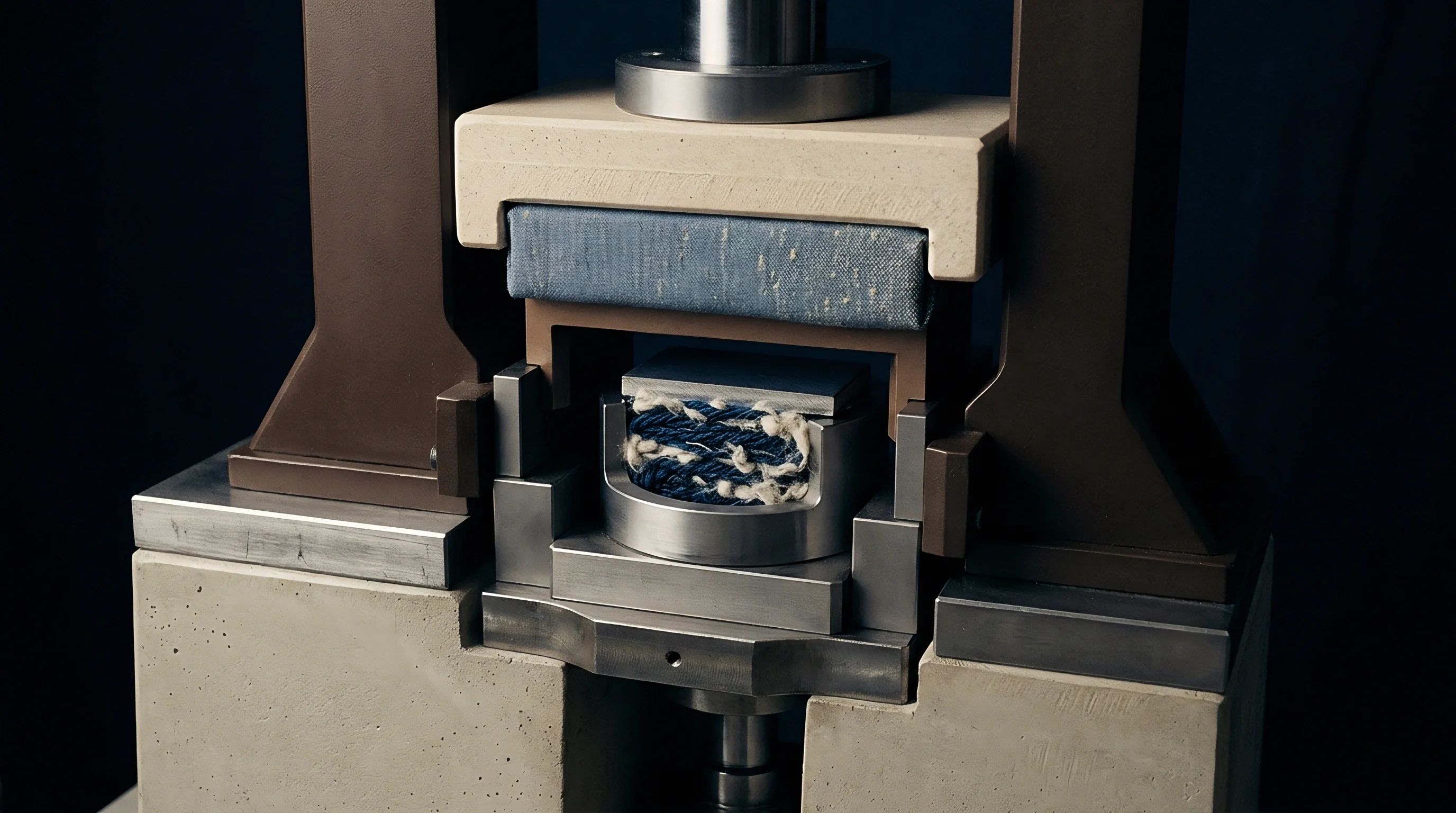
The stationary collection element acts as the mechanical foundation for vortex fasciated yarn formation. Positioned axially opposite the drafting delivery rolls, its tapered conical tip sits directly inside the swirling air chamber. The interior bore of this component provides the passage through which the consolidated strand exits the twisting zone.
Trailing fiber tails must rotate cleanly around the perimeter of the tip before wrapping the interior strand. When contaminants adhere to this conical surface, fiber dynamics fail.
Local friction governs wrapper formation. Clean, polished ceramic or coated steel tips maintain a fiber-to-metal friction coefficient between 0.12 and 0.15 under ambient test conditions. Deposition of sticky waxes or oxidized spin finish raises this coefficient past 0.35.
Trailing fiber ends encounter excessive drag along the collector periphery. The swirling airflow lacks the force needed to overcome this surface drag. Wrapper fibers fail to rotate freely.
Fibers stall on the collector shoulder, bunching into irregular slubs or snapping off entirely. The interior axial strand passes through unwrapped.
What Disturbs Helical Wrapper Distribution?
Nozzle aerodynamics interact directly with surface deposits. Four or six injector orifices direct compressed air tangentially into the swirl chamber at speeds exceeding three hundred meters per second. Micro-deposits forming around the perimeter of these air inlets cause localized air stagnation and turbulence.
Velocity vector angles drift away from target parameters. Instead of a uniform helical airflow pattern, the vortex develops asymmetric pressure waves.
| Deposit Thickness | Friction Coefficient | Wrappers Per Centimeter | Uster H Value | Zweigle s3 Count |
|---|---|---|---|---|
| 0.00 Millimeters | 0.14 | 42 | 3.85 | 14 |
| 0.02 Millimeters | 0.21 | 34 | 4.40 | 38 |
| 0.05 Millimeters | 0.32 | 22 | 5.30 | 115 |
| 0.10 Millimeters | 0.48 | 9 | 6.80 | 340 |
Air consumption increases. Drafting breaks down. The core loses cohesion.
The experimental data confirms that deposit thickness on the collector tip directly governs yarn hairiness. As deposit layer thickness approaches one-tenth of a millimeter, wrapper frequency drops by more than seventy-five percent. Trailing fiber ends, unable to complete a full rotation around the axial strand, project outward perpendicularly from the yarn axis.
Zweigle s3 values escalate from fourteen to three hundred forty protruding hairs per hundred meters.
Twist insertion stops. Wrapper counts decrease. When the stationary collector tip fouls, hairiness escalates immediately.
Clean spinning machinery produces tight, smooth yarn profiles with minimal wild fibers. Contaminated machinery produces weak yarns dominated by uncontrolled surface hairs that fail subsequent fabric knitting operations.
Viscous surface drag on collector tips prevents clean wrapping regardless of nozzle air pressure.
Inspection
Quantitative verification of yarn hairiness and structural degradation relies on optical and physical testing instruments. Testing laboratories utilize the Uster Tester 6 hairiness channel alongside the Zweigle G566 optical hairiness tester. The Uster H value measures the total length of protruding fibers within a one-centimeter yarn length, expressing the result as an integrated ratio.
The Zweigle system counts the absolute quantity of protruding fiber ends at discrete distances from the yarn body, focusing on the s3 category, which aggregates all hairs three millimeters and longer.
Surface contamination inside spinning chambers manifests differently across these two metrics. The Uster H value reflects short-fiber fuzz, which rises moderately when micro-deposits develop. The Zweigle s3 value detects true structural breakdown, reacting with exponential increases as wrapper fibers fail to enclose the axial strand.
A yarn showing an acceptable Uster H value of 4.20 can simultaneously yield a catastrophic Zweigle s3 count of two hundred fifty. Relying on integrated hairiness ratios alone allows severely defective fasciated yarn to pass inspection.
Contracts specifying only Uster H values fail to protect purchasers from delivery lots with severe wrapper detachment and elevated Zweigle s3 hairiness.
Can Optical Scanners Isolate Surface Debris?
High-resolution optical scanners mounted on winding units detect local structural defects in real time. Modern optical sensors identify yarn hairiness fluctuations along twenty-millimeter testing lengths. When nozzle deposits cause cyclical wrapper shedding, optical profiles reveal rhythmic hairiness surges.
These periodic surges distinguish machine contamination defects from random fiber nep contamination.
- Specimen Extraction requires conditioning yarn packages under ISO 139 standard atmosphere at twenty degrees Celsius and sixty-five percent relative humidity for twenty-four hours before testing.
- Solvent Extraction Testing according to ISO 307 isolates oligomer levels on polyester yarns using boiling methanol or dichloromethane over six hours in a Soxhlet apparatus.
- High Speed Optical Hairiness Evaluation across ten thousand meters per package establishes baseline Uster H, hairiness standard deviation sh, and Zweigle s3 metrics.
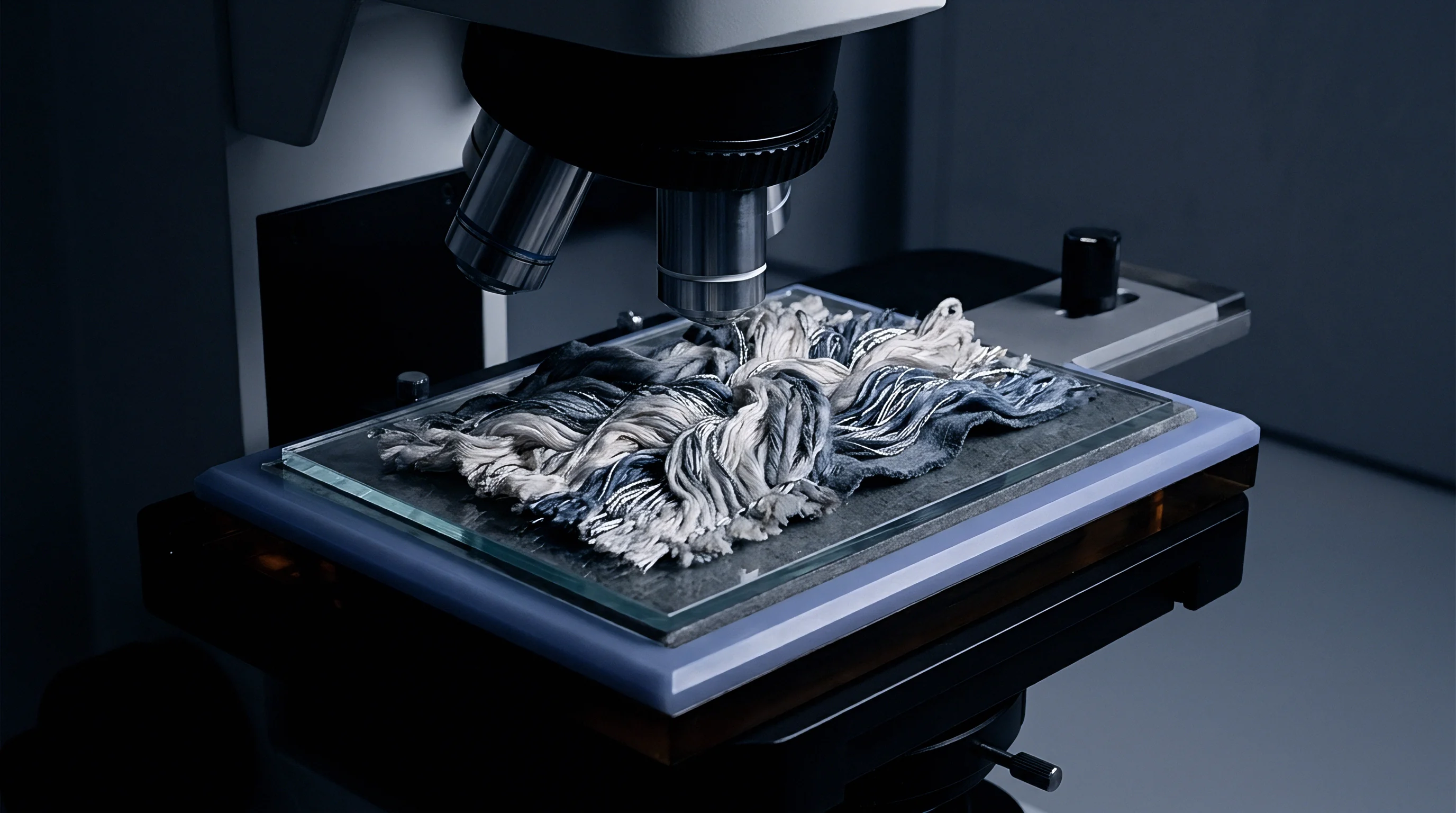
- Scanning Electron Microscopy confirms wrapper angle distribution and quantifies the frequency of wild fibers per unit length.
- Spin Finish Determination via nuclear magnetic resonance spectroscopy measures finish on yarn within a tolerance of plus or minus 0.02 percent.
Disputes frequently center on moisture regain and laboratory conditioning. Natural cotton fibers regain up to 8.5 percent moisture under standard conditions, while polyester absorbs less than 0.4 percent. Hairiness testing conducted without moisture equilibrium produces erratic Zweigle counts because dry cotton fibers develop electrostatic charges that flare outwards from the yarn spine.
Spin finish oil levels must be verified alongside physical hairiness to determine whether defect causes originate in fiber preparation chemistry or spinning machine maintenance.
Laboratory trials demonstrate that a cotton polyester yarn exhibiting a nominal finish level of 0.12 percent can generate divergent hairiness profiles across testing benches if nozzle cleaning intervals vary by more than eight operating hours. Whether current optical sensor hardware can definitively distinguish between thermal spin-finish residue and entomological sugar deposits during continuous high-speed spinning remains an open engineering question.
Penalty
Yarn defects originating from micro-deposits generate downstream costs in textile conversion. In single knit jersey production, yarn with elevated Zweigle s3 counts sheds loose surface fibers at yarn guides, stop motions, and knitting needles. Fiber fly packs into needle tricks, causing latch failure, needle breakage, and dropped stitches.
Knitting machines processing contaminated vortex yarns experience unprogrammed downtime every three hours compared to thirty-hour clean run cycles. The resulting labor and downtime expenses degrade manufacturing margins.
Abrasion resistance collapses. Knitters reject hairy yarn. Pilling ratings decline.
Finished fabrics knitted from yarns with defective wrapper architecture fail standardized testing. Under ISO 12945-2 Martindale pilling tests at two thousand cycles, normal fasciated yarn fabrics achieve grade 4 to 5 due to their tight outer wrapper structure. When micro-deposits reduce wrapper density, loose fiber tails migrate to the fabric surface, forming dense pill clusters that downgrade the fabric to grade 2.
Chemical depilling through enzymatic bio-polishing becomes mandatory for cotton goods, adding eight to twelve cents per kilogram to processing costs.
Commercial Consequences in Downstream Processing
Financial impacts propagate across the supply chain when hairiness specifications are breached.
- Knitting Machine Fly Waste increases from 0.4 percent of yarn mass to 2.1 percent, filling factory environments with airborne respirable dust.
- Dye Pick Up Nonuniformity creates visual barre streaks across dyed knit fabrics because variations in wrapper distribution scatter light unevenly.
- Weaving Shed Air Jet Stoppages multiply fivefold due to warp cling in the weaving shed when protruding hairs entangle adjacent warp yarns.
- Customs Classification Rejection risks arise when severe fiber loss alters blend percentages past declared tariff tolerances under Harmonized System headings.
Procurement contracts for vortex spun yarns must incorporate clear hairiness limits to prevent commercial exposure. Yarn purchase specifications should read: The delivery lot must maintain a Zweigle s3 value below thirty hairs per one hundred meters tested under ISO 26463, with an upper tolerance limit of forty hairs per one hundred meters; exceeding this threshold transfers all downstream knitting downtime costs, needle breakage expenses, and fabric re-dyeing charges directly to the yarn manufacturer.