Nonlinear Oligomer Extraction Dynamics in Capillary Viscometry and Quantitative Mass Dissolution Testing
Oligomer extraction during viscometry distorts baseline solvent viscosity, skewing intrinsic viscosity values and causing blend composition misclassification.

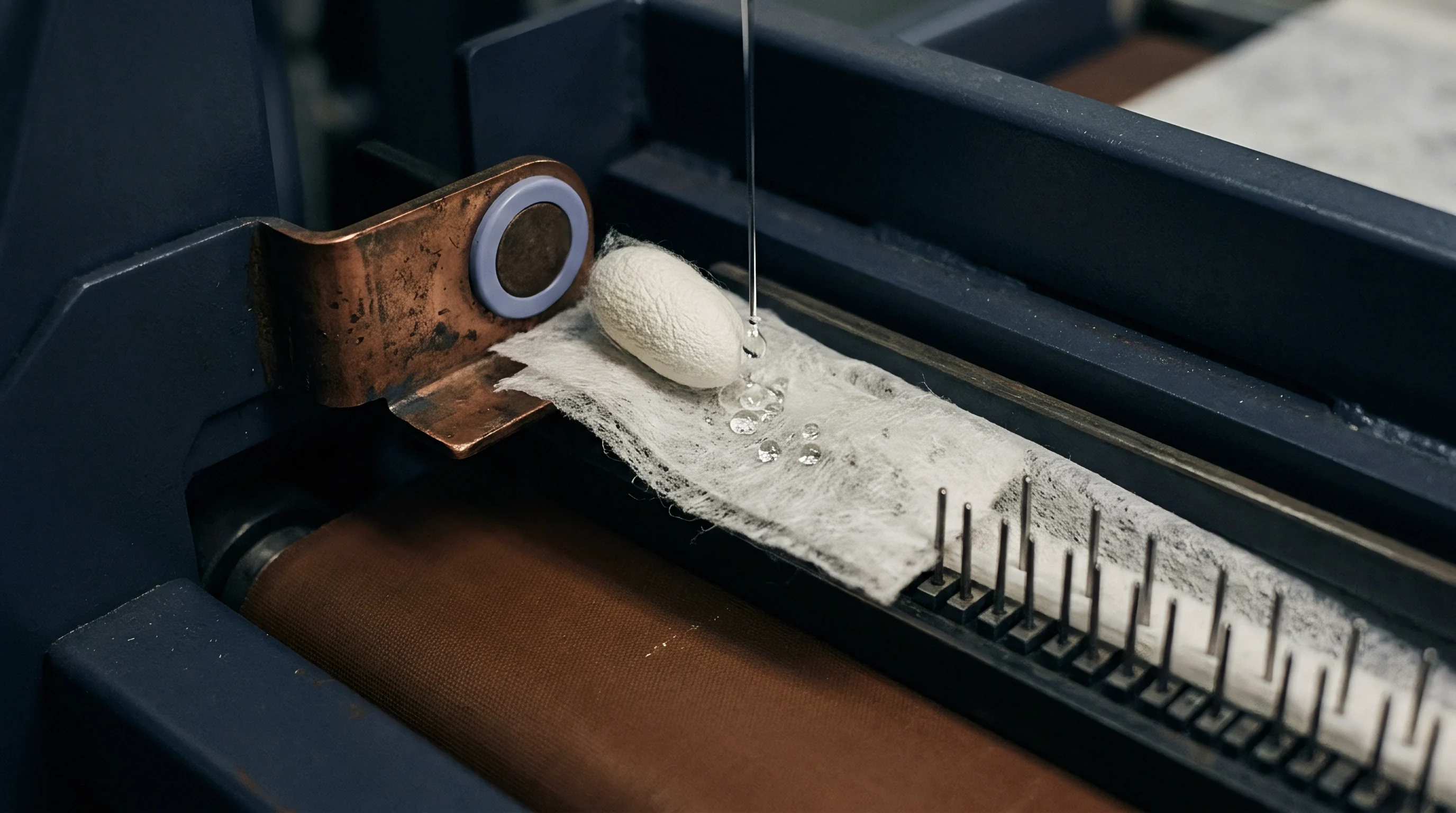
Efflux
Capillary viscometry reports the efflux time of a dissolved polymer volume passing between two etched timing marks in a glass capillary tube. In polyalkylene terephthalates and polyamides, the dissolution stage prior to measurement does not yield a static, homogeneous macromolecular solution. Low molecular weight species, primarily cyclic trimers in polyethylene terephthalate and caprolactam monomer and cyclic oligomers in polyamide 6, leach continuously from the solid polymer matrix into the solvent phase.
This extraction proceeds across both the sample preparation thermal cycle and the subsequent flow timing runs inside the capillary. When solvent choices like dichloroacetic acid, phenol with 1,1,2,2-tetrachloroethane, or 90 percent formic acid interact with raw filament or ground chip samples, these oligomeric species enter the liquid phase at rates governed by local swelling kinetics and crystalline morphology. The resulting increase in solute particle count alters both liquid density and absolute viscosity prior to the first efflux timing run.
Standard testing protocols assume that solvent properties remain fixed and that solute species remain stable throughout viscometric efflux. Oligomer leaching breaks this baseline assumptions. As cyclic species dissolve into the capillary volume, they alter the solvent reference viscosity.
Efflux time shifts recorded across successive measurements reflect dynamic dissolution rather than true macromolecular flow resistance. A sample held at 25 degrees Celsius for 120 minutes during dissolution displays a different efflux profile than one measured immediately after liquid clarity occurs. Capillary flow behavior changes continuously during measurement.
The rate of oligomer migration into the viscometric solvent depends directly on particle surface area and orientation. Drawn industrial filaments exhibit suppressed diffusion rates compared to amorphous polymer flakes due to high chain orientation and crystalline packing density. Unextracted chip samples release up to 1.8 percent of their total mass as cyclic oligomers within the first thirty minutes of solvent exposure at elevated temperatures.
Fully drawn yarns release less than 0.4 percent mass over the same interval. This discrepancy introduces systematic measurement divergence when comparing raw polymer feedstock against finished yarn lots.
| Polymer Matrix | Solvent Medium | Dominant Extractable Species | Dissolution Temp (°C) | Mass Fraction Solubilized (%) | Baseline Viscosity Shift (%) |
|---|---|---|---|---|---|
| PET Industrial Chip | Phenol / 1,1,2,2-Tetrachloroethane (60:40) | Cyclic Trimer (c-PET3) | 135 | 1.45 | +2.8 |
| PET Fully Drawn Yarn | Phenol / 1,1,2,2-Tetrachloroethane (60:40) | Cyclic Trimer (c-PET3) | 135 | 0.38 | +0.7 |
| Polyamide 6 Virgin Chip | Formic Acid (90% w/w) | Caprolactam & Cyclic Dimer | 25 | 2.10 | +4.1 |
| Polyamide 6 Staple Fiber | Formic Acid (90% w/w) | Caprolactam & Cyclic Dimer | 25 | 0.62 | +1.2 |
| Polyamide 66 Filament | Dichloroacetic Acid | Cyclic Dimer & Linear Monomer | 25 | 0.45 | +0.9 |
Solvent power governs the extraction boundary rate during sample preparation. Strong organic acids penetrate amorphous polymer domains rapidly, accelerating the release of low molecular weight fractions before complete chain disentanglement occurs. Non-polar or chlorinated solvent mixtures swell the polymer matrix at a slower pace, establishing a prolonged extraction phase that persists throughout the capillary timing sequence.
Viscometer capillary diameters ranging from 0.58 millimeters to 1.03 millimeters amplify these timing variations when dissolved oligomers concentrate near the capillary glass wall.
Capillary flow timing records dynamic solute release alongside macromolecular extension.
Laboratories that skip preliminary extraction cycles observe artificial drift in measured relative viscosity values across duplicate flow runs. The primary cause rests in the transient concentration of solubilized trimers that contribute to osmotic pressure without adding to hydrodynamic volume in the same proportions as long-chain polymer molecules. The calculated specific viscosity shifts upward as a result.
Higher recorded specific viscosity generates an artificially elevated intrinsic viscosity value on the final lab certificate.
Spinning mills frequently attribute these viscosity shifts to calibration drift in automated glass viscometers or temperature control fluctuation within the fluid bath.


Plug
Dissolution proceeds inward from the outer fiber boundary toward the core plug of the solid polymer structure. When solvent contacts a synthetic fiber bundle, it establishes a sharp diffusion front separating the liquid phase from the unpenetrated solid core. Polymer chains of high molecular weight remain constrained within the swollen gel layer while low molecular weight cyclic species partition rapidly into the advancing solvent phase.
This differential extraction mechanism changes the chemical composition of the liquid volume prior to total core disintegration.

Microstructural Diffusion Pathways
Fiber geometry establishes the physical surface area available for solvent contact and immediate extraction. Microfiber structures present large surface-to-volume ratios that release cyclic trimers into solution almost instantly upon immersion. Heavy decitex monofilaments retain their core plug structure for extended periods, releasing extractable species over tens of minutes.
Amorphous regions dissolve first, leaving crystalline lamellae exposed to solvent shear. Extractable content trapped within inter-crystalline domains dissolves only as the surrounding crystalline lattice relaxes under solvent penetration.
Capillary shear stresses during efflux induce wall depletion effects within the viscometer tube. Low molecular weight oligomers migrate toward the capillary wall under high shear gradients, forming a thin, low-viscosity lubrication layer adjacent to the glass boundary. This wall layer accelerates the core flow of the main polymer solution, reducing measured efflux time below the true hydrodynamic value.
The magnitude of this wall depletion effect scales inversely with capillary bore diameter.
- Dry the yarn swatch or polymer chip in a vacuum oven at 105 degrees Celsius for four hours to strip absorbed moisture before weighing.
- Perform a preliminary Soxhlet extraction using reagent-grade dichloromethane for six hours to remove surface spin finishes and free cyclic trimers.
- Desiccate the extracted sample under nitrogen purge until mass equilibrium reaches a tolerance of 0.0002 grams.
- Dissolve the pre-extracted polymer substrate in the chosen viscometric solvent under controlled mechanical agitation at specified temperature limits.

Anomalous Transport Dynamics
Solvent transport within semi-crystalline polymers deviates from classical Fickian diffusion behavior. Case II transport mechanisms dominate when the solvent glass transition temperature of the polymer system drops below the ambient bath temperature. Swelling stresses generate micro-fissures along the fiber axis, opening bulk fluid channels that bypass the protective amorphous matrix.
These micro-fissures release concentrated pockets of cyclic oligomers directly into the viscometry cell, producing stepped increases in solution concentration during flow measurement.
A two percent mass loss during preliminary Soxhlet extraction prevents a six percent error in calculated intrinsic viscosity.
Viscometric measurements taken during active Case II transport contain unpredictable background noise. The presence of undissolved sub-micron crystalline fragments alongside solubilized oligomers scatters light and alters shear dissipation profiles within narrow Ubbelohde capillaries. The measured efflux time ceases to reflect molecular weight distribution and instead measures the progress of structural disintegration within the core plug.
Shorter dissolution heating cycles preserve the unpenetrated center of large polymer chips, leaving cyclic oligomers trapped within the unswollen core while long chains at the surface dissolve into the measurement cell.
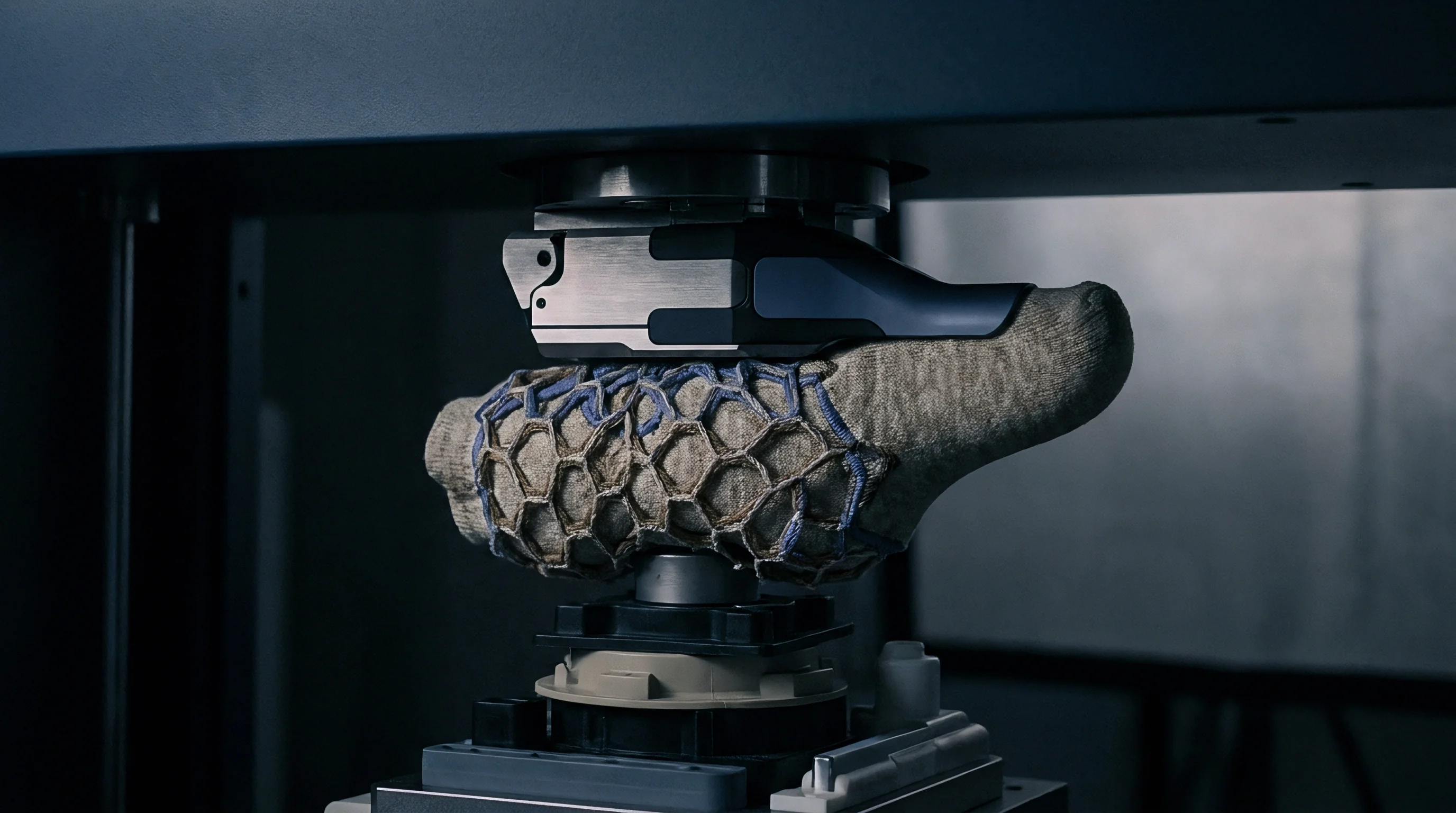

Separation
Quantitative mass dissolution testing determines fiber blend ratios by selectively dissolving one component while leaving the remaining fibers intact. Standard methods such as ISO 1833 depend on complete gravimetric isolation of the insoluble residue. When the dissolving solvent extracts oligomeric fractions from the designated insoluble fiber, the remaining dry mass drops below its true mass fraction.
This selective leaching generates systematic errors in declared commercial composition ratios.

Interference in Binary Blend Analysis
In polyester and cotton blends, concentrated sulfuric acid or hot phenol derivatives dissolve the polyester component. If the cotton residue absorbs solubilized oligomeric degradation products, its dry weight increases artificially. Conversely, in polyamide and wool blends, formic acid dissolves the polyamide component while partially leaching low molecular weight proteins and lipid components from the wool matrix.
The insoluble wool fraction loses mass beyond the target polymer removal, distorting the calculated percentage composition.
Recycled fibers compound these analytical discrepancies. Post-consumer mechanical recycling introduces degraded polymer fractions with broad molecular weight distributions and high initial oligomer concentrations. Exposure to selective solvents extracts these short chains from the supposedly insoluble fiber component during test procedures.
The analytical balance registers this mass loss as part of the dissolved fraction, misattributing matrix material to the secondary blend component.
| Declared Blend Composition | Test Method Standard | Dissolving Agent | Target Insoluble Component | Uncorrected Residue Mass (%) | Corrected Residue Mass (%) | Composition Error (% absolute) |
|---|---|---|---|---|---|---|
| 65% PET / 35% Cotton | ISO 1833-11 | 75% Sulfuric Acid | Cotton | 34.12 | 35.04 | -0.92 |
| 50% PA 6 / 50% Wool | ISO 1833-7 | 80% Formic Acid | Wool | 48.35 | 50.11 | -1.76 |
| 80% Recycled PET / 20% Viscose | ISO 1833-11 | 75% Sulfuric Acid | Viscose | 18.84 | 20.08 | -1.24 |
| 55% PA 66 / 45% Elastane | ISO 1833-20 | Dimethylformamide | Polyamide 66 | 56.22 | 54.88 | +1.34 |
Bale-room sampling procedures fail to capture lot-wide oligomer variance when samples are drawn exclusively from outer bale wraps. Core samples taken from dense bale centers display higher residual moisture and altered oligomer mobility compared to surface fibers. Processing heat during yarn formation drives cyclic trimers toward the fiber surface, establishing a radial concentration gradient that makes yarn swatches more susceptible to solvent extraction than raw staple stock from the same production lot.

Mechanisms of Analytical Distortion
Mass dissolution testing relies on clear boundaries between component solubility profiles. Oligomer extraction blurs these boundaries through several distinct dynamic phenomena.
- Differential Solubilization Rates alter the mass ratio of the residue before target polymer dissolution reaches thermodynamic completion.
- Solvent Swelling Entrapment traps extractable cyclic species inside the matrix of the insoluble component, preventing their removal during rinsing steps.
- Thermal Degradation of Extractables creates secondary insoluble precipitates during high-temperature solvent filtration phases.
- Redeposition of Dissolved Oligomers onto filter crucibles increases measured residue dry weights during vacuum aspiration.
A blend report issued without preliminary Soxhlet extraction risks misclassifying chief weight customs declarations.
Standard purchase contracts for synthetic yarns include specific laboratory test method designations that bind both buyer and seller to agreed composition tolerances. When specifications fail to mandate pre-extraction of low molecular weight fractions prior to quantitative dissolution, the testing laboratory must apply standard correction factors derived from virgin polymer baselines. These default correction factors understate oligomer loss in recycled fibers, shifting the legal burden of composition non-compliance onto the fabric importer.
All quantitative mass dissolution reports for recycled fiber blends shall state whether preliminary Soxhlet extraction was performed, and unextracted test results exceeding a two percent compositional tolerance shall revert to pre-extracted re-testing at the supplier’s expense.


Computation
Hydrodynamic calculations transform raw efflux times into intrinsic viscosity values. Intrinsic viscosity represents the specific viscosity contribution of a polymer at infinite dilution, reflecting the isolated macromolecular chain volume without inter-chain crowding effects. The presence of solubilized oligomers invalidates standard linear extrapolation routines by altering solute mass concentration values and introducing non-linear concentration dependencies into the Huggins and Kraemer equations.

Mathematical Formulation of Oligomer Interference
The standard Huggins equation models relative viscosity as a function of polymer concentration and intrinsic viscosity.
ηsp = c + kH 2 c2
Here, ηsp is specific viscosity, is intrinsic viscosity, c is mass concentration in grams per deciliter, and kH is the dimensionless Huggins constant. When a mass fraction wo of cyclic oligomers dissolves from the polymer matrix into the solvent phase, the active polymer concentration contributing to high molecular weight viscosity drops from nominal concentration c0 to effective concentration ce = c0(1 – wo). Simultaneously, the extracted oligomers alter the baseline solvent viscosity from η0 to ηs = η0(1 + α wo c0), where α is the intrinsic viscosity contribution coefficient of the low molecular weight species.
Substituting these altered terms into the specific viscosity relationship demonstrates that the observed specific viscosity deviates non-linearly from true macromolecular behavior. The uncorrected calculation uses nominal concentration c0 against the altered efflux time, generating a distorted intrinsic viscosity estimate.
measured = true(1 – wo) + α wo – kH true2 c0 wo
For a typical recycled polyester chip sample containing 1.5 percent cyclic trimer mass fraction dissolved in dichloroacetic acid, nominal concentration c0 = 0.50 grams per deciliter, Huggins constant kH = 0.35, and measured relative viscosity ηr = 1.420. The uncorrected Huggins calculation yields an apparent intrinsic viscosity of 0.742 deciliters per gram. Correcting for the reduced effective concentration of high molecular weight chains and the baseline solvent viscosity shift reveals a true matrix intrinsic viscosity of 0.685 deciliters per gram.
The uncorrected calculation overstates matrix molecular weight by 8.3 percent.
| Nominal IV (dL/g) | Oligomer Mass Fraction (%) | Apparent Efflux Time (s) | Calculated Apparent IV (dL/g) | True Matrix IV (dL/g) | Molecular Weight Skew (%) |
|---|---|---|---|---|---|
| 0.640 | 0.50 | 128.4 | 0.648 | 0.638 | +1.56 |
| 0.640 | 1.50 | 131.2 | 0.669 | 0.632 | +5.85 |
| 0.850 | 0.50 | 148.2 | 0.861 | 0.847 | +1.65 |
| 0.850 | 1.50 | 152.6 | 0.894 | 0.841 | +6.30 |
| 1.050 | 2.00 | 181.0 | 1.122 | 1.032 | +8.72 |
This computational divergence directly affects calculated Mark-Houwink-Sakurada molecular weight estimates. Average molecular weight calculations depend on intrinsic viscosity raised to the power of the Mark-Houwink exponent a, which typically ranges from 0.65 to 0.80 for flexible synthetic polymers in good solvents. Small errors in calculated intrinsic viscosity propagate exponentially into target molecular weight values.
Uncorrected oligomer extraction mass shifts exponentially alter Mark-Houwink molecular weight derivations.
Laboratories that report intrinsic viscosity values to three decimal places without accounting for extraction dynamics publish mathematically flawed data. When an industrial yarn spinner relies on uncorrected chip viscosity reports, melt extrusion temperature profiles are set too low for the actual, lower molecular weight matrix polymer. The extruded filament experiences melt fracture, elevated drop rates, and unexpected tenacity losses on the draw frame.
Accepting uncorrected viscometric reports leads to severe processing failures during high-speed spinning operations.


Exposure
Commercial contracts for synthetic filaments and polymer chips ground their pricing structures on certified intrinsic viscosity and composition boundaries. A shift of 0.03 deciliters per gram in polyester chip IV moves product classification from high-tenacity industrial grade down to standard textile grade, altering the commercial valuation per metric ton. Tariff classifications under the Harmonized System similarly depend on precise quantitative composition metrics.
Importers face customs seizure and misdeclaration penalties when quantitative mass dissolution test results conflict with declared fiber percentage splits.

Tariff Line Vulnerabilities
Customs authorities verify synthetic yarn shipments under specific headings based on chief weight and linear density. Chapter 54 of the Harmonized Tariff Schedule distinguishes between high-tenacity filament yarns of nylon or polyester and standard single yarns. High-tenacity classification requires meeting rigorous minimum tenacity thresholds in centinewtons per tex, which directly correlate with raw polymer intrinsic viscosity.
If an importer declares high-tenacity polyester industrial yarn under tariff heading 5402.20 based on an uncorrected lab certificate showing 0.85 dL/g IV, but customs laboratory testing following preliminary extraction returns a true matrix IV of 0.79 dL/g, the shipment falls into standard filament heading 5402.47. The duty differential between these tariff lines can exceed 4.5 percent of total invoice value, accompanied by administrative fines.
Quantitative fiber blend declarations present identical landed-cost risks. A fabric declared as 65 percent polyester and 35 percent cotton under chief weight rules faces duty reclassification if selective dissolution testing extracts 1.8 percent oligomer mass from the polyester phase and misallocates it to the cotton content. If the verified cotton mass fraction crosses 36 percent due to test residue artifacts, preferential trade agreement origin thresholds may be violated.
Duty-free status under regional trade agreements often hinges on exact composition percentage cutoffs.
- Mandatory Soxhlet Pre-Extraction Clauses require suppliers to clear low molecular weight fractions before executing viscometric or dissolution testing.
- Dual-Laboratory Arbitrage Protocols define clear re-testing pathways using agreed solvent systems when reported IV values differ by more than 0.015 dL/g.
- Recycled Content Penalty Schedules tie price adjustments directly to verified cyclic trimer mass fraction limits in post-consumer chip lots.
- Customs Classification Indemnities shift tariff re-classification financial exposure back to the yarn manufacturer if certified fiber ratios fail standard extraction audits.
The financial impact of mismanaged oligomer verification extends onto the spinning floor. High-speed texturing machines running at 900 meters per minute experience filament breaks when processing yarn spun from over-estimated IV resin lots. Each breakdown requires manual creel re-threading, dropping machine efficiency and generating waste.
The cost of lost production time routinely surpasses the initial purchase price savings achieved by buying unverified, low-cost polymer feedstock.
Establishing clear technical specifications requires aligning laboratory testing procedures directly with commercial contract terms. Importers and mill buyers must mandate consistent extraction protocols across all quality control tiers to prevent latent financial liability at port entry points.
What analytical consensus will emerge to standardize dynamic extraction corrections in automated viscometry systems without slowing routine commercial lot clearance?