Solvent Extraction Testing for NonFibrous Matter in Cotton Yarns
Solvent extraction testing isolates non-fibrous matter in cotton yarn using Soxhlet reflux to prevent weight padding and ensure uniform dyeing.
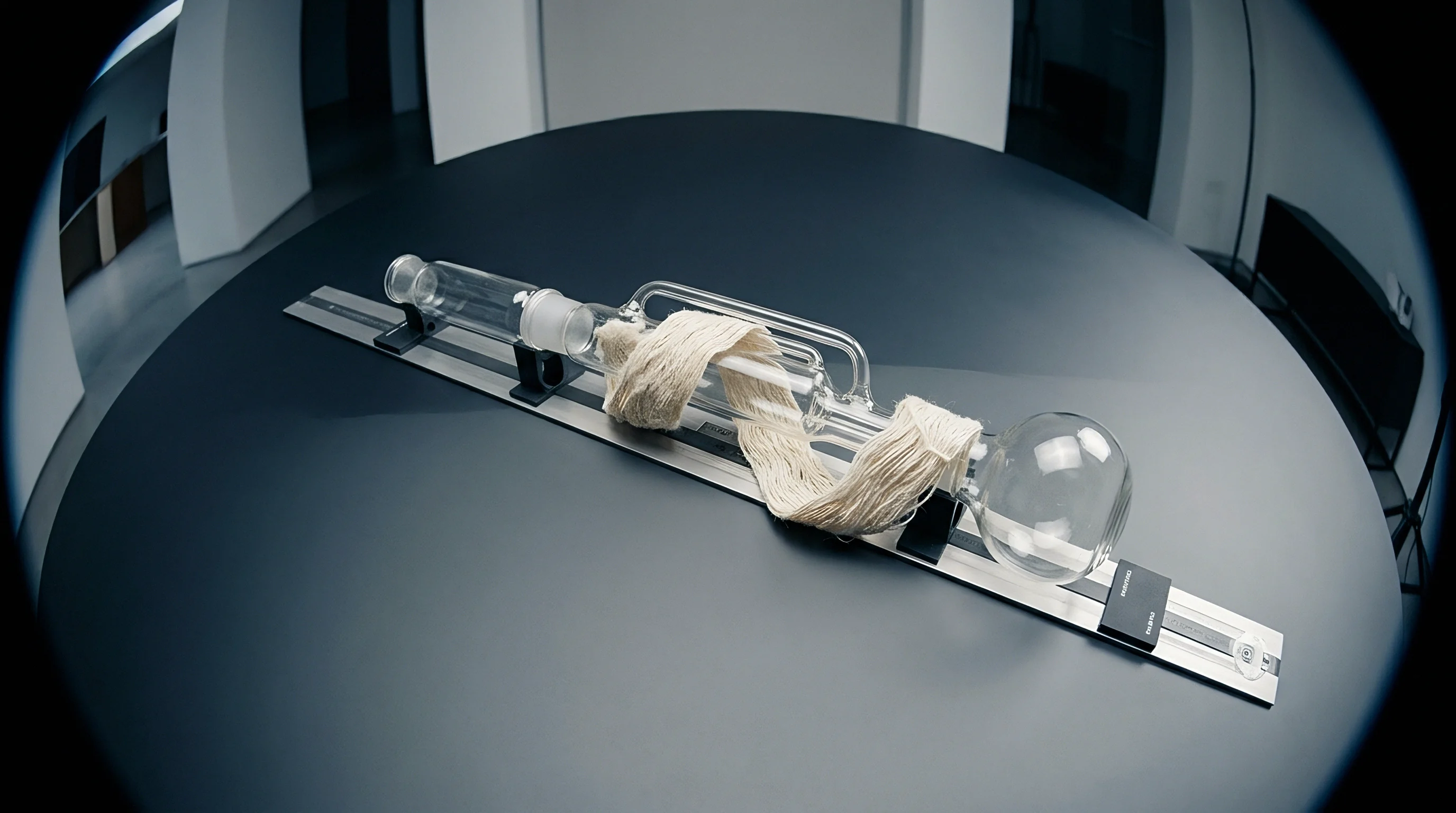
Flask
Soxhlet apparatus reflux cycles strip organic additives and native fatty compounds from grey cotton ring-spun yarn under controlled boiling temperatures. Quantitative extraction depends on matching the polarity of the liquid phase to the specific non-cellulosic compounds present on the yarn substrate. Natural cotton fibers carry a surface wax layer composed of high-molecular-weight monohydric alcohols, solid hydrocarbons, and fatty acids that protect the growing fiber in the boll.
Spinning mills supplement this natural lubricant with synthetic coning oils, paraffin disk waxes, antistatic conditioning agents, and polymeric sizing formulations to maintain low yarn-to-metal friction during high-speed winding and knitting. Standardized testing frameworks like ASTM D2257 and ISO 3074 define the laboratory apparatus and chemical choices necessary to separate these non-fibrous components from pure cellulose.
Solvent selection governs which fractions of non-fibrous matter separate from the cotton fiber matrix during the heating cycle. Petroleum ether, operating within a boiling range of 40°C to 60°C, extracts aliphatic hydrocarbon oils, free fatty acids, and low-melting paraffin waxes while leaving complex synthetic polymers largely undisturbed. Dichloromethane targets a broader chemical spectrum, dissolving oxidized lubricants, synthetic waxes, polyglycols, and residual knitter oil formulations.
Replacing halogenated solvents with low-toxicity alternatives alters the measured extraction percentage because aliphatic hydrocarbons lack the solvating strength needed to strip partially cross-linked synthetic sizing agents.
The extraction thimble holds a prepared yarn sample suspended above the distillation flask where boiling solvent turns to vapor. Rising vapor passes through the side arm into a water-cooled condenser, dripping liquid solvent over the packed cotton yarn package. Soluble matter dissolves into the siphoning chamber until liquid reaches the upper bend of the siphon tube, discharging the solute-laden fluid back into the boiling flask below.
Solvents evaporate under vacuum. Repeating this siphoning process sixteen to twenty-four times ensures complete removal of accessible organic extractables from the yarn assembly.
Reflux rates below six siphonings per hour leave high-molecular-weight waxes trapped inside dense yarn packages.
Laboratory errors during solvent extraction alter the final non-fibrous mass calculation, creating friction between spinning mills and textile converters. Chemical missteps during the initial wash phase degrade test repeatability across different testing sites.
- Solvent contamination bias introduces non-volatile residue from unrefined reagent lots directly into the distillation flask during boiling.
- Insufficient cycle counts fail to dissolve high-viscosity paraffin waxes embedded within tight twist core structures of ring-spun yarns.
- Thermal degradation overshoots scorch residual oils during prolonged flask drying steps, leading to inaccurate dry residue weighings.
- Incomplete moisture removal leaves bound water in the unextracted sample, artificially inflating the calculated non-fibrous matter percentage.
Purchasing specifications for high-speed knitting yarns incorporate extractable limits based on ASTM D2257 testing protocols. Contracts specify that total extractable matter determined via Soxhlet extraction using technical grade hexane shall not exceed 1.20% by dry weight of yarn delivered. Exceeding this limit grants the buyer the right to adjust commercial invoice weights or reject the lot entirely.

Residue
Quantitative gravimetric measurement isolates non-cellulosic extractables by vaporizing solvent from collected liquor inside a constant-weight glass dish. The remaining material represents the sum of raw cotton waxes and processing aids applied during yarn manufacturing. Raw cotton fiber natively carries between 0.40% and 1.00% natural wax by weight, depending on growth region, seed variety, and boll maturity.
Extractable values exceeding 1.00% indicate the presence of added coning oils, paraffin waxes, or knitting lubricants introduced during spinning.
Differentiating native cotton wax from synthetic lubricants requires post-extraction chemical characterization or sequential solvent extractions. A preliminary wash with petroleum ether removes neutral hydrocarbons and added paraffin waxes. Following this initial wash with a second extraction using ethyl alcohol strips polar soap residues, natural pectins, and organic salts bound to the cellulosic cell wall.
Evaluating the dual residue weights identifies whether excess non-fibrous mass originated in the bale room or on the winding floor.
| Solvent System | Boiling Point Range | Target Compound Class | Extraction Yield Expectation |
|---|---|---|---|
| Petroleum Ether | 40°C – 60°C | Paraffin waxes, mineral oils, neutral lipids | 0.40% to 0.85% |
| Dichloromethane | 39°C – 41°C | Synthetic lubricants, ester waxes, total fats | 0.60% to 1.30% |
| Ethyl Alcohol | 78°C – 79°C | Organic salts, pectins, polar sizes, soap residues | 1.10% to 2.20% |
| Trichloroethylene | 86°C – 88°C | Polymeric sizes, heavy mineral waxes, greases | 0.70% to 1.50% |
Accurate calculations require normalizing the dry mass of the extracted residue against the oven-dry mass of the initial yarn specimen. Testing personnel dry the extracted yarn sample in a ventilated oven at 105°C ± 2°C until reaching constant weight. Wet yarn corrupts the balance.
Non-fibrous content is expressed as a direct mass percentage of the dry yarn substrate, excluding environmental moisture regain from the baseline formula.
A baseline cotton yarn carrying 0.60% natural wax shows up to 1.80% extractable matter when over-lubricated with low-grade coning oil.
Isolating specific extractable fractions requires systematic laboratory decisions during sample preparation and heating stages.
- Establish dry sample tare by heating extraction thimbles and glass evaporating dishes to 105°C for two hours prior to weighing.
- Isolate paraffin components by performing a preliminary petroleum ether wash before applying polar alcohol solvents.
- Evaporate solvent carriers under a fume hood water bath kept strictly at 10°C above the solvent boiling point to avoid splattering.
- Desiccate hot residue dishes for forty-five minutes over active silica gel before taking final dry mass readings.
Excessive surface lubricants reduce yarn-to-yarn friction, causing package sloughing and unstable cone geometry during transit. High wax levels lower friction on knitting needles, but excess oil migrates into dye baths, creating streakiness and spotty dye absorption across finished fabrics. Managing solvent extraction levels keeps spinning lubrication balanced against downstream wet-processing performance.

Variance
Inter-laboratory dispersion in non-fibrous content figures stems from extraction cycle frequency, thimble packing density, and moisture re-absorption during post-test desiccator cooling. When two testing facilities report divergent extractable percentages for the same yarn lot, operational differences in Soxhlet bench assembly are usually responsible. Controlling extraction cycle timing and solvent reflux temperature reduces inter-laboratory standard deviation below 0.05 percentage points on duplicate samples.
What Causes Solvent Channeling in Yarn Extraction Thimbles?
Channeling occurs when solvent vapor condenses and flows down low-resistance pathways along the inner wall of the thimble rather than percolating through the tightly packed yarn mass. Densely wound yarn specimens or tightly packed thimbles force liquid solvent to bypass inner package strata. Siphoning liquid stays clear despite high wax concentrations remaining inside the center of the yarn bundle.
Sample preparation dictates that yarn must be wound into loose skeletal hanks prior to thimble placement to guarantee uniform solvent contact across all fiber surfaces.
- Cut representative yarn samples into ten-centimeter strands using clean stainless steel shears.
- Fluff the cut yarn fragments manually to break up structural yarn twist and increase open surface area.
- Pack fifteen grams of fluffed yarn loosely into a high-purity cellulose extraction thimble without compacting the base.
- Insert a porous glass wool plug above the yarn sample to distribute falling solvent droplets evenly across the thimble cross-section.
- Verify that solvent level in the main extraction chamber rises at least one centimeter above the top of the yarn sample before siphoning triggers.
- Maintain Soxhlet reflux heaters to deliver between seven and nine siphon cycles per hour for three continuous hours.
Solvents absorb atmospheric humidity if left exposed in ambient laboratory conditions. Water contamination elevates solvent boiling points, reduces solvating power for non-polar mineral oils, and dissolves water-soluble salts into the extraction flask. Siphoning frequency dictates yield.
Using fresh, ACS-reagent grade solvents prevents atmospheric moisture contamination from distorting dry residue mass measurements.
Desiccator cooling protocols represent another major source of laboratory disagreement. Standard evaporating dishes containing dry non-fibrous residue absorb ambient humidity within seconds when exposed to open room air. Cold glass surfaces attract airborne water molecules, artificially inflating measured residue weight.
Weighing dishes within thirty seconds of removal from the desiccator prevents humidity re-absorption from altering analytical balance outputs.
The trade faces continuous debate regarding whether standard solvent extraction methods should isolate natural cotton wax from added synthetic lubricants or simply report total non-fibrous mass. Standard test methods measure total extractable matter, leaving open the question of whether high test figures originate from agricultural growth conditions or heavy-handed mill lubrication practices.
Deduction
Commercial invoice mass adjustments depend on subtracting solvent-extracted non-fibrous matter from the gross parcel weight before applying official moisture regain rates. Cotton yarn is traded globally based on calculated commercial mass rather than raw scale weight. Standard commercial regain for cotton yarn is fixed at 8.50% under ISO 6741 standards.
When non-fibrous matter exceeds agreed contract thresholds, the buyer pays pure yarn prices for synthetic oil and mineral wax contaminants that wash away during bleaching and dyeing.
Calculating corrected commercial mass requires adjusting the oven-dry mass of the yarn parcel. The formula first deducts the percentage of extractable matter exceeding the baseline allowance from the oven-dry fiber mass. Standard commercial regain percentages apply only to the clean, dry cellulosic fiber fraction that remains after removing non-fibrous additions.
Clean cellulose weighs less.
| Financial Metric Parameter | Contract Allowance Baseline | Excessive Oil Delivered Lot | Financial Variance Impact |
|---|---|---|---|
| Scale Weight Delivered | 10,000.00 kg | 10,000.00 kg | 0.00 kg |
| Solvent Extractable Matter | 0.80% | 2.30% | + 1.50% excess oil |
| Oven-Dry Fiber Mass | 9,073.00 kg | 8,935.00 kg | – 138.00 kg dry fiber |
| Billable Commercial Mass (8.5% Regain) | 9,844.20 kg | 9,694.48 kg | – 149.72 kg billable weight |
| Landed Invoice Value ($4.50/kg) | $44,298.90 | $43,625.16 | $673.74 overcharge refund |
Excess non-fibrous matter alters customs tariff classifications under national Harmonized System (HS) codes. Import authorities inspect textile shipments to confirm whether organic coatings represent functional sizing or artificial weight-padding agents designed to shift tariff line eligibility. Excessive paraffin dosing applied to yarn packages triggers re-classification from pure cotton yarns to prepared textile processing preparations, exposing importers to higher duty brackets and administrative penalties.
Contract clauses specifying maximum non-fibrous matter protect buyers from paying spun-yarn prices for low-cost mineral oils.
Commercial contracts require documentation supporting composition and purity claims before releasing international letter-of-credit funds.
- Independent laboratory test reports displaying ISO 17025 accreditation stamps for extractable matter determination.
- Solvent type identification certificates confirming petroleum ether or hexane execution during Soxhlet wash stages.
- Dual-oven drying mass records documenting dry sample weight before and after solvent extraction procedures.
- Commercial mass calculation sheets showing explicit deductions for non-fibrous content exceeding contract baseline levels.
Failing to verify extractable matter before releasing yarn into fabric production leads to wet-processing failures. Excess mineral oil strips off into scouring baths, overloading wastewater treatment systems and causing dye bath instability that ruins thousands of meters of knitted fabric.
Verification
Receiving inspections for incoming yarn lots require a dual-sample protocol that isolates inner-cone package strata from outer-layer yarn to detect uneven oil spray application. Spinning mills operating high-speed winders occasionally over-spray coning oil on outer yarn package layers to mask poor yarn surface friction. Sampling inner core yarn alongside outer package layers reveals whether lubrication is uniform throughout the yarn package.
Quality assurance teams select five yarn packages per box from ten random cartons within a twenty-tonne shipping container. Technicians strip off the outermost fifty meters of yarn from each bobbin to eliminate surface dust contamination acquired during transit. Analysts then wind twenty-gram test hanks from both the outer package layer and the core layer adjacent to the paper cone tube, labeling each specimen for separate Soxhlet extraction analysis.
Heavy paraffin wax layers on knitting yarn reduce surface friction on needles but clog micro-feeders during long production runs.
Acceptable quality limits for extractable non-fibrous matter range between 0.60% and 1.20% for combed ring-spun cotton yarns destined for circular knitting. Open-end rotor yarns used for weaving accept higher ranges up to 1.50% due to higher natural trash levels and heavy wax disk application required to protect fibers against rotor abrasion. Test reports returning extractable values below 0.30% indicate harsh mill scouring that damages cotton fiber flexibility, causing yarn embrittlement and high end-breakage rates during spinning.
Audit documentation tracks sample history from the receiving dock through chemical extraction to final balance entries. Testing facilities store extracted residue containers for thirty days to allow re-testing in the event of commercial disputes between yarn buyers and spinners. Maintaining sealed duplicate yarn packages from the original lot sampling provides verified evidence needed to resolve international commercial claims.