Determining Nonylphenol Ethoxylate Levels in Raw Textile Materials
Determining nonylphenol ethoxylates in raw textiles requires methanolic extraction followed by LC-MS/MS oligomer summing to verify the 100 mg/kg limit.


Ceiling
European border authorities enforce a concentration limit of one hundred milligrams per kilogram for nonylphenol ethoxylates under REACH Annex XVII entry 46a. This statutory threshold applies to washable textile articles placed on the European Union market. Private certification bodies apply tighter restrictions.
The OEKO-TEX Standard 100 sets a combined limit of one hundred milligrams per kilogram for total alkylphenol ethoxylates alongside a ten milligram per kilogram maximum for free alkylphenols across all product classes. Brand restricted substance lists often lower the reporting threshold for incoming unfinished goods to twenty milligrams per kilogram. A buyer issuing purchase orders against these technical specifications assumes the burden of quantitative batch proof.
Mill suppliers frequently present chemical safety declarations from dye manufacturers instead of actual laboratory reports on the delivered yarn or greige rolls. The chemical safety declaration proves only what the chemical vendor intended to put into the formulation. A test report on the greige bale confirms what remains on the fiber after spinning, sizing, and winding.
Laboratory reports express alkylphenol ethoxylate concentrations as a mass fraction based on the dry weight of the textile specimen. Quantifying these surfactants demands analytical separation because commercial preparations consist of complex oligomeric mixtures rather than a single compound. Nonylphenol ethoxylates contain an alkyl chain of nine carbons attached to a phenolic ring, coupled with an ethoxy chain varying from one to more than forty repeating ethylene oxide units.
Regulatory enforcement targets the entire oligomeric cluster. When custom authorities analyze an import sample, they measure both the degraded lipophilic fragments, specifically free nonylphenol, and the longer hydrophilic ethoxylate chains.
REACH Annex XVII entry 46a detains textile imports containing nonylphenol ethoxylate fractions exceeding one hundred milligrams per kilogram based on dry fabric weight.
Raw natural and synthetic materials carry different exposure profiles. Raw wool brings scouring liquor additives, where historic scouring practices favored technical nonylphenol ethoxylate blends for emulsifying lanolin. Cotton fibers accumulate nonylphenol ethoxylates through wetting agents used in spinning baths and size emulsions.
Synthetic fibers gather these compounds through spin finishes, antistatic lubricants, and winding oils applied during extrusion. Testing greige fibers establishes the chemical baseline before bleaching, dyeing, or finishing introduces secondary chemistry.
| Compliance Scheme | Target Analytes | Maximum Allowable Limit | Analytical Standard | Scope Details |
|---|---|---|---|---|
| REACH Annex XVII Entry 46a | NPEO Oligomer Sum | 100 mg/kg | EN ISO 18254-1 | Apparel and home textiles washable in water |
| OEKO-TEX Standard 100 | NPEO and OPEO Sum | 100 mg/kg | EN ISO 18254-1 | Classes I through IV including trims and accessories |
| OEKO-TEX Standard 100 | Nonylphenol and Octylphenol | 10 mg/kg | ISO 21084 | Free alkylphenols across all classes |
| ZDHC PRSL Version 2.0 | Total Ethoxylates | 100 mg/kg | EN ISO 18254-1 | Finished consumer goods and apparel |
| ZDHC MRSL Version 3.1 | NPEO Formulation Residue | 250 mg/kg | Direct LC-MS | Commercial processing chemical formulations |
Shipments bearing nonylphenol ethoxylate concentrations above one hundred milligrams per kilogram face border confiscation, mandatory hazardous destruction at the importer of record’s expense, and immediate listing on market surveillance recall platforms.
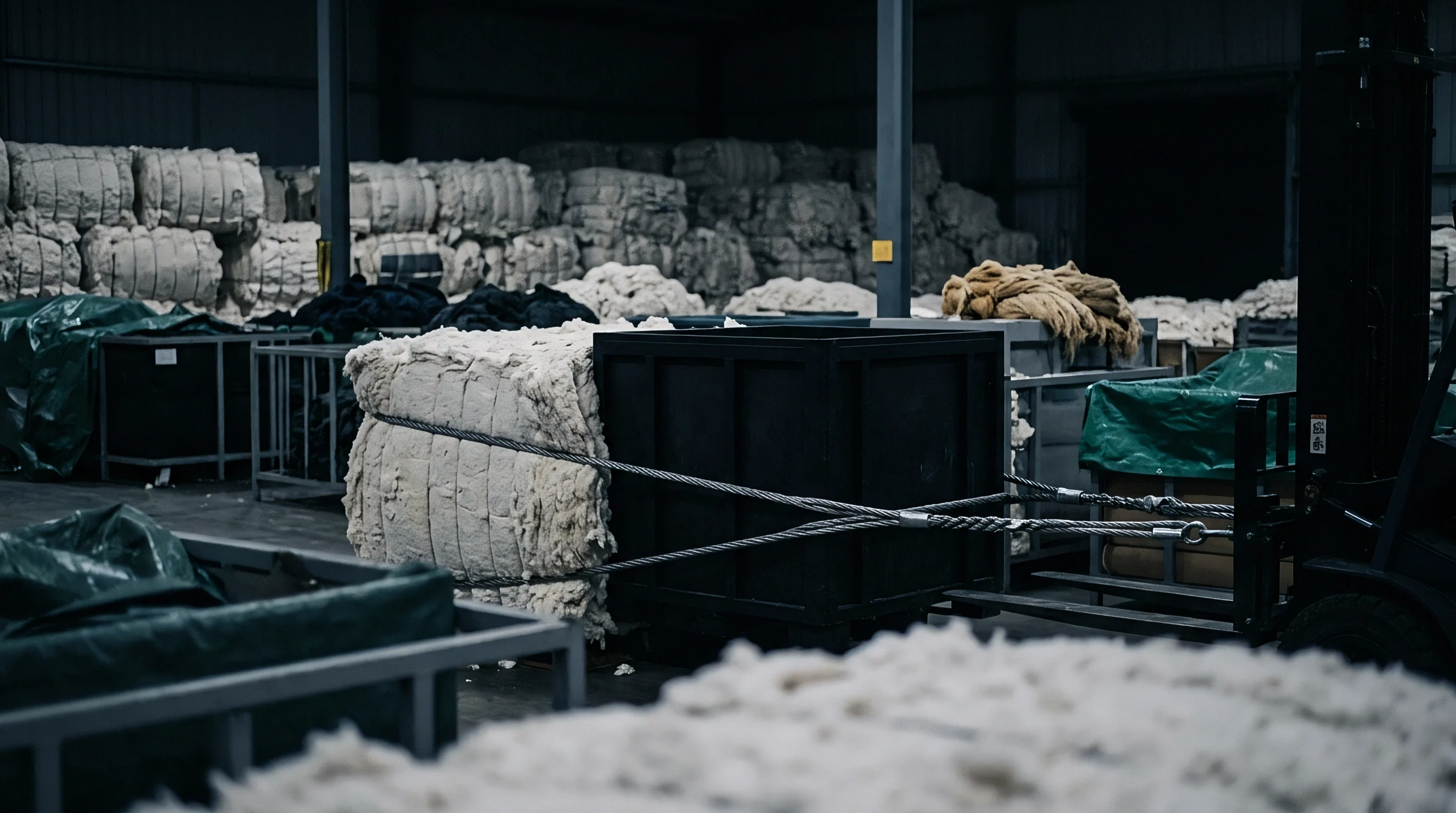
Bale
Field swatches drawn from raw cotton or wool fibers arrive at the cutting bench loaded with natural greases, pectins, and industrial lubricants. Natural wax layers trap non-ionic surfactants within the cellular lumen. When greasy fibers undergo routine surface swabbing, nonylphenol ethoxylates embedded in these natural matrices resist detection.
Analysts must mechanically reduce the fibrous mass to maximize surface exposure before solvent immersion. Cutting specimens into fragments measuring two millimeters by two millimeters increases interfacial contact between the extracting liquid and the hydrophobic fiber core. Laboratories standardizing on EN ISO 18254-1 weigh precisely one gram of homogenized fiber clippings into an extraction vessel.
The bench technician documents the moisture content of the lot simultaneously. Wet fibers skew mass fraction calculations downward, creating false negative reports that collapse upon official border re-testing.
Spinning finishes on raw synthetic yarns create parallel analytical interferences. Polyester and polyamide filaments leave spinnerets coated with mineral oils, fatty acid esters, and non-ionic surfactant emulsifiers. Nonylphenol ethoxylates with five to nine ethoxy groups act as economical emulsifiers for these petroleum lubricants.
Unscoured yarns carry surfactant loadings up to one percent of total yarn weight. Greige yarn inventory purchased from secondary spinning mills presents substantial compliance risks. The yarn broker advertises pure virgin polymer, yet the winding lubricant contains banned ethoxylated surfactants applied during high-speed take-up.
Natural raw wool presents the highest matrix density of any commodity fiber. Lanolin wax constitutes up to twenty-five percent of raw fleeces. Scouring mills historically used branched nonylphenol ethoxylates because their cloud point matched hot wash bath temperatures.
When a testing technician digests wool grease, co-extracted cholesterol esters and free fatty acids overwhelm chromatographic columns. Clean laboratory execution demands specific cleanup steps to isolate ethoxylates without losing short-chain oligomers. The analytical process separates matrix waxes using solid-phase extraction cartidges packed with reversed-phase silica sorbents.
- Cryogenic milling reduces tangled raw fibers into fine, uniform particulate without generating frictional heat that degrades short-chain ethoxylate rings.
- Moisture equilibration stabilizes fiber mass inside a controlled chamber at twenty degrees Celsius and sixty-five percent relative humidity prior to gravimetric tare logging.
- Silica cleanup strips heavy ester fractions from wool wax extract solutions while passing polar ethoxylated compounds directly into the analytical vial.
- Matrix-matched blanks expose baseline interference arising from natural plant sterols that mimic chromatographic retention times of branched nonylphenol isomers.
The scouring supervisor routinely insists that residual processing oils wash away completely in hot water rinses without leaving chemical traces on finished yarn.
Solvent
Methanol acts as the primary medium for liberating nonylphenol ethoxylate molecules from raw textile substrates under EN ISO 18254-1. Ultrasonic extraction at seventy degrees Celsius for sixty minutes delivers dependable recovery across cotton, wool, and synthetic yarn matrices. The ultrasonic energy disrupts mechanical adhesion between the hydrophobic alkyl tail and the fiber wall, driving the surfactant into solution.
Pressurized liquid extraction, also termed accelerated solvent extraction, provides an alternative pathway. This automated system operates at one hundred degrees Celsius under one hundred bar of pressure. Pressurized solvent penetrates deep fiber pores within twenty minutes.
Laboratories comparing ultrasonic baths against accelerated systems report minor variations in total yield, provided the methanolic volume remains at twenty milliliters per gram of fiber.

Would Border Surveillance Seize Borderline Scoured Greige?
Customs enforcement laboratories test greige cloth under standard washing parameters to determine if released waters violate discharge laws. Border inspectors evaluate imported greige against the strict letter of REACH Annex XVII entry 46a. The regulation does not grant exemptions for unfinished gray cloth.
If raw denim or greige sheeting tests at one hundred and ten milligrams per kilogram, authorities reject the entry. The importer cannot defend the cargo by arguing that downstream desizing and scouring will remove the chemical. Compliance is judged entirely on the physical state of the cargo arriving at the maritime terminal.
Commercial purchase contracts void supplier indemnification clauses when goods land without lot-specific gas chromatography confirmation.
Standardized chemical cleavage procedures outlined in EN ISO 18254-2 approach the extraction challenge through chemical digestion rather than physical dissolution. The digestion process uses hydriodic acid to cleave the polyoxyethylene chain from the phenol ring at one hundred and thirty degrees Celsius. Cleavage converts every nonylphenol ethoxylate oligomer into alkyl iodides and free nonylphenol fragments.
The laboratory measures the cleaved product through gas chromatography coupled to a mass spectrometer. This cleavage method eliminates the analytical complexity of resolving thirty distinct oligomeric peaks on a liquid chromatogram. The entire ethoxylate family collapses into a single quantifiable peak.

Shall Matrix Suppression Skew Electrospray Ionization?
Direct liquid chromatography coupled with tandem mass spectrometry avoids chemical cleavage but introduces ionization risks. Liquid extracts injected into an electrospray ionization source suffer ion suppression when residual fiber waxes co-elute with early oligomers. Highly polar ethoxylates with two or three ethoxy units elute close to matrix lipids.
The electric field in the ionization source becomes saturated by non-target compounds. The detector records an artificially depressed signal for the surfactant. Adding isotopically labeled internal standards counteracts this matrix interference directly.
Natural waxes resist pure alcoholic dissolution. Combining nonpolar modifiers with methanol improves penetration into greige cotton. Solvents must not dissolve the polymeric fiber itself.
Formic acid additions dissolve nylon, destroying the chromatographic separation column. Pure methanol maintains structural fiber integrity while scavenging surface-deposited processing aids.
Whenever raw cellulosic fibers exhibit stubborn natural waxes during incoming inspection, methanolic extraction yields truer surfactant values than accelerated nonpolar rinses.

Recovery
Accurate quantification of nonylphenol ethoxylates hinges on liquid chromatography combined with tandem mass spectrometry using triple quadrupole detectors. The instrument operates in positive electrospray ionization mode. The analytical column, typically a C18 reversed-phase column measuring one hundred millimeters with a sub-two-micron particle size, resolves individual ethoxymer peaks across a methanol-water gradient containing five millimoles of ammonium acetate.
The ammonium ions promote stable ammonium adduct formation + for each ethoxylate oligomer. Fragmentation patterns generate diagnostic product ions at mass-to-charge ratios of one hundred and twenty-one, representing the alkyl-substituted phenolic fragment, and two hundred and forty-seven, corresponding to the bare ethoxylate chain terminus.
Mass spectrometry benchmarks require labeled surrogate standards. The analyst spikes the dry fiber sample with carbon-13 labeled nonylphenol diethoxylate and carbon-13 labeled nonylphenol nonaethoxylate before adding solvent. These labeled compounds experience identical physical extraction resistance and ionization suppression as native surfactants.
The instrument software calculates the recovery percentage for the internal standards. Analytical runs showing internal standard recoveries outside seventy to one hundred and twenty percent require total sample re-extraction.
A laboratory recovery rate below seventy percent invalidates the test report during customs arbitration hearings.
Determining total content involves summing the concentration of individual oligomers from ethoxymer number one through ethoxymer number twenty. The technician calculates individual response factors using certified technical mixtures containing known oligomeric distributions. Consider a worked quantitative scenario.
Assume an analytical laboratory processes a five-gram specimen cut from an imported twenty-tonne lot of unscoured greige cotton yarn. The technician extracts the specimen into twenty-five milliliters of pure methanol.
- The operator records a dry specimen mass of exactly 5.024 grams on an analytical balance.
- The internal standard spike adds 500 nanograms of carbon-13 labeled nonylphenol diethoxylate to the extraction chamber.
- Liquid chromatography detects an integrated peak area for the target oligomer cluster corresponding to 628 nanograms per milliliter in the final extract.
- The instrument data system calculates the total mass of surfactant present in the twenty-five milliliter volume as 15.70 micrograms.
- Dividing this chemical mass by the dry specimen weight yields a lot concentration of 3.12 milligrams per kilogram.
The resulting value of 3.12 milligrams per kilogram clears the REACH limit of one hundred milligrams per kilogram. It also clears the commercial restricted threshold of twenty milligrams per kilogram. If the extract concentration had registered twenty-five micrograms per milliliter, the calculation would yield 124.4 milligrams per kilogram, triggering an immediate non-compliance quarantine.
| Oligomer Group | Precursor Ion (m/z) | Product Ion (m/z) | Collision Energy (eV) | Ionization Polarity |
|---|---|---|---|---|
| NPEO1 Adduct | 282.2 | 121.1 | 22 | Positive Electrospray |
| NPEO2 Adduct | 326.3 | 121.1 | 26 | Positive Electrospray |
| NPEO5 Adduct | 458.4 | 121.1 | 34 | Positive Electrospray |
| NPEO9 Adduct | 634.5 | 121.1 | 42 | Positive Electrospray |
| 13C-NPEO2 Standard | 332.3 | 127.1 | 26 | Positive Electrospray |
| Precursor ions represent ammonium adducts formed under five millimolar ammonium acetate mobile phase conditions. | ||||
Gas chromatography with mass spectrometry following hydriodic cleavage offers lower operating costs per test but strips away oligomeric distribution data. Cleavage converts the entire sample into nonylphenol and alkyl iodides. The detector measures a single chromatographic peak for nonylphenol.
The technician multiplies the calculated nonylphenol mass by a conversion factor of 2.9 to estimate the original ethoxylate mass based on an assumed average of 8.5 ethylene oxide units per molecule. This mathematical conversion introduces uncertainty. When an unscoured batch contains primarily short-chain diethoxylates, the 2.9 factor overestimates the total ethoxylate weight by up to forty percent.
A shipment rejected under cleavage testing can often pass when re-tested through intact oligomer liquid chromatography.
Whether industry consensus will ultimately define total ethoxylate compliance through whole-molecule intact detection or through hydrolytic cleavage into alkylphenol base units remains an active dispute among standard committees.
Default
Commercial fallout from nonylphenol ethoxylate contamination strikes long after the spinning mill cashes the letter of credit. Importers discover exceedances when brand customers pull spot check samples from warehouse inventory. If testing reveals one hundred and forty milligrams per kilogram of surfactant on raw greige rolls already cut into finished apparel panels, the economic damage cascades.
The apparel brand cancels the production contract. The manufacturer cannot sell the contaminated stock in regulated territories. Diverting contaminated goods to less stringent markets requires steep discounts and additional shipping freight.
Secondary market disposal yields pennies on the dollar.
The financial ledger deepens when state regulators intervene. Border authorities assessing an entry with elevated nonylphenol ethoxylates issue red notices. Port storage charges accrue daily while the importer requests independent re-testing.
Demurrage penalties mount rapidly. A standard forty-foot container held under chemical examination incurs demurrage and detention fees running into thousands of dollars per week. The buyer pays these terminal charges out of pocket while waiting for analytical confirmation.
Independent re-tests at accredited facilities take ten to fourteen business days unless the importer authorizes expedited rush fees. Retesting cost pales beside demurrage liabilities.
Mitigating financial risk requires explicit purchase order mechanics. Raw material contracts must bind the upstream spinning mill to chemical compliance through lot-tied testing documentation. Generic supplier compliance forms provide no legal protection in commercial arbitration.
A buyer must demand an ISO 17025 accredited test report matching the specific lot number on the bill of lading. The certificate must name the identical fiber composition, trade name, and manufacturing facility. When raw material inventories arrive without traceable laboratory dossiers, the buyer absorbs the entire product recall liability.
Inserting clause twenty-four point two shifts all testing, storage, and customs penalty debits directly to the raw material vendor upon any confirmed laboratory exceedance.