Machine Configuration
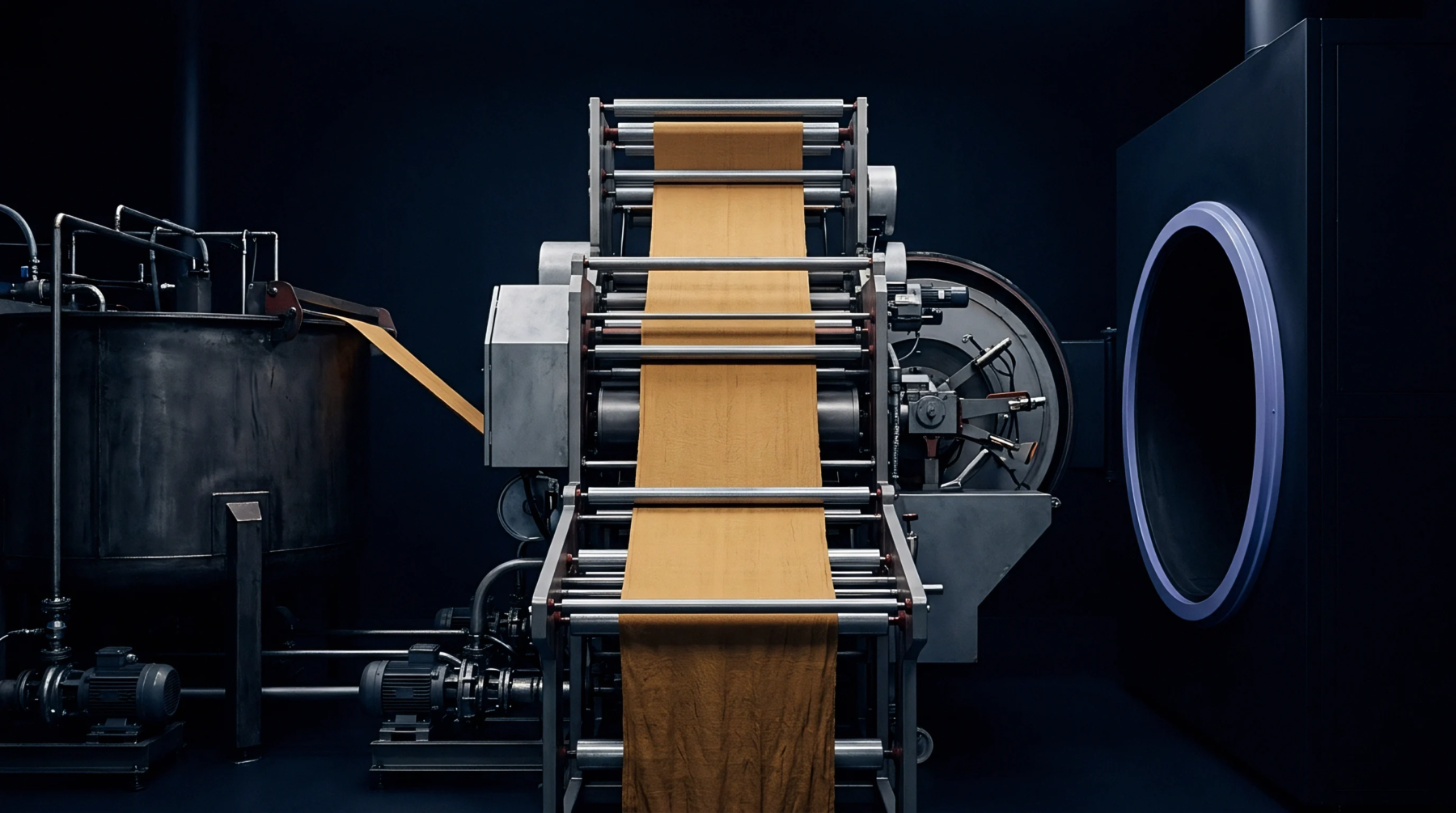
Open-width processing machinery for long-run fabric coloration integrates pad application, intermediate drying, chemical fixation, and open-width washing into an uninterrupted production train. Inside a continuous dyeing range, flat goods pass across driven guide rollers directly into dye liquor before entering nip rollers set to a predetermined wet pickup percentage. The processing format accommodates interlaced yardage or dimensionally stable knit textiles requiring uniform shade depth across thousands of meters.
Processing stops at the entry to finishing tenters where chemical finishes or mechanical compactions apply downstream modifications.
Squeeze Uniformity
Pneumatic pressure applied across foulard rolls dictates the initial liquid absorption across the running textile face. Within a continuous dyeing range, uneven roll deflection across wide working widths produces lateral dye concentration gradients before drying commences. Crowned roll profiles or swimming rolls containing internal pressure chambers counterbalance mechanical deflection under heavy linear load.
When nip pressure drifts out of specification, liquor expression fluctuates across the fabric width. That variation establishes irreversible side-to-center shade variances during the subsequent infrared predrying pass.
Thermofixation Residence
Controlled heat transfer mechanisms activate dye diffusion through the fiber matrix at designated process velocities. In thermosol or pad-steam operations on a continuous dyeing range, disperse dyes on polyester fibers require temperatures between two hundred and two hundred twenty degrees Celsius for roughly sixty seconds. Reactive dyes on cellulosic goods demand saturated steam environments without air ingress to prevent dyestuff hydrolysis.
Hot flue zones isolate wet goods from direct roller contact to avert pick-off and two-sided color disparities before solid fixation occurs. Line speed governs dwell time precisely, meaning any sudden machine deceleration alters thermal exposure and causes longitudinal shade bands across yardage. Recovery from an unscheduled stop requires purging intermediate fabric lengths that suffered excessive heat exposure.
Colorimetric Divergence
Spectral variations recorded along continuous yardage establish the commercial acceptance threshold for entire dye lots. Production off a continuous dyeing range undergoes online or bench spectrophotometric evaluation against master digital standards. Tolerance envelopes typically enforce a total color difference below zero point eight DE CMC units between lot heads and tails.
Beyond absolute shade depth, excessive metamerism caused by formulation shifts across long batch campaigns forces laboratory reformulations. Finished continuous dyeing range outputs face outright rejection by garment cutters when lot-to-lot shading precludes panel intercutting.