Production Methodology
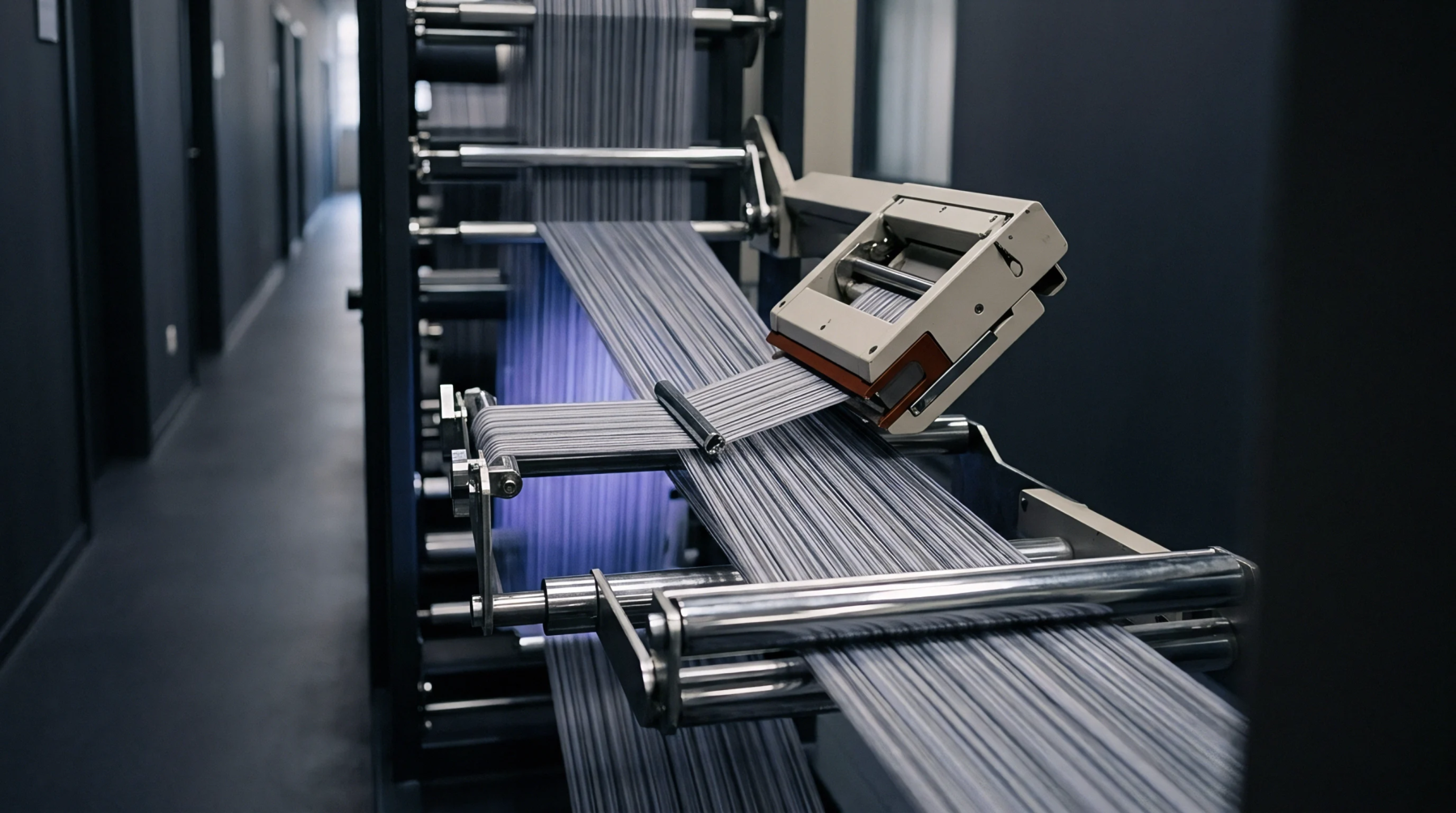
High production speeds and open mesh structures define a fabrication process involving multiple sets of warp beams feeding yarn to latch needles. In raschel warp knitting, needle beds arrange loops in pillars while simultaneously passing inlay threads across the fabric width to establish complex geometric forms. Mills operate these machines to generate rigid netting, dense lace, or technical spacer fabrics depending on the gauge and configuration of the needle bars.
Precision tension control across the warp beams regulates the loop density and dimensional stability of the final output. Latch needles pull the yarn through existing loops to form new courses, creating a stable interlocking structure that resists laddering even when individual strands snap. Each needle operates in a fixed cycle that draws, cleans, and casts off the stitch to ensure uniformity across wide widths.
Factories verify the structural integrity of the fabric by measuring mass per unit area and tensile strength against standardized quality parameters before the rolls leave the finishing floor.
Operating Mechanics
Individual needle bars drive the pattern complexity by shifting laterally according to programmed chain links or electronic actuators. This machine class differs from tricot equipment through a higher density of guide bars, which allows for the insertion of pillars, tricot, and inlaid structures within a single cycle. Engineers configure the movement of these bars to create varied surface textures or open grid formats essential for industrial applications.
Actuators govern the timing of the latch needle motion to accommodate monofilament yarns or heavy multifilament cords. Operators adjust the take up speed relative to the knitting frequency to maintain consistent loop geometry across the entire machine width.
Material Performance
Synthetic polymers like polyester, nylon, or polyethylene provide the tensile strength required for heavy duty industrial nets or medical supports. Fibres move through the knitting zone under controlled tension to prevent distortions in the final grid geometry. Bulk production behaviour depends on the interaction between the fibre modulus and the loop shape, where higher stiffness correlates to reduced deformation under lateral load.
Finishing processes like heat setting finalize the fabric dimensions and lock the loop structure to prevent later shrinkage during garment assembly.
Verification Standards
Quality control protocols assess the dimensional stability and seam slippage of the finished textile to confirm it meets end use requirements. Inspectors measure the mesh size and weight variations to identify potential machine faults that occur during high speed production. Technicians compare the elongation profile of the finished roll against internal laboratory benchmarks to ensure consistent performance during high stress applications.
Reliable production depends on the alignment of the yarn feed system with the mechanical timing of the needles to minimize structural defects. Uniformity in the loop structure dictates the long term durability of industrial components fabricated through this method.