Greige Warp Beaming Economics and Basic Minimum Calculation
Greige warp beaming economics requires minimum 5000 metre set lengths to absorb fixed slasher setup losses, sizing waste, and creel remnant expenses.
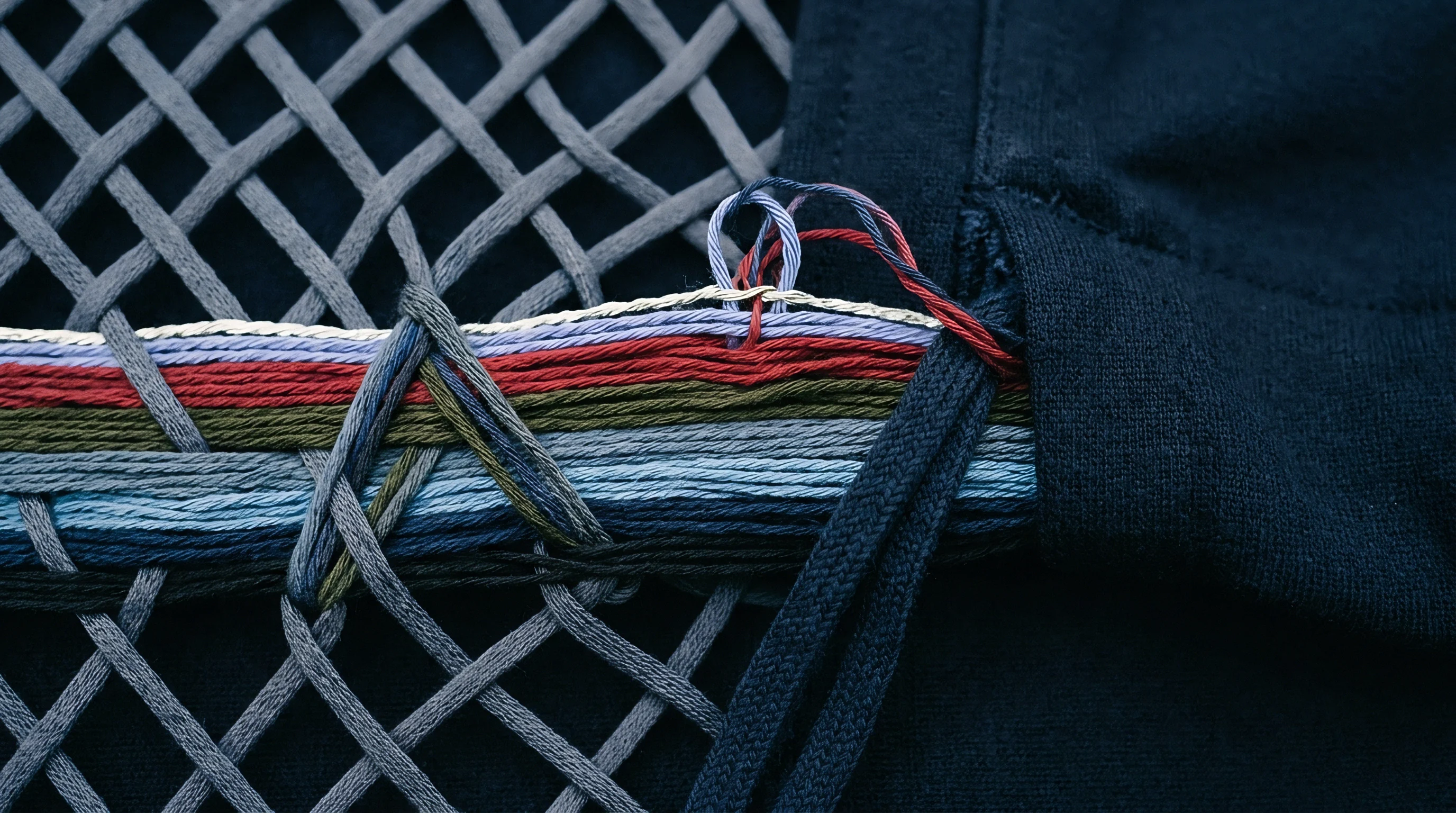

Creel
Direct beaming winds several hundred yarn ends from individual package spools onto a single gray beam under uniform mechanical tension. Minimum economic order lengths for greige fabric depend on how much yarn this holding frame takes. Loading eight hundred to twelve hundred spools onto bobbin holders requires substantial manual labor.
If an order falls below the volume needed to fill a complete set of section or direct beams, the mill absorbs extra setup labor and package scrap, raising the price per linear metre.
Warping machines pull yarn from package spools at 600 to 1200 metres per minute. At these speeds, dynamic tension must remain consistent across every spool position. Spools on the outer edges have longer paths to the front reed than those in the center, causing uneven drag and stretch.
Individual tensioners correct these geometric differences by applying braking force through disc, hysteresis, or pneumatic mechanisms. When tension fluctuates by more than two centinewtons per tex across the array, warp ends unwind unevenly during weaving, leading to slack ends, floats, and loom stops.
Creel capacity dictates the absolute minimum thread count per beam set before bobbin changes double the setup labor cost.
Direct warping draws yarn straight from the package frame onto a broad warp beam ready for sizing. Sectional warping winds narrow bands sequentially onto a conical drum before transferring the full width onto a weaver beam. High-volume production relies almost exclusively on direct beaming to feed multi-beam slashing sets.
Sectional preparation suits short runs and complex multi-colour stripes, but its low speed makes it impractical for commodity cotton, polyester, and viscose constructions.
Auditing warp preparation facilities involves measuring beam hardness across five points on the barrel. Density variations across a beam create tension streaks during sizing. When high-speed warper beams have soft edges or dense centers, individual ends bury themselves under outer layers during unwinding at the slasher creel.
The resulting yarn snaps force a machine stop, leaving a thermal dwell mark across the full width of the sizing sheet.

Direct and Sectional Warping Mechanical Distinctions
High-speed yarn winding from multiple bobbin packages forms the basis of woven fabric preparation. Direct beaming runs hundreds of yarn ends simultaneously onto a single warper beam, typically loading 40,000 to 80,000 metres per end. High-density fabrics require combining four to twelve direct beams at the slasher size box to reach the total end count in the reed plan.
Sectional beaming builds the full end count section by section on a drum, which limits maximum warp length to the yarn capacity of a single package.
Package Geometry and Tension Control Dynamics
Unwinding yarn from conical bobbins creates friction variations between the shoulder and the nose. As a package empties from full diameter down to the paper tube, ballooning tension rises sharply. Centralized tension control systems adjust braking pressure on individual strands as the package shrinks.
Without equalized ballooning forces across full and empty spools, residual differences in elongation cause tight warp ends in the finished dyed fabric.
| Process Parameter | Direct Warping Route | Sectional Warping Route | Commercial Sourcing Consequence |
|---|---|---|---|
| Target Order Volume | GreaterThan 10000 Metres | LessThan 3000 Metres | Direct warping lowers preparation cost for bulk runs |
| Warping Speed Range | 600 to 1200 m/min | 200 to 500 m/min | Direct route reduces machine hour allocation per beam |
| Creel Setup Labor Factor | Amortized over 80000m | Amortized over 3000m | Short runs on direct creels carry high labor penalties |
| Beam Density Uniformity | High (Hydraulic Press Roller) | Moderate (Drum Transfer) | Direct beams deliver superior unwinding tension at slasher |
| Yarn Waste Percentage | 1.0% to 1.5% | 2.5% to 4.0% | Sectional warping increases package remnant losses |
The spatial configuration of package holders determines how many individual threads can be processed at once. Standard V-creels and rectangular package racks accommodate between 500 and 1200 packages. When a fabric specification calls for 7,200 total warp ends, a direct creel carrying 900 packages requires eight warper beams to complete a sizing set.
Ordering a greige volume that uses only a fraction of a beam set’s length forces the weaver to bill for unused yarn remnants left on thousands of spools.
Defects introduced during warping carry directly into sizing and weaving. Tension irregularities and package flaws create recurring weaving failures that lower gray cloth yields.
- Package Nose Snagging occurs when yarn catches on damaged bobbin rims, causing sudden tension spikes that break single filaments or spun yarns before reaching the warper comb.
- Crossed End Entanglement develops when broken threads drop across adjacent running ends on the frame, creating double ends that shear off during winding.
- Barrel Density Sloughing results from inadequate hydraulic control on the warper pressure roll, allowing outer yarn layers to slip sideways toward the flanges.
- Package Remnant Variance arises from unequal yarn lengths on spinning bobbins, leaving substantial residual yarn in certain creel positions when target beam length is reached.
Package density variations from the spinning mill make edge-to-center tension uniformity impossible across a nine-hundred-end creel.
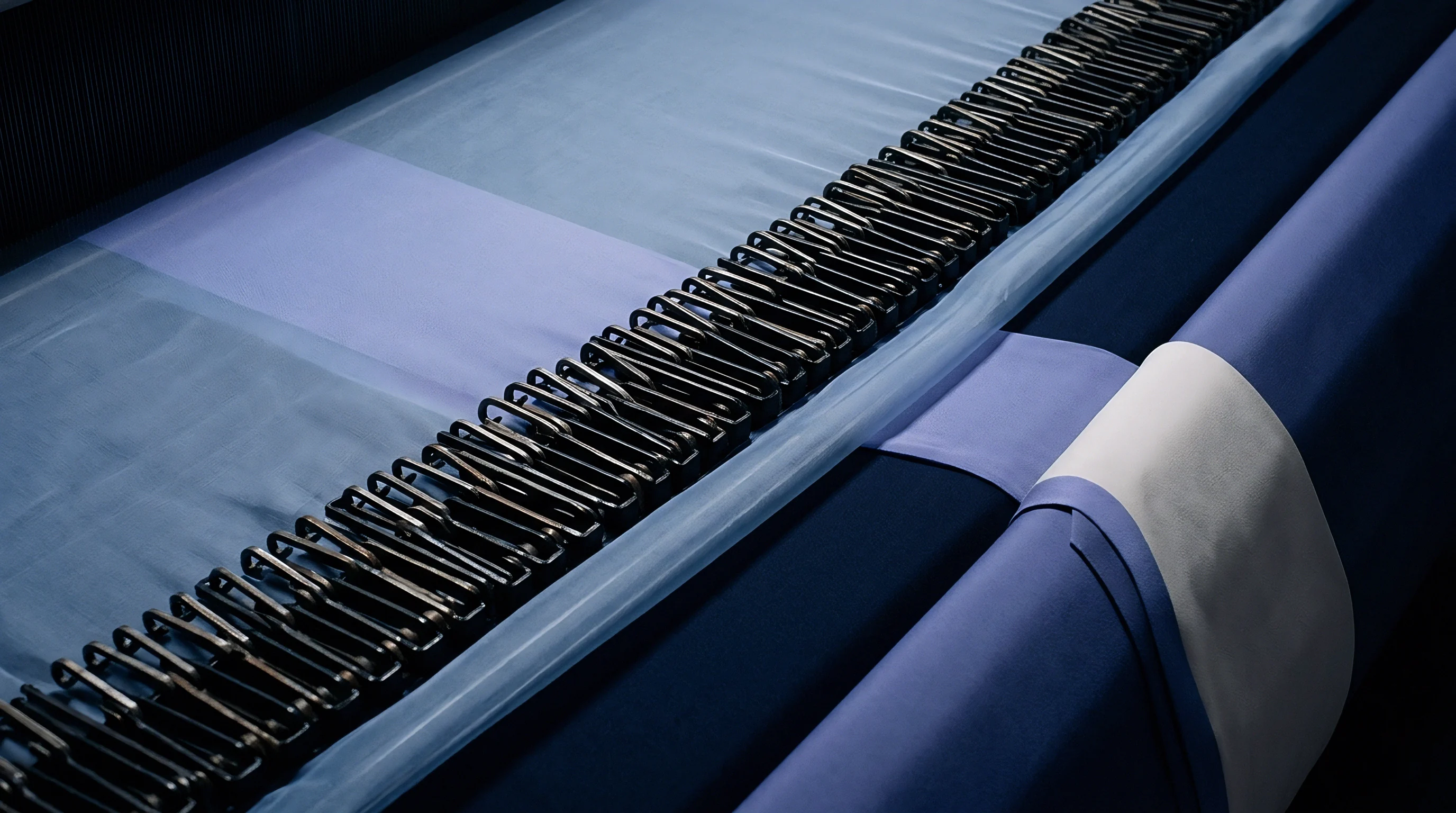
Sizing
Slashing applies a protective liquid film to single spun yarns before weaving. Raw warp yarns cannot withstand the heavy abrasion from drop wires, heddles, and the reed during shed opening. Sizing passes warp ends through an aqueous polymer bath, squeezes out excess liquor through heavy rubber rollers, and dries the sheet over steam-heated, Teflon-coated cylinders.
Without this coating, high-speed rapier and air-jet looms suffer frequent warp breaks within minutes of starting.
Size pickup represents the dry weight of protective chemical added relative to the dry weight of raw yarn, expressed as a percentage. Standard cotton poplins and twills require between 9% and 14% dry size add-on to sustain weaving stresses. Filament warps need far less, typically 2% to 5%, relying on film adhesion rather than fiber bundle penetration.
If hydraulic nip pressure falls below targeted thresholds, wet pickup increases, raising drying costs and leaving surface encrustations that flake off in the loom shed.
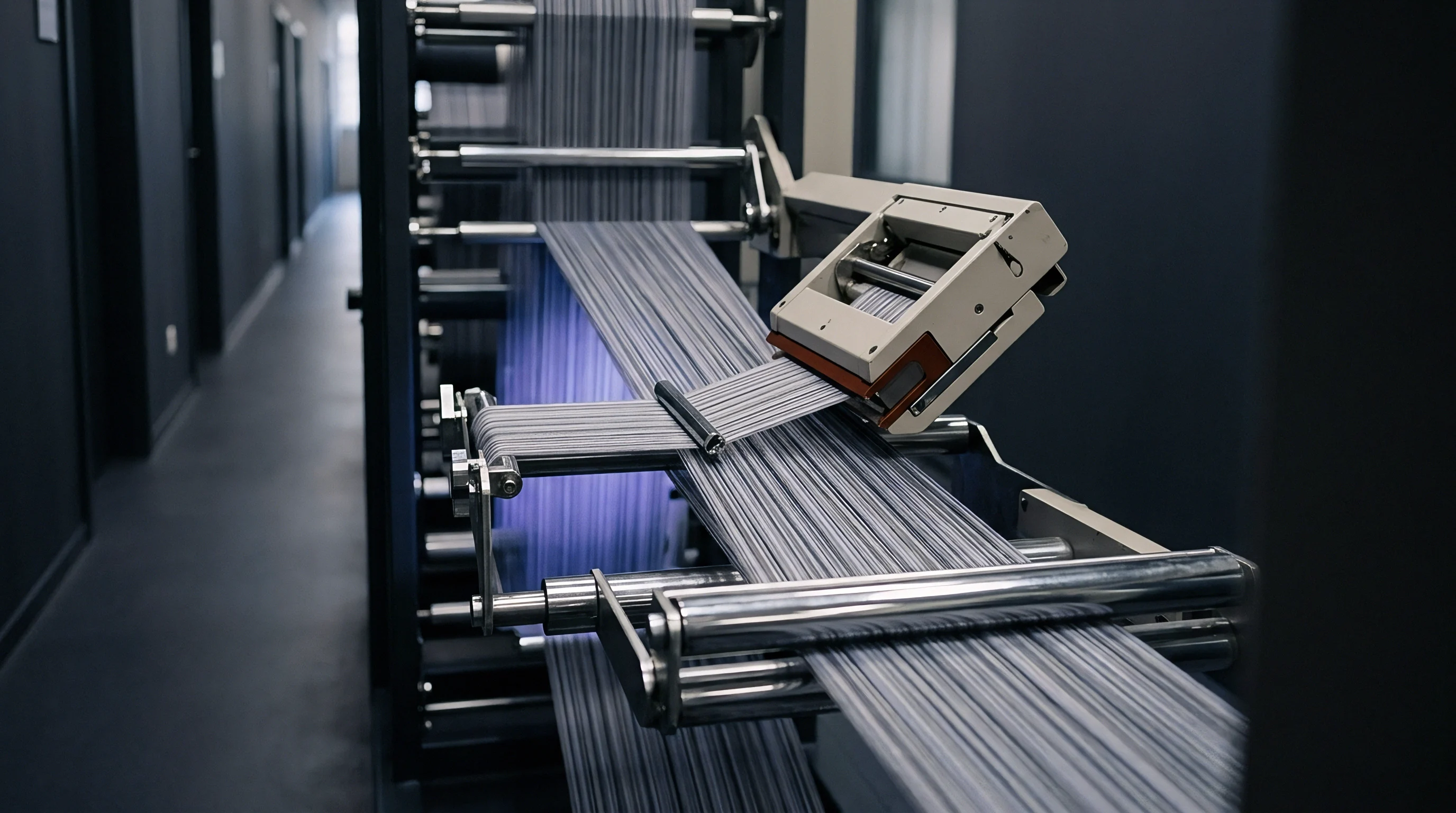
Slashing Chemistry and Film Formation Mechanics
Polymer binders and lubricants protect delicate warp yarns from abrasion in the loom reed. Native maize or potato starches remain the economic standard for spun cotton, though high molecular weight limits film flexibility and requires high cooking temperatures. Carboxymethylation or acid thinning reduces starch viscosity, allowing deeper penetration into the yarn core.
Polyvinyl alcohol (PVA) offers higher film strength and abrasion resistance, making it the preferred synthetic binder for polyester-cotton blends.
Acrylic copolymers and carboxymethyl cellulose (CMC) modify film elasticity and water solubility alongside primary starch binders. Acrylics improve size adhesion to hydrophobic synthetic fibers, while lubricants like hydrogenated tallow and wax emulsions lower friction as ends pass through heddle eyes. Size pickup directly affects desizing cost ~ excessive wax or cross-linked binders demand aggressive alkaline scouring and enzymatic treatment, raising chemical oxygen demand (COD) in wastewater streams.
Native starch sizing requires ten percent dry add-on weight on combed cotton to maintain loom stops below two per hundred thousand picks.
Drying cylinder temperature profiles shape the crystalline structure of the applied film. Slasher drying sections run steam cans at graduated temperatures, from 110 degrees Celsius in the initial zone to 140 degrees Celsius in the primary drying section, dropping to 90 degrees Celsius near the delivery end. Flash drying on the surface forms a brittle crust that cracks as threads flex over lease rods, whereas gradual moisture removal preserves at least 75% of original yarn elongation capacity.
Size film distribution demands precise operational control throughout the slasher run. Evaluating sizing liquor viscosity with a Zahn cup at sixty degrees Celsius during mill runs detects binder degradation early.
- Extract a 500 millilitre sample of size liquor from the primary size box overflow weir into a insulated glass vessel.
- Measure liquor temperature using a calibrated digital probe to confirm the sample sits within one degree of eighty-five degrees Celsius.
- Immerse a clean number four Zahn cup fully into the liquor bath and draw it vertically out of the fluid while starting a stopwatch.
- Stop the timer at the precise instant the continuous stream of sizing liquid breaks into discrete drops at the cup nozzle exit.
- Record efflux time in seconds and compare against the mill standard range of twenty-two to twenty-six seconds for standard starch-PVA formulations.
Squeeze Roll Hydraulics and Size Add-on Control
Rubber-coated nip rolls remove excess liquid while pressing active solids into the yarn core. Slasher squeezer systems apply hydraulic forces between 10 and 40 kilonewtons across the roll face width. High viscosity combined with low nip pressure leaves too much coating on the outside of the yarn bundle, stiffening the strand without anchoring internal fibers and causing heavy shedding at the reed.
Conversely, excessive nip pressure forces liquor too far into the core, leaving outer fibers exposed to metal friction.
| Fibre Blend | Primary Film Polymer | Add-on Percentage Range | Desizing Process Route |
|---|---|---|---|
| 100% Combed Cotton | Modified Starch / PVA (80/20) | 10.0% to 12.0% | Enzymatic (Alpha-Amylase) Pad-Batch |
| 65/35 Poly-Cotton | PVA / Acrylic (60/40) | 8.0% to 10.0% | Hot Water Scour (85°C) with Surfactant |
| 100% Viscose Rayon | Water-Soluble Acrylic / Starch | 6.0% to 8.0% | Neutral Aqueous Wash at 60°C |
| Polyester Filament | Sulfonated Polyester Resin | 2.5% to 4.5% | Mild Soda Ash Scour at 70°C |
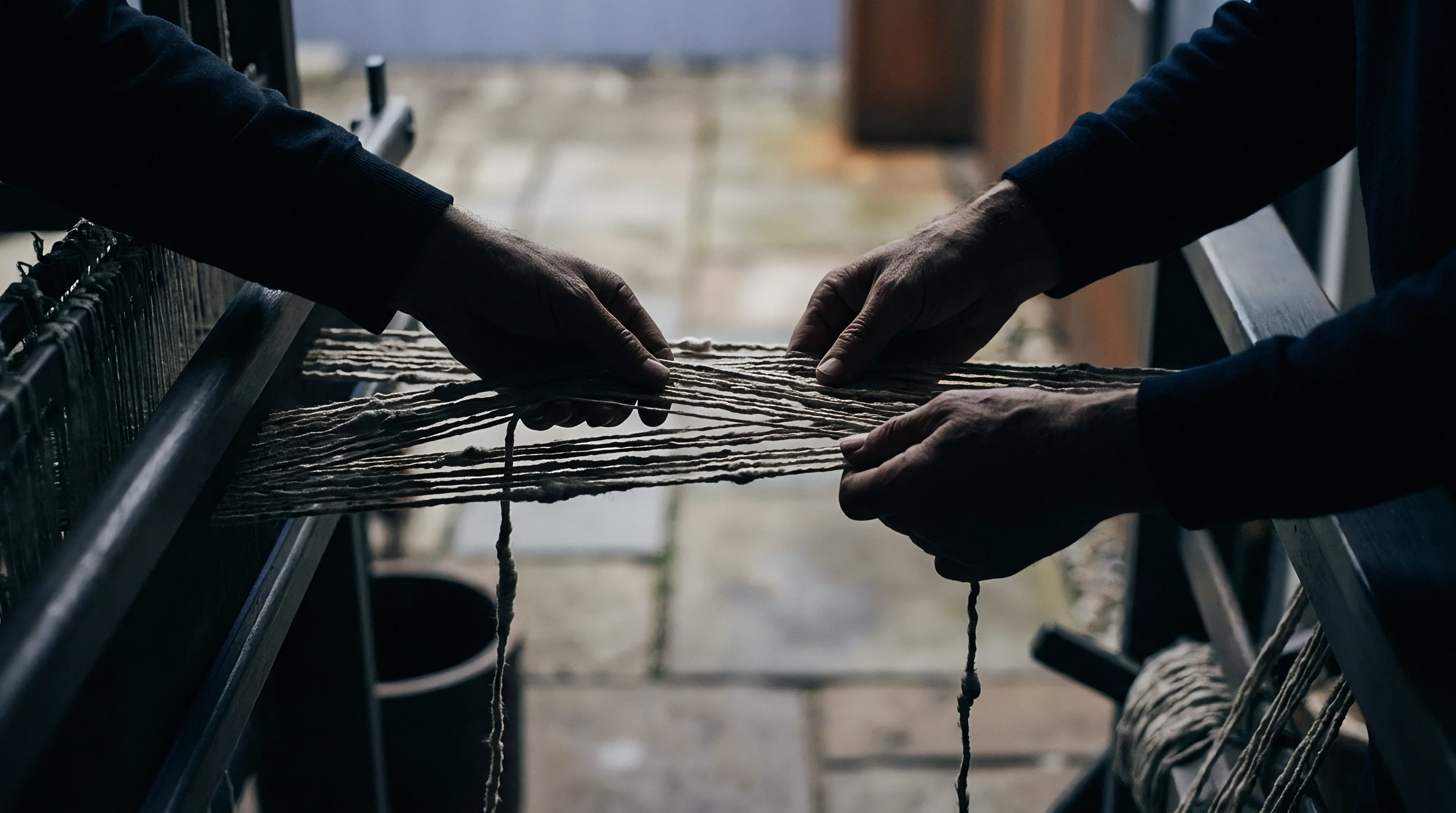
Dry split lease rods separate the warp sheet back into individual threads after it leaves the drying cylinders. High add-on levels glue adjacent threads into a solid ribbon at the steam cans. Forcing these chemical bridges apart at the lease rods leaves rough fracture points along the yarn.
These damaged points catch on drop wires, creating micro-snags that disrupt air-jet loom nozzles.
A converter absorbed an eight-thousand-dollar re-finishing charge when un-emulsified acrylic size survived scouring and caused spotty dye resist across five thousand metres of twill.

Arithmetic
Calculating minimum order quantities for greige weaving requires balancing creel capacity, beam barrel volume, and sizing set economics. Every production run incurs fixed losses in material and labor before usable grey cloth reaches the loom take-up. Slasher setup consumes yarn during creel threading, size box immersion, wet splitting, and dry leasing; operators must strip and discard fifty to one hundred metres of warp yarn per set because these initial segments are un-sized or unevenly coated.
The total weight of warp yarn required for a specific fabric order depends on yarn count, total ends, loom width, greige sett, and total set length including non-weaving setup allowances. Converting raw yarn specifications into landed fabric pricing requires calculating yarn consumption step by step across preparation, weaving, and finishing shrinkage stages.
Equations Governing Minimum Economic Warp Set Length
Determining the shortest viable production run begins with yarn package winding limits and slasher trough volume. Fixed setup losses stay constant whether a beam set yields 2,000 metres or 50,000 metres of fabric, so small greige orders absorb a much higher per-metre cost burden as fixed waste spreads over limited billable meterage.
The total warp ends calculation determines how many individual thread lines run parallel through the loom reed:
Total Warp Ends = (Greige Reed Width in Inches x Ends Per Inch) + Total Selvage Ends
Total warp yarn weight required for a complete sizing set accounts for yarn length, yarn count, and preparation waste factors:
Warp Weight in Kilograms = (Total Ends x Total Set Length in Metres) / (Yarn Count Ne x 1693.36) x (1 + Waste Factor Percentage / 100)
Where 1693.36 is the constant converting English Cotton Count (Ne) metres per pound to metres per kilogram. Total set length must include the billable greige fabric length plus all non-productive structural allowances:
Total Set Length = (Greige Fabric Metres / (1 – Weaver Crimp Factor)) + Slasher Setup Waste + Loom Cut-off Allowance + Creel Package Remnant Loss

Worked Case for Combed Cotton Greige Orders
A standard fifty-inch finished width twill in single 40s cotton shows how fixed preparation losses scale with run length. Consider an order for 5,000 finished metres of 100% combed cotton 3/1 twill. Target finished specifications call for 130 ends per inch, 70 picks per inch, and a weight of 210 grams per square metre.
Weaving contraction and wet-processing width shrinkage require a greige reed width of 63 inches. Setting greige density at 118 ends per inch yields 130 ends per inch after finishing. Adding 60 selvage ends (30 per side using doubled ground yarn) gives a total warp count of 7,494 ends (63 inches x 118 EPI + 60 selvage ends).
Calculating yarn mass requires adding operational losses step by step across production. Slasher setup consumes 80 metres of warp ends, while loom gaiting and tying-in consume 25 metres per weaver beam. Fabric crimp during weaving accounts for an 8.5% length loss, and finishing shrinkage adds another 3.0% loss from greige roll to finished fold.
| Run Length Scenario | Total Set Length (m) | Fixed Preparation Waste (m) | Waste Percentage of Warp Set | Preparation Cost per Metre ($/m) |
|---|---|---|---|---|
| Single Beam (2000m Greige) | 2,320 | 155 | 6.68% | 0.38 |
| Four-Beam Set (8000m Greige) | 8,980 | 230 | 2.56% | 0.12 |
| Eight-Beam Set (16000m Greige) | 17,860 | 330 | 1.85% | 0.06 |
| Full Slasher Run (40000m Greige) | 44,500 | 650 | 1.46% | 0.03 |
Delivering 5,000 finished metres requires 5,155 greige loom metres (5,000 / (1 – 0.03)). Accounting for weaving crimp requires 5,634 metres of sized warp (5,155 / (1 – 0.085)). The mill splits this across three weaver beams holding 1,878 metres each.
Total set length on the slasher comes to 5,789 metres, which combines the 5,634 metres with 80 metres of slasher waste and 75 metres of tie-in waste (3 beams x 25 metres).
Applying the warp weight formula for 7,494 ends of 40s Ne yarn over 5,789 metres yields (7,494 x 5,789) / (40 x 1693.36) = 640.4 kilograms of net warp yarn. Factoring in 1.5% creel package remnant loss raises raw yarn procurement to 650.1 kilograms. If the spinning mill mandates a minimum lot of 1,000 kilograms per count, the buyer either pays a structural yarn surcharge or must increase the order to 7,700 finished metres to meet the spinning lot minimum.
Standard gray cloth purchasing contracts allow a five percent quantity variance on order volumes below ten thousand metres due to head-end sizing cut-offs.
Shifting from section to direct beaming on a forty-thousand-metre order increases loom efficiency by three percent. Grey mill calculations directly affect margins, and evaluating these variables before signing purchase orders prevents cost overruns from package scrap and slasher waste.
- Creel Package Match aligns total creel end capacity with fabric reed end count to eliminate multi-pass beaming steps.
- Slasher Trough Capacity minimizes standing chemical bath volume discarded at the end of a warp set run.
- Weaver Beam Barrel Width matches grey loom reed space to prevent flange deflection and edge yarn collapse.
- Yarn Spinning Lot Sizing aligns raw fiber procurement volumes with full warp beam multiples to avoid partial package scrap.
Clause 4.2 of the International Standard Greige Contract specifies that warp waste exceeding two point five percent of total yarn weight remains the financial responsibility of the weaver unless package defects are documented upon arrival.

Waste
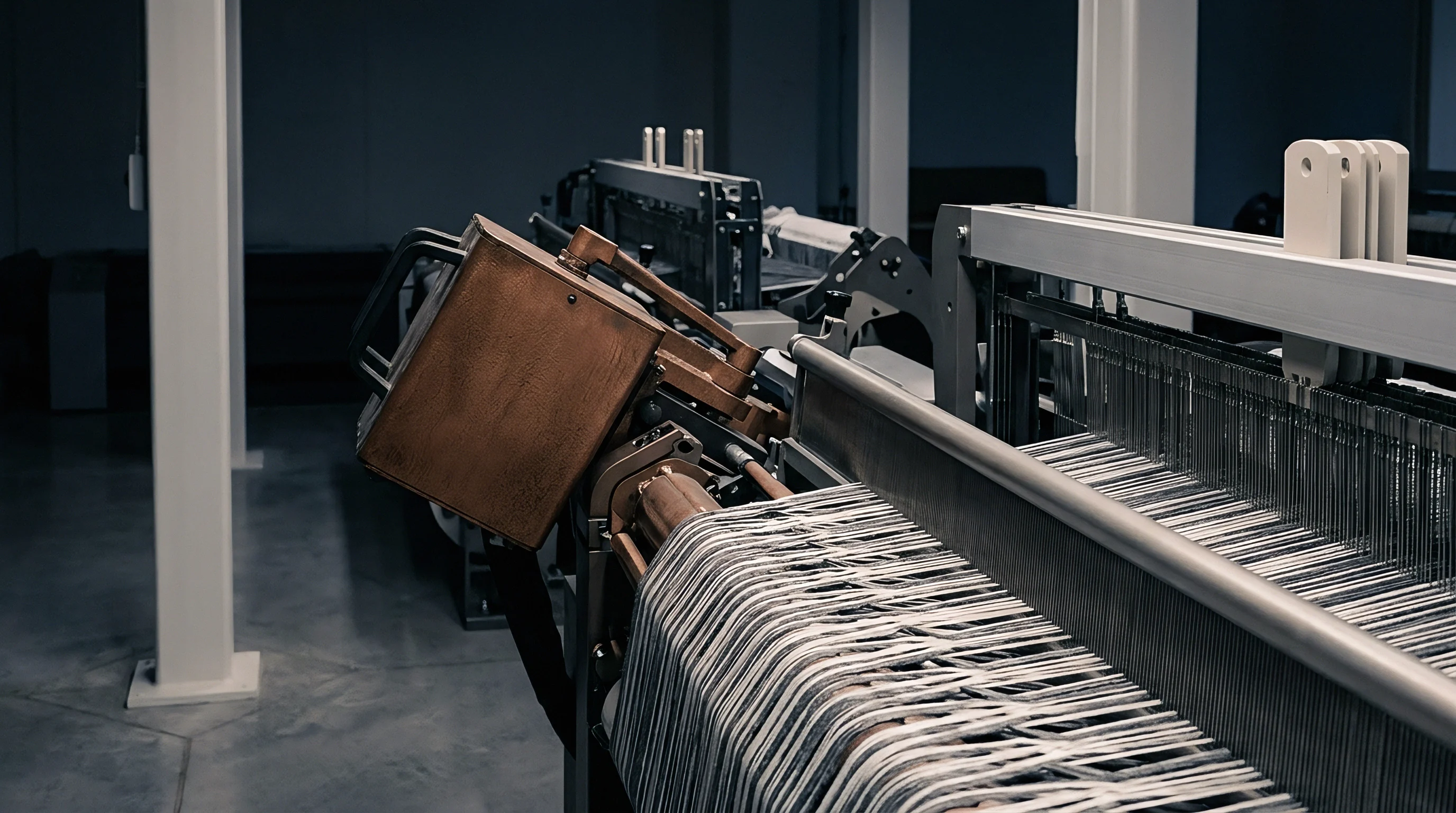
Unusable yarn generated during beam changes and sizing setup inflates landed costs per metre. Mills track waste across three areas: package remnants on creel bobbins, head-end cut-offs at the slasher size box, and setup tails from harness threading. Poorly optimized preparation can push cumulative yarn waste past eight percent of total purchased mass, erasing thin converter margins on commodity greige cloth.
Tension variations, soft beam edges, and crossed ends created during warping cause frequent machine stops in the loom shed. Each warp stop requires repair, leaving a visible stop mark or pick-finding distortion in the fabric. High break rates force weavers to run looms at lower picks per minute, inflating machine-hour costs that raise the greige cloth price.
How Does Greige Creel Waste Impact Landed Fabric Cost?
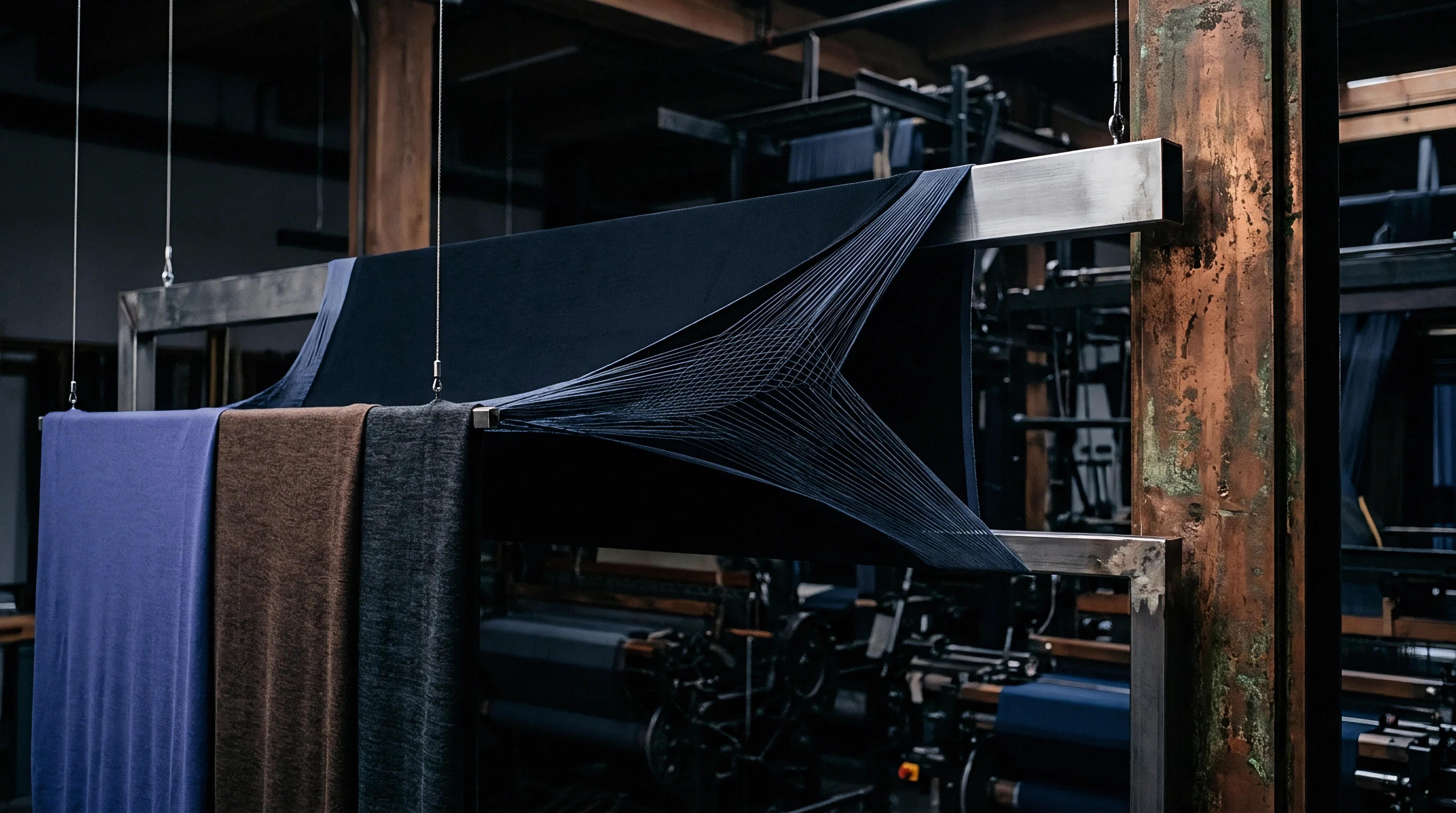
Yarn left on creel bobbins after a warp set completes represents an unaccounted material cost passed to the buyer. Uneven package lengths cause outer spools to run out while inner spools still hold hundreds of metres of usable yarn. High-speed beaming lines cannot economically strip and rewind these small remnants, so they are discarded as scrap while their purchase price remains in the net fabric invoice.
| Beaming and Sizing Defect | Mechanical Root Cause | Dyehouse Manifestation | Quality Tolerance Limit |
|---|---|---|---|
| Tension Striping | Unequal individual creel braking | Shade banding under D65 lighting | Zero visual tolerance on dyed goods |
| Sized End Ridge | Damaged comb dent at warper | Local abrasion streaks across rolls | Max 1 ridge per 1000m beam |
| Size Flaking (Shedding) | Inadequate binder film adhesion | Resist spot contamination in dye bath | LessThan 0.5% weight loss on loom |
| Thermal Dwell Line | Slasher stop over hot steam cans | Uneven dye affinity across full width | Reject affected roll segment |
Insufficient size add-on leaves surface fibers unprotected against friction from high-speed heddle movement. These fibers peel back into micro-balls or fuzz buttons that catch adjacent threads and trigger false warp stops on air-jet sensors. Conversely, excessive add-on makes yarn stiff and brittle, causing clean snaps under shed opening tension.
Both extremes drop loom productivity and increase fabric defects.
Yarn package tail remnants under two hundred grams per spool are rarely rewound and enter industrial scrap channels as low-value waste.
Warp break records trace directly to uneven creel package tension during high-speed beaming operations. Grey mill documentation must detail exact setup allowances and yarn utilization figures to establish accurate landed cost models.
- Warper Creel Loading Ledger detailing yarn spinning batch numbers, package mass, and individual tension setting records per spindle position.
- Slasher Process Control Sheet recording bath temperature, liquor solids concentration, squeeze roll hydraulic pressure, and drying cylinder steam pressures.
- Beam Density Inspection Certificate logging durometer hardness readings across five transverse points on every delivered warper and weaver beam.
- Loom Gaiting and Cut-off Report documenting head-end waste length, knotting efficiency, and initial fabric inspection scoring prior to volume production.
The industry continues to debate whether automated package splicing on high-speed creels reduces labor costs enough to offset the capital expense of optical sensor arrays.

Yield
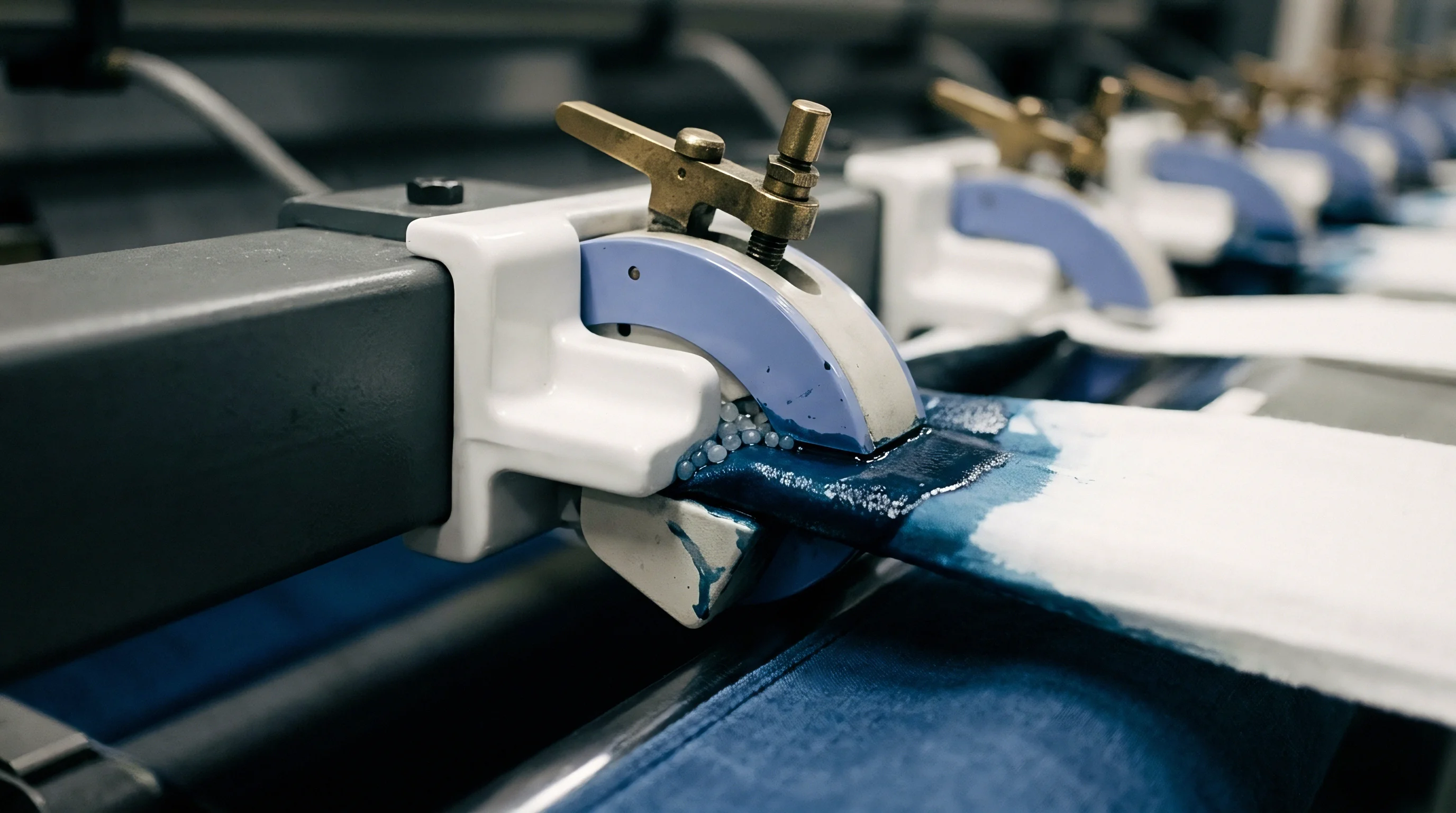
Converting raw warp yarn into acceptable finished fabric depends on loom efficiency and grey cloth inspection pass rates. Weaving speeds range from 500 picks per minute on heavy rapier looms to over 1200 picks per minute on narrow air-jet frames. Machine productivity hinges on warp beam quality ~ a well-sized, uniformly tensioned beam maintains operation with under one warp stop per 100,000 picks, achieving high pass rates under standard 4-point inspection procedures.
As weft threads interlace with warp threads under tension, warp ends bend around the filling yarns, contracting the sheet’s overall length. Warp crimp contraction typically ranges from 4% in loose plain weaves to over 12% in tight, high-density poplins and twills. Miscalculating warp crimp leads to purchasing insufficient yarn to fulfill linear metre contract commitments.
Loom Performance and Warp Stop Mechanics
High weaving speeds on modern air-jet looms demand high tensile strength and consistent film lubrication. When a single warp thread breaks, a drop wire falls onto an electrical contact bar to trigger the main brake. Frequent restarts create stop marks ~ horizontal bands where pick density spikes or drops.
Standard grey fabric inspections under ISO 13687 or ASTM D5430 heavily penalize stop marks, reducing the yield of first-quality cloth delivered to the dyehouse.
Variations in winding density across the weaver beam barrel cause edge threads to unwind at different rates than center threads. Slack edge threads sag in the shed opening, impeding pneumatic filling insertion on air-jet looms and causing weft stops. Greige beams require inspection for selvage buildup before approval for air-jet weaving, as tight edge threads snap under shed opening and create selvage tears that rip out completely during stenter drying.

Grey Goods Metre Conversion and Cost Recovery
Width contraction during weaving and wet processing alters final yield per beam set. Off the loom, greige cloth sits wider and lighter than its finished state. Desizing, scouring, bleaching, and dyeing remove warp size solids while shrinking the fiber matrix, raising mass per unit area under ISO 3801.
A gray fabric weighing 180 grams per square metre off the loom can reach 210 grams per square metre after wet processing, reducing linear yield while increasing weight density.
Inadequate press roll pressure during warp beaming creates soft internal layers that shift sideways during transport. When mounted on the loom unwinding stand, these soft beams feed unevenly, causing alignment drift that distorts selvage geometry. Correcting these structural defects at the dyehouse requires heavy tentering tension, which degrades tear strength and introduces dimensional instability.
Accurate greige minimum calculations require combining warp yarn weight, slasher waste allowances, weaving crimp, and finishing dimensional changes into a unified commercial model. Buying gray cloth without auditing a mill’s beaming and sizing parameters invites unrecoverable material losses and shade variation across finished production rolls.
Maintaining uniform warp beam hardness across the full barrel width prevents edge slackness and ensures clean shed opening in high-speed weaving.