Substrate Texture and Finishing Chemical Distortions across Multi Illuminant Color Matching Systems
Substrate texture and chemical finishes alter boundary layer reflectance, causing severe multi-illuminant color distortions that mimic true dye metamerism.


Ground
A lab dip matching an approved digital target at Delta E zero point four under CIE Illuminant D65 often registers a Delta E above one point eight under incandescent Illuminant A or commercial fluorescent Illuminant TL84. Dyehouses routinely attribute this mismatch to metamerism originating purely in the dyestuff formulation. Spectrophotometric analysis of finished goods demonstrates that the physical architecture of the substrate and the chemical film deposited during wet processing frequently cause this distortion.
Surface roughness alters the ratio of specular to diffuse reflectance, while functional finishes shift the refractive index of the boundary layer, producing illuminant-dependent color deviations.
When light strikes a textile, reflectance splits into two components: front-surface specular reflection and diffuse volume scattering. Specular reflection preserves the spectral power distribution of the incident light source without selective absorption by dyestuff molecules. Diffuse reflection penetrates the fiber matrix, undergoing internal refraction and wavelength-selective absorption by colorant aggregates before scattering back to the viewing plane.
An untreated 3/1 twill cotton greige presents a rough, anisotropic surface with high geometric variance. This profile induces multiple internal light traps, lowering overall lightness and scattering specular reflections unevenly across directional viewing angles. Calendering, flat pressing, or continuous hot-air stentering flattens surface yarn crowns, aligning fiber axes and elevating directional specular reflectance.
Standardized spectrophotometric tolerance agreements fail across secondary illumination sources when surface roughness indices diverge between the primary standard and bulk finished lots.
Reflective behavior shifts when synthetic or natural resin finishes coat the substrate. Application of a durable water repellent fluoropolymer emulsion or an amino-silicone micro-emulsion establishes a thin optical boundary film over the fiber walls. Typical fiber refractive indices span 1.51 to 1.54 for cotton and 1.58 to 1.62 for polyethylene terephthalate.
Typical cured silicone films register refractive indices between 1.40 and 1.43, whereas fluorochemical coatings span 1.33 to 1.38. This intermediate layer alters Fresnel reflection values across the air-coating and coating-fiber boundaries. The resulting shift in boundary layer reflectance disproportionately affects incident spectra possessing pronounced peaks in short wavelengths, such as CIE Illuminant D65, relative to red-heavy continuous spectra characteristic of CIE Illuminant A.
Spectral power distribution shifts between daylight simulators and narrow-band tri-phosphor fluorescents expose how surface geometry distorts colorant perception. Illuminant TL84, centered on narrow emissions at 435, 545, and 611 nanometers, interacts unevenly with surface morphology. Rough substrates scatter these discrete emission peaks through micro-crevices, changing the path length of light passing through dyed fiber layers.
The dye formulation absorbs along its calibrated transmission curve, but the effective absorption coefficient changes as local scattering coefficients fluctuate. Consequently, a digital recipe balanced for diffuse illumination under standard D65 conditions fails under structured point-source illumination. The technician in the light booth observes a severe batch-to-standard shade shift, mistakenly diagnosing chemical metamerism when the failure stems from unmanaged substrate texture and topochemical finish variations.


Boundary

Optical Mechanics of Fiber Coatings
The boundary between ambient air and a textile fiber serves as the initial optical interface. Untreated fibers scatter incident flux based on their cross-sectional morphology. Round cross-section polyester yields smooth, predictable specular bands, whereas trilobal filaments create multi-directional high-intensity specular highlights.
The introduction of wet-finishing chemistries modifies this baseline behavior. Cross-linking resins applied for wrinkle resistance, such as dimethyloldihydroxyethyleneurea, deposit uneven crystalline films within amorphous fiber zones and along the outer yarn surfaces. These films introduce microscopic variations in optical thickness, generating phase differences in reflected light waves.
Silicone softening agents generate distinct optical modifications across the visible spectrum. Cationic macro-emulsions deposit irregular droplet residues across outer fiber sheaths, creating localized scattering nodes that disperse short-wavelength light. Micro-emulsions, exhibiting particle sizes below forty nanometers, penetrate the yarn structure, laying down a thin film that smooths the outer fiber envelope.
This surface smoothing eliminates microscopic air gaps, suppressing diffuse surface scattering. Specular reflection concentrates along narrow angles, increasing apparent depth of shade by three to eight percent. The color appears visibly deeper despite identical dye mass uptake, disrupting color-matching algorithms calibrated on untreated greige reference targets.
| Material or Chemical Treatment | Base Refractive Index (nD at 20C) | Specular Gloss Ratio (ASTM D523 60 deg) | Mean Surface Roughness Ra (microns) | Short-Wave Reflectance Shift (400-500 nm) |
|---|---|---|---|---|
| Ring-Spun Combed Cotton Twill (Untreated) | 1.53 | 2.1 | 14.8 | Reference Baseline |
| Mercerized Combed Cotton Twill | 1.54 | 5.8 | 8.2 | -4.2 percent |
| Cotton Finished with DMDHEU Resin (65 g/L) | 1.49 | 3.4 | 11.6 | +6.1 percent |
| Cotton Finished with Amino-Silicone (20 g/L) | 1.41 | 7.2 | 6.4 | -8.7 percent |
| Cotton Finished with C6 Fluoropolymer (30 g/L) | 1.36 | 4.1 | 9.8 | +3.5 percent |
| Polyester Interlock (Microdenier, Untreated) | 1.61 | 12.4 | 4.1 | Reference Baseline |
| Polyester Finished with Polyurethane Binder | 1.50 | 18.6 | 2.2 | -11.4 percent |
Hydrophobic fluorochemical finishes create low-energy surfaces through fluorocarbon tails oriented outward toward the air boundary. This chemical architecture forms an optical barrier with a refractive index substantially lower than the underlying substrate. When unpolarized incident light strikes this barrier, the Brewster angle shifts, modifying internal reflection ratios within the dyed fiber.
Spectrophotometric measurement geometries conforming to CIE 15:2018 reveal that integrating-sphere instruments operated in specular-component-included mode fail to isolate these micro-boundary shifts from true colorant absorption. Measuring the identical swatch with the specular component excluded produces a sharp color vector deviation, identifying the finish as a primary contributor to spectral variation.
Optical boundary films with a refractive index below one point four increase internal reflection angles, shifting measured spectral coordinates under directional lighting.
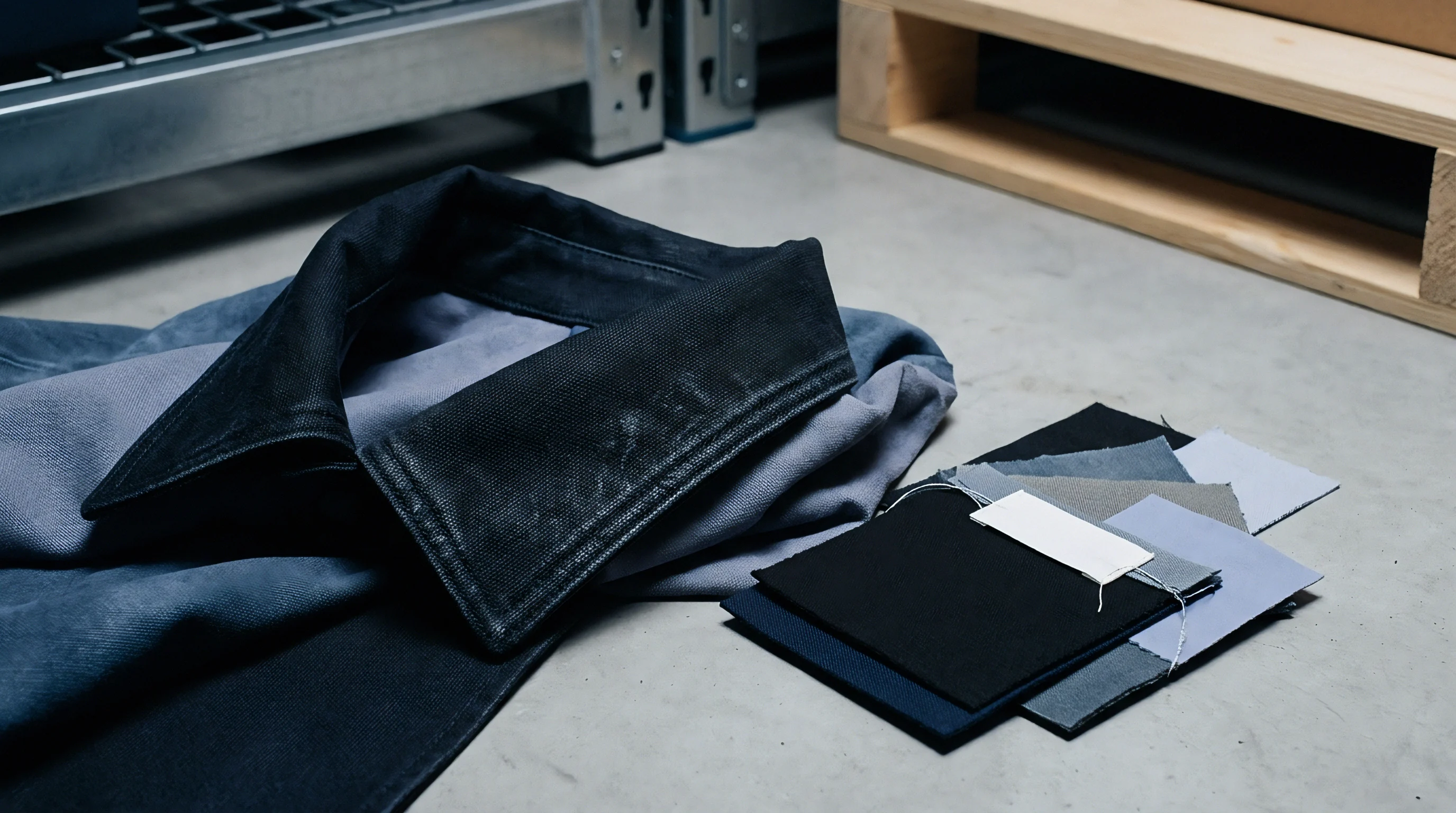
Topochemical Influence on Spectral Power Distributions
Topochemical chemical deposits act as secondary spectral filters when struck by specific light sources. Under high-color-rendering daylight simulators, such as filtered tungsten systems matching ISO 3664 parameters, the balanced continuous spectrum masks subtle localized distortions caused by surface finishes. When transferred to fluorescent sources like Illuminant F02 (Cool White Fluorescent) or narrow tri-band sources like F11 (TL84), the textile reflects discrete spectral bands into the observer eye.
Uneven resin applications induce differential scattering across these localized peaks, generating an artificial metamerism index that does not exist on untreated dyed yardage.
Optical brightening agents present in scouring formulations or co-applied with functional softeners introduce an active emission layer. These stilbene derivatives absorb ultraviolet radiation between 340 and 380 nanometers, re-emitting visible light in the 420 to 460 nanometer blue spectrum. If a laboratory standard contains an uncalibrated brightener while the production bulk incorporates a cross-linking resin that quenches fluorescence, the two lots diverge dramatically when moved from an ultraviolet-rich D65 light booth to an ultraviolet-depleted incandescent Illuminant A booth.
The chemical quenching alters the blue emission balance, producing a visible shade shift across light sources without changes to the base dye formula.


Weave
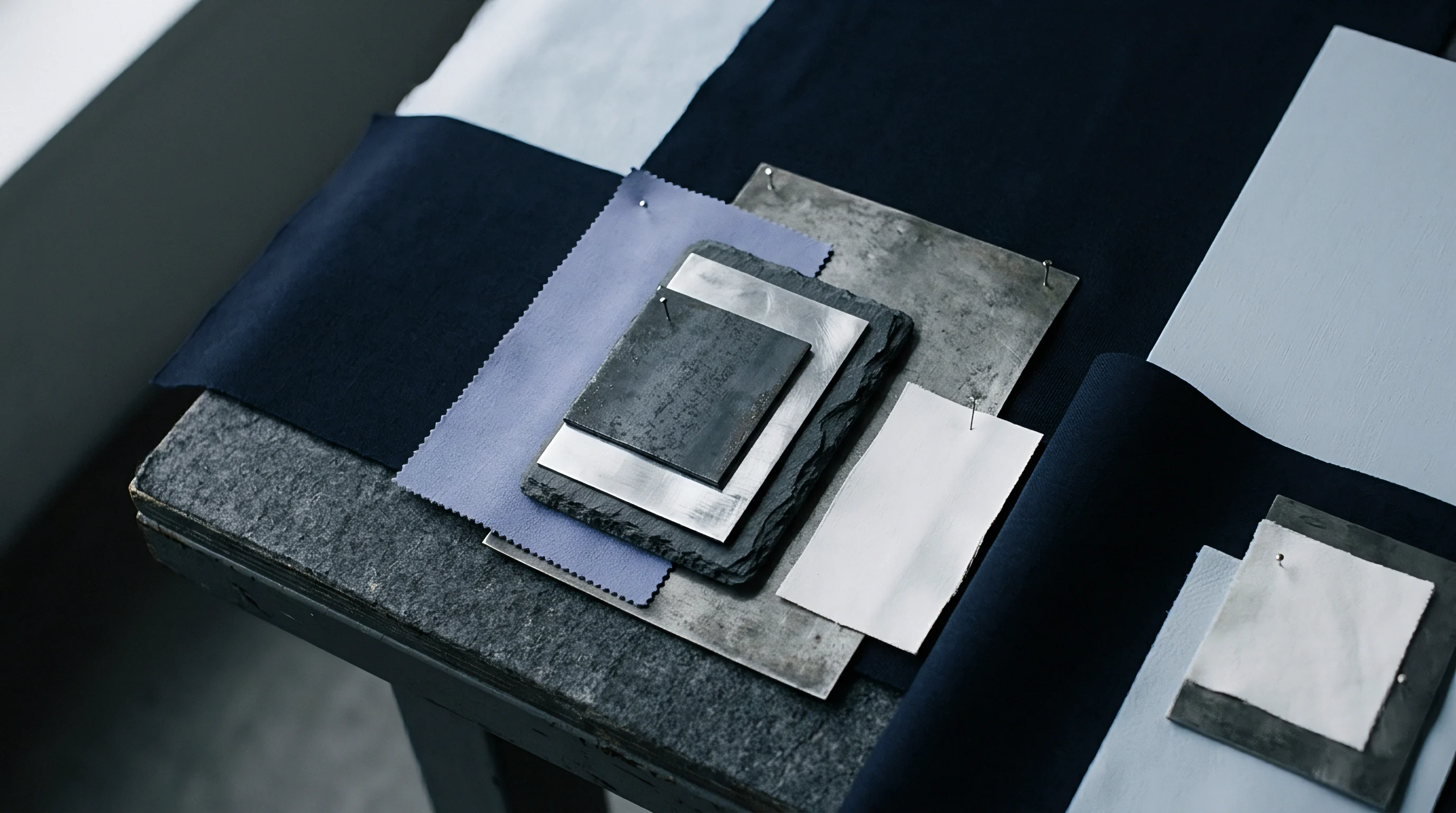
Geometric Shading and Yarn Architecture
Yarn structure sets the mechanical baseline for textile light interaction. Ringspun yarns present protruding surface hairs that disperse specular reflection across three hundred sixty degrees, producing an isotropic, matte visual appearance. Open-end rotor yarns introduce wrapper fibers oriented perpendicular to the main yarn axis, creating irregular optical disruptions that scatter light unpredictably across short distances.
Continuous filament yarns, particularly flat zero-twist polyester or polyamide, reflect light like cylindrical mirrors, concentrating specular flux along rigid geometric paths. Texturizing via false-twist processes introduces crimp loops that disperse these specular bands into high-frequency glittering patterns, directly distorting spectrophotometric aperture readings.
Fabric construction establishes structural shadowing through float geometry. In a plain weave 1/1 construction, warp and weft yarns cross at every thread, generating high crimp frequency and numerous microscopic light-trapping crevices. A satin weave 4/1 or 7/1 architecture features long surface floats that align fibers in a singular directional plane.
Incident light parallel to these floats reflects specularly, increasing measured chroma and lightness. Rotating the satin specimen ninety degrees on the spectrophotometer aperture exposes cross-thread interstitial shadows, causing measured L-star values under CIE L a b color space to drop by two to four units. Multi-illuminant software algorithms misinterpret this rotational directional variance as formulation drift, driving unneeded dyestuff corrections on the production floor.
Knitted architectures introduce three-dimensional loop curvature. The needle loop and sinker loop present continuously varying surface angles to incident light. In single jersey structures, loop spirality caused by unbalanced yarn torque skews directional reflectance.
When high-twist single yarns relax during wet processing, wales lean at angles between four and twelve degrees. A directional light source, such as a focused retail LED spotlight with a forty-degree beam angle, casts unequal shadows across the leaning wales. Light sources containing narrow spectral emissions interact with these physical shadows, causing localized color shifts that flat-plane Kubelka-Munk formulations cannot calculate.
Jacquard designs and complex dobby weaves compound these optical shifts by combining disparate float lengths across adjacent zones. Long-float warp zones behave like satin structures, while ground zones behave like plain weaves. When treated with wet-finishing processes, long-float areas absorb finishing chemicals differently from tightly crimped ground areas due to variable packing density and fluid capillary pressure.
Differential resin uptake across structural patterns produces localized differences in refractive index and specular gloss, leading to variable shade matching across illuminants on identical woven ground.

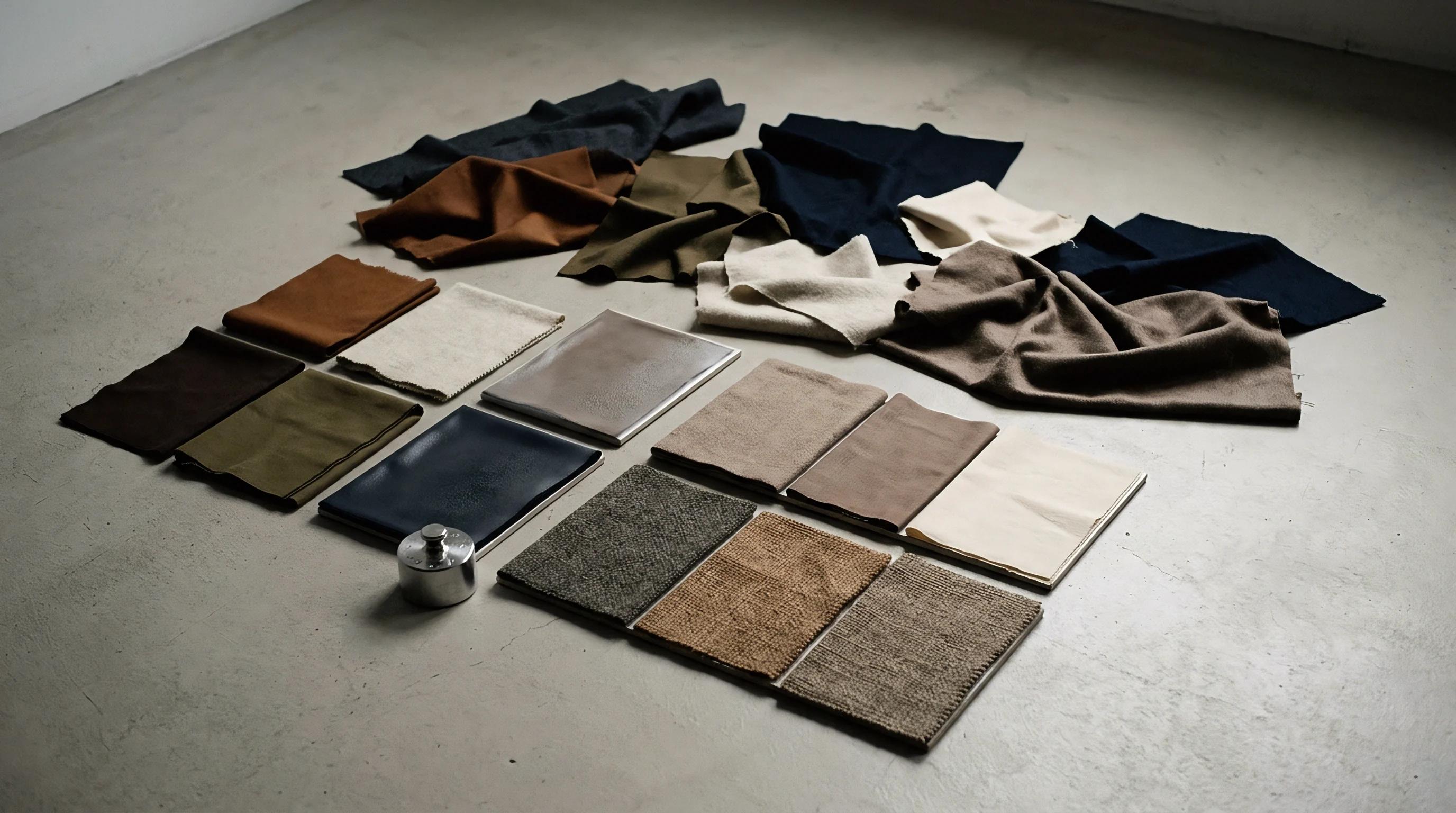
Aperture

Integration Geometry and Specular Management
Accurate color evaluation across disparate light sources requires careful configuration of instrument measurement geometry. Standard benchtop spectrophotometers employ either an integrating sphere geometry (diffuse/8-degree or 8-degree/diffuse) or a directional geometry (45/0 or 0/45). Integrating-sphere systems illuminate the fabric sample diffusely via a barium sulfate or PTFE-coated cavity, reading reflected energy at an angle eight degrees from perpendicular.
These systems feature specular gloss traps, enabling measurement with the specular component included or excluded. Selecting specular-included mode captures all reflected flux, theoretically neutralizing the impact of surface texture. However, heavily textured fabrics introduce internal self-shadowing that traps light before it can exit into the sphere cavity, frustrating theoretical compensation.
Directional 45/0 geometry illuminates the specimen at forty-five degrees and reads reflected light at ninety degrees normal to the surface, mimicking human viewing geometry inside a standard light booth. This configuration remains sensitive to surface texture and directional finishing patterns. A calendered fabric measured on a 45/0 instrument shows dramatic color changes when rotated on the port, directly reflecting the visual shift human observers encounter under showroom spotlights.
For quality audits, pairing 45/0 measurements with diffuse/8-degree data isolates geometric finish artifacts from real colorant metamerism. Failure to isolate these variables leads suppliers to reformulate dye mixtures when the root cause sits in stenter frame overfeed settings.
| Wet-Finishing State | d/8 Specular Included (D65) | d/8 Specular Excluded (D65) | 45/0 Geometry (D65) | 45/0 Geometry (Illuminant A) | Delta E cmc (D65 to A Shift) |
|---|---|---|---|---|---|
| Scoured Greige (No Finish) | L: 42.1, a: 12.3, b: -8.4 | L: 41.8, a: 12.4, b: -8.3 | L: 40.2, a: 12.8, b: -8.1 | L: 41.1, a: 14.2, b: -6.5 | 0.82 |
| Cationic Softener (Padding 30 g/L) | L: 40.8, a: 12.6, b: -8.6 | L: 39.9, a: 12.9, b: -8.5 | L: 38.1, a: 13.4, b: -8.2 | L: 39.4, a: 15.1, b: -6.1 | 1.44 |
| Amino-Silicone (Padding 25 g/L) | L: 39.4, a: 13.1, b: -8.9 | L: 38.2, a: 13.5, b: -8.8 | L: 36.4, a: 14.1, b: -8.4 | L: 37.9, a: 16.2, b: -5.8 | 1.96 |
| Melamine Resin + Calendered (20 bar) | L: 38.2, a: 13.4, b: -9.1 | L: 36.5, a: 14.2, b: -9.0 | L: 34.2, a: 15.3, b: -8.3 | L: 36.1, a: 17.8, b: -5.1 | 2.68 |
| C6 Fluorochemical DWR (Padding 40 g/L) | L: 41.4, a: 12.5, b: -8.5 | L: 40.9, a: 12.7, b: -8.4 | L: 39.3, a: 13.1, b: -8.2 | L: 40.4, a: 14.8, b: -6.3 | 1.15 |
Aperture dimensions directly influence measurement stability on structured surfaces. Small area view apertures, spanning three to six millimeters, capture localized high-gloss yarn crowns or deep interstitial shadows. Measurements taken across three adjacent spots on a textured woven cloth often exhibit a Delta E spread exceeding one point zero under identical light conditions.
Switching to large area view apertures, spanning twenty-five to thirty millimeters, averages these microscopic light traps over multiple weave repeat units, stabilizing spectral curves. When auditing suppliers, buyers must enforce sample folding routines, standardized multi-rotation averages, and minimum aperture dimensions to prevent texture-induced noise from masquerading as batch-to-batch shade drift.


Stenter

How Does Finishing Tension Distort Spectral Reflectance?
The stenter frame serves as the final arbiter of surface geometry and finish distribution in the dyehouse. Overfeed settings and mechanical cross-tensions determine the finished thread count and surface density of woven and knitted substrates. High warp overfeed relaxes longitudinal tension, bunching yarns closer together, elevating the fabric cover factor, and creating raised cross-grain ridges.
Conversely, high mechanical weft pull widens interstitial gaps between threads, exposing deeper yarn facets to incident illumination. When light strikes these stretched fabrics, internal light scattering increases through open apertures, diminishing the intensity of specular reflectance and flattening spectral absorption curves.
Thermal zones within the stenter control the migration of water-soluble finishes toward fabric surfaces. Rapid hot-air drying at elevated temperatures, exceeding one hundred seventy degrees Celsius, vaporizes unbound water prematurely from core fibers. This capillary evaporation draws dissolved cross-linking resins, fluorochemical emulsions, and silicone softeners outward to the yarn crowns.
This process, known as thermal chemical migration, deposits an abnormally concentrated chemical crust across the fabric surface. If heat balance across stenter nozzles varies from left to right, chemical crust thickness fluctuates across the fabric width, causing a side-center-side shade discrepancy that magnifies under secondary light sources.
The mechanical interaction of high heat and finish distribution alters perceived metamerism:
- Mechanical tension adjustments stretch interstitial yarn spaces, exposing deeper fibers and altering the diffuse light scattering coefficient across the full visible spectrum.
- High-velocity air nozzles induce rapid capillary fluid migration toward top yarn crowns, concentrating functional polymers on the outer optical boundary layer.
- Thermosol cross-linking reactions cure resin deposits into uneven surface micro-lenses that distort refractive behavior under directional retail spotlights.
- Cooling zone friction fixes fiber structural alignment permanently, locking in anisotropic specular reflectance vectors that disrupt multi-illuminant color match algorithms.
Tension imbalances also produce structural skew and bow. When weft yarns skew past three percent off square, directional reflectance aligns diagonally across the width of the bolt. In apparel assembly facilities, cutting panels across skewed fabric lots introduces directional shade mismatches along joined seams.
The pattern pieces, cut at opposing angles relative to skewed yarn crowns, reflect different specular ratios toward visual inspectors. Under uniform CIE D65 light in the inspection station, the shade variation appears negligible. Under directional narrow-band LED or fluorescent retail lighting, the differential bounce off skewed surface filaments causes adjoining garment panels to register as two distinct dye lots.
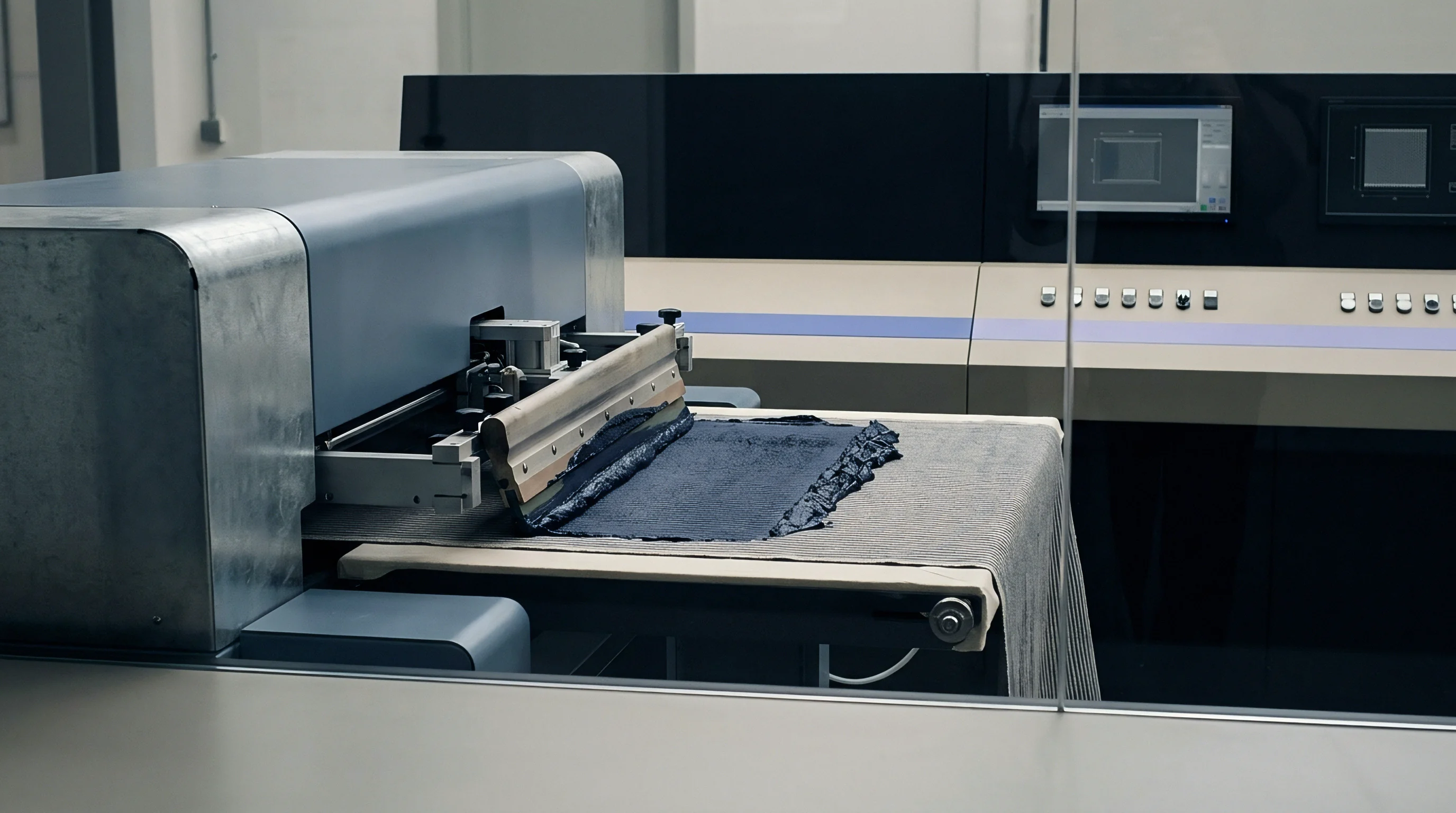
Audit
Establishing Multi-Illuminant Verification Standards
Preventing chemical and substrate color distortions requires strict verification protocols that separate base dye formulation metamerism from mechanical finish artifacts. Relying solely on a primary illuminant D65 shade sign-off exposes buyers to retail-floor rejection when goods land under secondary light sources. Technical specifications must establish three mandatory illuminants for commercial sign-off: CIE D65 for artificial daylight, CIE Illuminant A for residential incandescent conditions, and a point-of-sale narrow tri-band fluorescent (TL84/F11) or thirty-one hundred Kelvin LED standard.
Bulk production lots must achieve strict Delta E tolerances under all three lights simultaneously to secure shipping authorization.
Fabric purchase orders must define instrumental tolerances tied directly to substrate classification and wet-finishing chemistry. Smooth filament woven fabrics with low resin finishes accept tight tolerances, whereas textured knits with heavy topical softeners require wider tolerances that account for structural geometric noise. Sourcing contracts should require the following specific clauses to bind mills to measurable standards:
- Spectrophotometer configuration clauses enforce integrating-sphere diffuse/8-degree instrument parameters using a twenty-five millimeter large area view aperture, specular component included, with the final batch average derived from four ninety-degree rotational readings.
- Illuminant tolerance thresholds set commercial limits using the CMC (2:1) color difference formula: Delta E below zero point seven under primary D65, Delta E below zero point nine under secondary Illuminant A, and Delta E below zero point eight under commercial point-of-sale illuminant TL84.
- Metamerism Index ceilings restrict the calculated metamerism index across the three specified illuminants to a maximum value of zero point five, preventing the use of cheaper dye formulations with wild cross-illuminant swings.
- Sample conditioning requirements mandate that all test swatches equilibrate for at least four hours at twenty degrees Celsius and sixty-five percent relative humidity per ISO 139 prior to spectral reading.
Implementing these controls prevents mills from masking poor dyestuff selection under the guise of finish variation, while protecting them from unfair rejections caused by improper measurement technique.
According to the standard supplier sales conditions, finish-related shade shifts across retail illumination are natural physical traits of functional textiles that fall outside standard batch color tolerances.
Transit
Finished goods rarely remain in the stable physical state achieved upon exiting the stenter frame. Ocean transit subjects packed fabric rolls to prolonged thermal and hygroscopic stress inside sealed steel shipping containers. Ambient temperatures inside container holds routinely climb above fifty degrees Celsius in equatorial shipping lanes, while relative humidity levels fluctuate between sixty and ninety-five percent over three to four weeks of transit.
These aggressive environmental conditions reactivate residual finishing chemicals, swell cellulosic fibers, and alter the structural geometry of the substrate before the fabric reaches the cutting room table.
Hygroscopic swelling alters the mechanical relationship between warp and weft yarns. As natural fibers like cotton, linen, or viscose absorb moisture vapor from humid shipping air, fiber diameter expands by fifteen to twenty-five percent, while longitudinal length remains static. This radial expansion forces adjacent yarns tightly against each other, increasing crimp amplitude and pushing yarn crowns higher along the fabric surface.
The fabric thickens, surface roughness indices increase, and the ratio of specular to diffuse reflectance shifts dramatically between the final inspection frame at the origin mill and the incoming quality audit at the destination warehouse. Color measurement taken in the receiving facility reveals an apparent loss of chroma and an increase in lightness, skewing multi-illuminant delta values beyond agreed contractual tolerances.
Hydrophobic finishes and silicone softeners behave unstably under sustained container heat. Prolonged thermal exposure near the glass transition temperature of soft acrylic polymers or silicone micro-emulsions encourages continuous phase migration. Lower-molecular-weight silicone fractions flow through capillary action toward the outer surface of packed rolls, pooling against adjacent fabric layers under high mechanical roll-winding tension.
This uneven chemical redistribution produces mottled surface films with variable refractive indices across the length of the bolt. When unrolled under retail lighting at destination, localized areas exhibit variable specular gloss, causing perceived patchiness that cannot be corrected without scouring and refinishing the yardage.
A shipping container packed with moist rolls carries significant economic risk. When post-transit shade drift forces fabric rejections at the destination port, returning the container to the origin mill incurs catastrophic freight and duty losses. Stripping the finish, re-dyeing the lot to compensate for optical drift, and re-applying chemical softeners adds two to three weeks of lost production time, erodes mill margins, and strains vendor-buyer relationships.
Addressing transit-induced distortions requires controlling fabric moisture regain prior to roll packing, sealing goods inside moisture-impermeable plastic liners, and accounting for post-finishing relaxation dynamics when formulating color recipes on the dyehouse floor.
Whether regional logistics hubs will adopt climate-controlled shipping containers for moisture-sensitive technical textiles remains dependent on freight rate economics.