Calculating Commercial Weight Adjustments under International Standard Fibre Regain Allowances
Commercial weight adjustments convert scale mass to settled value by adding official international fibre regain percentages to verified oven-dry test mass.

Audit
Trading raw textile fibres, continuous filament yarns, and spun packages across borders involves paying for water under legally binding parameters. When ocean containers dock after three weeks at sea, scale tickets never match mill packing lists. Ambient humidity in transit drives physical mass up or down depending on polymer chemistry, packaging integrity, and seasonal temperature swings.
Settlement relies on calculating commercial weight through standardized regain factors rather than honoring the gross scale pull at unloading bays. Standard bodies define commercial regain as an agreed percentage added to moisture-free dry mass to establish an equitable commercial transaction value.
A moisture deviation of two percent on twenty metric tonnes of combed cotton shifts invoice settlement by eight hundred and forty kilograms of billed material.
Water alters landed commodity pricing. An invoice generated purely on gross scale mass penalizes either the spinner or the merchant whenever atmospheric moisture fluctuates. International contracts under standard trade terms eliminate variable water mass by converting as-received bulk scale tickets into corrected commercial billing weights.
The conversion strips actual water through standardized oven drying or certified moisture meters, isolates oven-dry mass, and adds back the legally designated commercial regain allowance. This arithmetic establishes parity across varied container voyages, warehouse climates, and mill processing halls.

Invoice Weight versus Moisture Corrected Valuation
Physical scales measure gravitational pull on fibre mass, surface finishes, natural impurities, and trapped atmospheric water. In contrast, commercial mass represents an agreed legal construct designed to eliminate weather volatility from trade ledgers. Commercial regain values originate from industry conventions codified by ASTM International, the International Bureau for the Standardisation of Man-Made Fibres, and the International Wool Textile Organisation.
These numbers reflect the moisture percentage that bone-dry fibres absorb when exposed to standard atmospheric testing conditions of twenty degrees Celsius and sixty-five percent relative humidity, with small adjustments to cover process finishes and residual impurities.
Suppliers quote landed commodity prices per kilogram based on certified commercial weight. When moisture testing reveals that raw baled stock carries moisture above standard allowance, the buyer deducts excess water weight from the payable invoice total. Conversely, shipments arriving below standard regain permit the seller to apply a surcharge upward, billing for delivered dry substance that will absorb environmental humidity during downstream carding and drafting.
Neglecting this adjustment distorts the true price per kilogram by three to eight percent on cellar-conditioned cotton and cellulosic yarns.
Where Do Commercial Regain Values Part from Physical Content?
Regain expresses water mass as a percentage of bone-dry fibre weight, whereas moisture content expresses water mass as a percentage of total damp material weight. Confusing these two distinct definitions represents an expensive administrative error in contract reconciliations. If one hundred kilograms of oven-dry cellulosic staple contains eleven kilograms of water, the moisture regain equals eleven percent.
The moisture content of that exact same parcel equals nine point nine one percent because the eleven kilograms of water is divided by the one hundred and eleven kilograms of moist fibre.
Cellulose absorbs ambient atmospheric water. Natural protein structures pull even greater quantities from damp air. Synthetic polymers shed ambient humidity.
Because industrial drying ovens establish zero-moisture dry mass as the baseline reference point, international commercial adjustments utilize moisture regain formulas rather than moisture content fractions. Standard commercial allowances frequently exceed equilibrium moisture regains measured inside scientific testing chambers. Commercial regain for scoured wool fleece sits between sixteen and seventeen percent, whereas commercial allowances for combed wool top treated with oil reach eighteen point two five percent to compensate spinners for protective lubricants applied during processing.
Failure to execute commercial regain reconciliations hands sellers an unearned cash windfall whenever wet containers enter receiving docks.

Desiccation
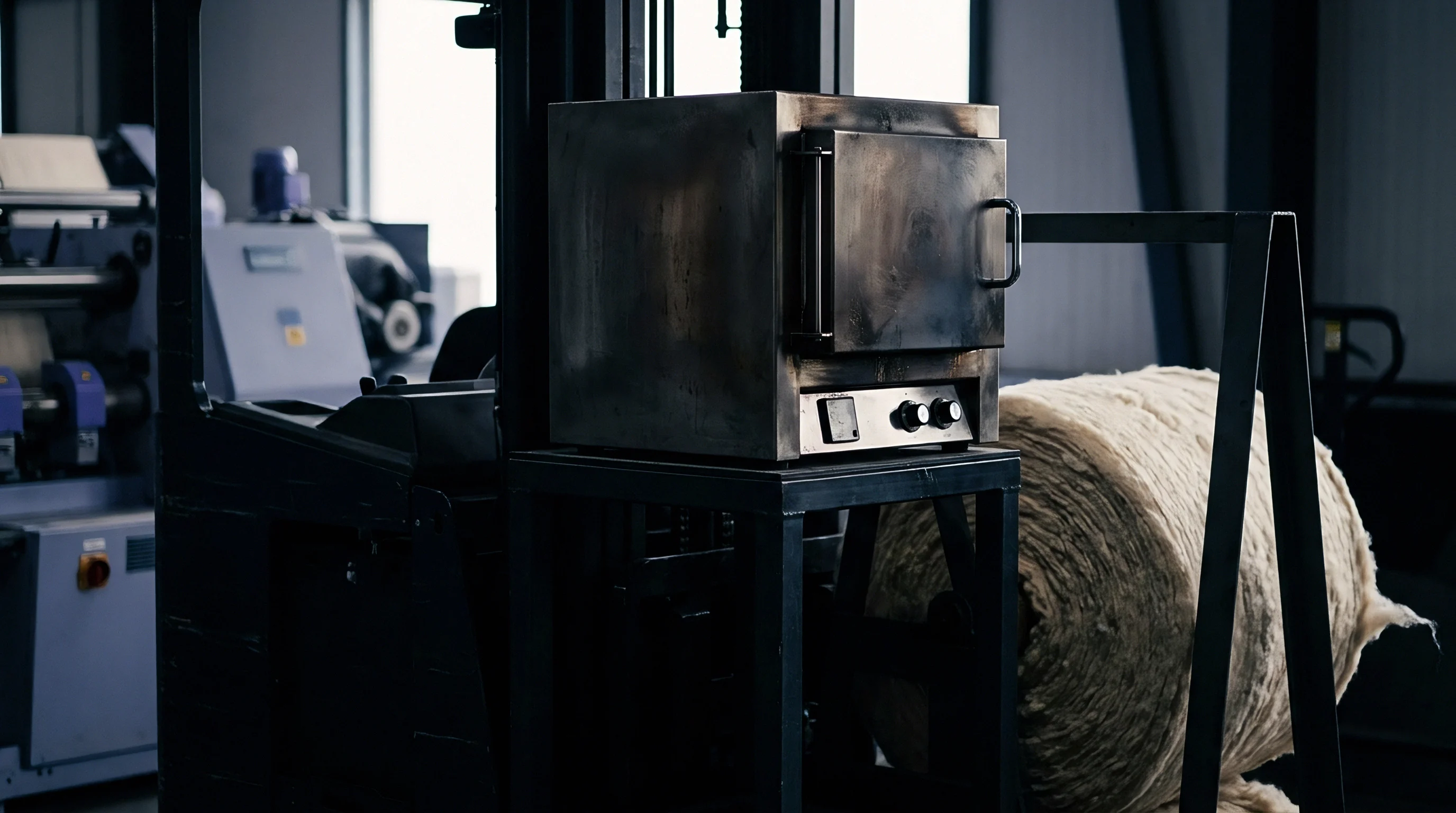
Determining the true commercial mass of any textile consignment begins by extracting representative test samples and desiccating them to absolute bone-dry mass inside ventilated conditioning ovens. Standard testing protocols, such as ISO 6741 and ASTM D2495, govern this thermal extraction process. Technicians extract laboratory subsamples from designated zones within opened bales or yarn cases immediately upon container unstuffing.
These specimens are sealed inside vapour-tight aluminum canisters before mill floor air alters their moisture state.
The weighing vessel stays sealed. Technicians transfer specimen canisters to analytical balances inside temperature-controlled testing rooms. Bone-dry determinations demand heating test specimens to one hundred and five degrees Celsius plus or minus three degrees until successive weighings separated by fifteen-minute drying intervals show weight constancy below zero point zero five percent.
The final dry measurement establishes the denominator for every contractual commercial weight adjustment calculation.
Oven Drying Parameters across Testing Houses
Drying apparatus design influences moisture extraction kinetics and dry mass determination accuracy. Forced-air circulation ovens draw ambient laboratory air, heat that air stream to one hundred and five degrees Celsius, and pass it continuously over wire-basket specimens before exhausting moisture-laden air outside the chamber. High-volume testing houses verify the relative humidity of incoming laboratory air, because heated air retains absolute ambient moisture that resists complete sample dehydration.
Hot containers vent air pressure. Handling hot weighing cans demands either weighing specimens directly inside the heated oven chamber using integrated balance linkages or sealing specimens inside desiccators chilled with activated silica gel. Weighing hot canisters on external pan balances without temperature stabilization creates convection currents that generate false negative weight readings on laboratory displays.
- Thermal Degradation of Cellulosic Chains occurs when drying temperatures exceed one hundred and ten degrees Celsius, causing polysaccharide scorching and artificial mass loss through pyrolysis.
- Volatilization of Synthetic Spinning Finishes occurs during prolonged heating cycles, venting paraffin lubricants and spin finishes alongside evaporating water to produce overstated dry weight deductions.
- Moisture Readsorption During Vessel Transfer distorts tare weights whenever technicians leave hot desiccator lids ajar during ambient cooling steps.
- Air Convection Buoyancy generates fluctuating balance readouts when technicians weigh uncooled aluminum canisters directly on open analytical pans.

Can Desiccation Oven Temperatures Distort True Oven Dry Mass?
Keratin structures inside animal fibres react sensitively to sustained thermal desiccation. Wool testing under International Wool Textile Organisation standard IWTO-33 enforces strict drying regimes to avoid oxidizing disulfide bonds. Heating protein fibres above one hundred and five degrees Celsius volatilizes residual wool grease and degrades peptide linkages, creating artificial weight loss mistaken for moisture loss.
The international standard prescribes drying at one hundred and five degrees Celsius, coupled with calibrated air filtration to strip ambient humidity before drying air contacts wool test specimens.
Testing synthetic polymers introduces different thermal challenges. Polyamide 6, polyamide 6.6, and acrylic fibres carry surface antistatic finishes, mineral oils, and cohesive lubricants. These processing aids decompose or boil off at standard oven desiccation temperatures.
Testing laboratories apply solvent extraction using petroleum ether or dichloromethane to determine finish mass percentages separately. Subtracting solvent-soluble matter from the raw dry specimen isolates pure, clean dry polymer mass prior to applying official commercial regain factors.
Whichever party controls the conditioning room controls the invoice balance.
Table 1 provides official commercial moisture regain values and commercial allowances codified by ASTM D1909, ISO 6741, BISFA rules, and IWTO regulations across commercial textile polymers.
| Fibre Classification | ASTM D1909 Regain (%) | ISO 6741 Regain (%) | BISFA Allowance (%) | IWTO Standard (%) |
|---|---|---|---|---|
| Raw Cotton (Baled) | 8.50 | 8.50 | 8.50 | N/A |
| Combed Cotton Yarn | 8.50 | 8.50 | 8.50 | N/A |
| Viscose (Rayon) Staple | 11.00 | 13.00 | 13.00 | N/A |
| Modal Staple | 11.00 | 13.00 | 13.00 | N/A |
| Lyocell Staple | 11.00 | 13.00 | 13.00 | N/A |
| Polyester (PET) Filament / Staple | 1.50 | 1.50 | 3.00 | N/A |
| Polyamide 6 (Nylon 6) | 5.75 | 6.25 | 6.25 | N/A |
| Polyamide 6.6 (Nylon 6,6) | 4.50 | 4.50 | 4.50 | N/A |
| Acrylic (PAN) | 1.50 | 2.00 | 2.00 | N/A |
| Wool (Scoured Fleece) | 16.00 | 17.00 | N/A | 16.00 |
| Wool (Combed Top with Oil) | N/A | 18.25 | N/A | 18.25 |
| Mulberry Silk (Degummed) | 11.00 | 11.00 | N/A | N/A |
| Values reflect standard atmospheric exposure conditions and include commercial finish allowances where stipulated by publishing bodies. | ||||
Spinning mills frequently insist that warehouse moisture variations balance out across quarterly order allocations.

Skein
Yarn packages delivered to weaving sheds and knitting mills consist of wound lengths wrapped onto cardboard cones or perforated dye tubes. Commercial mass verification requires subtracting tare weight, including internal cones, plastic wrappers, paper dividers, wooden pallets, and strapping bands. ISO 2060 details yarn sampling procedures, directing inspectors to strip outer protective windings, cut representative skein lengths, and record precise initial mass prior to thermal conditioning.
A batch invoice settles exclusively on net commercial yarn mass.
Polyester repels atmospheric water vapor. Wool yields seventeen percent water. When spinning mills create intimate multi-fibre compositions containing two or more distinct polymers, calculating commercial mass requires establishing a weighted composite regain factor.
This composite value reflects the dry-weight proportion of each component polymer multiplied by its respective international commercial regain allowance. Calculating composite regain from invoice nominal mixture percentages rather than actual chemically determined dry mass fractions generates material errors in settled billing amounts.
Commercial Mass Arithmetic in Multi Fibre Compositions
Computing corrected commercial weight follows explicit algebraic equations. For a uniform single-fibre consignment, commercial weight equals oven-dry mass multiplied by one plus the commercial regain divided by one hundred. When determining billing mass directly from certified net landed mass and actual measured regain, the formula adjusts:
Commercial Weight = Net Landed Mass (100 + Commercial Regain) / (100 + Actual Measured Regain)
Multi-component yarns demand establishing the clean dry mass fraction of each constituent. Chemical analysis per ISO 1833 selectively dissolves one fibre component, isolating the insoluble partner to establish true bone-dry ratios. Composite commercial regain calculates across components:
Composite Regain Percentage = (Dry Fraction Fibre A Regain Fibre A + Dry Fraction Fibre B Regain Fibre B) / Total Dry Mass
- Gross Consignment Weighing records the total unconditioned weight of all shipping containers, pallets, cartons, and packaging items on calibrated platform scales.
- Tare Mass Deduction subtracts verified container, box, pallet, and yarn cone weights to isolate the gross landed textile material mass.
- Specimen Extraction and Rapid Sealing takes representative yarn skeins across upper, middle, and bottom carton layers, transferring them into airtight containers.
- Oven Desiccation to Constant Weight dries test specimens at one hundred and five degrees Celsius until consecutive weighings confirm zero moisture retention.
- Quantitative Separation Analysis dissolves selective polymer components chemically to establish exact dry-weight composition percentages.
- Commercial Weight Calculation applies composite regain factors to total dry consignment mass, generating final payable invoice weights.
Spinning oils alter oven results. Clean dry samples lose solvent. When spinning mills introduce six percent lubricating oil during wool carding or three percent knitting wax onto open-end yarn cones, unadjusted desiccation registers these chemical additives as evaporated water unless laboratory chemists perform Soxhlet extractions.

Nonextractable Finishes and Processing Oils
Commercial regain specifications set by BISFA incorporate fixed allowances for spinning finishes. For polyester filament, BISFA specifies a commercial allowance of three point zero percent, whereas ASTM D1909 states an equilibrium moisture regain of one point five zero percent. The difference of one point five zero percent covers spin finishes applied during extrusion and texturing.
Contracts that fail to specify whether BISFA or ASTM standards govern commercial adjustments expose trading partners to an immediate one point five percent price dispute on raw polymer mass.
Incorporation of ISO 6741 into sales agreements forces invoice recalculation whenever arrival moisture departs from commercial regain by more than zero point five percent.
Assume a commercial contract covering twenty thousand kilograms gross billed mass of an intimate mixture yarn containing sixty percent combed cotton and forty percent polyester staple. The agreed price sits at four dollars and eighty cents per kilogram. The purchasing contract stipulates ASTM D1909 regain values: eight point five zero percent for cotton and one point five zero percent for polyester.
The composite contractual regain calculates directly:
Composite Regain = (0.60 8.50) + (0.40 1.50) = 5.10 + 0.60 = 5.70 percent
The consignment arrives at the importing warehouse. Receiving scales record a net yarn mass of twenty thousand kilograms after deducting tare pallets and cardboard tubes. Laboratory oven desiccation reveals an actual delivered moisture regain of seven point eight zero percent, caused by monsoon loading conditions at the origin port.
The commercial weight calculates:
Commercial Mass = 20,000 (100 + 5.70) / (100 + 7.80) = 20,000 105.70 / 107.80 = 19,610.39 kilograms
The deliverable commercial mass totals nineteen thousand six hundred and ten point three nine kilograms. The buyer deducts three hundred and eighty-nine point six one kilograms of billed water. At four dollars and eighty cents per kilogram, this single arithmetic correction prevents an invoice overpayment of one thousand eight hundred and seventy dollars and thirteen cents.
Table 2 models weight corrections and financial reconciliations for this twenty thousand kilogram lot across varied landing moisture regain values.
| Actual Measured Regain (%) | Commercial Weight (kg) | Mass Adjustment (kg) | Invoice Settlement ($) | Settlement Variance ($) |
|---|---|---|---|---|
| 3.50 | 20,425.12 | +425.12 | 98,040.58 | +2,040.58 |
| 4.50 | 20,229.67 | +229.67 | 97,102.42 | +1,102.42 |
| 5.70 | 20,000.00 | 0.00 | 96,000.00 | 0.00 |
| 6.50 | 19,849.77 | -150.23 | 95,278.90 | -721.10 |
| 7.80 | 19,610.39 | -389.61 | 94,129.87 | -1,870.13 |
| 9.00 | 19,394.50 | -605.50 | 93,093.60 | -2,906.40 |
| 10.50 | 19,131.22 | -868.78 | 91,829.86 | -4,170.14 |
Contract agreements stipulating that net billed mass equals oven-dry mass plus standard regain replace container scale receipts with certified desiccation sheets.
Dispute
Discrepancies between invoiced yardage weight and warehouse receiving mass trigger frequent commercial claims between mills, converters, and trading houses. High-volume buyers often discover weight deficits when yarn moves from cold dock storage onto heated knitting floors. The dock scale recorded moisture.
Dry yarn runs lighter. When moisture vaporizes into climate-controlled plant air, yarn packages lose weight without dropping length, creating apparent shortages during inventory audits.
Resolving weight discrepancies requires strict adherence to contractual sampling windows and accredited testing methodologies. Disputed consignments must remain segregated in unopened factory packaging until independent surveyors draw official reference specimens. If a receiving mill unboxes cartons and conditions cones inside ambient winding halls before calling an inspection agency, legitimate claims for excessive moisture weight collapse under cross-examination.

Sampling Protocols Governing Arrival Discrepancies
Statistical validity governs international arbitration awards under International Chamber of Commerce rules. Testing five cones selected arbitrarily from the rear pallets of a forty-foot container fails legal scrutiny. ISO 6741-2 mandates square-root sampling distributions across multi-pallet consignments.
For a shipment containing one hundred cartons, technicians sample ten cartons; for four hundred cartons, twenty cartons require physical coring or package extraction.
Specimens must represent the entire container cross-section. Packages resting against outer container walls experience thermal cycling and condensation during ocean voyages, while inner packages maintain their original baling moisture. Sampling teams draw cylindrical cores from outer, middle, and interior carton positions, dropping material into sealed vapor containers within ninety seconds of extraction.
- Certified Weighbridge Scale Tickets proving gross container, tractor, and tare trailer weights taken at port gates immediately upon container discharge.
- Independent Surveyor Extraction Dockets detailing bale numbers, sampling positions, ambient dock temperature, relative humidity, and immediate canister sealing.
- Oven Desiccation Test Certificates issued by an ISO 17025 accredited laboratory detailing specimen weights before and after drying at one hundred and five degrees Celsius.
- Quantitative Blend Analysis Reports establishing actual bone-dry polymer proportions via chemical dissolution testing per ISO 1833 standards.
- Commercial Weight Adjustment Worksheets demonstrating algebraic recalculations using contractual commercial regain percentages rather than nominal scale readings.
Invoice Reconciliations and Settlement Calculations
Settlement negotiations balance moisture adjustments against contract tolerance bands. Most international yarn purchase agreements specify a commercial weight tolerance threshold, typically zero point five percent or one point zero percent. If measured commercial weight departs from billed net mass by less than the agreed tolerance band, parties settle on the original invoice figure.
Once the variance breaches the tolerance boundary, settlement calculations recalculate the total financial value across the entire consignment from the initial kilogram.
Complications arise when shipping lines delay container handoffs, exposing pallets to rain or unventilated quayside storage. Sellers disclaim responsibility for water absorbed after cargo transfers past the ocean vessel rail under Free On Board terms. Buyers counter that inadequate moisture-barrier lining inside export packaging allowed marine humidity penetration.
Maintaining continuous temperature and relative humidity dataloggers inside sealed containers provides factual evidence distinguishing origin over-moisturizing from transit marine exposure.
Whether transit moisture gains justify contract rejection when water absorption alters physical yarn running tensions remains an uncodified question in commodity trading.

Exposure
Customs authorities inspect arriving textile consignments to verify tariff classifications and prevent revenue loss from improper material declarations. Border valuation rests directly on accurate mass and fibre identification. Customs inspectors reweigh arriving containers.
Border officers recheck invoice percentages. Tariff lines shift on moisture. Because international customs schedules classify multi-component yarns and woven goods based on the chief weight rule, uncalibrated moisture content can flip tariff headings between natural and synthetic schedules.
Tariff schedules impose sharply divergent duty rates between commodity fibres. Harmonized System Chapter 52 assesses cotton yarns under different duty rates and trade preference rules than Chapter 54 and Chapter 55 man-made filaments and staple yarns. When an intimate mixture yarn hovers close to an equal split, differential moisture absorption between component polymers can alter the apparent weight dominance determined at port customs laboratories.

Customs Classification and Chief Weight Thresholds
Consider an intimate mixture yarn declared on commercial shipping manifests as fifty-one percent combed cotton and forty-nine percent polyester staple by weight. Cotton carries a commercial regain allowance of eight point five zero percent, while polyester carries an allowance of one point five zero percent under ASTM standards. Under standard dry mass equilibrium, cotton represents chief weight, placing the import declaration squarely inside Chapter 52 of the Harmonized Tariff Schedule.
If the cargo experiences hot, arid transit conditions through desert railway corridors, natural cellulose desorbs moisture significantly faster than synthetic polyester filaments. A port customs laboratory testing unconditioned yarn straight from a opened container may measure an actual cotton mass fraction below fifty percent due to uneven water loss. This mechanical shift moves chief weight to polyester, transferring the goods into Chapter 55.
Reclassification triggers penalty assessments, loss of preferential tariff treatments, and anti-dumping duty investigations.
A contract clause defining commercial weight under ISO 6741 prevents transit moisture desorption from overturning legal chief weight customs declarations.
Drafting Sourcing Terms to Restrict Water Invoicing
Protecting purchase margins requires inserting precise commercial regain clauses into international requests for quotation and purchase orders. Procurement managers must eliminate vague wording that specifies net scale weight without defining bone-dry testing protocols. Purchase agreements must explicitly cite the governing standard body, whether ISO 6741, ASTM D1909, or BISFA, while establishing clear inspection rights and moisture tolerance thresholds.
Contracts must state whether commercial allowances include spin finishes, sizing agents, or knitting oils. When buying dyed yarns, specifications must mandate whether extractable dyestuffs count toward bone-dry mass or commercial finish fractions. Legal language should define the exact formula used to adjust billing totals, specifying that independent laboratory oven drying results supersede factory weighbridge tallies whenever dock measurements indicate moisture saturation.
Unconditioned scales always favor the seller in humid weather.