Optical Diameter Profiling and Residual Guard Hair Counting in Dehaired Cashmere Lots
Optical profiling quantifies cashmere down fineness and coarse hair fractions, establishing binding commercial adjustments and tariff classifications before spinning.

Morphology
Follicle Differentiation and Keratin Structure
Dehaired cashmere lots consist of non-medullated undercoat wool harvested from Capra hircus laniger, isolated from coarse, heavily medullated outer guard hair through mechanical carding and air separation. The cuticular scale morphology of the undercoat fibre exhibits a mean scale frequency of 60 to 70 scales per millimetric length, featuring low scale height below 0.55 micrometres and smooth, distant margin profiles. Guard hair, produced by primary hair follicles, displays a distinct continuous or interrupted ladder-type medulla, wall thicknesses exceeding 12 micrometres, and sharp cuticular margins.
These structural variations determine optical refractive properties and shadow projection profiles during high-throughput analysis.
Fibre cross-sections in high-grade cashmere undercoat maintain near-circular ellipticity, with aspect ratios between 1.05 and 1.15. In contrast, guard hair exhibits flattened or irregular oval geometry, accompanied by central void spaces that scatter incident light. When evaluating dehaired lots, the presence of transitional hair, originating from secondary follicles that have begun coarsening, complicates simple threshold classifications.
Transitional fibres carry mean diameters from 22 to 30 micrometres, often showing narrow, interrupted medullary cavities that confuse basic optical diameter instruments.
| Fibre Classification | Mean Diameter Range (μm) | Medullation Volume (%) | Scale Height (μm) | Refractive Index (μ) |
|---|---|---|---|---|
| Cashmere Undercoat | 13.5 ~ 16.5 | 0.00 | 0.20 ~ 0.50 | 1.545 ~ 1.548 |
| Transitional Fibre | 19.0 ~ 28.0 | 1.50 ~ 12.00 | 0.50 ~ 0.75 | 1.548 ~ 1.552 |
| Guard Hair | 30.0 ~ 90.0 | 35.00 ~ 85.00 | 0.80 ~ 1.40 | 1.550 ~ 1.556 |
| Coarse Sheep Wool | 21.0 ~ 40.0 | 0.50 ~ 15.00 | 0.80 ~ 1.20 | 1.553 ~ 1.557 |
Standard testing methods rely on these cuticular differences to differentiate cashmere from fine sheep wool and yak fibres. Under ISO 17751-1, microscopic examination under oil immersion at 400x magnification quantifies scale distance and margin height. Fine wool scales present prominent, sharp edges with a frequency exceeding 100 scales per millimetric length.
Yak fibre exhibits darker pigmentation granules concentrated near the cuticular margins. Accurate classification requires verifying both diameter distribution curves and cuticular scale geometry across a minimum count of 1,000 individual fibre fragments.
Chemical and Physical Biaxial Properties
The interior cortical cell layout further distinguishes fine down from coarse guard fibre. Cashmere undercoat possesses a bilateral orthocortex and paracortex arrangement, giving the fibre its characteristic high crimp frequency and soft hand. Guard hair consists almost entirely of a dense paracortex surrounding the porous proteinaceous medulla.
The differential swelling of these cortical regions under varying ambient relative humidity alters the cross-sectional geometry during wet preparation steps on optical testing slides.
Conditioning dehaired samples at 20 degrees Celsius and 65 percent relative humidity for 24 hours fixes the physical dimensions prior to optical measurement. Unconditioned samples measured under dry ambient conditions exhibit diameter contraction up to 0.4 micrometres, artificially shifting the recorded mean fineness downward. Moisture regain in pure cashmere down reaches 15.0 to 17.0 percent under standard laboratory conditions, whereas coarse guard hair exhibits lower moisture regain near 13.5 percent due to its lower keratinous surface area per unit volume.
Coarse guard hair content reduces moisture regain values across the lot in direct proportion to its mass fraction.
Keratin density in non-medullated down averages 1.31 grams per cubic centimetre. The structural voids inside medullated guard hair drop the apparent density of individual coarse fibers to values between 0.95 and 1.15 grams per cubic centimetre. Bulk lot weight measurements that fail to adjust for residual guard hair content distort dry-yield calculations.
Buyers relying on simple mass yields without optical coarse-fibre verification risk paying cashmere tariffs on light, hollow guard hair fragments dispersed throughout the bale.
Scale heights below half a micrometre preserve the slick, frictionless tactile response demanded by premium knitters. Elevated residual guard hair fractions alter the kinetic coefficient of friction across the yarn surface, accelerating end-breaks during spinning.

Image

Optical Fibre Diameter Analyzer Mechanics
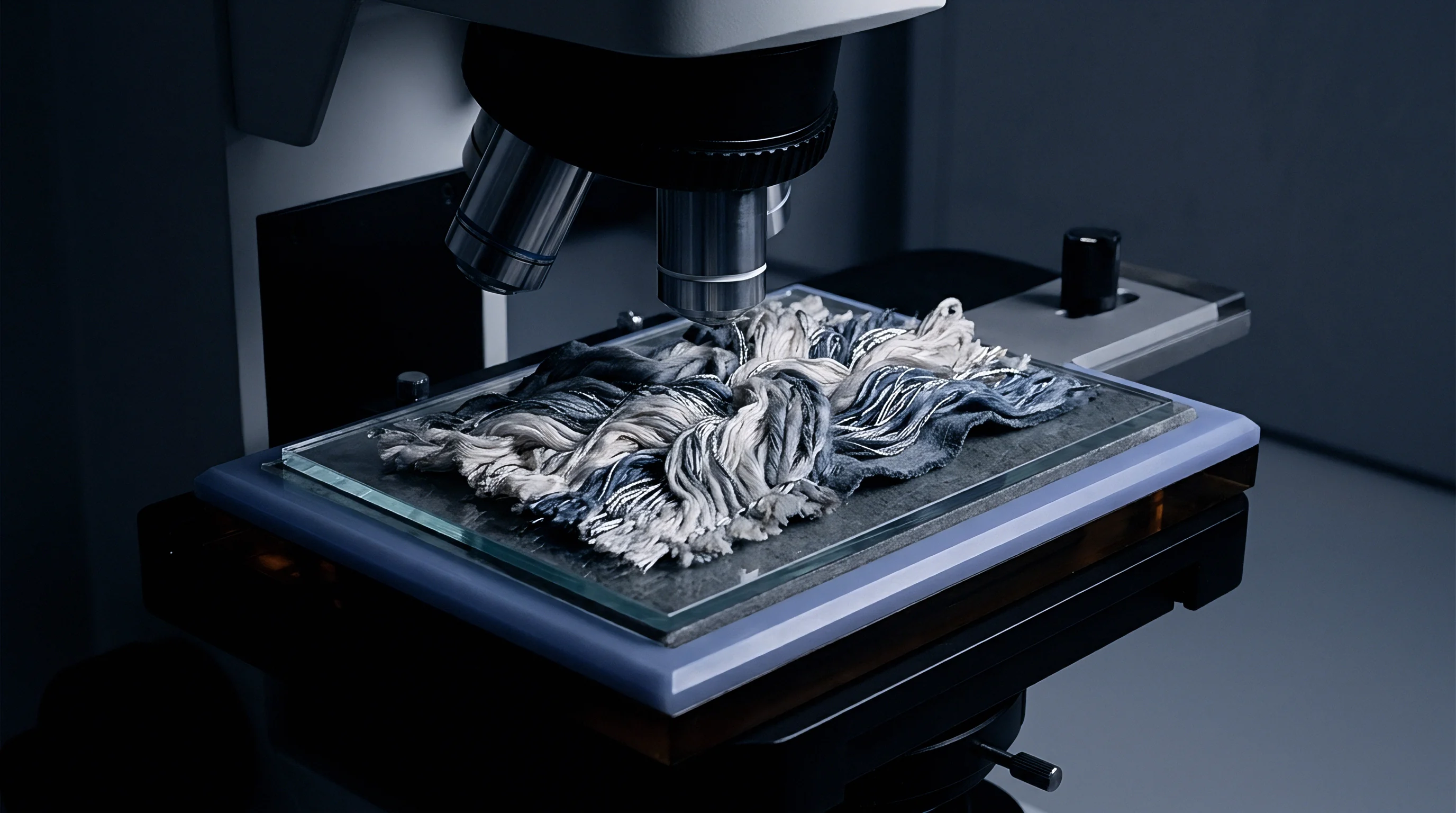
Automated optical diameter profiling systems, including the OFDA 100, OFDA 2000, and OFDA 4000 platforms, capture high-resolution shadow images of glass-mounted fibre snips using video cameras and focused LED illumination. Test specimens are cut to 2.0 millimetric snippet lengths using a precision guillotine, then dispersed across a glass slide using a pneumatic spreader. The instrument software scans thousands of individual snippets, identifying vector edges to compute the mean fibre diameter, standard deviation, and coefficient of variation.
Optical measurements depend on calibration against IWTO international wool top standards. The camera array detects light attenuation across the boundary of each individual snippet, mapping pixel dimensions to absolute length units. Snippets lying out of the focal plane introduce blur, widening the calculated edge boundary and exaggerating the recorded diameter.
Precision systems deploy automated z-axis stage motors that re-focus the lens array prior to capturing each image frame, maintaining absolute spatial resolution within 0.1 micrometres.
How does optical profiling detect medullated guard hairs?
Light passing through solid keratin creates a uniform shadow profile across the snippet width. Medullated guard hairs contain central gas cavities that refract light away from the collector lens, producing a distinct bright band inside the shadow boundary. The image analysis software identifies this central opacity variation, flags the individual snippet as medullated, and records both its total outer diameter and its inner medullary width.
This dual parameter logging allows simultaneously reporting diameter statistics and medullation percentages from a single slide run.
The pneumatic dispersion step must achieve uniform snippet separation without creating fiber overlaps. When two fine down fibers overlap on the glass slide, the optical software registers the crossed image as a single coarse snippet, skewing the coarse-edge count upward. Advanced algorithm routines evaluate snippet shape ratios, rejecting non-circular or intersecting profiles.
If sample preparation creates excessive fiber clumping, the percentage of rejected frames rises, reducing the valid sample population and invalidating the statistical confidence of the report.

Laser Scan Technology and Projection Microscopy
Laser Scan Fibre Diameter Analysers utilize a helium-neon or solid-state laser beam focused through a flow cell containing short fibre fragments suspended in an isoparaffinic fluid stream. As snippets flow past the optical window, the laser beam scatters according to the individual snippet thickness. Photodiode detectors capture the forward scattering intensity, converting the light pulse height into an electrical signal calibrated against standard reference samples.
Laser scanning processes up to 10,000 snippets per minute, offering rapid execution for high-volume dehairing plants.
Projection microscopy, governed by ISO 137, remains the referee standard when optical instrument outputs are contested. An operator manually measures 1,000 to 2,000 individual fibre images projected at 500x magnification onto a calibrated glass screen using a mobile graduated wedge scale. While labor-intensive, projection microscopy permits human judgment to distinguish overlapping fine fibers from authentic single coarse guard hairs, eliminating software counting artifacts.
The technique provides an absolute cross-check when dispute margins approach contract penalty limits.
Manual projection microscopy remains the ultimate referee method for settling disputes over automated coarse snippet counts.
Modern hybrid optical benches integrate spectral imaging with standard silhouette profiling. By measuring light polarization changes through the cuticular keratin layer, these systems separate cashmeres from fine wools based on birefringence differences. Wool exhibits higher optical anisotropy than cashmere under polarized light, permitting real-time detection of wool contamination inside dehaired cashmere lots without requiring separate chemical or DNA analysis.
Discrepancies in optical diameter results frequently stem from slides prepared in high-humidity ambient environments. Mill technicians frequently claim that ambient humidity spikes caused fiber swelling on the slide bench to explain coarse-edge excursions above specification boundaries.

Separation
Dehairing Equipment Mechanics and Yield Profiles
Raw greasy cashmere clips contain 30 to 60 percent guard hair by weight, requiring multi-stage mechanical processing to isolate the fine undercoat down. Industrial dehairing lines utilize series of carding cylinders, worker rolls, stripper rolls, and air-velocity separation chambers. The raw material undergoes initial opening and scouring to remove grease, dirt, and suint before feeding into the dehairing machines.
Carding wire clothing grabs the coarse fibers, taking advantage of their higher flexural rigidity to pull them away from the soft, pliable down fibers.
Air airflow chambers exploit the differential drag-to-mass ratio between down and guard hair. Fine down fibers, possessing high specific surface area, float upward into collector ducts under lower air velocities. Coarse guard hairs, featuring higher density and thicker individual mass, drop out into lower waste hoppers.
A standard commercial dehairing train running six to ten sequential carding heads achieves a residual guard hair content below 0.2 percent by weight, producing refined commercial dehaired cashmere tops.
- Scouring and Drying ~ Raw fleece passes through aqueous detergent bowls to lower residual grease content below 1.5 percent before mechanical opening.
- Coarse Opening ~ Mechanical beaters break up dense locks, dropping heavy sand and soil out of the open fibre web.
- Primary Carding Dehairing ~ High-speed carding cylinders flex coarse guard hairs out of the main fiber stream into primary waste bins.
- Secondary Air Separation ~ Air collection ducts draw light down fibers upward while centrifugal force rejects residual transitional fibers.
- Final Top Finishing ~ Dehaired down passes through gilling and combing frames to align fibers and consolidate the web into commercial sliver or loose fleece lots.
Over-processing dehaired cashmere damages fragile down fibers, shortening the mean staple length and generating short-fibre content below 15 millimetres. Excessive carding speeds break fine fibers, elevating pilling propensity in finished yarns. Sourcing managers balance residual guard hair targets against mean staple length retention.
Pushing residual guard hair fractions below 0.1 percent often reduces mean staple length by 2 to 3 millimetres through mechanical fiber breakage.

Residual Coarse Hair Counting Standards
Evaluating residual guard hair content requires converting optical snippet counts into mass-percentage declarations. Standard test procedure IWTO-58 defines the operational protocols for determining coarse fibre content in processed fleece. The operator prepares multiple slides containing a combined minimum of 10,000 measured snippets.
The software or manual counter segregates all snippets with diameters exceeding a specified threshold, typically set at 30.0 micrometres for standard cashmere declarations.
Residual guard hair declarations are expressed in two distinct formats: count percentage and weight percentage. Count percentage represents the direct number of coarse snippets divided by the total snippet population scanned. Weight percentage calculates the estimated mass of those coarse snippets using volumetric cylinder formulas based on the measured diameter, snippet length, and standard fibre density.
Because mass scales with the square of the diameter, a very low coarse snippet count percentage can translate into a significant mass fraction on commercial delivery certificates.
Failure modes in optical coarse hair evaluation arise from distinct operational and structural factors:
- Fragment Splitting ~ Guard hair fragments shattered during mechanical dehairing create numerous thin, non-medullated splinters that pass through coarse diameter filters undetected.
- Snippet Clumping ~ Poor pneumatic dispersion on the testing glass slide forces multiple fine fibers into dense clusters, generating false coarse-edge counts.
- Focal Depth Variance ~ Out-of-focus snippet edges broaden image boundaries, shifting 28-micrometre transitional fibers into the greater-than-30-micrometre counting bin.
- Sample Preparation Bias ~ Drawing samples exclusively from the outer surface of a compressed bale misses dense guard hair pockets settled deep inside the core.
Fibre count errors directly hit financial margins when lots are retested at destination ports. A lot certified at 0.15 percent residual guard hair by weight that tests at 0.35 percent upon import arrival faces immediate customs reclassification, generating unexpected tariff penalties and expensive laboratory arbitration fees.

Histogram
Diameter Distribution Curves and Skewness
Fine cashmere down displays a log-normal diameter distribution curve characterized by a sharp peak in the 13 to 15 micrometre zone and a positive, long-tail skew toward coarser micron values. The mathematical parameters describing this distribution include mean diameter, standard deviation, coefficient of variation, and the coarse-edge percentage. Standard deviation in high-purity lots remains below 3.5 micrometres, yielding a CV of diameter between 20 and 24 percent.
The coarse edge parameter measures the proportion of fibers exceeding specific micron limits relative to the main distribution peak. Standard trade metrics track the percentage of fibers exceeding 24.0 micrometres and 30.0 micrometres. A healthy dehaired histogram drops to near-zero counts beyond 22 micrometres.
A secondary bump or elongated tail in the 30 to 60 micrometre region signals incomplete dehairing or deliberate blending with coarse wool tops.
Calculations for fine-fibre lot characterization follow standard statistical formulas applied across scanned snippet populations:
Mean Diameter (bard) = fracsum (ni · di)N
Standard Deviation (s) = sqrtfracsum ni (di – bard)2N – 1
Coefficient of Variation (CV) = left( fracsbard right) × 100
Where ni represents the number of snippets counted in diameter bin di, and N represents the total number of valid snippets measured across all slide frames.
When analyzing a 1000-kilogram lot of dehaired cashmere, assume a baseline mean diameter of 15.2 micrometres with an initial SD of 3.3 micrometres. If the dehairing line leaves 0.40 percent guard hair by weight with an average coarse hair diameter of 45.0 micrometres, the calculated mean diameter of the lot shifts upward to 15.32 micrometres, but the standard deviation widens significantly to 3.85 micrometres. This widening elevates the calculated CV to 25.1 percent, triggering quality flags on high-speed spinning specifications.

Coarse Edge Tail Dynamics and Contamination Detection
Detecting fine wool adulteration inside dehaired cashmere lots relies heavily on analyzing histogram asymmetry. Fine sheep wool features a symmetrical Gaussian distribution centered around its mean diameter. When 21-micrometre wool top is blended into 15-micrometre cashmere, the resulting histogram loses its sharp single peak, developing a broad shoulder between 18 and 23 micrometres.
Automated OFDA software detects this shoulder by measuring skewness and kurtosis deviations from standard cashmere baseline templates.
The tail fraction beyond 30 micrometres carries major commercial weight. Contract specifications for luxury yarn production limit fibers over 30 micrometres to a maximum of 0.10 percent by count. Exceeding this boundary introduces coarse fiber ends that protrude from the spun yarn matrix, causing skin prickle sensations in finished garments.
Prickle perception occurs when protruding fiber ends possess flexural rigidity sufficient to activate human skin pain receptors, a threshold typically reached by fibers exceeding 25 micrometres in diameter.
Coarse fibre protrusion beyond 25 micrometres directly triggers skin prickle sensations in finished next-to-skin garments.
Customs authorities analyze diameter histograms to verify Harmonized System tariff classifications under Chapter 51. Cashmere classified under subheading 5102.11 requires clear proof of fine animal hair identity and down purity. If an imported lot exhibits a broad diameter histogram with excessive coarse tail counts, customs laboratories reclassify the shipment as coarse animal hair or wool waste, applying higher duty rates and administrative fines.
Will advanced optical machine-learning classifiers eliminate the need for manual microscopic verification in contested blend declarations?
Arbitration
Standard Tolerances and Testing Variability
Laboratory-to-laboratory variance in optical fibre diameter measurements is an established reality in international trade. The International Wool Textile Organisation defines acceptable tolerance limits between independent test certificates in publication IWTO-47. For fine cashmere with a mean diameter around 15.0 micrometres, the 95 percent confidence allowance between two distinct accredited laboratories is 0.3 micrometres for mean diameter and 0.8 percent for CV of diameter.
When buyer and seller certificates disagree within these published IWTO tolerances, the original test result stands, and contract execution proceeds without price adjustments. If the divergence exceeds the standard tolerance limit, a third accredited referee laboratory receives sealed duplicate samples drawn from the original lot sampling procedure. The referee laboratory performs a dual-slide run using both optical image analysis and projection microscopy, issuing a final binding certificate.
| Parameter | Mean Range (μm) | Single Lab Repeatability (±) | Between Lab Reproducibility (±) |
|---|---|---|---|
| Mean Fibre Diameter | 14.0 ~ 16.0 | 0.14 μm | 0.31 μm |
| Mean Fibre Diameter | 16.1 ~ 18.0 | 0.18 μm | 0.38 μm |
| Standard Deviation | 3.0 ~ 4.5 | 0.20 μm | 0.45 μm |
| Coarse Hair (>30 μm) | 0.0 ~ 0.5% | 0.04% | 0.12% |
Sampling methodologies dictate the validity of any arbitration claim. core sampling using motorized rotary tube drills must penetrate deep into a minimum of 10 percent of the total bale count in a lot, following ISO 3171 rules. Grab samples pulled manually from bale corners yield unrepresentative data because coarse guard hair tends to migrate toward outer edges during mechanical baling compression. Non-compliant sampling voids all laboratory arbitration rights under standard commercial contracts.
Contractual Quality Guarantees and Test Dossiers
Commercial purchase contracts for dehaired cashmere lots must specify the test methods, sampling standards, and precise tolerance thresholds governing delivery acceptance. Standard boilerplate clauses citing generic quality terms fail to protect buyers when coarse hair counts drift above limits. A robust commercial contract details the exact optical instrument model, conditioning protocols, snippet counting minimums, and specific financial penalty schedules linked to laboratory metrics.
The documentation dossier accompanying every dehaired cashmere shipment must contain comprehensive laboratory evidence:
- IWTO Certified Test Report ~ Stamping official laboratory accreditation, sample origin, ambient test conditions, and total snippet count scanned.
- Diameter Distribution Histogram ~ Visual graphic plotting frequency against micron bins from 0 to 100 micrometres, showing skewness metrics.
- Coarse Fibre Breakdown Data ~ Detailed log itemizing snippet counts and calculated weight percentages for fibers exceeding 24, 30, and 45 micrometres.
- Medullation Analysis Certificate ~ Specific optical or microscopic audit documenting the percentage of medullated fragments present in the lot.
Standard contract clause: Contract specifications require a mean fiber diameter under 15.5 micrometres and residual guard hair content under 0.20 percent by weight under IWTO-58 testing rules. Delivery testing above these limits grants the buyer the option of a 2.5 percent purchase price reduction per 0.1 micrometre diameter excess or immediate lot rejection at seller expense.
Failure to mandate IWTO-accredited testing methodology in the initial purchase agreement forces buyers to accept domestic supplier certificates generated on non-calibrated optical benches.

Yield
Landed Cost Calculations and Quality Penalties
Financial valuation of dehaired cashmere depends on pure down yield, mean diameter, and residual guard hair compliance. Raw clip transactions evaluate scoured yield and dehairing efficiency to establish base prices per kilogram. Once dehaired, pricing formulas apply sharp premiums for every 0.1 micrometre drop in mean diameter below 15.5 micrometres, alongside severe penalties for elevated coarse hair fractions.
The landed cost must account for net clean mass, moisture regain adjustments, and freight tariff lines.
Consider a commercial purchase scenario involving a 2,000-kilogram nominal order of dehaired cashmere tops. The contract establishes a base price of 140.00 USD per kilogram for a specification demanding a mean diameter of 15.2 micrometres, a maximum residual guard hair content of 0.15 percent by weight, and a standard moisture regain of 18.25 percent under commercial invoice conventions. The total baseline contract value equals 280,000.00 USD delivered to the mill floor.
Upon arrival, official laboratory testing reveals a true mean diameter of 15.45 micrometres, a residual guard hair content of 0.32 percent by weight, and an actual moisture content of 20.10 percent due to poor moisture barrier packaging during maritime transport. The contract specifies a 2.0 percent price deduction for every 0.1 micrometre diameter increase over baseline, a 1.5 percent price penalty for every 0.05 percent guard hair excess over baseline, and a direct invoice weight deduction for moisture exceeding standard commercial regain limits.
Calculations proceed sequentially to determine the adjusted final invoice settlement:
Diameter Penalty Percent = left( frac15.45 – 15.200.10 right) × 2.0% = 2.5 × 2.0% = 5.0%
Guard Hair Penalty Percent = left( frac0.32 – 0.150.05 right) × 1.5% = 3.4 × 1.5% = 5.1%
Total Price Penalty Percent = 5.0% + 5.1% = 10.1%
Adjusted Base Unit Price = 140.00 USD × (1 – 0.101) = 125.86 USD per kg
Moisture Corrected Mass = 2000 kg × left( frac1 + 0.18251 + 0.2010 right) = 2000 × left( frac1.18251.2010 right) = 1969.19 kg
Final Settlement Value = 1969.19 kg × 125.86 USD per kg = 247,842.25 USD
The cumulative effect of the quality penalties and the excess moisture weight adjustment reduces the final lot payout from 280,000.00 USD to 247,842.25 USD, representing a total financial adjustment of 32,157.75 USD. This calculation illustrates how precise laboratory optical profiling directly protects purchasing capital against quality shortfalls.
Customs Tariffs and Value Chain Compliance
Importers must classify dehaired cashmere under accurate Harmonized System tariff codes to maintain customs compliance. Subheading 5102.11 covers fine animal hair of cashmere goats, subject to specific duty rates based on origin and preferential trade agreements. Incorrect declarations caused by undetected guard hair contamination trigger customs investigations under mislabeling regulations, exposing sourcing operations to retroactively applied tariffs, severe fines, and shipment confiscation at port terminals.
Traceability initiatives increasingly demand linking optical testing dossiers directly to specific bale lot numbers throughout the supply chain. Digital passports embedded in shipping documentation aggregate fiber diameter histograms, residual guard hair certificates, and DNA verification reports. This technical documentation provides end-to-end proof of composition, satisfying regulatory anti-adulteration laws and consumer labeling mandates across retail markets.
The integration of rapid optical profiling at the bale-room stage prevents sub-standard lots from entering the spinning stream. Mill managers who verify incoming diameter metrics and coarse hair counts before opening bales isolate quality failures early, preserving spinning efficiency, protecting expensive equipment, and maintaining contract margins across high-value luxury production runs.