Quantifying Solvent Extraction Errors in Elastomeric Knits
Pre-extracting circular knits with petroleum ether prevents finishing oil retention from artificially inflating solvent-based elastane composition results.


Residue
Non-fibrous additives present on finished elastomeric knits skew quantitative chemical analysis before chemical dissolution begins. Spin finishes, knitting oils, paraffin waxes, and silicone softeners add non-polymeric mass to the raw textile structure. Standard gravimetric separation relies on solvent extraction to dissolve specific elastomeric filaments while leaving matrix fibers intact.
When auxiliary chemistry remains on the specimen, extraction fluids strip these non-fibrous components alongside the targeted polymer. The loss of lubricant mass records falsely as dissolved elastane. Solvent choice alters gravimetric yield.
Cotton circular knits with elastane components frequently carry high loads of hydrophobic softeners. Scouring cycles during wet processing remove natural waxes, but subsequent finishing application returns organic compounds to the yarn bundle surface. If testing technicians bypass preliminary Soxhlet degreasing, solvent baths extract silicone emulsion polymers alongside polyurethane.
The resulting gravimetric calculation overstates elastane composition. Unextracted softeners distort net results.

Non-Fibrous Contamination Mechanics
Pretreatment solvent selection defines the accuracy of subsequent chemical dissolution steps. Light petroleum ether effectively strips paraffinic lubricants and fatty ester oils without swelling polyurethane microstructures. Methylene chloride removes complex silicone finishes, yet prolonged exposure risks swelling low-dtex elastane filaments.
Swollen filaments trap extraction solvent within their amorphous regions. This solvent retention offsets the gravimetric mass loss produced by softener removal. Cold wash steps fail here.
- Silicone Softener Retention forms hydrophobic boundary layers that impede solvent penetration into dense core yarns during analytical procedures.
- Knitting Oil Solubilization transfers paraffinic lubricants into the primary solvent bath, artificially inflating calculated elastane mass percentages.
- Polymer Degradation Residues form insolubles when thermal processing cross-links polyurethane hard segments during stenter heat setting.
Light petroleum extraction for four hours removes up to two point three percent of non-elastomeric finish mass from raw circular knits.
Soxhlet Extraction Protocols
Executing pre-extraction degreasing demands strict monitoring of siphoning rates inside the Soxhlet apparatus. A rate below thirteen cycles per hour allows localized solvent concentration gradients to develop. High concentration gradients slow the mass transfer of hydrophobic waxes from core-spun cotton strands.
The extraction period must extend until a evaporated solvent droplet leaves no visual ring on clean glass. Non-fibrous matter distorts clean separation.
Following degreasing, the specimen requires thorough desiccation prior to recording the initial dry weight. Moisture retention in cotton fibers distorts the baseline gravimetric mass. Standard laboratory drying at one hundred five degrees Celsius removes free water, but bound moisture equilibrium shifts rapidly when specimens transition to balance chambers.
Using desiccators equipped with active silica gel prevents ambient moisture reabsorption during cooling cycles.
Pretreatment protocols must account for insoluble inorganic salt deposits left from dyeing processes. Aqueous rinsing before solvent extraction eliminates ionic residue that resists organic dissolution. Skipping the aqueous wash phase leaves dense mineral salts on matrix fibers, artificially swelling the measured residual weight after elastane extraction.
A steady wash sequence isolates true fiber composition.

Dissolution
Solvation kinetics in elastane extraction depend on the chemical structure of the polyurethane polymer and the solvent matrix. Polyurethane elastomeric yarns consist of alternating soft segment polyethers or polyesters and hard segment polyurethane-ureas. Dimethylformamide at boiling temperatures breaks hydrogen bonds within the hard segments, bringing the polymer into solution.
Matrix fibers like polyamide 6 or polyamide 6,6 exhibit partial solubility in nitrogenous solvents if temperature control drifts. Heat setting changes dissolution kinetics.
Cyclohexanone provides an alternative solvent route for separating elastane from polyamide matrix yarns. At eighty-five degrees Celsius, cyclohexanone selectively dissolves polyether-based polyurethane without attacking nylon filaments. Higher temperatures cause cyclohexanone to swell polyamide fibers, initiating surface oligomer leaching.
Leached oligomers reduce polyamide specimen mass, falsely inflating calculated elastane percentage yields. Dissolution timers govern test accuracy.
Solvent Selectivity Standards
Solvent selection must reflect the composition of the non-elastomeric matrix yarn. Formic acid solutions dissolve polyamide components completely while leaving polyurethane untouched, reversing the standard extraction sequence. Direct dissolution of the primary matrix suits heavy knits where elastane forms a minor core component.
When working with polyamides, eighty-eight percent formic acid dissolves nylon 6 within thirty minutes at room temperature. Pure cyclohexanone dissolves hard segment polyurethanes.
| Solvent System | Target Fibre | Matrix Fibre | Temperature Boundary | Matrix Weight Loss Range |
|---|---|---|---|---|
| Dimethylformamide | Elastane | Cotton | 95°C to 103°C | 0.2% to 0.4% |
| Dimethylacetamide | Elastane | Polyester | 110°C to 115°C | 0.1% to 0.3% |
| Cyclohexanone | Elastane | Polyamide 6,6 | 80°C to 85°C | 0.5% to 0.9% |
| Formic Acid (88%) | Polyamide 6 | Elastane | 20°C to 23°C | 0.3% to 0.7% |

Matrix Attack Dynamics
Polyester and elastane mixtures present minimal matrix solubility errors when using boiling dimethylformamide. Terephthalic ester linkages resist polar aprotic solvent attack up to one hundred twenty degrees Celsius. Isophthalic polyester modifications applied for low-temperature dyeing lower chemical resistance.
Modified polyesters experience partial mass loss during extended boiling extraction cycles, altering final gravimetric ratios.
Higher polyurethane segment cross-linking demands longer solvent exposure than standard laboratory timers allow.
Polyurethane formulations containing high urea ratios require elevated temperatures to break urea-urea hydrogen bonding networks. Standard testing durations of forty minutes prove insufficient for complete dissolution of medical-grade elastane yarns. Partially dissolved elastane residue remains on matrix fibers after filtration, leading to underreported elastane content.
The mill claimed that heat-setting temperature variations naturally render polyurethane insolubles unextractable by standard chemical methods.


Bias
Gravimetric measurement errors enter test reports through uncontrolled atmospheric moisture and incomplete drying cycle execution. Polyurethane polymers feature high hygroscopicity within their amorphous polyether chains. Following solvent extraction and rinsing, residual wash fluid must be completely removed from matrix fibers.
Drying specimens in forced-air ovens at one hundred five degrees Celsius removes volatile solvents, but thermal degradation occurs if exposure times exceed two hours. Mass loss shifts the composition ratio.
Cooling specimens in desiccators presents systematic errors if desiccant media saturation levels exceed nominal thresholds. Saturated silica gel allows ambient humidity inside the chamber during vessel opening. Hydrophilic matrix fibers such as cotton or cellulosics absorb moisture instantly upon balance plate contact.
Specimen moisture alters initial balance measurements.

Gravimetric Oven Kinetics
Glass weighing bottles fitted with ground joints prevent air exchange during mass determinations. Open aluminum dishes allow ambient moisture absorption while transferring items from oven to balance. A specimen weight reading taken five seconds late on an unsealed dish picks up zero point two percent additional mass from atmospheric humidity.
Systematic bias accumulates across serial testing batches.
- Moisture Regain Correction adjusts dry specimen mass against standard allowance figures defined in regional regulatory schedules.
- Solvent Vapor Retention delays mass stabilization inside weighing bottles during post-wash desiccation stages.
- Matrix Fibre Dissolution attacks polyamide filaments when formic acid concentrations exceed nominal laboratory thresholds.
ISO 1833-1 Clause 8 dictates complete drying to constant mass at one hundred five degrees Celsius, where a variance above zero point one percent invalidates the gravimetric yield.

Atmospheric Regain Corrections
Calculating commercial mass requires applying standardized moisture regain factors to dry mass values. ISO 6741 defines commercial regain allowances for common textile fibers, assigning eight point five percent to combed cotton and one point five percent to elastane. Applying incorrect regain percentages distorts calculated invoice weights.
Standard gravimetric formulas must incorporate specific fiber regain parameters matching regional compliance mandates.
Discrepancies arise when testing micro-modal and elastane circular knits. Regenerated cellulosic fibers possess commercial moisture regains reaching thirteen percent, making dry mass measurement sensitive to environmental humidity. Small shifts in laboratory relative humidity alter dry mass determinations, inducing variance into official lab findings.
Residual solvent retains unwanted mass.
Whether high-frequency microwave moisture analyzers can isolate bound solvent mass from regain water in polyamides remains unproven across commercial testing houses.


Fraction
Mathematical modeling of dual-component separation highlights how minor laboratory deviations expand into major commercial composition errors. Consider a nominal ninety-two percent cotton and eight percent elastane single jersey knit structure evaluated under variable pre-extraction protocols. Gravimetric loss recording includes extracted finishing oils alongside dissolved elastane mass when degreasing steps are skipped.
Assume an initial dry specimen mass of five point zero zero zero grams. The true elastane content equals zero point four zero zero grams, leaving four point six zero zero grams of pure cotton matrix. If the specimen carries two percent non-fibrous lubricant mass that dissolves in dimethylformamide, total dissolved mass rises to zero point five zero zero grams.
The calculated elastane fraction jumps to ten point zero percent without proper finish removal adjustments.
What Thermal Conditions Induce Polyurethane Degradation?
Stenter heat setting temperatures exceeding one hundred ninety degrees Celsius induce thermal cross-linking within polyurethane hard segments. Cross-linked polyurethane exhibits reduced solubility in boiling dimethylformamide. During standard extraction protocols, zero point zero five zero grams of degraded elastane remains trapped inside the matrix core.
Sintered glass filters capture coarse debris.
| Extraction Protocol | Recorded Dry Specimen (g) | Dissolved Mass Yield (g) | Calculated Elastane (%) | Absolute Error (%) |
|---|---|---|---|---|
| Standard Pre-extracted Baseline | 5.000 | 0.400 | 8.00 | 0.00 |
| Unextracted (Finishing Oil Error) | 5.100 | 0.500 | 9.80 | +1.80 |
| Thermal Degradation (Incomplete Dissolution) | 5.000 | 0.350 | 7.00 | -1.00 |
| Matrix Solubilization Over-exposure | 5.000 | 0.440 | 8.80 | +0.80 |

Quantitative Error Propagation
Error propagation models demonstrate how combined measurement uncertainties widen final tolerance bands. Combining a zero point two percent weighing vessel error with a one point five percent unextracted lubricant error shifts total calculated elastane fraction by over two percentage points. Vacuum filtration speeds solvent displacement.
Knitting oil residues consistently migrate into dimethylformamide baths and register falsely as dissolved elastane mass.
Laboratory reports issued without explicit correction factors expose importers to trade non-compliance penalties. Customs authorities perform independent laboratory testing using standardized pre-extraction degreasing sequences. Misalignment between factory quality control data and port customs test results causes shipment rejections at import terminals.
Precision testing prevents costly customs hold-ups.
ISO 1833-1 Annex A specifies a formal correction factor d of 1.01 for cotton treated with dimethylformamide, altering net calculated elastane ratios by zero point two percentage points.


Remnant
Laboratory inter-calibration data reveals substantial variation when separate facilities test identical cuts from circular knit bolts. Inter-laboratory trials show quantitative elastane content variances reaching one point two percentage points on identical rolls. Variance stems from non-standardized specimen preparation, variable solvent bath temperatures, and inconsistent washing steps.
Testing precision requires tight procedural execution.
Specimen selection across circular knit width affects chemical extraction results. Core-spun elastane tension drifts between center and edge sections on high-speed circular knitting machines. Edge cuts feature slightly different elastane linear density distributions relative to center panel swatches.
Drawing specimens from across the full usable width minimizes sampling bias.

Inter-Laboratory Variance Control
Standardizing laboratory apparatus calibration eliminates systematic analytical drift. Sintered glass filter crucibles require periodic acid washing to clean pore structures. Clogged crucible pores slow filtration velocity, allowing cooling solvent baths to drop below critical polymer solubility temperatures.
Recrystallized elastane precipitates onto matrix fibers during slow filtration passes. Clean glassware maintains uniform flow dynamics.
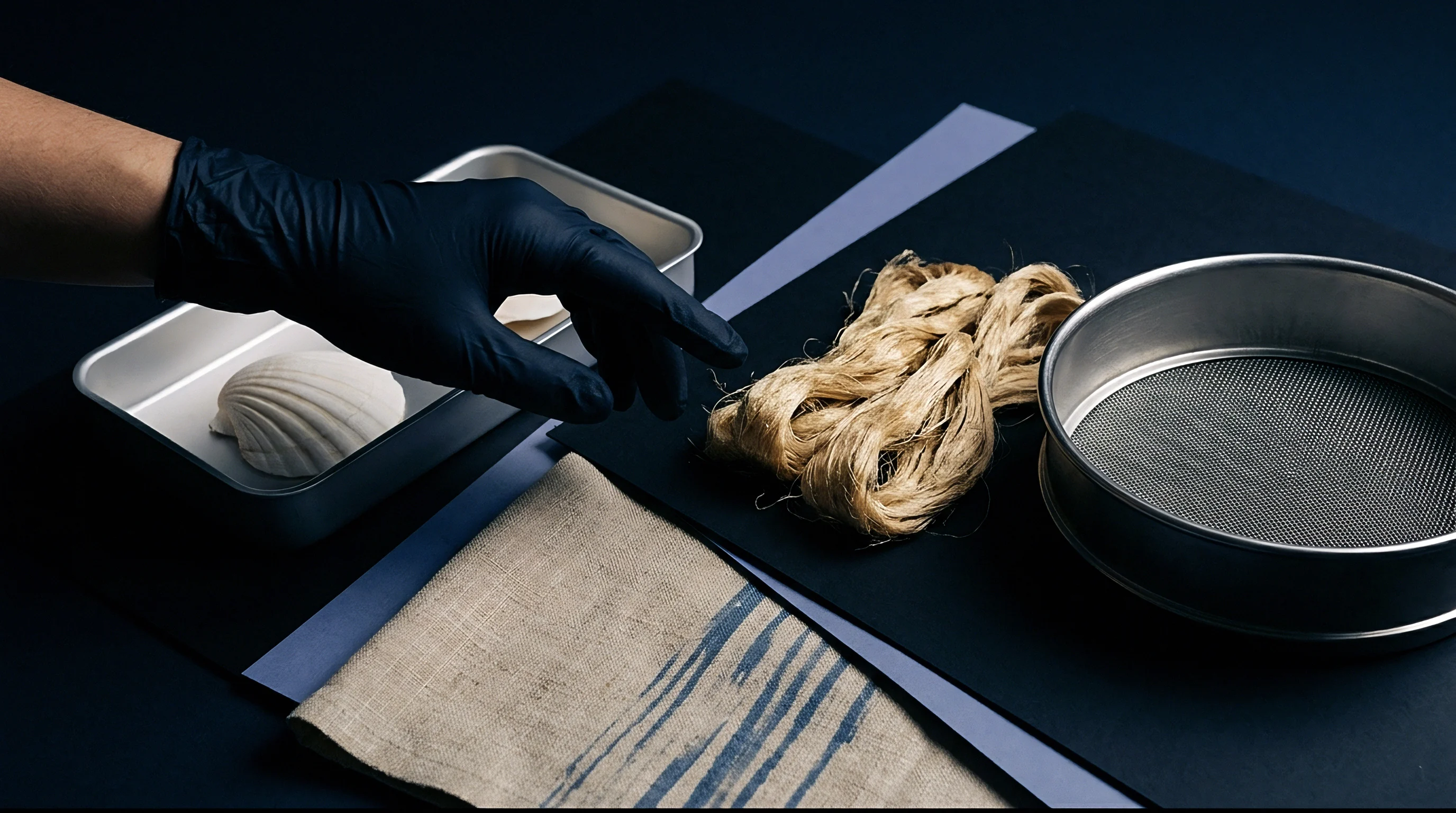
- Condition five specimens drawn from representative roll locations at standard laboratory temperature for twenty-four hours.
- Extract non-fibrous additives using light petroleum in a Soxhlet apparatus for sixteen siphoning cycles.
- Agitate dry specimen in boiling dimethylformamide for forty minutes to dissolve polyurethane components completely.
- Filter insoluble matrix fibers through a weighed sintered glass crucible under vacuum pressure.
Sampling Specimen Distribution
Drying washed matrix remnants demands precise oven temperature management. Localized hot spots inside convection ovens degrade delicate cellulosic matrix fibers, causing thermal mass loss. Thermal degradation lowers remnant weight, artificially inflating calculated solvent-extracted elastane content.
Calibrating oven chamber temperature profiles prevents thermal damage.
Miscalculating elastane composition by one percentage point in bulk shipments triggers customs seizure, mandatory laboratory re-testing fees, and terminal storage charges that erode garment gross margins.

Exposure
Customs classification thresholds create rigid commercial boundaries where small analytical discrepancies change tariff rates significantly. Harmonized System Chapter 60 dictates tariff treatment based on fiber mass distribution. Circular knits containing five percent or more elastane by weight incur different duty rates compared to lower-elastane alternatives under specific trade agreements.
Tariff lines turn on exact mass.
Importers declaring an eight percent elastane circular knit risk reclassification if customs test reports return four point eight percent due to incomplete solvent dissolution. Reclassification triggers duty recalculations, retroactive tariff penalties, and mandatory administrative reviews. Accurate solvent extraction data defends declared tariff lines.
Tariff Classification Thresholds
Trade compliance regulations under EU Regulation 1007/2011 demand accurate fiber composition labeling. A three percent tolerance is permitted for generic fiber blends, but functional elastomeric declarations face strict regulatory enforcement. Mislabeling elastane content invites commercial regulatory sanctions, market withdrawals, and brand reputational damage.
Label claims face severe regulatory scrutiny.
Garment tech packs that mandate specific power stretch properties rely on accurate core elastane percentages. Supplying fabric with lower functional elastane mass reduces stretch recovery performance, generating garment growth after repeated wear. Chemical verification validates yarn specifications before bulk cutting commences.

Commercial Retest Protocols
Establishing binding commercial retest clauses in sourcing contracts protects buyers against lab variance disputes. Sourcing contracts should mandate ISO 1833 chemical extraction protocols performed by accredited independent laboratories. Defining clear secondary testing frameworks resolves composition disputes before shipping payments clear.
Integrating rigorous solvent extraction testing into quality assurance workflows secures trade compliance and protects commercial margins. Raw material classing, precise lab execution, and commercial duty alignment ensure consistent compliance across international supply networks.