Quantifying Thermal Fixation Margins in Polyamide Elastane Knits
Thermal fixation of polyamide elastane requires 188 to 195 degrees Celsius for 15 seconds to hold shrinkage under 3 percent without elastic recovery losses.

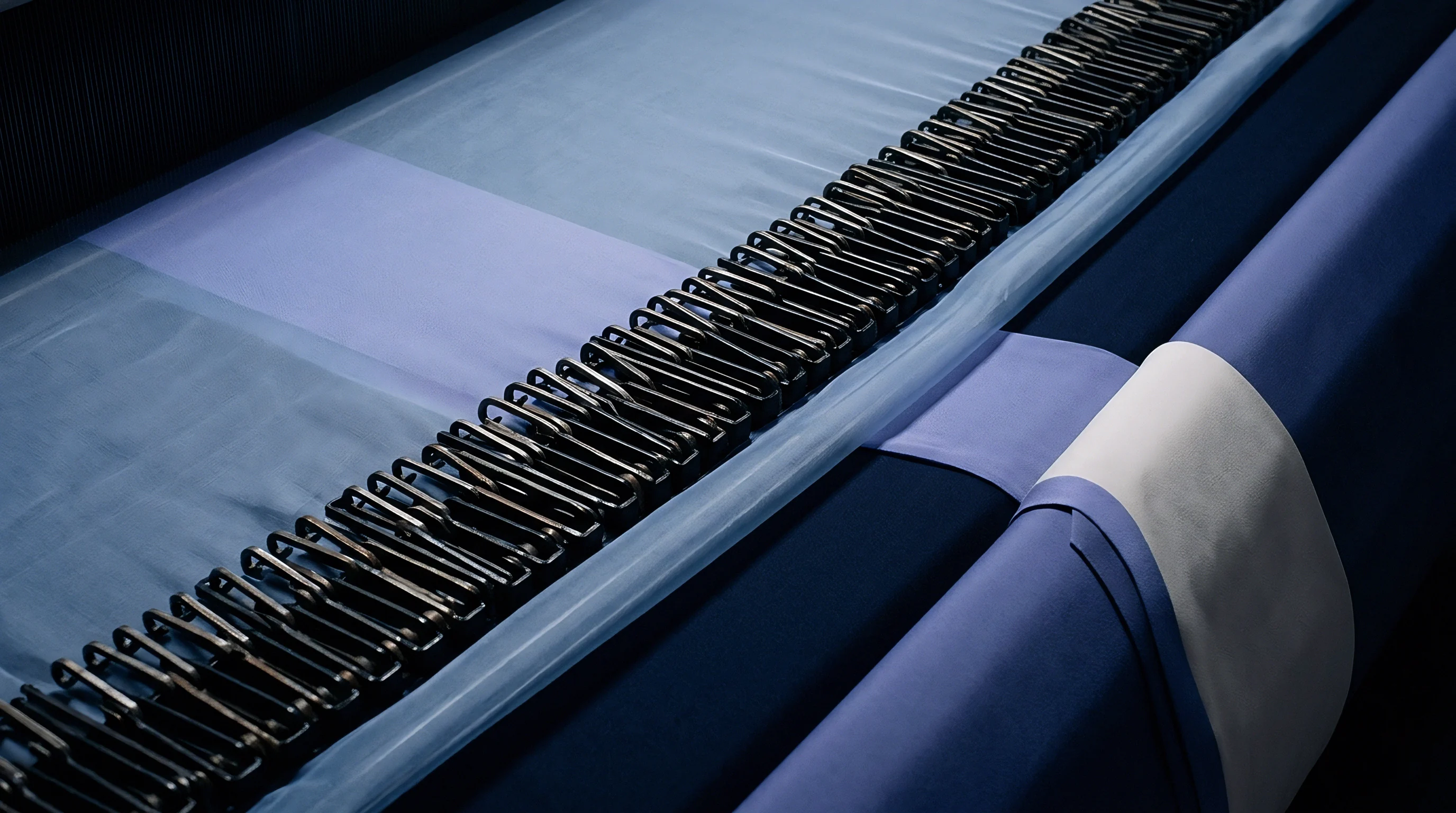
Stenter
Thermal fixation of polyamide elastane knits operates inside a narrow processing window where the thermal destruction of polyether-based polyurethane elastane directly borders the incomplete dimensional stabilization of the polyamide matrix. The target window on the stenter frame occupies an operating band of 188 degrees Celsius to 195 degrees Celsius for polyamide 6,6 paired with bare elastane, dropping to 178 degrees Celsius to 184 degrees Celsius for polyamide 6. Processing below the lower boundary leaves excessive residual shrinkage in the finished fabric, exceeding the standard four percent threshold under ISO 5077 after domestic laundering at 40 degrees Celsius.
Processing above the upper boundary degrades the hard segments of the elastane yarn, causing immediate losses in uncoiling power, tensile recovery, and ultimate elongation.
Fabric dwelling inside the heated chambers undergoes three distinct thermal phases: sensible heating of the wet or dry textile substrate, phase equilibration at target temperature, and macromolecular restructuring. Polyamide 6,6 reaches its crystallization temperature during the plateau phase, rearranging amorphous chain segments into stable crystalline lamellae. Elastane simultaneously approaches its softening point, where the secondary hydrogen bonds holding the urethane hard domains dissociate.
The applied mechanical overfeed and pin-rail width set the new spatial equilibrium of the knit loops. Cooling below the glass transition temperature before the fabric exits the pinning chain locks this geometry in place.
Heat setting below 188 degrees Celsius yields finished polyamide 6,6 elastane warp knits that fail the four percent dimensional stability threshold under ISO 5077 laundering cycles.
The speed of the stenter dictates actual dwell time within the active heating chambers. A typical six-chamber industrial stenter with three-meter chamber lengths yields an eighteen-meter active hot zone. Running this machine at twenty-four meters per minute provides forty-five seconds of gross dwell time.
The effective dwell time at full air temperature measures substantially less, as the fabric requires fifteen to twenty seconds merely to evaporate residual moisture and elevate mass to the chamber setpoint. Variations in base fabric weight shift this thermal lag directly. A light circular knit of 140 grams per square metre reaches ambient chamber temperature nine seconds faster than a dense warp knit of 280 grams per square metre run under identical air velocity and nozzle pressure.
Warp knit tricot structures and weft knit single jerseys exhibit divergent dimensional behaviors during this exposure. Tricot knits, commonly configured with 44-decitex polyamide 6,6 filament laid in front of 44-decitex bare elastane on 28-gauge or 32-gauge knitting machines, maintain structural stability primarily along the wale direction. Single jersey knits with plated bare elastane possess high loop mobility, generating pronounced edge curling and torque if the overfeed parameters do not precisely compensate for loop distortion during thermal relaxation.
Overfeed settings between positive fifteen percent and positive twenty-five percent introduce sufficient slack along the length to prevent yarn necking and yield the targeted finished square-metre weight.
Operating outside these margins destroys downstream processability during acid or disperse dyeing. Uneven heat distribution across the stenter width generates variations in polyamide dye uptake, manifesting as horizontal dye streaks or barre. Variations exceeding two degrees Celsius between the drive side, center, and operator side of the stenter chamber generate noticeable Delta E shifts under standard illuminant D65.
Thermally degraded elastane also releases silicone spin finishes and volatile oligomers into the stenter exhaust air, which condense onto nozzle fingers and drip back onto the moving web, producing hydrophobic spots that reject aqueous dye liquor entirely.
The mechanical settings on the entry rails establish the boundary conditions for all downstream processing steps, leaving the operative tension profile fixed prior to the first bath contact.

Hysteresis
Tensile recovery testing isolates the viscoelastic response of the elastomer network after exposure to finishing temperatures. The cycling behavior recorded under standard method DIN 53835-2 or ASTM D2594 documents the exact mechanical cost of thermal stabilization. Subjecting a raw polyamide elastane knit to five successive cycles of elongation to eighty percent of its initial length generates a characteristic stress-strain loop.
The area enclosed between the loading curve and the unloading curve quantifies the energy dissipated as internal friction and permanent molecular displacement.
Elastic Recovery Degradation
Thermal degradation shifts both the shape and position of this hysteresis loop. Elevated temperatures above 193 degrees Celsius on bare 44-decitex elastane cause cleavage of the polyether soft segments and disrupt the cross-linking hard segments. The consequence appears as unrecoverable plastic deformation, known as unrecovered elongation or set.
Virgin elastane yarns exhibit unrecovered elongation below six percent after cyclic extension. Fabric exposed to excessive temperature or protracted dwell times registers permanent set values between twelve percent and twenty-two percent. The garment produced from such cloth sags during active wear, losing its retention force around the body.
| Exposure Temperature | Dwell Time | Modulus at 50 Percent Extension | Unrecovered Elongation | ISO 5077 Length Shrinkage | ISO 5077 Width Shrinkage |
|---|---|---|---|---|---|
| 180 degrees Celsius | 30 seconds | 4.2 Newtons | 5.8 percent | -6.8 percent | -5.2 percent |
| 185 degrees Celsius | 30 seconds | 4.1 Newtons | 6.2 percent | -4.5 percent | -3.8 percent |
| 190 degrees Celsius | 30 seconds | 3.8 Newtons | 7.4 percent | -2.1 percent | -1.9 percent |
| 195 degrees Celsius | 30 seconds | 3.1 Newtons | 11.6 percent | -1.2 percent | -0.9 percent |
| 200 degrees Celsius | 30 seconds | 2.1 Newtons | 18.9 percent | -0.8 percent | -0.6 percent |
| 205 degrees Celsius | 30 seconds | 1.2 Newtons | 26.4 percent | -0.5 percent | -0.4 percent |
The loss of elastic recovery directly degrades garment sizing retention over time. Fabrics set at 190 degrees Celsius maintain an optimal equilibrium, holding residual shrinkage inside a two percent window while restricting permanent set to less than eight percent. Increasing the thermal exposure to 200 degrees Celsius minimizes dimensional shrinkage to under one percent, yet degrades the modulus at fifty percent extension by forty-four percent compared to the under-set fabric.
The finished fabric feels soft initially but displays marked structural breakdown following minimal consumer usage.
Modulus Shift Mechanisms
The modulus at fifty percent elongation defines the holding power of shapewear and compression textiles. When elastane is exposed to thermal fixation, thermal oxidative cleavage attacks the polymer backbone. Soft segments responsible for low-strain extension unravel, lowering the resistance force of the fabric during initial extension.
Simultaneously, the polyamide ground yarn undergoes thermal shrinkage if not held under rigid pin control. This differential shrinkage changes the structural load distribution between the ground yarn and the elastic yarn, shifting the mechanical burden prematurely onto the degrading elastane core during cyclic movement.
A contract clause rejecting fabric lots with permanent set exceeding nine percent under DIN 53835 cycling forces mills to run stenters below 194 degrees Celsius.
Microscopic evaluation of over-set knits demonstrates elastane filament fusion. Individual elastane filaments within a multi-filament bundle or adjacent single filaments in a circular knit stitch coalesce into homogenous, brittle polymer blocks. This coalesced structure lacks the independent compliance of discrete filaments, creating localized stress concentrations during tensile expansion.
Subsequent flex fatigue tests generate premature transverse cracking along the elastane filaments, leading directly to fiber cleavage and the visual defect known as elastane slippage or grin-through on the technical face of the fabric.
The balance of modulus retention against dimensional stability represents a zero-sum mechanical trade-off during stenter operations.


Air
Convective heat transfer inside the stenter drying chamber depends upon air velocity, nozzle geometry, and the circulating atmospheric composition. The heat transfer coefficient governs the time required for the fabric surface and internal yarn intersections to attain thermal parity with the circulating air stream. Typical industrial pin frames utilize slot nozzles or round-hole perforated nozzles positioned between twelve and twenty-five millimeters above and below the moving web.
The impinging air jets disrupt the stationary boundary layer of cooler, humid air clinging to the wet knit fabric.

Nozzle Velocity Dynamics
Nozzle discharge air velocity determines whether heat transfer remains efficient or induces fabric flutter. Operational air velocities range from twenty to thirty-five meters per second, generated by variable-speed circulating fans driven by independent inverter motors. If nozzle air velocities exceed twenty-eight meters per second on lightweight circular jersey fabrics below 130 grams per square metre, the upward aerodynamic force lifts the cloth from the pin plates, causing edge unpinning and massive width distortion.
Lowering the velocity below twenty meters per second extends the required sensible heating time by up to forty percent, preventing the substrate from reaching target fixation temperatures inside the available chamber length.
- Differential air volume balances the static pressure between top and bottom nozzles to prevent fabric sag or rail detachment over the central span.
- Counter-flow air routing directs heated air against the travel direction of the textile web to maximize the thermal gradient across early drying zones.
- Exhaust humidity throttling maintains absolute water vapor content inside the stenter atmosphere to control sensible heat transfer rates from dry air mixtures.
- Nozzle finger alignment prevents localized hot spots that generate narrow lengthwise bands of over-set elastane and degraded tensile strength.
Maintaining air balance requires continuous monitoring of dynamic pressure across every chamber module. Imbalanced nozzle pressures generate mechanical turbulence, flexing the elastic loops while they dwell at their softening point. This agitation deforms the stitch geometry permanently, locking skew and bow into the finished goods roll.
Modern stenters introduce symmetrical sinusoidal air flow patterns, alternating top and bottom jet impacts to suspend the knit web in a stable, float-like state between the pin chains.

Are Chamber Atmospheres Chemically Inert?
Circulating air inside a gas-fired stenter contains direct combustion byproducts, including nitrogen oxides, carbon monoxide, water vapor, and sulfur traces. Polyamide 6 and polyamide 6,6 filaments possess terminal amino end groups that react with atmospheric nitrogen oxides at temperatures above 140 degrees Celsius. This chemical interaction induces thermal gas yellowing, which permanently shifts the base whiteness of goods intended for optical white or pastel shades.
Elastane components subjected to nitrogen oxide concentrations exceeding five parts per million at 190 degrees Celsius undergo accelerated macromolecular chain scission compared to hot-air exposure inside indirect steam or thermal-oil heated stenter chambers.
Indirectly heated stenter frames isolate the fabric chamber from burner exhaust, utilizing closed loops of circulating thermal fluid passing through internal finned tube heat exchangers. This design maintains an unpolluted ambient air atmosphere across the textile web. Indirect heating requires higher maintenance overhead and limits maximum chamber air temperatures to approximately 205 degrees Celsius, yet it eliminates catalytic gas yellowing and preserves the base tensile integrity of bare elastane yarns during long fixation cycles.
Drying operations that ignore convective air mechanics inevitably produce goods with irregular structural geometry across the usable cuttable width, compounding yield losses during subsequent spreading.
Route
The sequence of wet processing and thermal fixation steps establishes the operational route for polyamide elastane goods. Two fundamentally opposed production workflows dominate current commercial practice: the pre-setting route and the post-setting route. The selection between these manufacturing sequences determines machinery allocation, recipe design, dye affinity, energy consumption, and the financial liability assumed before coloration begins.
The Pre-Setting Workflow
Greige fabric arriving from the knitting shed contains up to eight percent by weight of lubricating knitting oils, spin finishes, and antistatic chemicals. In a strict pre-setting route, the greige knit passes directly through a continuous open-width scouring range to strip these surface oils before entering the thermal fixation stenter. Attempting to pre-set unwashed greige fabric bakes knitting lubricants into the interior of the polyamide filament bundles, polymerizing fatty acid derivatives and mineral oils into indelible yellow or brown residues that permanently resist uniform aqueous dye penetration.
- Continuous open-width scouring at 60 degrees Celsius in an alkaline non-ionic detergent bath removes residual knitting lubricants.
- Vacuum slot extraction dewaters the open-width knit web to a uniform residual moisture content of thirty-five percent.
- Hot-air stenter pre-fixation runs at 190 degrees Celsius for forty seconds with eighteen percent lengthwise overfeed to establish dimensions.
- Discontinuous jet dyeing in an overflow or air-jet machine applies acid or metal-complex dyestuffs at 98 degrees Celsius.
- Post-rinse and chemical finishing bath applications deposit softening agents, antistatic chemicals, or hydrophilic finishes.
- Final low-temperature drying operates at 120 degrees Celsius to 130 degrees Celsius strictly to evaporate water without altering the thermal set.
Pre-setting locks the flat, open loop architecture of circular knits, neutralizing residual knitting stresses. This spatial stability permits the fabric to withstand the high mechanical turbulence and intense rope folding inside high-temperature jet dyeing machines without creating permanent rope marks, crow’s feet, or edge rolling. The pre-set fabric maintains uniform length and width during dyeing, eliminating uncontrolled shrinkage inside the dye vessel.
However, thermal exposure prior to coloration decreases the total volume of accessible amorphous regions in the polyamide fibers, lowering the initial dye strike rate and reducing ultimate dye bath exhaustion by eight to fourteen percent compared to un-set substrates.

The Post-Setting Workflow
The alternative production sequence defers thermal fixation until all aqueous wet operations conclude. Greige fabric is opened, slit, relaxed in a tensionless scouring range, and dyed directly in rope form using specialized low-tension jet dyeing machinery loaded below eighty percent of nominal capacity. Post-setting applies the high-temperature stenter pass as the final wet-to-dry conversion step, stabilizing dimensions, evaporating moisture, and curing functional topical auxiliaries simultaneously.
Post-setting routes reduce processing costs by three cents per linear meter by eliminating an entire stenter pass, but elevate jet-dyeing crease reject rates to four percent.
This operational sequence saves considerable thermal energy and shortens factory production lead times by eliminating a complete stenter cycle. The dyehouse achieves deeper, richer color yields because the polyamide ground yarn accepts dyes uninhibited by prior crystalline reorientation. The operational hazards, however, fall upon the dyehouse floor.
Un-set elastane knits shrink violently upon first contact with hot water inside the jet dyer, contracting up to twenty-five percent in area within the first six minutes of bath heating. If the rope speed, liquor ratio, and temperature ramp rates do not match this contraction precisely, the fabric develops severe rope marks and permanent structural creases that no amount of subsequent post-stenter tension can pull out.
Converter facilities lacking modern tensionless scouring equipment routinely rely on pre-setting to protect against catastrophic rope creasing across their standard product lines.
Arithmetic
Executing accurate thermal fixation requires strict mathematical reconciliation between greige yield, stenter dimensional adjustments, and finished fabric specifications. A mill producing warp-knitted tricot fabrics must control grams per square metre, cuttable width, and elastane extension margins within precise customer tolerances. Sourcing contracts dictate delivered weights within a plus or minus three percent band, leaving zero margin for uncalculated shrinkage or excessive stenter draft.
Yield Balance Calculations
A representative production order involves a 32-gauge warp knit elastane jersey targeted for active apparel applications. The target finished specification calls for a fabric weight of 220 grams per square metre at a finished usable width of 150 centimeters, displaying less than three percent dimensional change after washing. The raw greige off the Karl Mayer warp knitting machine exhibits a width of 172 centimeters, a weight of 180 grams per square metre, and contains twenty-two percent 44-decitex elastane with seventy-eight percent 44-decitex / 34-filament polyamide 6,6.
Greige knits undergo longitudinal contraction and transverse relaxation during the initial open-width scour. Wet relaxation contracts length by twelve percent while width drops from 172 centimeters to 142 centimeters. Calculating the required entry and exit parameters on the stenter establishes whether the target metrics remain achievable without exceeding the physical yield boundaries of the fiber blend.
| Processing Phase | Fabric Width | Length Yield Factor | Calculated Fabric Weight | Elastane Draft Ratio |
|---|---|---|---|---|
| Knitting Greige State | 172 centimeters | 1.000 | 180 grams per square metre | 3.15 |
| Post-Scour Relaxed State | 142 centimeters | 0.880 | 248 grams per square metre | 2.62 |
| Stenter Entry Pinning | 145 centimeters | 1.050 (Overfed) | 208 grams per square metre | 2.88 |
| Thermal Setting Zone | 156 centimeters | 1.000 | 193 grams per square metre | 3.05 |
| Stenter Exit Finished | 150 centimeters | 0.940 (Elastic snap) | 221 grams per square metre | 2.92 |
Achieving 221 grams per square metre finished weight requires an entry chain overfeed setting of positive twenty percent relative to the stenter drive rolls. As the pinned web enters the heated chambers at 156 centimeters, the transverse chain divergence applies a mechanical cross-draft of 7.5 percent over the relaxed width. The elastane filaments undergo thermal relaxation, resetting their zero-stress state to the enlarged loop dimensions.
When the fabric detaches from the pins at the delivery end, instantaneous elastic recovery retracts the open width from 156 centimeters to 150 centimeters, simultaneously recovering six percent in length. The resulting density matches the contract target of 220 grams per square metre within half a percent.
Financial Exposure from Process Drifts
Financial margins evaporate when stenter parameters drift outside prescribed tolerances. Consider a bulk dyeing and finishing contract covering 20,000 linear meters of this 220 grams per square metre fabric. At 1.50 meters width, 20,000 linear meters represents 30,000 square meters of material, equating to an intended finished mass of 6,600 kilograms of processed yarn.
If the finishing line under-feeds the fabric by five percent, running an actual overfeed of positive fifteen percent instead of the required positive twenty percent, the finished fabric weight drops from 220 grams per square metre to 209 grams per square metre. The width remains pinned to 150 centimeters, but the fabric length extends to 21,050 meters. While this provides additional yardage, apparel cutting rooms programmed to lay marker patterns based on 220 grams per square metre cloth reject the entire lot: the reduced weight fails opacity benchmarks in white and pastel colorways, and fails the compression modulus threshold of 3.5 Newtons at fifty percent stretch.
Conversely, excessive overfeed running at positive twenty-five percent produces fabric weighing 233 grams per square metre. The 20,000-meter run now consumes 6,990 kilograms of greige yarn instead of 6,600 kilograms. The additional 390 kilograms of raw material represents an unrecoverable yield loss.
At an average raw polyamide elastane yarn blend cost of 8.50 US dollars per kilogram, this parameter drift incurs a direct chemical and material cost overrun of 3,315 US dollars on a single production lot, entirely eroding the converter’s finishing commission.
The mathematical reality of knit finishing binds mass balance directly to commercial margins; operators who adjust stenter speed without recalibrating overfeed transfer margin straight to the floor waste bin.

Control
Process verification requires real-time instrumentation capable of monitoring fabric temperature directly rather than relying on ambient chamber air thermometers. Fabric temperature lags chamber air temperature until all moisture evaporates and sensible heat absorption stabilizes. Deploying non-contact infrared pyrometers inside each individual drying chamber establishes the actual temperature curve of the moving textile web.

Pyrometric Monitoring Layout
A standard industrial configuration positions infrared radiation sensors at the exit point of each stenter bay. Sensor lenses focus on the central portion of the web, with secondary arrays tracking the left and right selvedges. These pyrometric instruments measure thermal radiation across the 8-to-14 micrometer spectral band, translating surface emissions into precise fabric core temperatures with a response time under fifty milliseconds.
The reading reflects the actual temperature of the polymer chains rather than the ambient environment.
- Chambers 1 and 2 function as the sensible heating and drying zone, holding fabric temperature between 100 degrees Celsius and 125 degrees Celsius while moisture evaporates.
- Chambers 3 and 4 elevate the dry fabric from 130 degrees Celsius to the target fixation temperature of 192 degrees Celsius.
- Chamber 5 functions as the true setting zone, maintaining fabric temperature at exactly 192 degrees Celsius plus or minus 1.5 degrees Celsius for fifteen seconds.
- Chamber 6 initiates controlled in-frame cooling via ambient air impingement to drop fabric temperature below 140 degrees Celsius before pin detachment.
Automated stenter management systems modulate machine throughput speed based directly on pyrometer feedback from the setting zone. If infrared sensors in Chamber 4 register that the fabric has attained 190 degrees Celsius prematurely due to lighter greige weights or lower ambient moisture, the system accelerates chain drive speed. This speed increase shortens overall dwell time, preventing elastane overheating in Chamber 5.
If the fabric enters with higher moisture content, the control logic decelerates the chain, ensuring the textile web completes its structural crystallization process before exiting the heated bays.

Laboratory Verification Protocols
Finished goods release hinges on destructive laboratory testing of cut swatches taken from the front, middle, and end of each finished dye lot. The testing dossier must document residual dimensional stability, elastic recovery, base whiteness, and color fastness. Relying on visual hand-feel evaluations creates commercial exposure.
Objective verification requires standardized physical methods executed under controlled atmospheric conditioning per ISO 139 at twenty degrees Celsius and sixty-five percent relative humidity.
A laboratory test report registering ISO 5077 laundering shrinkage below 2.5 percent confirms correct thermal fixation only when DIN 53835 unrecovered elongation remains under eight percent.
The standard verification battery for elastane knits comprises four sequential testing methodologies. Dimensional change after domestic laundering follows ISO 5077, utilizing washing procedures outlined in ISO 6330 at forty degrees Celsius with horizontal tumble drying. Fabric recovery parameters run under DIN 53835-2 across five successive cycles to determine elastic loss.
Bursting strength testing per ISO 13938-2 evaluates whether the combined effects of chemical scouring, thermal fixation, and high-temperature dyeing have degraded the structural integrity of the polyamide continuous filaments below standard apparel performance minimums of 250 kilopascals.
Color fastness to perspiration under ISO 105-E04 and fastness to domestic washing under ISO 105-C06 evaluate chemical degradation at the yarn surface. Over-set fabrics frequently demonstrate diminished wet fastness because fractured elastane oligomers and degraded fiber surfaces facilitate dyestuff desorption into aqueous test solutions. When laboratory testing detects a drop of a full half-step on the ISO Grey Scale for staining alongside low recovery force, the finishing line has violated its upper thermal fixation boundary.
Systematic laboratory qualification confirms whether a mill possesses the process discipline required to hold fine chemical and mechanical tolerances across continuous bulk output.
Fault
When thermal fixation boundaries are breached, specific material failure modes emerge downstream in the cutting room, during retail distribution, or throughout post-consumer maintenance. Identifying these physical manifestations enables quality auditors to trace defects back to discrete machine settings and incorrect processing parameters on the finishing floor. The visual and mechanical profile of a failed knit fabric carries the precise fingerprint of its thermal history.
Thermal Shock and Edge Defects
The selvedges of polyamide elastane knits experience severe localized thermal stress. Circular knits slit open prior to stenter processing expose loose raw loop edges along both flanks. If the stenter gumming units fail to apply sufficient water-soluble adhesive or if edge trimming blades run dull, the loose loops curl instantaneously upon entering the 190-degree Celsius heating environment.
These curled edges trap heat, creating dense, over-set bands two to four centimeters wide that cannot be flattened by downstream fabric spreaders in the apparel manufacturing plant.
Pin-hole tearing represents another critical processing defect. If rail divergence is applied aggressively while the fabric remains cool in early chambers, or if excessive pin-chain tension pulls against a web undergoing heat-induced shrinkage in Chamber 5, the brass pins tear jagged voids through the elastane-depleted border. These tears propagate inward into the usable cuttable width, creating regular scallop-shaped edge defects that force cutting-room markers to narrow their pattern nests, reducing garment yield per linear meter.
Post-Dyeing Elastic Rupture
The catastrophic failure mode for warp and weft knits containing bare elastane occurs when degraded elastic cores snap under low mechanical strain. Known across cutting rooms as yarn fracture or core breakage, this defect manifests as microscopic curly yarn tails poking through the technical face of the knit. The defect frequently escapes detection on standard illuminated fabric inspection frames run at commercial speeds of thirty meters per minute, becoming fully visible only when the finished garment is pulled over an expanding fitting form or subjected to initial consumer laundering.
Thermal degradation combined with prolonged exposure to acidic dye baths at pH 4.5 accelerates elastane embrittlement. The polyether chains undergo simultaneous hydrolytic and thermal cleavage, dropping their critical elongation at break from over four hundred percent down to less than one hundred and twenty percent. When an automated apparel spreading machine applies normal longitudinal lay-out tension across the cutting table, the compromised elastane fibers snap cleanly within their knit loops.
The ground polyamide yarns remain intact, but the fabric loses all structural recovery, resulting in localized bagginess, puckering along sewn seams, and customer product recalls.
The mill typically defends these elasticity failures by asserting that the garment manufacturer applied excessive sewing tensions or used blunt needle points during assembly operations.
Settlement
Commercial resolution of thermal fixation defects depends upon establishing clear chain-of-custody verification and unassailable laboratory evidence before disputed fabric rolls are converted on the cutting table. Once a garment factory cuts cloth into pattern panels, legal title and financial liability shift decisively under international standard commercial textile terms. Discovering elastane breakdown, cross-directional shade barre, or erratic shrinkage profiles after cutting leaves the brand holding the total financial loss of cut waste, assembled garment labor, and stranded trim inventory.

Contractual Tolerance Architecture
A purchase contract for polyamide elastane performance knits must move beyond standard merchantable quality assertions. The procurement technical dossier must state explicit numerical performance parameters linked to standardized testing methods, accompanied by clear rejection protocols. Standard trade agreements allow converters to claim compliance if average metrics fall within wide historical bands; buyers eliminate this ambiguity by writing single-roll compliance clauses directly into the technical purchase order.
- Usable width boundaries establish that pin-mark perforations, adhesive edge gum, and width variation exceeding plus or minus one centimeter from master spec constitute non-conforming yardage.
- Dimensional stability ceilings enforce an outright rejection threshold if length or width shrinkage exceeds 3.0 percent under ISO 5077 after three consecutive 40-degree Celsius washes.
- Elastic retention minimums define an unacceptable roll as any sample exhibiting unrecovered elongation greater than 8.5 percent when tested under DIN 53835 cycling.
- Colorimetric variance limits mandate that within-roll selvedge-to-center Delta E values and roll-to-roll shade variations must not exceed 0.8 CMC (2:1) under D65 illumination.
Enforcing these clauses requires systematic four-point fabric inspection per ASTM D5430 on a minimum ten percent statistical sample of every delivered dye lot. Inspection stations must cut full-width retain swatches from the head and tail of sampled rolls, dispatching them to an accredited testing laboratory for physical verification prior to bulk release. If testing reveals over-setting indicated by elevated permanent set or under-setting indicated by wash shrinkage failures, the inspection agency issues an immediate hold certificate, freezing the lot before warehouse inventory enters cutting production lines.
Allocating Converter Liability
Establishing converter financial liability for thermal fixation errors requires precise technical diagnosis. When lab reports confirm dimensional shrinkage exceeding contractual limits alongside low permanent set values, the defect is definitively categorized as under-fixation. Rectifying under-set fabric remains technically feasible: the converter can re-pin the goods onto a stenter frame, apply calibrated overfeed, and run a corrective thermal pass at 192 degrees Celsius to lock final dimensions without damaging virgin fiber properties.
The converter absorbs the direct cost of this secondary finishing run, including logistics freight between facilities and machine time charges.
When laboratory testing diagnoses over-fixation, manifested by ruined elastic modulus, high permanent set, and elastane yarn breakage, the material is ruined permanently. Thermal macromolecular degradation cannot be reversed by chemical additions, re-stentering, or topical finishing treatments. The fabric lot represents total economic scrap.
In these instances, clear specification parameters and comprehensive pre-cut laboratory dossiers provide the buyer with the legal mechanism required to reject the shipment entirely, debit the converter for the full invoiced yardage, and demand immediate replacement manufacturing from freshly sourced greige stock.
Whether non-conforming rolls derive from speed shifts on an aging stenter or uncalibrated air burners across a converter network, unambiguous physical contracts protect commercial margins across global production corridors.