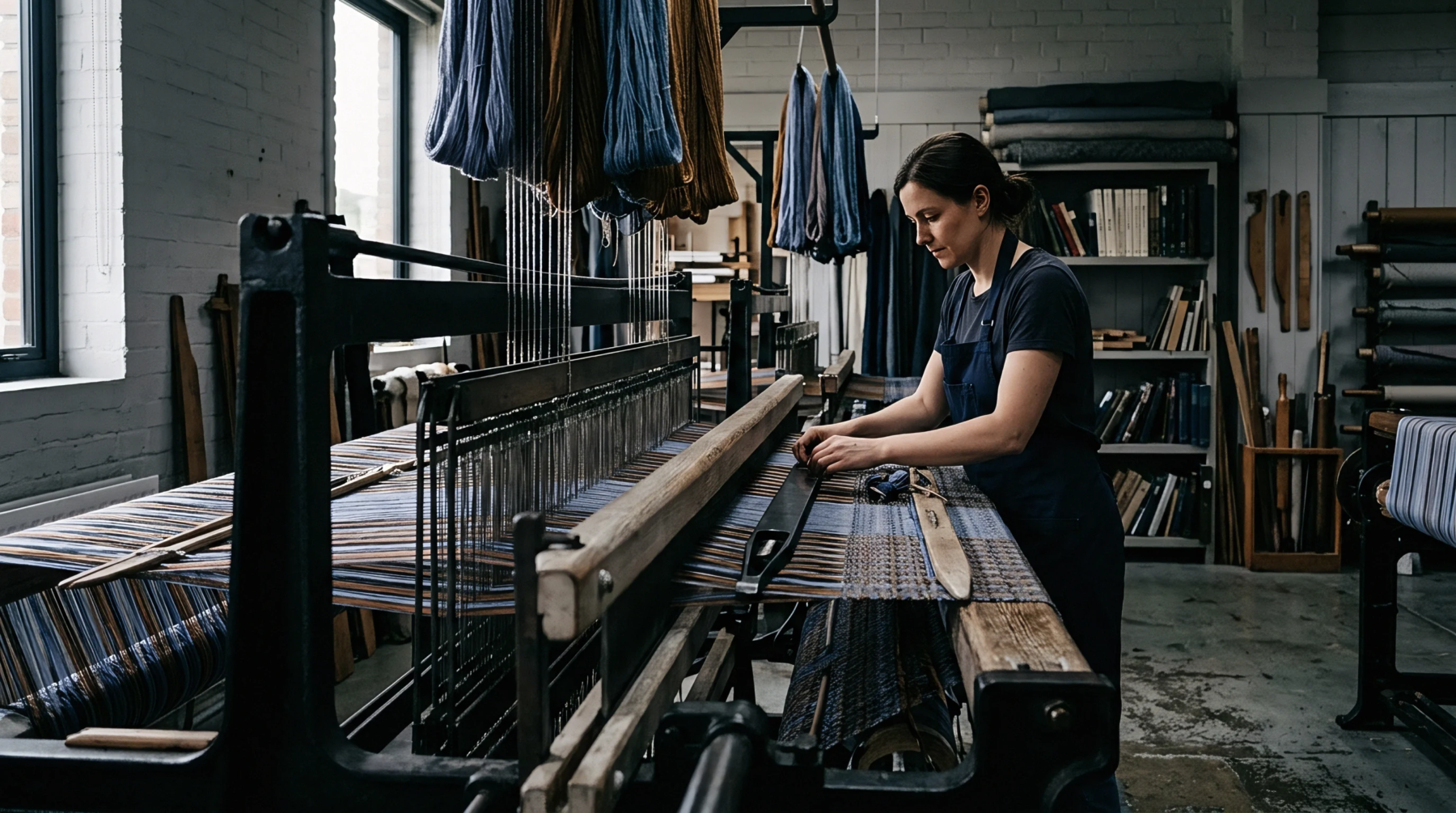
Kinematic Action
Mechanical force transfers from a moving reed directly into the cloth fell during insertion of filling yarns. This transient collision governs beat-up dynamics across high-speed weaving looms. Peak displacement happens when the sley mechanism reaches front dead centre, driving the freshly laid pick against preceding picks.
Resistance rises sharply as yarn density increases, causing peak fabric-fell displacement during shed closure. The boundary of this dynamic stops at the point where the reed withdraws from physical contact with the yarn matrix.
Force Generation
Inertial movement of the sley combines with warp tension to dictate the peak impact pressure. Crank drives or conjugate cams accelerate the reed toward the fell line, delivering an impulse that overcomes structural friction among crossing threads. In heavy canvas or high-sett constructions, warp yarns stretch under the blow, storing strain energy before releasing it as the reed retreats.
Low-tension settings cause pick rebound, where filling yarns slip back into the open shed. Excessive force promotes warp end breakage or reed mark striping.
On-Loom Measurement
Piezoelectric load cells mounted behind reed holders record real-time force pulses during each insertion cycle. Mill technicians inspect these force profiles to identify irregular fell displacement caused by faulty let-off or take-up synchronisation. Signal tracing isolates mechanical backlash within the crank linkage, distinguishing it from variable yarn friction across dyed warp bands.
When tension spikes exceed yarn breaking tenacity, loom monitoring consoles register repetitive warp stops. Correcting reed angle and shed timing brings the peak force back into tolerance without reducing loom operational speeds.
Defect Prevention
Stable fell positioning prevents starting marks, thick bands, and uneven pick spacing during continuous runs. Beat-up dynamics remain critical when producing tight technical fabrics, where uniform density determines permeability and tear strength. Adjusting the backrest height alters tension differentials between upper and lower shed sheets, moderating the force demanded at the fell.
Excessive dynamic impact flattens filament cross-sections, weakening the grey cloth before finishing. Controlled deceleration of the reed preserves yarn geometry and stabilises finished pick density across the entire fabric width.